OK, just found out To Live and Shave in LA are playing this Thursday at the Mocad. Their first time through since 2004 when I saw them at Detroit Art Space. (Thus, the youtube video.) I think they'll be playing w/o the killer lineup of that set--sans Mark Morgan, Don Fleming, and Andrew WK. I was so blown away by them at that gig I'm afraid of the letdown this time around. Nothin's ever as good the second go-round. Plus, I tend to think of them so differently after getting to know Mark, whereas at that show, I hadn't yet met Mark, tho I had had a few very fun encounters with Rat Bastard when the Laundryroom Squelchers stayed at my house. Crazy! Hearing Mark discuss Tom and touring with that group was very amusing, but there's a way in which not knowing what the fuck I was seeing and hearing that first time will, I think, be diluted by my supposed "knowledge." I don't mean to suggest that I have any real insight into this rag-tag "band," I just mean that I am in love with experiences of coming across something that blows you away with its shear "what the fuck?"ness. I recall feeling absolutely exuberant, joyous after that DAS show. It was a really quite brilliant art/love fest. And so I wonder if, minus that lineup and considering the sense that I know--to a *certain* extent--what to expect...will it be a letdown? I'll let ya know...
Thursday, May 10, 2007
TO LIVE AND SHAVE IN LA detroit 2004

Sunday, May 06, 2007
A tidbit on Reznikoff and Objectivism
from LS Dembo's The Monological Jew:
"Reznikoff, for instance, cites a Chinese text of the eleventh century in which it is argued that "Poetry presents the thing in order to convey the feeling. It should be precise abvout the thing and reticent about the feeling." This, Reznikoff tells us, was a very accurate expression of what the Objectivists were trying to do. Later he elaborated on the term, at the same time describing the poetics of Testimony, a two-volume survey of the everyday cruelties of American Life: by "objectivist I suppose a writer may be meant who does not write directly about his feelings but about what he sees and hears; who is restricted almost to the testimony of a witness in a court of law; and who expresses his feelings indirectly by the selection of his subject matter" (117).
"Reznikoff, for instance, cites a Chinese text of the eleventh century in which it is argued that "Poetry presents the thing in order to convey the feeling. It should be precise abvout the thing and reticent about the feeling." This, Reznikoff tells us, was a very accurate expression of what the Objectivists were trying to do. Later he elaborated on the term, at the same time describing the poetics of Testimony, a two-volume survey of the everyday cruelties of American Life: by "objectivist I suppose a writer may be meant who does not write directly about his feelings but about what he sees and hears; who is restricted almost to the testimony of a witness in a court of law; and who expresses his feelings indirectly by the selection of his subject matter" (117).
Right up my philosophical, interdisciplinary alley
From Urbanomic: Philosophical Research and Development:
URBANOMIC proposes to pursue fundamental research and development in logical ontological and abstract matters, outside any institutional framework, with no thematic disciplinary or methodological constraints.
We seek to support a renewal of philosophy through a vigorous repudiation of its insidious contemporary enemies. Firstly, a theorism which reaches from magazine columns to the exalted heights of 'culturally-engaged' academia, the two being distinguished only by the level of indulgence afforded to the authors' interminable interpretative speculation (magazine readers at least having the sincerity of their attention spans). Secondly the fatal overspecialisation and delimitation of philosophy in its academic setting.
Certainly the sphere of popular culture acts as the unconstrained experimental testing ground for deterritorialised symbolic discourses and new sensations. Equally - despite the depredations of the imperatives of business and management - the university is not yet entirely stripped of its ability to provide, under cover of its nominal traditional purposes, a support for independent thought. However in general in the latter, the productive capacity of abstract thought finds itself asphyxiated by supposed disciplinary self-sufficiency, reinforced by the socialisation apparatus of academic propriety. Whereas in the former a superficial relation of 'thought-provoking' relevance demands the novel application of generalised 'theories' to popular topics, destining thought to become exactly as reactive and inconsequential as its 'objects'.
We propose that philosophy can indeed break away from these malign attractors and reclaim a certain autonomy of purpose, but that the potency required for this escape can only be generated by philosophy's maintaining porous boundaries with other disciplines: art, music, science, mathematics...
Not in a relation of application, where philosophy would theorise external 'subjects' by employing its historical resources; but by enriching and expanding these latter through the rigorous and selective analysis and interrogation of local ontologies and vernacular logics.
Given that we oppose equally the wholesale appropriation of abstract thought by the allied postmodern pseudo-theorisms of therapy, capitalist apologetics and management 'science', why do we borrow a trope from industry to describe our activity? By 'Research and Development' we mean to affirm that we do not believe that philosophy in the present must necessarily limit itself to a mere exegetical and scholarly status. Philosophy - as methodical investigation into abstract matter(s) - enhances its pertinence, and highlights its problematic relation to the sciences, by free recourse to abstract-empirical experimentation, supported by suitable technologies. Philosophy would thus conduct materialised 'thought experiments' outside of the methodological presuppositions which circumscribe scientific disciplines. Even if we mean to problematise and question the nature of such an experimental practice, we do not propose to postpone experimentation indefinitely in lieu of supposedly grounding principles, but rather, in addition to ongoing theoretical work, to conduct open-ended experiments the form of whose outcome is not presupposed (amongst which we count the journal COLLAPSE and the URBANOMIC project itself).
However soberly and prudently it may be necessary to proceed, the involuntary passion for thought that is philosophy is always delirious in so far as at every turn it flees from the forces that prescribe (whether in the name of history or contemporaneity, of personal or institutional authenticity, of romantic passion or academic hard-labour) the path it must take.
____
and to subscribe to their journal publication Collapse
URBANOMIC proposes to pursue fundamental research and development in logical ontological and abstract matters, outside any institutional framework, with no thematic disciplinary or methodological constraints.
We seek to support a renewal of philosophy through a vigorous repudiation of its insidious contemporary enemies. Firstly, a theorism which reaches from magazine columns to the exalted heights of 'culturally-engaged' academia, the two being distinguished only by the level of indulgence afforded to the authors' interminable interpretative speculation (magazine readers at least having the sincerity of their attention spans). Secondly the fatal overspecialisation and delimitation of philosophy in its academic setting.
Certainly the sphere of popular culture acts as the unconstrained experimental testing ground for deterritorialised symbolic discourses and new sensations. Equally - despite the depredations of the imperatives of business and management - the university is not yet entirely stripped of its ability to provide, under cover of its nominal traditional purposes, a support for independent thought. However in general in the latter, the productive capacity of abstract thought finds itself asphyxiated by supposed disciplinary self-sufficiency, reinforced by the socialisation apparatus of academic propriety. Whereas in the former a superficial relation of 'thought-provoking' relevance demands the novel application of generalised 'theories' to popular topics, destining thought to become exactly as reactive and inconsequential as its 'objects'.
We propose that philosophy can indeed break away from these malign attractors and reclaim a certain autonomy of purpose, but that the potency required for this escape can only be generated by philosophy's maintaining porous boundaries with other disciplines: art, music, science, mathematics...
Not in a relation of application, where philosophy would theorise external 'subjects' by employing its historical resources; but by enriching and expanding these latter through the rigorous and selective analysis and interrogation of local ontologies and vernacular logics.
Given that we oppose equally the wholesale appropriation of abstract thought by the allied postmodern pseudo-theorisms of therapy, capitalist apologetics and management 'science', why do we borrow a trope from industry to describe our activity? By 'Research and Development' we mean to affirm that we do not believe that philosophy in the present must necessarily limit itself to a mere exegetical and scholarly status. Philosophy - as methodical investigation into abstract matter(s) - enhances its pertinence, and highlights its problematic relation to the sciences, by free recourse to abstract-empirical experimentation, supported by suitable technologies. Philosophy would thus conduct materialised 'thought experiments' outside of the methodological presuppositions which circumscribe scientific disciplines. Even if we mean to problematise and question the nature of such an experimental practice, we do not propose to postpone experimentation indefinitely in lieu of supposedly grounding principles, but rather, in addition to ongoing theoretical work, to conduct open-ended experiments the form of whose outcome is not presupposed (amongst which we count the journal COLLAPSE and the URBANOMIC project itself).
However soberly and prudently it may be necessary to proceed, the involuntary passion for thought that is philosophy is always delirious in so far as at every turn it flees from the forces that prescribe (whether in the name of history or contemporaneity, of personal or institutional authenticity, of romantic passion or academic hard-labour) the path it must take.
____
and to subscribe to their journal publication Collapse
Friday, April 27, 2007
Turkey Vulture?

I swear, I saw a turkey vulture outside our office window yesterday. Luckily, a fellow grad student, Jill, was in her office next door and she confirmed the sighting, otherwise I'm sure everyone would claim I mistook a lousy pigeon for a freaking vulture! But this thing flapped out of the sky and initially perched atop one of the gargoyle-like heads that jut out above the 11th floor windows, until he eventually moved to one of the windowsills a few floors up. Can you imagine gazing out your office window thinking you're about to take in the pleasant, calming scene of a distant city skyline spread before you and instead coming face to face with a vulture? Awesome!
Thursday, April 26, 2007
The Holocaust and the Book
Just came across the following review on Jstor and find it *very* intriguing...
The Holocaust and the Book: Destruction and Preservation. Edited by Jonathan Rose. Amherst: University of Massachusetts Press, 2001. 314 pp. $39.95. ISBN 1-55849-253-4.
This book of fifteen essays, with an introduction by Jonathan Rose, is a testimonial to the importance of the written word in the preservation of a culture and the necessity to record events under even the most harrowing conditions. For readers of Libraries & Culture who are already well informed about libraries and archives in times of war and revolution, The Holocaust and the Book can only deepen their appreciation of the written word and the often heroic efforts involved in its safekeeping.
Rose notes in his introduction that "the story of the Six Million is also the story of the One Hundred Million," the estimated number of books destroyed by the Nazis in Europe over a twelve-year period (1). Beginning with the book burnings in 1933, the essays describe the relentless destruction of Jewish books in Germany, Rome, Salonika, the U.S.S.R., the Netherlands, Poland, Vilna, and Bosnia, presenting a variety of approaches to the topic.
Part 1, "Destruction and Preservation," contains five essays: "The Nazi Attack on 'Un-German' Literature, 1933-1945" by Leonidas E. Hill; "Bloodless Torture: The Books of the Roman Ghetto under the Nazi Occupation" by Stanislao G. Pugliese (see an article on the same topic in L&C 34, no. 3 [summer 1999]); "The Confiscation of Jewish Books in Salonika in the Holocaust" by Yitzchak Kerem; "Embers Plucked from the Fire: The Rescue of Jewish Cultural Treasures in Vilna" by David E. Fishman; and "'The Jewish Question' and Censorship in the U.S.S.R." by Arlen Viktorivich Blium. While the events chronicled in these essays, notably, the Nazi book burnings, have been described before, the authors have dealt with their topics in a fresh way that should appeal to even seasoned historians.
Part 2, "Culture and Resistance," offers three fascinating essays on somewhat lesser known aspects of the topic. "The Secret Voice: Clandestine Fine Printing in the Netherlands, 1940-1945" by Sigrid Pohl Perry surveys several of the major clandestine presses operating during the period and includes some interesting photos. "Reading and Writing during the Holocaust as Described in Yisker Books" by Rosemary Horowitz describes the "memorial" books using source materials written during the war, prepared by immigrant associations to commemorate their communities. The Yisker books drew from diaries, illegal publications, letters, and records kept by Jews in the ghettos, the camps, and in hiding and offer much information about Eastern European Jewish life. The last essay, "Polish Books in Exile: Cultural Booty across Two Continents, through Two Wars" by Sem C. Sutter concerns the evacuation of priceless books and manuscripts that traveled from Poland to France to Quebec and finally back to Poland in 1959.
The title of part 3, "The Reader in the Holocaust: Documents," does not prepare us for the often moving accounts found in the four essays. Dina Abramowicz [End Page 273] writes on the daily difficulties of ghetto life in her essay, "The Library in the Vilna Ghetto," in which the presence of a library represented a rare and peaceful space for reading and reflection; the "Annual Report of the Vilna Ghetto Library, 1941-l942" is included. The second essay, "Library and Reading Room in the Vilna Ghetto, Strashun Street 6," by Herman Kruk, also deals with the matter of readership in the ghetto library. The next essay, "When the Printed Word Celebrates the Human Spirit," was written by Charlotte Guthmann Opfermann, a survivor of Theresienstadt who briefly describes her experience in the camp and the lack of time to read much of anything. Annette Biemond Peck closes the section with her brief essay, "Crying for Freedom: The Written Word as I Experienced It during World War II," about her wartime reading in Amsterdam.
Part 4, "Past and Present," begins with an interesting and provocative essay by John Rodden entitled "Zarathustra as Educator? The Nietzsche Archive in German History." This example of reception history, and the longest essay in the book, deals with the issue of cultural history in Germany, perhaps, as the author states, "a land with too much history" (251). He begins his essay in 1991 in Weimar, home of the Nietzsche Archive, and ranges back through Nietzsche's lifetime and his works before moving on to World War II and the Holocaust and finally to 1991 where he began—a thought-provoking journey. This essay is followed by Andras Riedlmayer's "Convivencia under Fire: Genocide and Book Burning in Bosnia," which reminds us that, even in the 1990s, books as cultural symbols continued to be destroyed. The essay briefly describes the history of book destruction in Bosnia over the last six centuries.
Finally, part 5 provides a useful bibliographic survey, "Jewish Print Culture and the Holocaust" by Joy A. Kingsolver and Andrew B. Wertheimer. It is divided into nine sections: an introduction, "Libraries and Archives," "Publishing," "Alfred Rosenberg and the Einsatztab Reichsleiter Rosenberg," "Jewish Cultural Reconstruction," "Documentation Centers and Archival Resources," "Holocaust Denial and Libraries," "Yisker Bikher," and "Additional Topics." This bibliographic essay is followed by "Notes on Contributors" but, unfortunately, not by an index. However, each of the essays is well documented with notes and, in some cases, bibliographies (in addition to the inclusive bibliographic essay at the end of the book). The use of judiciously selected photos, many courtesy of the National Archives, USHMM Photo Archives, serves to graphically evoke the period under consideration.
While The Holocaust and the Book is an examination of a dark period in history, it is as well a tribute to those who worked to preserve their written heritage throughout and beyond that period. The editor is to be commended for presenting a well-organized and very readable volume of diverse essays, only some of which grew out of the 1996 Drew University conference on "The Holocaust and the Book."
The Holocaust and the Book: Destruction and Preservation. Edited by Jonathan Rose. Amherst: University of Massachusetts Press, 2001. 314 pp. $39.95. ISBN 1-55849-253-4.
This book of fifteen essays, with an introduction by Jonathan Rose, is a testimonial to the importance of the written word in the preservation of a culture and the necessity to record events under even the most harrowing conditions. For readers of Libraries & Culture who are already well informed about libraries and archives in times of war and revolution, The Holocaust and the Book can only deepen their appreciation of the written word and the often heroic efforts involved in its safekeeping.
Rose notes in his introduction that "the story of the Six Million is also the story of the One Hundred Million," the estimated number of books destroyed by the Nazis in Europe over a twelve-year period (1). Beginning with the book burnings in 1933, the essays describe the relentless destruction of Jewish books in Germany, Rome, Salonika, the U.S.S.R., the Netherlands, Poland, Vilna, and Bosnia, presenting a variety of approaches to the topic.
Part 1, "Destruction and Preservation," contains five essays: "The Nazi Attack on 'Un-German' Literature, 1933-1945" by Leonidas E. Hill; "Bloodless Torture: The Books of the Roman Ghetto under the Nazi Occupation" by Stanislao G. Pugliese (see an article on the same topic in L&C 34, no. 3 [summer 1999]); "The Confiscation of Jewish Books in Salonika in the Holocaust" by Yitzchak Kerem; "Embers Plucked from the Fire: The Rescue of Jewish Cultural Treasures in Vilna" by David E. Fishman; and "'The Jewish Question' and Censorship in the U.S.S.R." by Arlen Viktorivich Blium. While the events chronicled in these essays, notably, the Nazi book burnings, have been described before, the authors have dealt with their topics in a fresh way that should appeal to even seasoned historians.
Part 2, "Culture and Resistance," offers three fascinating essays on somewhat lesser known aspects of the topic. "The Secret Voice: Clandestine Fine Printing in the Netherlands, 1940-1945" by Sigrid Pohl Perry surveys several of the major clandestine presses operating during the period and includes some interesting photos. "Reading and Writing during the Holocaust as Described in Yisker Books" by Rosemary Horowitz describes the "memorial" books using source materials written during the war, prepared by immigrant associations to commemorate their communities. The Yisker books drew from diaries, illegal publications, letters, and records kept by Jews in the ghettos, the camps, and in hiding and offer much information about Eastern European Jewish life. The last essay, "Polish Books in Exile: Cultural Booty across Two Continents, through Two Wars" by Sem C. Sutter concerns the evacuation of priceless books and manuscripts that traveled from Poland to France to Quebec and finally back to Poland in 1959.
The title of part 3, "The Reader in the Holocaust: Documents," does not prepare us for the often moving accounts found in the four essays. Dina Abramowicz [End Page 273] writes on the daily difficulties of ghetto life in her essay, "The Library in the Vilna Ghetto," in which the presence of a library represented a rare and peaceful space for reading and reflection; the "Annual Report of the Vilna Ghetto Library, 1941-l942" is included. The second essay, "Library and Reading Room in the Vilna Ghetto, Strashun Street 6," by Herman Kruk, also deals with the matter of readership in the ghetto library. The next essay, "When the Printed Word Celebrates the Human Spirit," was written by Charlotte Guthmann Opfermann, a survivor of Theresienstadt who briefly describes her experience in the camp and the lack of time to read much of anything. Annette Biemond Peck closes the section with her brief essay, "Crying for Freedom: The Written Word as I Experienced It during World War II," about her wartime reading in Amsterdam.
Part 4, "Past and Present," begins with an interesting and provocative essay by John Rodden entitled "Zarathustra as Educator? The Nietzsche Archive in German History." This example of reception history, and the longest essay in the book, deals with the issue of cultural history in Germany, perhaps, as the author states, "a land with too much history" (251). He begins his essay in 1991 in Weimar, home of the Nietzsche Archive, and ranges back through Nietzsche's lifetime and his works before moving on to World War II and the Holocaust and finally to 1991 where he began—a thought-provoking journey. This essay is followed by Andras Riedlmayer's "Convivencia under Fire: Genocide and Book Burning in Bosnia," which reminds us that, even in the 1990s, books as cultural symbols continued to be destroyed. The essay briefly describes the history of book destruction in Bosnia over the last six centuries.
Finally, part 5 provides a useful bibliographic survey, "Jewish Print Culture and the Holocaust" by Joy A. Kingsolver and Andrew B. Wertheimer. It is divided into nine sections: an introduction, "Libraries and Archives," "Publishing," "Alfred Rosenberg and the Einsatztab Reichsleiter Rosenberg," "Jewish Cultural Reconstruction," "Documentation Centers and Archival Resources," "Holocaust Denial and Libraries," "Yisker Bikher," and "Additional Topics." This bibliographic essay is followed by "Notes on Contributors" but, unfortunately, not by an index. However, each of the essays is well documented with notes and, in some cases, bibliographies (in addition to the inclusive bibliographic essay at the end of the book). The use of judiciously selected photos, many courtesy of the National Archives, USHMM Photo Archives, serves to graphically evoke the period under consideration.
While The Holocaust and the Book is an examination of a dark period in history, it is as well a tribute to those who worked to preserve their written heritage throughout and beyond that period. The editor is to be commended for presenting a well-organized and very readable volume of diverse essays, only some of which grew out of the 1996 Drew University conference on "The Holocaust and the Book."
Sunday, April 22, 2007
Who Knew?
Man, the Holocaust is depressing... writing a paper about Reznikoff's Holocaust is really causing me to rethink my focus on trauma and representation. I mean, its super interesting, but I feel like I'm in a fog all day after working on it. I know this sounds fairly flippant but really, I'm starting to think I should focus my future eforts on works a little less dark. I've had enough pain and sadness in my life, why do I need to emerse myself in it as a career? Yet, I find I'm continually drawn to issues of historical trauma, like it's somehow my responsibilty to face them, work on/through them. I've always felt (well, since i can remember) that I was sort of the memory depositor for my family. Like I have been assigned the task of carrying the lost memories of my family (most of whom are dead now), and this sense of responsibility has grown to include the choices and issues I've been focusing on in my academic work. There's this feeling I have that I can't do anything but work to redeem the past--and as grandiose as that may sound, it's not meant to. I don't mean the Past, I mean, like Reznikoff, all the little moments that make up a person's life, all their memories, are what must be--but can never be--preserved. I now have memories that were once my mother's memories--of dresses she wore, boys she dated, fights she had--these memories that filled in my sense of who she was, what she cared about; and I have memories of my grandmother's memories--her passage to America from what was then Autria-Hungary, her struggle to "make it" in Detroit, her shame at her reading disability as a young girl, for which she was beaten and humiliated, since that was, of course, not known in the early 1900's as what we now know to be dyslexia. I feel responsible to and for these memories of others, and I feel haunted and burdened by them at the same time. In some major and terrible way they are what comprises my own sense of self; I don't know why I have always been drawn to other's memories, perhaps because they were the way I found to connect as a child who came into a family that was crumbling when I entered it--the past was what was most alive and enjoyable, it made my relatives happy to talk about the past...well, for the most part. Ah, this isn't helping.....
Friday, March 30, 2007
Tuesday, March 13, 2007
Archive and memory
This is pretty much a "note to self" post.
Derrida notes a distinction, in terms of archiving and memory, between "anamnesis," "mneme" and "hypomnema." Anamnesis is, acording to the OED: "a. The recalling of things past; recollection, reminiscence. b. Liturgiol. That part of the Eucharistic canon in which the sacrifice of Christ is recalled and pleaded." The definition of mneme, on the other hand, is: "The capacity which a substance or organism possesses for retaining after-effects of experience or stimulation undergone by itself or its progenitors." And, finally, hypomnema is (not from the OED, from Wikipedia) a form of material or written memory, in other words, a "technology" of memory. Thus the "archive" is a technology of memory that is neither embodied nor voluntarily spontaneous and related to presence or speech, nor is it immaterial and abstract. It is, precisely, I think, a mediating or prosthetic function/extension that constitutes what can be remembered (re-membered as in put back together, constructed) in the first place. We can see the link here, from Derrida's work in Of Grammatology to Archive Fever. The archive is the "groundless ground."
from Mal d'Archive, Une Impresion Freudienne: "[T]he question of the archive is not, I repeat, a question of the past, the question of a concept dealing with the past which already might either be at our disposal or not at out disposal, an archivable concept of the archive, but rather a question of the future, the very question of the future, question of a response, of a promise and of a responsibility for tomorrow. The archive: if we want to know what this will have meant, we will only know tomorrow. Perhaps. A spectral messianicity is at work in the concept of the archive and like religion, like history, like science itself, this ties it to a very singular experience of the promise."
Yay!
Derrida notes a distinction, in terms of archiving and memory, between "anamnesis," "mneme" and "hypomnema." Anamnesis is, acording to the OED: "a. The recalling of things past; recollection, reminiscence. b. Liturgiol. That part of the Eucharistic canon in which the sacrifice of Christ is recalled and pleaded." The definition of mneme, on the other hand, is: "The capacity which a substance or organism possesses for retaining after-effects of experience or stimulation undergone by itself or its progenitors." And, finally, hypomnema is (not from the OED, from Wikipedia) a form of material or written memory, in other words, a "technology" of memory. Thus the "archive" is a technology of memory that is neither embodied nor voluntarily spontaneous and related to presence or speech, nor is it immaterial and abstract. It is, precisely, I think, a mediating or prosthetic function/extension that constitutes what can be remembered (re-membered as in put back together, constructed) in the first place. We can see the link here, from Derrida's work in Of Grammatology to Archive Fever. The archive is the "groundless ground."
from Mal d'Archive, Une Impresion Freudienne: "[T]he question of the archive is not, I repeat, a question of the past, the question of a concept dealing with the past which already might either be at our disposal or not at out disposal, an archivable concept of the archive, but rather a question of the future, the very question of the future, question of a response, of a promise and of a responsibility for tomorrow. The archive: if we want to know what this will have meant, we will only know tomorrow. Perhaps. A spectral messianicity is at work in the concept of the archive and like religion, like history, like science itself, this ties it to a very singular experience of the promise."
Yay!
Monday, February 19, 2007
Galaxy 500
I don't wanna stay at your party
I don't wanna talk with your friends
I don't wanna vote for your president
I just wanna be your tugboat captain
There's a place I'd like to be
There's a place I'd like to be
There's a place I'd like to be
I don't wanna talk with your friends
I don't wanna vote for your president
I just wanna be your tugboat captain
There's a place I'd like to be
There's a place I'd like to be
There's a place I'd like to be
Monday, February 12, 2007
I heart youtube
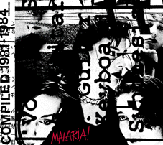
I know, I know, who doesn't. But really, I just found this! Fucking shit!
DAF documentary short
and this Malaria video! (thus pic above). Not my favorite song, but whatever. Ooh, wait, this live performance is way more interesting and a better song....
Oh, and if you don't know who DAF or Malaria is you are a loser. I mean it, a Total Loser.
(Mean comment inspired by a few recent comments field posts on certain poetry blogs aimed at "40 something's." like you are young, cool, or hip. Fucking poetry dork.)
Saturday, February 03, 2007
Memory deux
Josh Corey on Whitman:
"Rereading Song of Myself, I was freshly conscious of the poem as the document of a mystical experience, and the tension between such consummately individual experience and the radically democratic absorption and embodiment of the American polis attempted by the poem: a dialectic of enlightenment in the spiritual sense. Many of the other students were primarily impressed by Whitman's fantastic egotism, but I want to make a case for his radical humility, stemming from an intuition I have that spiritual enlightenment is born of the experience and embracement of one's own thoroughly ordinary and thoroughly mortal life. It's possible to mistake the speaker of Whitman's poem for some kind of superman, but when he claims, "And to die is different from what any one supposed, and luckier," I think the immortality he claims comes from accepting his share in the multitude, and not from some superior self-founded power (though he flirts with this only to find himself "on a verge of the usual mistake"). At least I suspect that's his drift."
Interesting that this resonates so with Wordsworth's The Prelude, which I've been reading for a class on Memory. I wouldn't say that Wordsworth is a "fantastic egoist" or "radically humble," but the relation between immortality and democratic multiplicity is certainly there. That Whitman can impress us with a sense of "radical humility" because he embraces ordinary, mortal life seems right to me. But there's a bit of a paradox or perhaps a difficulty here. What I wonder in terms of how memory functions is whether individual memory, the sense of the self in the past, is itself a "democratic" or democratizing impulse. Memory, as the recollection and re-experience of incidents that accumulate in the interior resources of our consciousness and may be retrieved by our interaction with the contingent world around us that in some way contains them, only has meaning if that individual experience can be "translated" as essentially recognizable by another. Thus the shock of pleasure and recognition when reading Proust. Thus the dual pleasure of reading--the idea that reading someone else's memories are not only comparable or resonant with our own but that, in fact, we experience them as our own in the moment of reading. Wordsworth's Kantian idealism seems crucial here--which I take to be more a result of Coleridge's influence than anything else. The sense that the artistic genius, even as he is a law unto himself, a unique measure of the capacity of nature and the human mind to be in harmony with one another is, in fact, a universal capacity, or potential. Genius is something we can experience, something we feel something about in relation to our own lives.
So what, exactly, does one experience by reading Wordsworth's attempt to immortalize his memories, to engage with the "genius" of and within the work? Is it just a confirmation of experience? Or rather, is it an easy confirmation? The leaps and juxtapositions of Wordsworth's lyric seem to belie any seamless relation between writer and reader. The pleasure of a text that focuses so primarily on memory, alongside of which we are confronted with Wordsworth's questioning of Enlightenment reason (at the same time that he relies on it), and the particularity of the historical and cultural moments that he writes of and within push this idea of democratic idealism to the limit. This is the "memory crisis" that Richard Terdiman writes of as the condition of modernity, which thus demands a writing style and form that engages this tension-- a tension produced by the desire to communicate for and to all at the same time that this is precluded by the opacity of the radical individualism upon which theories of modern democracy are built. The modern subject writing for and to the world (or at least for and to someone) may, in the end, merely confirm the radical particularity of experience as the only possible universal. (and how is that a universal?) The demands of universality cannot be met, they can only be experienced as a desire, at least within the liberal-democratic imaginary. Writing and memory intertwine as a longing to unite past, present, and future beyond the individual. Wordsworth's writing anxiety and his memory crisis are one and the same, yet he writes through (not beyond) them as they are the condition upon which both the failure and the success of the work are built. If he confirms the difficulty of memory and writing, and the impossible desire for a democratic idealism and universality, this series of negatives paradoxically brings great pleasure (to both Wordsworth as the narrator within the poem as well as the reader). It is, to paraphrase Geoffrey Hartman, a shift from a hope in Revolution to the belief in the revolutionary possibilities of hope.
"Rereading Song of Myself, I was freshly conscious of the poem as the document of a mystical experience, and the tension between such consummately individual experience and the radically democratic absorption and embodiment of the American polis attempted by the poem: a dialectic of enlightenment in the spiritual sense. Many of the other students were primarily impressed by Whitman's fantastic egotism, but I want to make a case for his radical humility, stemming from an intuition I have that spiritual enlightenment is born of the experience and embracement of one's own thoroughly ordinary and thoroughly mortal life. It's possible to mistake the speaker of Whitman's poem for some kind of superman, but when he claims, "And to die is different from what any one supposed, and luckier," I think the immortality he claims comes from accepting his share in the multitude, and not from some superior self-founded power (though he flirts with this only to find himself "on a verge of the usual mistake"). At least I suspect that's his drift."
Interesting that this resonates so with Wordsworth's The Prelude, which I've been reading for a class on Memory. I wouldn't say that Wordsworth is a "fantastic egoist" or "radically humble," but the relation between immortality and democratic multiplicity is certainly there. That Whitman can impress us with a sense of "radical humility" because he embraces ordinary, mortal life seems right to me. But there's a bit of a paradox or perhaps a difficulty here. What I wonder in terms of how memory functions is whether individual memory, the sense of the self in the past, is itself a "democratic" or democratizing impulse. Memory, as the recollection and re-experience of incidents that accumulate in the interior resources of our consciousness and may be retrieved by our interaction with the contingent world around us that in some way contains them, only has meaning if that individual experience can be "translated" as essentially recognizable by another. Thus the shock of pleasure and recognition when reading Proust. Thus the dual pleasure of reading--the idea that reading someone else's memories are not only comparable or resonant with our own but that, in fact, we experience them as our own in the moment of reading. Wordsworth's Kantian idealism seems crucial here--which I take to be more a result of Coleridge's influence than anything else. The sense that the artistic genius, even as he is a law unto himself, a unique measure of the capacity of nature and the human mind to be in harmony with one another is, in fact, a universal capacity, or potential. Genius is something we can experience, something we feel something about in relation to our own lives.
So what, exactly, does one experience by reading Wordsworth's attempt to immortalize his memories, to engage with the "genius" of and within the work? Is it just a confirmation of experience? Or rather, is it an easy confirmation? The leaps and juxtapositions of Wordsworth's lyric seem to belie any seamless relation between writer and reader. The pleasure of a text that focuses so primarily on memory, alongside of which we are confronted with Wordsworth's questioning of Enlightenment reason (at the same time that he relies on it), and the particularity of the historical and cultural moments that he writes of and within push this idea of democratic idealism to the limit. This is the "memory crisis" that Richard Terdiman writes of as the condition of modernity, which thus demands a writing style and form that engages this tension-- a tension produced by the desire to communicate for and to all at the same time that this is precluded by the opacity of the radical individualism upon which theories of modern democracy are built. The modern subject writing for and to the world (or at least for and to someone) may, in the end, merely confirm the radical particularity of experience as the only possible universal. (and how is that a universal?) The demands of universality cannot be met, they can only be experienced as a desire, at least within the liberal-democratic imaginary. Writing and memory intertwine as a longing to unite past, present, and future beyond the individual. Wordsworth's writing anxiety and his memory crisis are one and the same, yet he writes through (not beyond) them as they are the condition upon which both the failure and the success of the work are built. If he confirms the difficulty of memory and writing, and the impossible desire for a democratic idealism and universality, this series of negatives paradoxically brings great pleasure (to both Wordsworth as the narrator within the poem as well as the reader). It is, to paraphrase Geoffrey Hartman, a shift from a hope in Revolution to the belief in the revolutionary possibilities of hope.
Friday, February 02, 2007
Memory
Spaces of Remembering
So, if I dream I have you, I have you,
For all our joys are but fantastical.
John Donne, "Elegy X: The Dream" 6
Subscribe to:
Posts (Atom)