Friday, April 27, 2007

Turkey Vulture?


I swear, I saw a turkey vulture outside our office window yesterday. Luckily, a fellow grad student, Jill, was in her office next door and she confirmed the sighting, otherwise I'm sure everyone would claim I mistook a lousy pigeon for a freaking vulture! But this thing flapped out of the sky and initially perched atop one of the gargoyle-like heads that jut out above the 11th floor windows, until he eventually moved to one of the windowsills a few floors up. Can you imagine gazing out your office window thinking you're about to take in the pleasant, calming scene of a distant city skyline spread before you and instead coming face to face with a vulture? Awesome!

Thursday, April 26, 2007

The Holocaust and the Book

Just came across the following review on Jstor and find it *very* intriguing...


The Holocaust and the Book: Destruction and Preservation. Edited by Jonathan Rose. Amherst: University of Massachusetts Press, 2001. 314 pp. $39.95. ISBN 1-55849-253-4.
This book of fifteen essays, with an introduction by Jonathan Rose, is a testimonial to the importance of the written word in the preservation of a culture and the necessity to record events under even the most harrowing conditions. For readers of Libraries & Culture who are already well informed about libraries and archives in times of war and revolution, The Holocaust and the Book can only deepen their appreciation of the written word and the often heroic efforts involved in its safekeeping.
Rose notes in his introduction that "the story of the Six Million is also the story of the One Hundred Million," the estimated number of books destroyed by the Nazis in Europe over a twelve-year period (1). Beginning with the book burnings in 1933, the essays describe the relentless destruction of Jewish books in Germany, Rome, Salonika, the U.S.S.R., the Netherlands, Poland, Vilna, and Bosnia, presenting a variety of approaches to the topic.
Part 1, "Destruction and Preservation," contains five essays: "The Nazi Attack on 'Un-German' Literature, 1933-1945" by Leonidas E. Hill; "Bloodless Torture: The Books of the Roman Ghetto under the Nazi Occupation" by Stanislao G. Pugliese (see an article on the same topic in L&C 34, no. 3 [summer 1999]); "The Confiscation of Jewish Books in Salonika in the Holocaust" by Yitzchak Kerem; "Embers Plucked from the Fire: The Rescue of Jewish Cultural Treasures in Vilna" by David E. Fishman; and "'The Jewish Question' and Censorship in the U.S.S.R." by Arlen Viktorivich Blium. While the events chronicled in these essays, notably, the Nazi book burnings, have been described before, the authors have dealt with their topics in a fresh way that should appeal to even seasoned historians.
Part 2, "Culture and Resistance," offers three fascinating essays on somewhat lesser known aspects of the topic. "The Secret Voice: Clandestine Fine Printing in the Netherlands, 1940-1945" by Sigrid Pohl Perry surveys several of the major clandestine presses operating during the period and includes some interesting photos. "Reading and Writing during the Holocaust as Described in Yisker Books" by Rosemary Horowitz describes the "memorial" books using source materials written during the war, prepared by immigrant associations to commemorate their communities. The Yisker books drew from diaries, illegal publications, letters, and records kept by Jews in the ghettos, the camps, and in hiding and offer much information about Eastern European Jewish life. The last essay, "Polish Books in Exile: Cultural Booty across Two Continents, through Two Wars" by Sem C. Sutter concerns the evacuation of priceless books and manuscripts that traveled from Poland to France to Quebec and finally back to Poland in 1959.
The title of part 3, "The Reader in the Holocaust: Documents," does not prepare us for the often moving accounts found in the four essays. Dina Abramowicz [End Page 273] writes on the daily difficulties of ghetto life in her essay, "The Library in the Vilna Ghetto," in which the presence of a library represented a rare and peaceful space for reading and reflection; the "Annual Report of the Vilna Ghetto Library, 1941-l942" is included. The second essay, "Library and Reading Room in the Vilna Ghetto, Strashun Street 6," by Herman Kruk, also deals with the matter of readership in the ghetto library. The next essay, "When the Printed Word Celebrates the Human Spirit," was written by Charlotte Guthmann Opfermann, a survivor of Theresienstadt who briefly describes her experience in the camp and the lack of time to read much of anything. Annette Biemond Peck closes the section with her brief essay, "Crying for Freedom: The Written Word as I Experienced It during World War II," about her wartime reading in Amsterdam.
Part 4, "Past and Present," begins with an interesting and provocative essay by John Rodden entitled "Zarathustra as Educator? The Nietzsche Archive in German History." This example of reception history, and the longest essay in the book, deals with the issue of cultural history in Germany, perhaps, as the author states, "a land with too much history" (251). He begins his essay in 1991 in Weimar, home of the Nietzsche Archive, and ranges back through Nietzsche's lifetime and his works before moving on to World War II and the Holocaust and finally to 1991 where he began—a thought-provoking journey. This essay is followed by Andras Riedlmayer's "Convivencia under Fire: Genocide and Book Burning in Bosnia," which reminds us that, even in the 1990s, books as cultural symbols continued to be destroyed. The essay briefly describes the history of book destruction in Bosnia over the last six centuries.
Finally, part 5 provides a useful bibliographic survey, "Jewish Print Culture and the Holocaust" by Joy A. Kingsolver and Andrew B. Wertheimer. It is divided into nine sections: an introduction, "Libraries and Archives," "Publishing," "Alfred Rosenberg and the Einsatztab Reichsleiter Rosenberg," "Jewish Cultural Reconstruction," "Documentation Centers and Archival Resources," "Holocaust Denial and Libraries," "Yisker Bikher," and "Additional Topics." This bibliographic essay is followed by "Notes on Contributors" but, unfortunately, not by an index. However, each of the essays is well documented with notes and, in some cases, bibliographies (in addition to the inclusive bibliographic essay at the end of the book). The use of judiciously selected photos, many courtesy of the National Archives, USHMM Photo Archives, serves to graphically evoke the period under consideration.
While The Holocaust and the Book is an examination of a dark period in history, it is as well a tribute to those who worked to preserve their written heritage throughout and beyond that period. The editor is to be commended for presenting a well-organized and very readable volume of diverse essays, only some of which grew out of the 1996 Drew University conference on "The Holocaust and the Book."

Sunday, April 22, 2007

Who Knew?

Man, the Holocaust is depressing... writing a paper about Reznikoff's Holocaust is really causing me to rethink my focus on trauma and representation. I mean, its super interesting, but I feel like I'm in a fog all day after working on it. I know this sounds fairly flippant but really, I'm starting to think I should focus my future eforts on works a little less dark. I've had enough pain and sadness in my life, why do I need to emerse myself in it as a career? Yet, I find I'm continually drawn to issues of historical trauma, like it's somehow my responsibilty to face them, work on/through them. I've always felt (well, since i can remember) that I was sort of the memory depositor for my family. Like I have been assigned the task of carrying the lost memories of my family (most of whom are dead now), and this sense of responsibility has grown to include the choices and issues I've been focusing on in my academic work. There's this feeling I have that I can't do anything but work to redeem the past--and as grandiose as that may sound, it's not meant to. I don't mean the Past, I mean, like Reznikoff, all the little moments that make up a person's life, all their memories, are what must be--but can never be--preserved. I now have memories that were once my mother's memories--of dresses she wore, boys she dated, fights she had--these memories that filled in my sense of who she was, what she cared about; and I have memories of my grandmother's memories--her passage to America from what was then Autria-Hungary, her struggle to "make it" in Detroit, her shame at her reading disability as a young girl, for which she was beaten and humiliated, since that was, of course, not known in the early 1900's as what we now know to be dyslexia. I feel responsible to and for these memories of others, and I feel haunted and burdened by them at the same time. In some major and terrible way they are what comprises my own sense of self; I don't know why I have always been drawn to other's memories, perhaps because they were the way I found to connect as a child who came into a family that was crumbling when I entered it--the past was what was most alive and enjoyable, it made my relatives happy to talk about the past...well, for the most part. Ah, this isn't helping.....

Friday, March 30, 2007

Suicide - Ghost Rider

One of the best bands of alltime.

Cabaret Voltaire - Nag Nag Nag

More for Yes...

Brigitte Bardot:

Yes!

Tuesday, March 13, 2007

Archive and memory

This is pretty much a "note to self" post.

Derrida notes a distinction, in terms of archiving and memory, between "anamnesis," "mneme" and "hypomnema." Anamnesis is, acording to the OED: "a. The recalling of things past; recollection, reminiscence. b. Liturgiol. That part of the Eucharistic canon in which the sacrifice of Christ is recalled and pleaded." The definition of mneme, on the other hand, is: "The capacity which a substance or organism possesses for retaining after-effects of experience or stimulation undergone by itself or its progenitors." And, finally, hypomnema is (not from the OED, from Wikipedia) a form of material or written memory, in other words, a "technology" of memory. Thus the "archive" is a technology of memory that is neither embodied nor voluntarily spontaneous and related to presence or speech, nor is it immaterial and abstract. It is, precisely, I think, a mediating or prosthetic function/extension that constitutes what can be remembered (re-membered as in put back together, constructed) in the first place. We can see the link here, from Derrida's work in Of Grammatology to Archive Fever. The archive is the "groundless ground."

from Mal d'Archive, Une Impresion Freudienne: "[T]he question of the archive is not, I repeat, a question of the past, the question of a concept dealing with the past which already might either be at our disposal or not at out disposal, an archivable concept of the archive, but rather a question of the future, the very question of the future, question of a response, of a promise and of a responsibility for tomorrow. The archive: if we want to know what this will have meant, we will only know tomorrow. Perhaps. A spectral messianicity is at work in the concept of the archive and like religion, like history, like science itself, this ties it to a very singular experience of the promise."

Yay!

Monday, February 19, 2007

Stereolab performing Emporer Tomato Ketchup

Oh, I miss Mary Hansen.

Damon and Naomi I Dreamed of the Caucasus

This is so nice. Made me happy.

Comets on Fire

My Bloody Valentine - Knows When

Oh my. This really sends me back. I can't stop myself.....

big black -

Spacemen 3 - Hypnotized (Full Version)

A few trips down memory lane....

Galaxy 500

I don't wanna stay at your party
I don't wanna talk with your friends
I don't wanna vote for your president
I just wanna be your tugboat captain

There's a place I'd like to be

Monday, February 12, 2007

I heart youtube


I know, I know, who doesn't. But really, I just found this! Fucking shit!

DAF documentary short

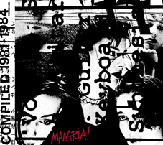
and this Malaria video! (thus pic above). Not my favorite song, but whatever. Ooh, wait, this live performance is way more interesting and a better song....

Oh, and if you don't know who DAF or Malaria is you are a loser. I mean it, a Total Loser.

(
Mean comment inspired by a few recent comments field posts on certain poetry blogs aimed at "40 something's." like you are young, cool, or hip. Fucking poetry dork.)

Saturday, February 03, 2007

Memory deux

Josh Corey on Whitman:

"Rereading Song of Myself, I was freshly conscious of the poem as the document of a mystical experience, and the tension between such consummately individual experience and the radically democratic absorption and embodiment of the American polis attempted by the poem: a dialectic of enlightenment in the spiritual sense. Many of the other students were primarily impressed by Whitman's fantastic egotism, but I want to make a case for his radical humility, stemming from an intuition I have that spiritual enlightenment is born of the experience and embracement of one's own thoroughly ordinary and thoroughly mortal life. It's possible to mistake the speaker of Whitman's poem for some kind of superman, but when he claims, "And to die is different from what any one supposed, and luckier," I think the immortality he claims comes from accepting his share in the multitude, and not from some superior self-founded power (though he flirts with this only to find himself "on a verge of the usual mistake"). At least I suspect that's his drift."

Interesting that this resonates so with Wordsworth's The Prelude, which I've been reading for a class on Memory. I wouldn't say that Wordsworth is a "fantastic egoist" or "radically humble," but the relation between immortality and democratic multiplicity is certainly there. That Whitman can impress us with a sense of "radical humility" because he embraces ordinary, mortal life seems right to me. But there's a bit of a paradox or perhaps a difficulty here. What I wonder in terms of how memory functions is whether individual memory, the sense of the self in the past, is itself a "democratic" or democratizing impulse. Memory, as the recollection and re-experience of incidents that accumulate in the interior resources of our consciousness and may be retrieved by our interaction with the contingent world around us that in some way contains them, only has meaning if that individual experience can be "translated" as essentially recognizable by another. Thus the shock of pleasure and recognition when reading Proust. Thus the dual pleasure of reading--the idea that reading someone else's memories are not only comparable or resonant with our own but that, in fact, we experience them as our own in the moment of reading. Wordsworth's Kantian idealism seems crucial here--which I take to be more a result of Coleridge's influence than anything else. The sense that the artistic genius, even as he is a law unto himself, a unique measure of the capacity of nature and the human mind to be in harmony with one another is, in fact, a universal capacity, or potential. Genius is something we can experience, something we feel something about in relation to our own lives.

So what, exactly, does one experience by reading Wordsworth's attempt to immortalize his memories, to engage with the "genius" of and within the work? Is it just a confirmation of experience? Or rather, is it an easy confirmation? The leaps and juxtapositions of Wordsworth's lyric seem to belie any seamless relation between writer and reader. The pleasure of a text that focuses so primarily on memory, alongside of which we are confronted with Wordsworth's questioning of Enlightenment reason (at the same time that he relies on it), and the particularity of the historical and cultural moments that he writes of and within push this idea of democratic idealism to the limit. This is the "memory crisis" that Richard Terdiman writes of as the condition of modernity, which thus demands a writing style and form that engages this tension-- a tension produced by the desire to communicate for and to all at the same time that this is precluded by the opacity of the radical individualism upon which theories of modern democracy are built. The modern subject writing for and to the world (or at least for and to someone) may, in the end, merely confirm the radical particularity of experience as the only possible universal. (and how is that a universal?) The demands of universality cannot be met, they can only be experienced as a desire, at least within the liberal-democratic imaginary. Writing and memory intertwine as a longing to unite past, present, and future beyond the individual. Wordsworth's writing anxiety and his memory crisis are one and the same, yet he writes through (not beyond) them as they are the condition upon which both the failure and the success of the work are built. If he confirms the difficulty of memory and writing, and the impossible desire for a democratic idealism and universality, this series of negatives paradoxically brings great pleasure (to both Wordsworth as the narrator within the poem as well as the reader). It is, to paraphrase Geoffrey Hartman, a shift from a hope in Revolution to the belief in the revolutionary possibilities of hope.

Friday, February 02, 2007

Memory

Spaces of Remembering

So, if I dream I have you, I have you,

For all our joys are but fantastical.

John Donne, "Elegy X: The Dream" 6

Tuesday, January 23, 2007

Why Bill Frist is a Nazi

My friend Emily sent me the following via an email rightly entitled: "As if being a Republican isn't bad enough."

Bill Frist medical school experiments controversy

From Wikipedia, the free encyclopedia

While he was a medical school student in the 1970's, Bill Frist (now a Republican U.S. Senator from Tennessee) performed medical experiments on shelter cats while researching the use of drugs on the mitral valve. By his own account, Frist improperly obtained these cats from Boston animal shelters, falsely telling shelter staff he was adopting the cats as pets. [1] In his 1989 book Transplant, Frist admitted that he killed these cats during medical experiments at Harvard Medical School , as part of what he claimed were his studies. [2] [3]
In his book, Frist explained that he succumbed to the pressure to succeed in a highly competitive medical school. Frist stated that he "treat[ed] them as pets for a few days" before he "cart[ed] them off to the lab to die." He went on to say, "And I was totally schizoid about the entire matter. By day, I was little Billy Frist, the boy who lived on Bowling Avenue in Nashville and had decided to become a doctor because of his gentle father and a dog named Scratchy. By night, I was Dr. William Harrison Frist, future cardiothoracic surgeon, who was not going to let a few sentiments about cute, furry little creatures stand in the way of his career. In short, I was going a little crazy." He went on to describe why he conducted animal experiments: "It can even be beautiful and thrilling work, as I discovered that day in the lab when I first saw the wonderful workings of a dog's heart . . . I spent days and nights on end in the lab, taking the hearts out of cats, dissecting each heart, suspending a strip of tiny muscle that attaches the mitral valve to the inner wall of the cat heart and recording the effects of various medicines I added to the bath surrounding the muscle." "I lost my supply of cats. I only had six weeks to complete my project before I resumed my clinical rotations. Desperate, obsessed with my work, I visited the various animal shelters in the Boston suburbs, collecting cats . . . it was a heinous and dishonest thing to do."

Senator Bill Frist
Although Frist's book had been published more than a decade before, the matter created public controversy after mention in a Boston Globe profile, published after his election as Senate majority leader. [4][5] PETA, which opposes scientific experimentation on animals that results in death or cruel treatment demanded that Frist atone by sponsoring legislation to protect animals from unnecessary suffering. [6] In response, Frist's office reaffirmed that he denounced the action, but made no promises about any animal protection legislation.
According to an ASPCA lawyer, Frist's action was "fraudulent and probably was illegal". Another ASPCA official stated it "probably would be considered cruel." [6] Massachusetts has a criminal statute prohibiting cruelty to animals. [7] Frist was never charged under this statute and his defenders have pointed out that until 1983 Massachusetts law permitted shelters to release animals for laboratory experiments, and some states continue to permit such activity today. Because the Boston area animal shelters in Frist's case did not release the animals to Frist knowing they would be used for experimentation because of the manner in which he adopted the cats, these laws may not have applied to the facts presently in the public record about Frist's actions. However, the statute of limitations has passed

Sunday, January 14, 2007

Alice Coltrane RIP


Sad to hear the news. This fall my friend Sam and I decided, last minute, to attend what turns out to be one of her last concerts (Ann Arbor ,(September 23, John Coltrane's birthday). We scrambled to get a ride to A2 with friends since neither of us had a car, and, literally, we--kindly driven by friends Brad and Becky. I am especially thinking of Brad today who loved Alice so much--arrived at Hill Auditorium with a minute to spare. It was a lovely, uplifting concert, unsurprisingly. She played with her son Ravi, Charlie Hayden, and Roy Haynes, which was really a special treat. Not to be cyncial, but there were moments when the spiritual uplift got a bit treacly, and the short movie tribute of John Coltrane's life was bizarre, hagiographic. But... it was also filled with amazing, beautiful moments. Leaving the concert, I saw so any people I knew (or recognized) standing in the rain outside Hill Auditorium chatting, smiling, looking and feeling happy. It's interesting to realize that you shared that last musical moment with a community of Alice Coltrane devotees.

Saturday, January 06, 2007

Why I love Richard Meltzer

From Vinyl Reckoning

"Having fled the academic gauntlet, escaped by the skin of my shoes, I walked smack into a new gauntlet about as depressing, and almost as draining, one with--what? not again?!--distinct academic coloration. Neoacademic? Crypto-academic? Pseudononacademic?
Like femmes fatales who "don't know it," academes who don't know it, or feign ignorance of the fact, can be--as they used to say--bad medicine. Bad enough. But wave the academy flag as if to disclaim it--"Only funning!"--while meantime masquerading as a practicing populist, and you're fucking RAT POISON. A pair of parties-I-have-known fit this bill, have fit it hand in glove for the last quarter century, behaving for all the world not merely like entrenched (and very constipated) academes but petty administrators...self-tenured department heads...deans, by golly.
Christgau, good old Bob, once dubbed himself the Dean of American Rock Critics. He had a T-shirt made up with his name above that title, and a likeness of Little Richard. What, you might wonder, could possess someone to adopt a handle so aridly pretentious, so dauntingly...insipid? Part was just ill-conceived hoax, as obtuse a sham as Springsteen's in bearing a nickname with zero proletarian reverb--the Boss!--but in larger part, it did accurately convey the man's aura of swaggerless dogmatism. Both personally and professionally, he is one drably imperious prick.
The Dean!--who to this day (in his syndicated "Consumer Guide") gives LETTER GRADES to albums and has a routine enabling him to monitor, or simulate monitoring, the complete "curriculum"--every current release. Years ago, more than once, I saw him in action. He'd put six LPs on the changer, stack all the covers in the same sequence, go about his bizness. If he suddenly heard something to catch his fancy, he would count discs and check the covers--"Three, four--oh, isn't that something?--Tom Paxton." Nowadays, I would assume he's got a multi-CD unit with a digital display so he needn't even count: technology favors the lame. (Dean of what branch? Admissions? Paper clips? Alphabetic studies?)
For us rockcrit underlings, the Dean in his incarnation as bigwig editor tried his darnedest to affect a supervisorly demeanor with an almost schoolmarmish (hit-you-with-a-ruler) facade. Looking back, it was sorta laughable, but every time I turned in an article, a review, sooner or later he'd phone, "Get your thesaurus--it's word choice time," and for two hours try to argue me out of certain key adjectives. Laughable but exasperating, and in hindsight maybe mostly laughable.
It was more in his "intellectual oversight" capacity--as surveillance pilot at large, unpaid and unassigned, far above the rockwrite fray--that this joker did me any lasting damage. In tandem with copilot/tag-team partner Greil Marcus, he at a crucial juncture blocked my progress to wider (um) recognition, effectively consigning me to marginality, and in the long run has denied me any significant role in official--"authorized"--"accredited"--rockwrite (as opposed to rock) history. The annals--the archive--the fugsucking "pantheon"! Oh yes--another pathetic house-o-cards for sure, but these two clowns act like they fucking OWN it.
And why do I care? Why do I care? I CARE.
It irks the hell out of me that while Marcus doesn't grade albums, he does grade people's CONDUCT, and conduct--alone!--is what kept me out of this high-bounty, high-visibility anthology he edited, oh, probably 18-20 years ago--yup, another old grudge. Stranded he called it, and he asked purt near every living, breathing rockwriter or rockwrite pretender of even quasi note to contribute an essay on his/her favorite album--the one you'd bring to a so-called desert island. I know, I know: cor-nee. But each contributor got $750, a whole lot more than I'd ever made off a single piece.
And what kept me out, he told me three years later, was my rude behavior at the final Sex Pistols show, the last of the Sid Vicious era, at Winterland. My job that night, well it wasn't a job, it was a labor of love, had been to go out and insult the audience before and after each band. Some guy from the Pistols' crew thought it all seemed too placid, too pat--"like a Grateful Dead show"--and asked me to give the ticket holders a jolt. All the invective in my arsenal I dispensed--in spades--I was one uncouth lout--until Bill Graham physically picked me up and threw me out of the building--"You can't insult my city!" Although what, precisely, was/is rocka rocka roll--or punk--or any kind of youth twitch--supposed to entail "if not that"? If not the high risk of behaving like a FLYING FUCKING ASSHOLE?
Marcus, who had been there, and been offended, never expressed regret for the slight, the exclusion, but later in the 80s he averred that, knowing what he knew now, now that he "understood punk," he would NOT have excluded me. Oh goody.
What I heard on the grapevine at the time the book came out was that he'd also disapproved of what I might write. The buzz was that Christgau, who "knew" me better than Greil did, told him, "Oh, he'd probably pick a Doors album anyway"--an odious no-no to Bob and Greil both--but that's just rumor. In his foreword to the '95 reprint of Stranded, Christgau, in a curious negative name-drop, draws attention to the lack of anything by "the irrepressible Richard Meltzer"...irrepressible? Is that like being a bon vivant? And if I couldn't be repressed, why the fuck did they have to repress me? (Like that of Meister Eckehart's cold Germanic God, my presence remained in my absence.)
A more persistent rumble back thereabouts was that these bozos found my rockwriting "politically incorrect" (ostensibly: I wasn't as keen as they on helping rock-roll find, adjust, and micro-tune its moral/humanistic compass, or in lieu of its willingness to accept same, SUPERIMPOSING suchever upon it)--the first time I actually heard the now-all-too-familiar aspersion. Basically, this signified only a slight upping of the transgressional ante, as I had already been deemed of dubious intellectual grounding. As far back as '73, Christgau was branding me "anti-intellectual": in a saner universe (in his purview), I'd have been tarred, feathered, run out of town.
What's daffy about this pair coming on so hoity-toity in their exercise of sovereignty is these're guys who need a telescope to reach--approach--make out the general outline of--whatever it is they purport to be confronting, so mega-removed are they from any tangible earthly what-the-hey. Like most culture wags laureate, what they are--all they are!--is pious OUTSIDERS. (Like Sam and Ann Charters.) Breast-beating squares. (Like George Will and Norman Podhoretz.) Stuffed-shirt know-it-alls. (Like John Updike and Leonard Feather.)
As point-to-point-to-point-to-point arbiters of the socioculturally valid, they're as embarrassing as the Medveds.
They don't have the existential oo-poo-pa-doo to be trucking in anything so both high and low (and so alien to their alleged lives) as standard-issue rock 'n' roll. In their frigging 50s, they haven't caught on yet that one thing rock does rather well, too well to ignore or dismiss--one of its stocks-in-trade--is SECOND-PERSON HOSTILITY. The many stations of I-dislike-you. Which isn't "good" or any such easy-moral A equals A, certainly isn't "nice," but it's the goddamn rock-roll terrain, it's fucking given. Might I add "universal"? Such itchy biz rubs Bob and Greil the wrong way, especially when the targeting is, well, nonrational, irrational, and above all "unjust." Taxonomically prejudiced (and prejudicial). They insist, for inst, that ANYTIME a male gender-specific voice expresses antipathy to a nonmale gender-specific other, UGLY SEXISM has reared its head--ring the alarm!--the voice forfeiting any claim to even antipathetic universality. It doesn't matter, say, that the gender voicings could be reversed, that with minimal change a female subject could be cussing out, shitting all over, a male object...that ill will is as central to rock as it is to boxing...it doesn't matter!
So meticulous have they been as rock watchdogs that they've troubled 'emselves over what Randy Newman might really've MEANT by "Short People" (yes--of course! Randy's being ironic--but should anyone even say these things?)...how poignant.
They try so-o-o hard to be good, caring New Deal Democrats, and good Boy Scouts, and far more telling: good boys, they've never been bad boys, never even tried it on for size. They wouldn't dare commit adultery. Never farted in the subway. They don't know danger from the inside looking out, locked away from any relief, asylum, any exterior safety net. Fuh, do they even know mischief? They've never tasted their own bile, never looked death in the eye in a mirror.
When I wrote somewhere that one of the things that helped kill Lester Bangs was WRITING, each of them accused me of romanticism--how can writing kill? they questioned. Well, guys, it doesn't always kill, but it certainly comes closest when you're doing it right. Only when it makes active use of your blood, your heart, your nerves, glands, sex fluids, vertebrae, and whatall, and don't forget your stink, in a word: your body. In a word: your life. They were more annoyed, I would guess, that I considered it a pity rockwriting was the genre that gored Lester, that a diet of rock and nothing but had rendered him too dumb to get out of the way.
At the risk of overextending my own second-person animus and getting downright ad hominem about all o' this, I'm gonna introduce a new term to the proceedings: COOTIES. I don't give a ding dang doodle if these blockheads ever stumble on some remote semblance of the True, or accurately peg the Good and/or the Beautiful--the smutch of their imperialist intentions will contaminate anything they touch, their seal of approval rendering LESS ACCEPTABLE the goods of its unfortunate recipients. In my idea of a saner universe, the sight and sound of such card-carrying outsiders fattening up, even commentarily, on the goodies of the culturally/intellectually aboriginal would release fucking ANTIBODIES in the world. Imperialist cooties: nothing to sneeze at.
Or if "imperialist" sounds too vigorous and resourceful--too vibrantly alive--like Teddy Roosevelt or Cortez or somebody--let's just call it "proprietary." Ideational as opposed to material proprietorship...dominion...superintendence of turf and sight lines. No matter how you slice it, the reigning King of Proprietary Cooties--let's print that on a shirt--is Greil Marcus.
It's hard to go very long without seeing this man's maiming-by-NOT-damning commentary on something. No other recent celebrity outsider--not George Plimpton, not Nat Hentoff, not Dr. Joyce Brothers--has functioned so relentlessly, so adamantly, as proponent, evaluator, certifier of relevance both passing and eternal, chalkboard huckster for so turgid a line of see-Spot-run. Michael Cuscuna? Well, that's only on jazz reissues.
So unremitting has Marcus been in affixing his byline to so much NOT requiring his collusion, his stultifying illumination, and certainly not HIS italics, that every juxtaposition of it and anything has come to feel as WRONG (i.e., as corrupt) as the mating of basketball footage to "The Revolution Will Not Be Televised" in a Nike commercial.
Last year an article in the New York Observer complained about Marcus's liner notes for the reissue of Harry Smith's Folkways anthology. Author Mark Schone's beef was that in gushing all over Harry there was an implied denigration of rival folklorist Alan Lomax, who Schone felt deserved a better fate.
What irritated me about Greil's presence in the package was simply that--his presence--although I could nitpick and say his lyric/historical spinout on Clarence Ashley's "The Coo Coo Bird," for one thing, bore traces of a METHODOLOGY of song dissection (and archaeology) I introduced to rockcrit (and yes, was better at) in my first published pieces 30 years ago...but fuck, I'm too much the folkie and populist myself to ever invoke an intellectual "copyright"--ownership isn't my game. (I don't own things in the air, I don't even own names I've given them.)
Anyway, it would've been preferable, I think, for Schone to have been more patient: chances are, left to his proprietary avarice (the pipe dream: champion something and you'll forever be associated with it), that Greil would eventually have carved his name on Lomax's legacy too...and still may.
Hey: this is a man who accepted payment to report nightly on a MICHAEL JACKSON TOUR for Ted Koppel's Nightline. Who/what won't he put his name on?
He even put his grimy stamp on one of my books, the '87 reprint of Aesthetics of Rock--which he didn't even like. And I didn't ask for him (I wanted Billy Altman), but he insisted and the publisher acquiesced. Wittingly or un-, his intro did little more than bracket the work, trivialize it (first paragraph: "I'm most of all convinced that the book is not a joke"; key word: "convinced"--thanks MUCH, you fucker), make it small (while lauding its hefty page count), finite, bounded, glibly sum-up-able, socially agreeable ("...the coolest book to be seen carrying"), no longer autonomous: a Greil-endorsed hunk o' pulp.
The endorsement didn't even improve my case with the endorser. So shallow had been his display of regard for me, so much did he not deem me even a colleague, that I didn't make it onto the mailing list for his own next book, Lipstick Traces, and he balked at first when I asked for a copy (how much humiliation did I think I needed?), telling me to go bother his publicist...he was in no mood to do so himself.
It wasn't mere protocol that prompted me to ask him, as this was the tome in which Greil reputedly "came to terms" with the events of Pistols night at Winterland. When I finally saw a copy, I wasn't in the index, or onstage at his Winterland, or anywhere else. Once an apparent eyesore, I was now beneath his notice (both forward and back).
It was a book that struck me also as, yes, derivative--secondary--and that M.T. Kinney would later proclaim a "broken-leg try at duplicating the Everest climb R. Meltzer pulled off in The Aesthetics of Rock. On an insight level it's the pits"--he said it, not me.
So what the hell am I after?
My due.
Don't think I want credit for having "influenced" Greil, or Bob, or the pen pushers of their cardboard academy, for trailblazing an activity that inevitably leads to them. I didn't (and if I had, I would rather I hadn't) and I don't.
But if they didn't actually "get it from" me, plenty of it, it didn't hurt 'em to have me as forerunner. To have my trial and error, naked as it was, ease the path and prime the pump.
Credit? I want credit for being Copernicus--Magellan--goddamn Socrates to their coffee-table Thoreau, and Thoreau to their Michael Medved. (Do you have any idea how degrading it is at this stage of my life to have to beat my own drum? What such a dance does to my "dignity"? They can kiss my fucking feet.)
Lester Young once said of Stan Getz, who profited mightily from a saxophone way-of-being Lester had pioneered: "There he goes driving my pink Cadillac." I don't want no Cadillac (though a middle-class income, after all these years, would be OK); I want to terminate the academy.
And what, precisely, is it that gives me the willies about the ascendancy of their shit and not mine--other than the obvious?
The reality of their ultimate message. Everything they write testifies: THERE IS NO JOY. NOTHING IS POSSIBLE. Regardless of what they imagine or wish it to be saying.
Seeing this travesty and obsessing on its repercussions forces me to redouble my efforts. I'm tired and tired and thinkin' I might maybe resign from this sorriest of "callings," and here I am stuck with a bran' new mission.
Needed (first things first): a countercootie to their cooties on everything. On things I still love.
Shit."