From The Nation
An article on the crucial role radio has played in the uprising
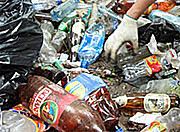
WASHINGTON (Reuters) -- Old toothbrushes, beach toys and used condoms are part of a vast vortex of plastic trash in the middle of the Pacific Ocean, threatening sea creatures that get tangled in it, eat it or ride on it, a new report says.
Because plastic doesn't break down the way organic material does, ocean currents and tides have carried it thousands of miles to an area between Hawaii and the U.S. West Coast, according to the study by the international environmental group Greenpeace.
This swirling vortex, which can grow to be about the size of Texas, is not far from the Northwestern Hawaiian Islands, designated as a protected U.S. national monument in June by President George W. Bush.
The Greenpeace report, "Plastic Debris in the World's Oceans" said at least 267 species -- including seabirds, turtles, seals, sea lions, whales and fish -- are known to have suffered from entanglement or ingestion of marine debris.
Some 80 percent of this debris comes from land and 20 percent from the oceans, the report said, with four main sources: tourism, sewage, fishing and waste from ships and boats.
The new report comes days after the journal Science projected that Earth's stocks of fish and seafood would collapse by 2048 if trends in overfishing and pollution continue.
Two weeks ago, the U.S. Institute of Medicine said the benefits of eating fish outweigh the risks of toxins detected in the animals.
Plastic pollution is a problem in all the world's oceans, the Greenpeace report said, but underlined the issue in the Pacific by sailing through the floating garbage dump and capturing images of wildlife interacting with plastic.
"It's not necessarily an area that's clearly defined; it's sort of a natural phenomenon ... wind and salt water break down the plastic," said Steve Smith, aboard the Greenpeace ship Esperanza.
The plastic trash, some in large pieces and others broken down to small but recognizable particles, is visible from the ship's deck, about 50 feet above the ocean surface, Smith said by telephone on Friday. Inflatable boats are dispatched from the ship to collect samples.
"We've been been unfortunately finding a lot of stuff out here, floating by, which doesn't paint a very good picture, because some of it is from faraway places, has marine life like barnacles and other little creatures living on the plastic," Smith said.
By hitching rides on plastic debris, invasive species can be carried thousands of miles to interact with native creatures, Smith said. Plastic also poses a hazard to animals that mistake it for prey and eat it, he said.
"Plastics in the oceans act as a toxic sponge, soaking up a lot of the persistent pollutants out here," Smith said. "We've seen photos of albatrosses who eat this plastic ... Even though their stomachs are filled, they end up starving because there's no nutrients in there."
Discarded or lost fishing nets and traps can continue to catch fish when they are no longer in use, the report said.
The report said an international agreement known as MARPOL is aimed at ending the dumping of plastic debris at sea, but noted that since most debris originates on land, even total enforcement of this agreement would not eliminate the problem.
Greenpeace called for a global network of marine reserves, covering 40 percent of the world's oceans, and responsibility by coastal countries to cut down on "excessive consumption" and boost recycling.
**************
You can read more about it here

I was tagged by Kasey. (Hi Kasey!).
1. What is a book that changed your life?
There are so many... I'll just go with the first two that come immediately to mind, and are diametrically opposed. Plato's Republic, read at age 18 in an intro to political theory course in college. It was a big reason behind my decision to major in pol. theory, and my secret desire to be a philosopher king (queen). And Mary Daly's Beyond God the Father, which I read in my early twenties and which nicely conflicted with my lingering patriarchal/religious sentiments.
2. What is a book you've read more than once?
I try to read everything at least twice; there's all this stuff you miss the first time around, so this is hard to answer. But a few that I have read over the years so many times I've lost count: all the Little House on the Prairie books ( I mean from age 7 to about 13 I read them over and over and over, and I still read them once in a while), all the Louisa May Alcott books, Jane Eyre, The Godfather (I have no idea why, but I was really into mafia shit when I was teenager), The Queen's Confesssion (a cheesy but very entertaining book by the romance novelist Victoria Holt about Marie Antoinette. It's a page turner. And I learned a lot about the historical facts and characters surrounding the French Revolution. Seriously. Historical biographies rule.) Anna Karenina, Foucault's Madness and Civilization, Swann's Way. MFK Fisher's The Gastronomical Me.
3. What is a book you'd want with you on a desert island?
Proust I guess, tho I don't really have an essential book.
4. What is a book that made you giddy?
Swann's Way. Those amazing sentences.
5. What is a book that made you sad?
Well, Paul Bowles's A Sheltering Sky made me depressed. Does that count?
6. What is a book you wish had been written?
Whenever I'm reading a good book I wish I'd written it.
7. What is a book you wish had never been written?
The bible.
8. What is a book you're currently reading?
I'm generally in the habit of reading several at once. Right now it's: The Portable Hannah Arendt, Daniel Deronda, Clark Coolidge's Space, Fredric Jameson's A Singulsr Modernity, Raymond Williams's Marxism and Literature.
9. What is one book you've been meaning to read?
Ha! Let's make this easier. Here's my Amazon wishlist
10. Now tag five bloggers.
Michael Schmidt, Shashi Thandra, Mr. Waggish, Kaplan Harris, Sarah Ruddy