Reading Peter Weiss's The Aesthetics of Resistance. (I should be reading for the Anderson seminar, but I'm squeezing in the time to "do my own thing.") Weiss's' book is truly absolutely amazing, heartrending, historically and politically thought-provoking. I am upset that only the first volume has been translated.
I feel the urge to transcribe something from it, although, due to the form--it's pretty much a series of huge, seamlessly melded paragraphs, no chapter divides, quasi-Proustian sentences, but ones that continually shift out of and into different descriptive registers--it's difficult to extract a moment. Actually, that's not quite right. The sentences and paragraphs both shift dramatically and meld almost imperceptibly, so that one an easily lose the shift, thus becoming disoriented, and/or one is jarred by a sudden transition. I really think this is a remarkable and new way to enact the dialectical possibilities of the novel. As Jameson notes in his very helpful introduction (well, helpful for Jameson), the novel, through its dialectical approach to form and content, is a form of pedagogy, (a totalizing pedagogy, if you will), or what Jameson calls "a proletarian Bildungsroman, a pedagogy of the subaltern" (x). The pedagogical theme is quite explicit in the novel; the workers and resistance leaders struggle for freedom is centrally connected to a struggle to understand and reformulate, for themselves, the meaning of art. This is all enacted through a series of dialogues that weave discusions on history, art, labor, and politics into each paragraph. Thus, volume 1 begins with a collective dialogue that weaves together the specific time period of the narrative (Germany/Europe of the 1930's and the Communist/Socialist underground resistance to fascism) to long, descriptive passages on (in vol. 1) the Pergamom Altar, a museum piece around which Weiss threads a dialogue and disquisition on exploitation and hope.
First let me quote from the Jameson introduction, which I think explains the form and significance of this dialectical apprach as a movement between continuity and discontinuity in the novel much better than I have been attempting here (and which I think is similar to my interest in the possibilites of perfection/imperfection). Since it's quite lengthy, I'll put up a quote from Weiss in another post :
"But this materialism is also reinforced by the sharp mental reversal administered by such a view: we do not normally connect the Spanish Civil War with the classical past, and, even more fundamentally, we do not often see the history of oppressed classes as a continuity: continuities are always on the side of "culture," that is to say, on the side of the modes of living of the dominant classes. To invert these ideological priorities is thus not necessarily to revive an idealist conception of history, so much as to administer a materialist shock to just such categories and sterotypes. Thus Walter Benjamin recommends a dual procedure: ' For the materialist dialectician discontinuity must be the regulative idea of the tradition of the ruling classes (essentially the bourgeoisie), continuity that of the oppressed classes (the proletariat)'.
[...]
In fact, it is precisely the idea of the methodological reversal which will provide the key to so many bewildering twists and turns in Peter Weiss's aesthetic analysis here: nor, given the agon-organized structure of his dialectical thought generally, should there be any surprise in the way in which the sympathetic contemplation of a given aesthetic position suddenly and without warning generates the emergence of a not always predictable opposite.
Yet the first moves are logical enough: the bloody triumph of the Olympians over the giants is a celebration and a warning, and transposes and expresses the power of the Attalid dynasty that commissioned the frieze. And just as this translation of human rulers into divine ones effaces history with a vision of the sheer eternity of power, so also the sculptors must make of the frieze itself a superhuman artifact, from which all traces of production must be removed: stylistic perfection, then, also serves the ideology of the masters. Yet this shift of attention toward the production of the work reminds us that class struggle can also be identified there, in the pulling and hauling of unskilled labor under the direction of the builders and master sculptors. Nor is the monitory effect of the frieze some merely "historical" one, which present-day viewers can abstract in the name of pure aesthetic reception ... [T]his reactivation of historical memory opens an access to the Alexandrian period generally, and in particular to Pergamum's own failed revolution, the uprising of Aristonicus, and even, ironically, all the way back up to the nineteenth century and the ideological reasons for the newly united German empire to 'buy' the newly excavated altar and transport it to Berlin. These seemingly extraneous historical footnotes are not only part and parcel of our reinterpretations: 'And after a lengthy silence, Heilmann said that works like those stemming from Pergamum had to be constantly reinterpreted until a reversal was gained and the earth-born awoke from darkness and slavery to show themselves in their true appearance' (1:44/1:53). More that that, I think we have to conclude that, for such an analyses from below, the split between form and content, between intrinsic and extrinsic, the aesthetic and its context, has not yet taken place. It is only for the bourgeois spectator or reader that it exists, only there that at best it has to be struggled against and overcome. It is the structure of bourgeois daily life and subjectivity, and the collective division of labor and privileges of power which tacitly underpin that structure, which exclude the unity of the work of art as something that can no longer be perceived or conceived, that escape the bourgeois categories of perception and reception, let alone analysis. A true 'aesthetics' of resistance therefore will not seek to 'correct' bourgeois aesthetics or to resolve its antinomies and dilemmas: it will rather search out that other social position from which those dilemmas do not emerge in the first place. The difficulties under which that other, proletarian aesthetic education labors, however, are of a different kind: not the philosphical or conceptual antinomies of form and content, but rather those of subalternity: fatigue after work, lack of access to knowledge and information, repudiation of the aesthetic of class privilege, underdevelopment, finally, of a stubborn will to appropriate the acheivements of the dominant class--aesthetic as well as scientific and technological--in the interests of building a new social order. In the present instance one may say that the very existence of the project of a proletarian aesthetic education is a sign that this will already exists" (xliv/xlv italics added).
Thursday, July 20, 2006

Sunday, July 16, 2006
It's official. I *am* a Melancholic
From Eric Santner's On Creaturely Life:
"The melancholic disposition is caught up in a 'desperate attempt to protect itself from the lost object and to adhere to it at least in its absence, so it might be said that the withdrawal of melancholic libido has no other purpose than to make viable an appropriation in a situation in which none is really possible. From this point of view, melancholy would be not so much the regressive reaction to the loss of the love object as the imaginative capacity to make an unobtainable object appear as if lost. If the libido behaves as if a loss had occurred although nothing has in fact been lost this is because the libido stages a simulation where what cannot be lost because it has never been possessed appears as lost, and what could never be possessed because it has never perhaps existed may be appropriated in so far as it is lost'. In this way melancholy comes very close to the modality of perversion that Freud called fetishism, that ingenious strategy of unconscious mental life that both avows and disavows a perception (of the missing maternal phallus) in a single symptomatic act or formation. 'Similarly' Agamben writes, 'in melancholia the object is neither appropriated nor lost, but both possessed and lost at the same time'" (91).
The inter-quote is from Agamben's Stanzas: Word and Phantasm in Western Culture.
"The melancholic disposition is caught up in a 'desperate attempt to protect itself from the lost object and to adhere to it at least in its absence, so it might be said that the withdrawal of melancholic libido has no other purpose than to make viable an appropriation in a situation in which none is really possible. From this point of view, melancholy would be not so much the regressive reaction to the loss of the love object as the imaginative capacity to make an unobtainable object appear as if lost. If the libido behaves as if a loss had occurred although nothing has in fact been lost this is because the libido stages a simulation where what cannot be lost because it has never been possessed appears as lost, and what could never be possessed because it has never perhaps existed may be appropriated in so far as it is lost'. In this way melancholy comes very close to the modality of perversion that Freud called fetishism, that ingenious strategy of unconscious mental life that both avows and disavows a perception (of the missing maternal phallus) in a single symptomatic act or formation. 'Similarly' Agamben writes, 'in melancholia the object is neither appropriated nor lost, but both possessed and lost at the same time'" (91).
The inter-quote is from Agamben's Stanzas: Word and Phantasm in Western Culture.
Sonic portraits


I want these albums described below. They're on sale at Stormy Records. Maybe I should get off their mailing list; its too tempting. That being the case, I'll pass it on.
The photographs are Jeff Wall's "A Sudden Gust of Wind (After Hokusai)" and Hiroshi Sugimoto's "North Atlantic Ocean-Cape Breton Island." These aren't the album covers, just images by the photographers who inspired the music. I love the idea of music made in contemplative response to photography....
CHARTIER, RICHARD & TAYLOR DEUPREE Specification Fifteen Line US CD $14.99 LINE is proud to present the first full-length collaboration by Richard Chartier and Taylor Deupree since 1999's Spec. (12k). For this collaboration, sound artists Richard Chartier and Taylor Deupree were invited by the Hirshhorn Museum and Sculpture Garden, Washington, DC, to create a new live work inspired by the Seascapes series of renowned Japanese photographer Hiroshi Sugimoto on the occasion of his retrospective exhibition. The result is this live recording, Specification.Fifteen. This work premiered on March 30, 2006 in front of the curved panoramic window of the Museum's Lerner Room as the sun set across the city1s skyline. Specification.Fifteen evokes the stillness and opposing yet related spaces of Sugimoto's Seascapes, which suggest infinitesimal change and variation under a seemingly uniform surface. Mystery of mysteries, water and air are right there before us in the sea. Every time I view the sea, I feel a calming sense of security, as if visiting my ancestral home; I embark on a voyage of seeing.
NOTO, ALVA For Line US CD $14.99
This Alva Noto CD brings together disparate recordings created throughout the last four years, unified under a theme of dedication. All nine studies share the history of being made specifically for someone or for a project that for one reason or another remained open ended. 'Wall Anfang' for example, opens with the voice sample 'there must be a reason why it is so clear in my mind.' When we realize the person speaking is pioneering contemporary Canadian photographer Jeff Wall, we may understand the rising high tone that introduces the track as the imitation of a photo-flash warming up to be triggered. The track was originally prepared for a documentary about Wall, who became famous for his large scale light boxes that cast white light evenly through his photographs. Like this balanced light, the track presents a purity of thought, that spirals inside and out, the voice of Wall breaking only impartially this conjecture of sound, while adding an atmosphere of introspection and study to the piece. The percussive, almost marimba-like sounds of the track 'jr' echo the woodcutting of Japanese printmaker Katsushika Hokusai, (whose work Wall allegorized in his photograph A Sudden Gust of Wind (after Hokusai),1993). The stark, poised three point intervals of sound bring to mind the intricate and exquisitely considered compositions of Hokusai's style of Ukiyo-e pictures of the floating world. Jhonn Balance's premature death in 2004 gave way to multiple dedications to his life and music by people who took influence from his activities in Coil. The track 'odradek' was originally prepared for the tribute record ...It Just Is (In Memoriam: Jhonn Balance). Nicolai worked with Balance when commissioning him for the award-winning release 20' to 2000 a CD set for the last 20 minutes of the year 1999. These diverse engagements come to rest within this release. Like the image that seals the font cover of the CD, that depicts liquid oscillating with various frequencies, we are reminded that sound can give form to image and to thought and that it may continue to resonate in absences, particles, or processes until a point of final closure.
Constitutionalism/Universality/Aspectivalism
For Amanda Anderson's seminar this week we are reading James Tully's Strange Multiplicity: Constitutionalism in an Age of Diversity. So far (I'm about half-way through), I'm finding it a stunning and compelling read. In particular, it's critique of universalist perspecitivalism (what I think of as both a Kantian and Cartesian one-to-one, transcendent, universal viewpoint) is opposed to a multiple, aspectival mode of thinking/seeing, which is seen as a more just form of approaching cultural recognition and therefore more effective for present and future forms of governance, constitution-making and reforming. I was struck by this, not just for its own importance culturally and politically, but because it seemed to be modeled on the opposition that postmodern aesthetics perform. Interestingly, Tully locates this aspectivalism and its influence on certain aesthetic practices (i.e., landart) with the storytelling (narrative), artmaking, and governing practices developed in aboriginal cultures. He notes: "Jamake Highwater, a Blackfoot-American philosopher, explains that this ability of reflective disequilibrium, which is common to Aboriginal cultures, has been learned by twentieth-century European artists and writers through their interaction with 'primitive art' and slowly introduced into European cultures under the name 'post-modern'" (28 italics added).
The notion of an aesthetic "reflective disequilibium" providing purchase on ways of rethinking cultural politics and forms of governance is, again, crucial in its own riht, of course, but in that it's totally inline with my interest in conceptual art... Exciting! With that in mind, I'd like to place part of an essay by Smithson alongside some quotes from Tully. (This isn't necessarily the best example of Smithson's writings on perspective, but I don't have my collected essays with me, so it'll have to do.):
An excerpt from Smithson's "A Crystal Land":
We arrived at the Great Notch Quarry, which is situated "about three hundred yards south west of the Great Notch station of the Erie Rail road." The quarry resembled the moon. A gray factory in the midst of it all, looked like architecture designed by Robert Morris. A big sign on one building said, THIS IS A HARD HAT AREA. We started claimbing over the files and ran into a 'rockhound', who came on, I thought, like Mr.Wizard, and who gave us all kinds of rock-hound-type information in an authoritative manner. We got a rundown on all the quarries that were closed to the public, as well as those that were open.
The walls of the quarry did look dangerous. Cracked, broken, shattered; the walls threatened to come crashing down. Fragmentation, corrosion, decomposition, disintegration, rock creep debris, slides, mud flow, avalanche were everywhere in evidence. The gray sky seemed to swallow up the heaps around us. Fractures and faults spilled forth sediment, crushed conglomerates, eroded debris and sandstone. It was an arid region, bleached and dry. An infinity of surfaces spread in every direction. A chaos of cracks surrounded us.
On the top of a promontory stood there motionless rockdrill against the blank which was the sky. High-tention towers transported electric cable over the quarry. Dismantled parts of steam shovels, tread machines and trucks were lined up in random groups. Such objects interrupted the depositions of waste that formed the general condition of the place. What vegetation there was seemed partially demolished. Newly made boulders eclipsed parts of a wire and pipe fence. Railroad tracks passed by the quarry, the ties formed a redundant sequence of modules, while the steel tracks projected the modules into an imperfect vanishing point.
On the way back to Manhattan, we drove through the Jersey Meadows, or more accurately the Jersey Swamps-a good location for a movie about life on mars. It even has a network of canals that are chocked by acres of tall reeds. Radio towers are scattered throughout these bleak place. Drive-inns, motels and gas stations exist along the highway, and behind them are smoldering garbage dumps. South, toward Newark and Bayonne, the smoke stacks of heavy industry add to the general air pollution.
As we drove throughout the Lincoln Tunnel, we talked about going on another trip, to Franklin Furnace; there one might find minerals that glow under ultra violet light or 'black light'. The countless cream colored square tiles on the walls of the tunnel sped by, until a sigh announcing New York broke the tiles' order.
Industry and arid wastelands that are "unlocatable" or that produce an "infinity of surfaces" are in effect returning land and space to multipying forms of vision and material complexity. It is as though the universalizing perspective necessary to justify the expansion of modes and forms of capitalist production, and the unifying vision that operates as the all-seeing eye, which guards the strict division of labor, is in a losing a battle against nature. Or that the cultural uniformity of "Nowhereland" (the moon, Mars, space, i.e., the universalist perspective of Euro-Western cultures) cannot bear up under the weight of "the avalanche everywhere in evidence."
Now Tully:
"As a consequence of the overlap, interaction, and negotiation of cultures, the experience of cultural difference is internal to cultures. This is the most difficult aspect of the new concept to grasp. On the older, essentialist view, the 'other' and the experiences of otherness were by definition associated with another culture. One's own culture provided an identity in the form of a seamless background or horizon against which one determined where one stood on fundamental questions (whether this identity was 'British' , 'modern', 'woman', or whatever). Having an identity consisted in being oriented in this essential space, whereas the loss of such a fixed horizon was equated with an 'identity crisis'; with the loss of all horizons. On the aspectival view, cultural horizons change as one moves about, just like natural horizons. The experience of otherness is internal to one's own identity, which consists in being oriented in an aspectival intercultural space constituted by the three features mentioned above" (13).
For Tully, the "three features"that all claims to cultural diversity and recognition have in common, despite their internal and external differences (and this is in terms of their constitutional or political demands) are: 1) "demands for cultural recognition are aspirations for appropriate forms of self government." 2) "The second similarity is the complementary claim that the basic laws and institutions of modern societies, and their authoritative traditions of interpretation, are unjust insofar as they thwart the forms of self government appropriate to the recognition of cultural diversity. and 3) The final similarity[...]is the ground of both the aspiration to culturally appropriate forms of self rule and the claim of injustice. It is the assumption that culture is an irreducible and constitutive aspect of politics. The diverse ways in which citizens think about, speak, act and relate to others in participating in a constitutional association (both the abilities they exercise and the practices in which they exercise them), whether they are making, following, or going against the rules and conventions in any instance, are always to some extent the expression of their different cultures. A constitution can seek to impose one cultural practice, one way of rule following, or it can recognize a diversity of cultural ways of being a citizen, but it cannot eliminate, overcome or transcend this cultural dimension of politics."
More to come....
The notion of an aesthetic "reflective disequilibium" providing purchase on ways of rethinking cultural politics and forms of governance is, again, crucial in its own riht, of course, but in that it's totally inline with my interest in conceptual art... Exciting! With that in mind, I'd like to place part of an essay by Smithson alongside some quotes from Tully. (This isn't necessarily the best example of Smithson's writings on perspective, but I don't have my collected essays with me, so it'll have to do.):
An excerpt from Smithson's "A Crystal Land":
We arrived at the Great Notch Quarry, which is situated "about three hundred yards south west of the Great Notch station of the Erie Rail road." The quarry resembled the moon. A gray factory in the midst of it all, looked like architecture designed by Robert Morris. A big sign on one building said, THIS IS A HARD HAT AREA. We started claimbing over the files and ran into a 'rockhound', who came on, I thought, like Mr.Wizard, and who gave us all kinds of rock-hound-type information in an authoritative manner. We got a rundown on all the quarries that were closed to the public, as well as those that were open.
The walls of the quarry did look dangerous. Cracked, broken, shattered; the walls threatened to come crashing down. Fragmentation, corrosion, decomposition, disintegration, rock creep debris, slides, mud flow, avalanche were everywhere in evidence. The gray sky seemed to swallow up the heaps around us. Fractures and faults spilled forth sediment, crushed conglomerates, eroded debris and sandstone. It was an arid region, bleached and dry. An infinity of surfaces spread in every direction. A chaos of cracks surrounded us.
On the top of a promontory stood there motionless rockdrill against the blank which was the sky. High-tention towers transported electric cable over the quarry. Dismantled parts of steam shovels, tread machines and trucks were lined up in random groups. Such objects interrupted the depositions of waste that formed the general condition of the place. What vegetation there was seemed partially demolished. Newly made boulders eclipsed parts of a wire and pipe fence. Railroad tracks passed by the quarry, the ties formed a redundant sequence of modules, while the steel tracks projected the modules into an imperfect vanishing point.
On the way back to Manhattan, we drove through the Jersey Meadows, or more accurately the Jersey Swamps-a good location for a movie about life on mars. It even has a network of canals that are chocked by acres of tall reeds. Radio towers are scattered throughout these bleak place. Drive-inns, motels and gas stations exist along the highway, and behind them are smoldering garbage dumps. South, toward Newark and Bayonne, the smoke stacks of heavy industry add to the general air pollution.
As we drove throughout the Lincoln Tunnel, we talked about going on another trip, to Franklin Furnace; there one might find minerals that glow under ultra violet light or 'black light'. The countless cream colored square tiles on the walls of the tunnel sped by, until a sigh announcing New York broke the tiles' order.
Industry and arid wastelands that are "unlocatable" or that produce an "infinity of surfaces" are in effect returning land and space to multipying forms of vision and material complexity. It is as though the universalizing perspective necessary to justify the expansion of modes and forms of capitalist production, and the unifying vision that operates as the all-seeing eye, which guards the strict division of labor, is in a losing a battle against nature. Or that the cultural uniformity of "Nowhereland" (the moon, Mars, space, i.e., the universalist perspective of Euro-Western cultures) cannot bear up under the weight of "the avalanche everywhere in evidence."
Now Tully:
"As a consequence of the overlap, interaction, and negotiation of cultures, the experience of cultural difference is internal to cultures. This is the most difficult aspect of the new concept to grasp. On the older, essentialist view, the 'other' and the experiences of otherness were by definition associated with another culture. One's own culture provided an identity in the form of a seamless background or horizon against which one determined where one stood on fundamental questions (whether this identity was 'British' , 'modern', 'woman', or whatever). Having an identity consisted in being oriented in this essential space, whereas the loss of such a fixed horizon was equated with an 'identity crisis'; with the loss of all horizons. On the aspectival view, cultural horizons change as one moves about, just like natural horizons. The experience of otherness is internal to one's own identity, which consists in being oriented in an aspectival intercultural space constituted by the three features mentioned above" (13).
For Tully, the "three features"that all claims to cultural diversity and recognition have in common, despite their internal and external differences (and this is in terms of their constitutional or political demands) are: 1) "demands for cultural recognition are aspirations for appropriate forms of self government." 2) "The second similarity is the complementary claim that the basic laws and institutions of modern societies, and their authoritative traditions of interpretation, are unjust insofar as they thwart the forms of self government appropriate to the recognition of cultural diversity. and 3) The final similarity[...]is the ground of both the aspiration to culturally appropriate forms of self rule and the claim of injustice. It is the assumption that culture is an irreducible and constitutive aspect of politics. The diverse ways in which citizens think about, speak, act and relate to others in participating in a constitutional association (both the abilities they exercise and the practices in which they exercise them), whether they are making, following, or going against the rules and conventions in any instance, are always to some extent the expression of their different cultures. A constitution can seek to impose one cultural practice, one way of rule following, or it can recognize a diversity of cultural ways of being a citizen, but it cannot eliminate, overcome or transcend this cultural dimension of politics."
More to come....
Friday, July 14, 2006
Sandy Denny

Someone on the Hansen Records/American Tapes message board just sent this youtube video (youtube rules!) of Sandy Denny. If you're not familiar with her...well, now there's this and then there's Google. I'll just say that she was an amazing, beautiful folksinger/songwriter from Britain who played a major part in the 60's folk scene and was in the band Fairport Convention for the good albums. She is, I think, better than Joan Baez and sadly overlooked.
Monday, July 10, 2006
Fragments on Proust
These are very disconnected fragments/thoughts on Proust, which I wrote last year. I'm not sure why I'm resurrecting them. (I blame Justin!) But maybe something will come of it. Plus, there's never a bad time to think about Proust or look over past ideas. It's amazing the overcomplicated garbage the mind struggles to produce then weed through.
Beginning to prepare a presentation on Proust (Swann's Way). And, of course, I want to disuss too many things... Love, perversity, jealousy/desire, inversion (i.e the homosexual), time, object, light, nature/artifice, class relations, textuality, music and the refrain arghhh...
There's this: Thinking about Deleuze's notion of the refrain and Proust... also this: would that work in organizing some a sense of heirarchy among these issues: " These elective affinities between love and textuality exist because love and text are two of our most fundamental social acts. We make love and we make texts, and we make both in a seemingly endless series of imaginative variations." - Jerome McGann, _The Textual Condition_.
A sense of presence and absence, of course memory or mnemonics is key to all of this. So a psychoanalytic take on Proust's desires and his textual unfolding of those desires sees time as repetition. How does repetition work in terms of the fudamental fluidity to all these concepts in there relation to one another and to a sense of subjective and objective historical time? The refrain is fluid and yet calls up (back) emotions due to its continued presentness. Idea for a presentation: Psychoacoustics of Love: The Refrain, Class, and Jealousy in Proust. That's kind of a joke.
But what can be made of the relationship between aesthetic forms in Proust? Music, painting, poetry... the movement and influence betwen these, seems related to the levelling of Swann's mind ostensibely produced by the effect of his love for Odette (low class) and his disinterested love of the higher classes. Thus, aesthetics and social forms are paralelled with the levelling he performs in his mind in terms of the flow of time, somehow. All are one or co-eval in Swann's mind. Bergson and Freud's ideas of repetition might be key here. And/or Deleuze's _Difference and Repetition_ (which I haven't read yet). And what might this have to do with sexuality and the formal qualities of the text, the way it's written? Is there , perhaps a palimsestual effect? So that the line of music, in its fluidity (and what it is able to call up), and love itself are developed through these layers of aesthetic mediations?
From Roger Shattuck's _The Work and Its Author_: "No single theory or approach will make Proust easily and quickly available to all inquiring minds. The very resistance of his work to simplification and analysis constitutes its most evident general characteristic. Beyond this feature, however, we discover endless contradictions in the Search. Walt Whitman lived at peace with the fact that he contradicted himself. He said that he contained multitudes. Proust asks the next question. How much of his multitudinous self can a person be or embody at one time? The first answer is plain common sense: it all depends. It depends on many things, from chance and volition to memory and forgetting. The second answer is categorical. No matter how we go about it, we cannot be all of ourselves all at once. Narrow light beams of perception and of recollection illuminate the present and the past in vivid fragments. The clarity of those fragments is sometimes very great. They may even overlap and reinforce one another. However, to summon our entire self into simultaneous existence lies beyond our powers. We live by synechdoche, by cycles of being. More profoundly than any other novelist, Proust perceived this state of things and worked as an economist of the personality. In himself and in others he observed its fluctuations and partial realizations. Through habit and convention we may find security in "the immobility of the things around us." Yet it affords only temporary refuge. We yield with excitement, apprehension, and a deeper sense of existence to the great wheeling motion of experience. On a single page Proust refers to that endless shifting process as both "the secret of the future" and "the darkness we can never penetrate." He also has a word for it: our lot is "intermittence," the only steady state we know. Problem is though, this assumed somewhat unproblematically, an author behind the work."
Quote from Village Voice Literary supplement article (October 2003) on Proust and translation:
"I want to try to translate my own soul," he wrote, "if it doesn't die in the meantime." The article emphasizes Proust's complete self-absorption as the very method that allowed him to convey the world around him. But what of the critique and satire? These imply or require a distance. Proust himself said (somewhere) that his viewpoint/writing was telescopic in nature. "Longtemps, je me suis couché de bonne heure" (Proust). "For a long time I used to go to bed early" (Moncrieff). " For a long time, I went to bed early" (Davis). Michael has brilliantly pointed out to me the differences b/w the two translations. The Voice article defends the Davis as more accurate, true to the original. But, upon closer examination, as Michael notes, with Proust's temporal intent in mind, the Moncreiff seems to convey the *repetition* of the event, even in its historical nature, more adequately. "I used to go..." implies a past that is repeated "more than once", it has a sense of that "continuous present' of Stein's, whereas "I went" is cut off, unrepeatable and unreachable.
**********
I want to bring in succession and simultaneity to my analysis of Proust (these are also significant terms, and can be developed for a reading of Joyce ,or almost any other modernist text, of course). Sucession, the linearity of temporality, is related to music. Think about the notion of meter and timing mentioned in Proust (the bobbing of a head to rythms of music) the listening to music itself that plays such a prominent role in Proust is a trope pointing to a method of negotiating (parceling out) time. It is also relating a type of negotiated time to an affective response. Music, (metered time) is a spaced and temporalized event that creates a rhythm (a rhythmic space ?) allowing for feelings. Then there is the concept of simultaneity asociated with the visual arts. These are in effect false divisions to some extent, as both visual and musical arts take place in the space of time. Time and space are concomitant, or necessarily related, so if visual works seem simultaneously graspable (can be apprehended all at once) this can actually be broken down into a series of succesive moments. By the same token, successive notes occupy spaces, not just virtually or metaphorically, but in that music or sonic elements require physical space to reverberate in and by or through which they are produced (the piano or the violin are physical spaces). So then, Proust's immobility of the object approaches what Roger Shattuck calls the "intermittence" of the totality that shines through the successive and simultaneous pairings of the arts that Proust attempts to mnemonically recall. Through various aesthetically rendered images --the sonata fragment, the church spire, Odette's face as a Boticelli --the totality inscribed in the figure is the total picture of sight and sound, or space and meter. Thus we have a rhythm of the image, and/or the portrait of a sonic fragment; a conjoining of presumably separable aesthetic techniques through the mnemonic faculty of both sides of the aesthetic coin.
Extracted from "Running Backwards Into the Future" at: http://www.mystae.com/streams/science/running2.html I have found this:
"The alternations of generation and decay, the evolutions ever beginning over and over again, the infinite repetition of the cycles of celestial spheres - this all represents merely a certain fundamental deficit, in which materiality consists. Fill up this deficit: at once you suppress space and time, that is to say, the endlessly renewed oscillations around a stable equilibrium always aimed at, never reached. Things re-enter into each other. What was extended in space is contracted into pure Form. And past-present and future shrink into a single moment, which is eternity." [Henri Bergson, Creative Evolution]
To look at the Vinteuil sonata as a fragment is to look at it in terms of memory, and the relation here would be that it 'represents' the fragmentation of memory as well. It is then, not only a metaphor but a metonym. Perhaps?
Is reading in Proust (is reading Proust) entropic, i.e a virtual experience of moving towards a state of irreversable equilibrium? If this is the case, then the becoming of time, the discreteness of events experienced within the novel, and repeated by both involuntary memory-- the presence of the past evoked by repeated images and refrains-- are all a becoming-entropic. The instability, gaps and interruptions of temporality (the non-linearity of the present as it "contains" fragments of the past) is a movement toward that stillness that de Man speaks of which is the reading space. The lived time or elan vital must then contain the becoming-entropic in order to reach the still point that contains the space for reading. And if entropy is irreversable then the immobility of the object necessary to achieve memory (to search for it) is then ......
***********
I can't recall now exactly where I was headed with the entropy claim above. D'oh! But I do think there might be something to my idea despite the fact that I don't think entropy can be defined as heading toward an "irreversible equilibrium." I think the use made in communication or information theory of entropy might be applicable to what I'm trying to do in relation to Proust and the refrain. Wikipedia source on that issue: http://en.wikipedia.org/wiki/Information_entropy
******
The Bergsonian concept of duree, or "lived time", in relation succession and simultaneity is analogous to the relation between mind and body, or the psychological and the physiological. For Bergson the example of aphasia (the loss of speech capacity as a physical fact) proved a theory of independnece b/w mind and body:"From this observation Bergson concluded that memory, and so mind, or soul, is independent of body and makes use of it to carry out its own purposes." Bergson's notion of elan vital (duree) opposes mechanistic time There are two profoundly different ways of knowing, he claimed. The one, which reaches its furthest development in science, is analytic, spatializing, and conceptualizing, tending to see things as solid and discontinuous. The other is an intuition that is global, immediate, reaching into the heart of a thing by sympathy. The first is useful for getting things done, for acting on the world, but it fails to reach the essential reality of things precisely because it leaves out duration and its perpetual flux, which is inexpressible and to be grasped only by intuition. Bergson's entire work may be considered as an extended exploration of the meaning and implications of his intuition of duration as constituting the innermost reality of everything.
Beginning to prepare a presentation on Proust (Swann's Way). And, of course, I want to disuss too many things... Love, perversity, jealousy/desire, inversion (i.e the homosexual), time, object, light, nature/artifice, class relations, textuality, music and the refrain arghhh...
There's this: Thinking about Deleuze's notion of the refrain and Proust... also this: would that work in organizing some a sense of heirarchy among these issues: " These elective affinities between love and textuality exist because love and text are two of our most fundamental social acts. We make love and we make texts, and we make both in a seemingly endless series of imaginative variations." - Jerome McGann, _The Textual Condition_.
A sense of presence and absence, of course memory or mnemonics is key to all of this. So a psychoanalytic take on Proust's desires and his textual unfolding of those desires sees time as repetition. How does repetition work in terms of the fudamental fluidity to all these concepts in there relation to one another and to a sense of subjective and objective historical time? The refrain is fluid and yet calls up (back) emotions due to its continued presentness. Idea for a presentation: Psychoacoustics of Love: The Refrain, Class, and Jealousy in Proust. That's kind of a joke.
But what can be made of the relationship between aesthetic forms in Proust? Music, painting, poetry... the movement and influence betwen these, seems related to the levelling of Swann's mind ostensibely produced by the effect of his love for Odette (low class) and his disinterested love of the higher classes. Thus, aesthetics and social forms are paralelled with the levelling he performs in his mind in terms of the flow of time, somehow. All are one or co-eval in Swann's mind. Bergson and Freud's ideas of repetition might be key here. And/or Deleuze's _Difference and Repetition_ (which I haven't read yet). And what might this have to do with sexuality and the formal qualities of the text, the way it's written? Is there , perhaps a palimsestual effect? So that the line of music, in its fluidity (and what it is able to call up), and love itself are developed through these layers of aesthetic mediations?
From Roger Shattuck's _The Work and Its Author_: "No single theory or approach will make Proust easily and quickly available to all inquiring minds. The very resistance of his work to simplification and analysis constitutes its most evident general characteristic. Beyond this feature, however, we discover endless contradictions in the Search. Walt Whitman lived at peace with the fact that he contradicted himself. He said that he contained multitudes. Proust asks the next question. How much of his multitudinous self can a person be or embody at one time? The first answer is plain common sense: it all depends. It depends on many things, from chance and volition to memory and forgetting. The second answer is categorical. No matter how we go about it, we cannot be all of ourselves all at once. Narrow light beams of perception and of recollection illuminate the present and the past in vivid fragments. The clarity of those fragments is sometimes very great. They may even overlap and reinforce one another. However, to summon our entire self into simultaneous existence lies beyond our powers. We live by synechdoche, by cycles of being. More profoundly than any other novelist, Proust perceived this state of things and worked as an economist of the personality. In himself and in others he observed its fluctuations and partial realizations. Through habit and convention we may find security in "the immobility of the things around us." Yet it affords only temporary refuge. We yield with excitement, apprehension, and a deeper sense of existence to the great wheeling motion of experience. On a single page Proust refers to that endless shifting process as both "the secret of the future" and "the darkness we can never penetrate." He also has a word for it: our lot is "intermittence," the only steady state we know. Problem is though, this assumed somewhat unproblematically, an author behind the work."
Quote from Village Voice Literary supplement article (October 2003) on Proust and translation:
"I want to try to translate my own soul," he wrote, "if it doesn't die in the meantime." The article emphasizes Proust's complete self-absorption as the very method that allowed him to convey the world around him. But what of the critique and satire? These imply or require a distance. Proust himself said (somewhere) that his viewpoint/writing was telescopic in nature. "Longtemps, je me suis couché de bonne heure" (Proust). "For a long time I used to go to bed early" (Moncrieff). " For a long time, I went to bed early" (Davis). Michael has brilliantly pointed out to me the differences b/w the two translations. The Voice article defends the Davis as more accurate, true to the original. But, upon closer examination, as Michael notes, with Proust's temporal intent in mind, the Moncreiff seems to convey the *repetition* of the event, even in its historical nature, more adequately. "I used to go..." implies a past that is repeated "more than once", it has a sense of that "continuous present' of Stein's, whereas "I went" is cut off, unrepeatable and unreachable.
**********
I want to bring in succession and simultaneity to my analysis of Proust (these are also significant terms, and can be developed for a reading of Joyce ,or almost any other modernist text, of course). Sucession, the linearity of temporality, is related to music. Think about the notion of meter and timing mentioned in Proust (the bobbing of a head to rythms of music) the listening to music itself that plays such a prominent role in Proust is a trope pointing to a method of negotiating (parceling out) time. It is also relating a type of negotiated time to an affective response. Music, (metered time) is a spaced and temporalized event that creates a rhythm (a rhythmic space ?) allowing for feelings. Then there is the concept of simultaneity asociated with the visual arts. These are in effect false divisions to some extent, as both visual and musical arts take place in the space of time. Time and space are concomitant, or necessarily related, so if visual works seem simultaneously graspable (can be apprehended all at once) this can actually be broken down into a series of succesive moments. By the same token, successive notes occupy spaces, not just virtually or metaphorically, but in that music or sonic elements require physical space to reverberate in and by or through which they are produced (the piano or the violin are physical spaces). So then, Proust's immobility of the object approaches what Roger Shattuck calls the "intermittence" of the totality that shines through the successive and simultaneous pairings of the arts that Proust attempts to mnemonically recall. Through various aesthetically rendered images --the sonata fragment, the church spire, Odette's face as a Boticelli --the totality inscribed in the figure is the total picture of sight and sound, or space and meter. Thus we have a rhythm of the image, and/or the portrait of a sonic fragment; a conjoining of presumably separable aesthetic techniques through the mnemonic faculty of both sides of the aesthetic coin.
Extracted from "Running Backwards Into the Future" at: http://www.mystae.com/streams/science/running2.html I have found this:
"The alternations of generation and decay, the evolutions ever beginning over and over again, the infinite repetition of the cycles of celestial spheres - this all represents merely a certain fundamental deficit, in which materiality consists. Fill up this deficit: at once you suppress space and time, that is to say, the endlessly renewed oscillations around a stable equilibrium always aimed at, never reached. Things re-enter into each other. What was extended in space is contracted into pure Form. And past-present and future shrink into a single moment, which is eternity." [Henri Bergson, Creative Evolution]
To look at the Vinteuil sonata as a fragment is to look at it in terms of memory, and the relation here would be that it 'represents' the fragmentation of memory as well. It is then, not only a metaphor but a metonym. Perhaps?
Is reading in Proust (is reading Proust) entropic, i.e a virtual experience of moving towards a state of irreversable equilibrium? If this is the case, then the becoming of time, the discreteness of events experienced within the novel, and repeated by both involuntary memory-- the presence of the past evoked by repeated images and refrains-- are all a becoming-entropic. The instability, gaps and interruptions of temporality (the non-linearity of the present as it "contains" fragments of the past) is a movement toward that stillness that de Man speaks of which is the reading space. The lived time or elan vital must then contain the becoming-entropic in order to reach the still point that contains the space for reading. And if entropy is irreversable then the immobility of the object necessary to achieve memory (to search for it) is then ......
***********
I can't recall now exactly where I was headed with the entropy claim above. D'oh! But I do think there might be something to my idea despite the fact that I don't think entropy can be defined as heading toward an "irreversible equilibrium." I think the use made in communication or information theory of entropy might be applicable to what I'm trying to do in relation to Proust and the refrain. Wikipedia source on that issue: http://en.wikipedia.org/wiki/Information_entropy
******
The Bergsonian concept of duree, or "lived time", in relation succession and simultaneity is analogous to the relation between mind and body, or the psychological and the physiological. For Bergson the example of aphasia (the loss of speech capacity as a physical fact) proved a theory of independnece b/w mind and body:"From this observation Bergson concluded that memory, and so mind, or soul, is independent of body and makes use of it to carry out its own purposes." Bergson's notion of elan vital (duree) opposes mechanistic time There are two profoundly different ways of knowing, he claimed. The one, which reaches its furthest development in science, is analytic, spatializing, and conceptualizing, tending to see things as solid and discontinuous. The other is an intuition that is global, immediate, reaching into the heart of a thing by sympathy. The first is useful for getting things done, for acting on the world, but it fails to reach the essential reality of things precisely because it leaves out duration and its perpetual flux, which is inexpressible and to be grasped only by intuition. Bergson's entire work may be considered as an extended exploration of the meaning and implications of his intuition of duration as constituting the innermost reality of everything.
Saturday, July 08, 2006
Perfection/Imperfection
From Frederick Copleston's A History of Philosophy:
"Vauvenargues treats of the passions which, 'as Mr. Locke says', are all founded on pleasure and pain. These last are to be referred respectively to perfection and imperfection. That is, man is naturally attached to his being, and if his being were in no way imperfect but developed itself always without hindrance or imperfection, he would feel nothing but pleasure. As it is, we experience both pleasure and pain; and 'it is from the experience of these two contraries that we derive the idea of good and evil'. The passions (at least those which come 'by the organ of reflection' and are not immediate impressions of sense) are founded on 'the love of being or of the perfection of being, or on the feeling of our imperfection'. For example, there are people in whom the feeling of their imperfection is more vivid than the feeling of perfection, of capacity, of power. We then find passions such as anxiety, melancholy and so on. Great passions arise from the union of these two feelings, that of our power and that of our imperfection and weakness. For 'the feeling of our miseries impels us to go out of ourselves, and the feeling of our resources encourages us to do so and carries us thereto in hope'" (26).
Granted, Vauvenargues's definition of the relation between perfection and imperfection, which for him is equivalent to good/evil axis, seems to be antithetical to my claim that imperfection is not a pejorative, but that isn't my point of interest, for the moment. (After all, we don't know what he means by 'good' or 'evil'.) What I find resonant is the last sentence-- that, as constitutive of one another, the 'passions' of perfection and imperfection impel a departure, a 'becoming outside' of ourselves. Is this necessary relation then a founding desire for community? A foundation for a politics? A psychological motive for investment in ourselves in and as other(s)? I love the possibilites of this imbrication.
"Vauvenargues treats of the passions which, 'as Mr. Locke says', are all founded on pleasure and pain. These last are to be referred respectively to perfection and imperfection. That is, man is naturally attached to his being, and if his being were in no way imperfect but developed itself always without hindrance or imperfection, he would feel nothing but pleasure. As it is, we experience both pleasure and pain; and 'it is from the experience of these two contraries that we derive the idea of good and evil'. The passions (at least those which come 'by the organ of reflection' and are not immediate impressions of sense) are founded on 'the love of being or of the perfection of being, or on the feeling of our imperfection'. For example, there are people in whom the feeling of their imperfection is more vivid than the feeling of perfection, of capacity, of power. We then find passions such as anxiety, melancholy and so on. Great passions arise from the union of these two feelings, that of our power and that of our imperfection and weakness. For 'the feeling of our miseries impels us to go out of ourselves, and the feeling of our resources encourages us to do so and carries us thereto in hope'" (26).
Granted, Vauvenargues's definition of the relation between perfection and imperfection, which for him is equivalent to good/evil axis, seems to be antithetical to my claim that imperfection is not a pejorative, but that isn't my point of interest, for the moment. (After all, we don't know what he means by 'good' or 'evil'.) What I find resonant is the last sentence-- that, as constitutive of one another, the 'passions' of perfection and imperfection impel a departure, a 'becoming outside' of ourselves. Is this necessary relation then a founding desire for community? A foundation for a politics? A psychological motive for investment in ourselves in and as other(s)? I love the possibilites of this imbrication.
Friday, July 07, 2006
Dusty Groove

I know I said I was going to put upstuff about 1) Brent Edwards talk and 2) musings on Proust and temporality, but for now I want to direct your attention to the Dusty Groove website. DG is a record distribution/store out of Chicago and their fab listings of new arrivals in the soul/funk vein are to drool over. And isn't this album cover awesome!? How fitting (except no Brazil in the finals this year...)
Tuesday, July 04, 2006
Monday, July 03, 2006
Love, friendship, community
An interesting discussion at Long Sunday on Hannah Arendt and her controversial response to Gershom Scholem's admonishment that she did not have Ahabath Israel-- "love of the Jewish People." ( I've always admired Arendt in this instance, it led, in great part, to my larger interest in her work--what are the conditions that the mind must engage in in order for it, for "us," to think of/against/with/beyond "our own.") This aligns interestingly with Kasey Mohammad's response on limetree to Lisa Robertson's recent journal post on friendship and community at the Poetry Foundation. (It's really worthwhile reading her posts in their entirety; she is truly amazing, one of my idols, and Kasey's response is very interesting, illuminating.)
Williams on Stein


"Either, we have been taught to think, the mind moves in a logical sequence to a definite end which is its goal, or it will embrace movement without goal other than movement itself for an end and hail "transition" only as supreme.
Take your choice, both resorts are an improper description of the mind in fullest play.
If the attention could envision the whole of writing, let us say, at one time, moving over it in swift and accurate pursuit of the modern imperative at the instant when it is most to the fore, something of what actually takes place under an optimum of intelligence could be observed. It is an alertness not to let go of a possibility of movement in our fearful bedazzlement with some concrete and fixed present. The goal is to keep a beleaguered line of understanding which has movement from breaking down and becoming a hole into which we sink decoratively to rest."
You can read it in its entirety here
Wednesday, June 28, 2006
Sites of imperfection
This is an old post I've been saving as a draft for some (no) reason. I actually forgot about it, and since I feel too lazy to write anything new.... I have examples to add from Benjamin and Darwin, but that'll have to wait since I don't have the books here in Ithaca.
The dialectic of public/private space is key to understanding Benjamin's style and theory. Interior spaces: the mind, apartments, rooms, dreams, are always immediately and complexly juxtaposed and interwoven within and alongside public frames of reference. What I find very interesting about the use of space is the half-finished or incomplete quality not only of the spatial dialectic employed but the material incompleteness of the spaces he chooses to focus on, i.e., their constructedness. The incompleteness or the open-ended construction of his work and the works he valorizes are what I would call, sites of imperfection. Imperfection is not meant here in the pejorative sense; rather, it is a pre-condition for the evolution of forms. By aligning imperfection with incompletion a series of dialectical constellations appear: interiority/exteriority: complete/incomplete, open/closed, these all have different,yet complementary, spatial valences. Thus, as correspondences, these constellations produce the mutable forms of Benjamin's critical/aesthetic work; they serve as both critical content and aesthetic form; that is, the works politics as well as its poetics is an ever-evolving (and necessarily imperfect) mode of production/construction--a dialectical evolution of form and content.
To my mind, the efficacy of multiple sites of imperfection is all over, to begin with, Darwin's theory of evolution. This is nowhere, as far as I know, explicitly stated in Darwin's theory. That is, he doesn't ever simply say evolution = imperfection. But it is everywhere implied. (It was in Cannon Schmitt's seinar on epistemologies of evolution that I first started thinking about imperfection as a useful tool for approaching aesthetic/cultural forms.) And it is in the radical forms of the avant garde that I think we may be able to put the concept to use. There are a lot of implications here, which I will try to unfold at some point. For now I'll just make a sweeping and general claim: for Benjamin, the perception/cognition of these imperfect sites produces modernity as the ground for new forms of living. Thus we have Benjamin the Surrealist.
(Justin, I'd like to hear what you have to say on this. I had you in mind when I wrote it, in a way.)
The dialectic of public/private space is key to understanding Benjamin's style and theory. Interior spaces: the mind, apartments, rooms, dreams, are always immediately and complexly juxtaposed and interwoven within and alongside public frames of reference. What I find very interesting about the use of space is the half-finished or incomplete quality not only of the spatial dialectic employed but the material incompleteness of the spaces he chooses to focus on, i.e., their constructedness. The incompleteness or the open-ended construction of his work and the works he valorizes are what I would call, sites of imperfection. Imperfection is not meant here in the pejorative sense; rather, it is a pre-condition for the evolution of forms. By aligning imperfection with incompletion a series of dialectical constellations appear: interiority/exteriority: complete/incomplete, open/closed, these all have different,yet complementary, spatial valences. Thus, as correspondences, these constellations produce the mutable forms of Benjamin's critical/aesthetic work; they serve as both critical content and aesthetic form; that is, the works politics as well as its poetics is an ever-evolving (and necessarily imperfect) mode of production/construction--a dialectical evolution of form and content.
To my mind, the efficacy of multiple sites of imperfection is all over, to begin with, Darwin's theory of evolution. This is nowhere, as far as I know, explicitly stated in Darwin's theory. That is, he doesn't ever simply say evolution = imperfection. But it is everywhere implied. (It was in Cannon Schmitt's seinar on epistemologies of evolution that I first started thinking about imperfection as a useful tool for approaching aesthetic/cultural forms.) And it is in the radical forms of the avant garde that I think we may be able to put the concept to use. There are a lot of implications here, which I will try to unfold at some point. For now I'll just make a sweeping and general claim: for Benjamin, the perception/cognition of these imperfect sites produces modernity as the ground for new forms of living. Thus we have Benjamin the Surrealist.
(Justin, I'd like to hear what you have to say on this. I had you in mind when I wrote it, in a way.)
Monday, June 26, 2006
"Lacking the Machinery"
"There are those who argue that people can never understand consciousness. The mystery is too deep. Colin McGinn, a philosopher from Rutgers University, argues that because our brains are products of evolution, they have cognitive limitations. Just as rats and monkeys cannot even conceive of quantum mechanics, humans may be prohibited from understanding certain aspects of existence, such as the relation between mind and matter. He says that for humans to grasp how subjective experience arises from matter might be like "slugs trying to do Freudian psychoanalysis--they just don't have the conceptual equipment." Consciousness, in other words, may remain forever beyond human understanding."
From one of my favorite sites, Cyberarts .
From one of my favorite sites, Cyberarts .
A Sad Day for Sad Bears

I love the BBC News.... Here's a lovely little article on Bruno the Bear. My favorite line: "The shooting has happened. The bear is dead." Why do I find this both tragic and funny? It sounds like a line out of a Herzog movie--so German. And I can't help thinking about The World According to Garp and the story of the Viennese bears....
Bruno the bear shot dead in Alps
Wild bears once roamed widely across much of Europe
Hunters in the Bavarian Alps have shot dead a brown bear called Bruno after spending weeks trying to find it.
Earlier the German authorities had said the bear could be shot because it posed a danger to humans.
"The shooting has happened. The bear is dead," said Bavaria's government bear expert Manfred Woelfl. Hunters found it early on Monday near Spitzingsee.
The bear had been blamed for killing dozens of sheep. It had crossed the Alps into Germany from Italy in May.
In the German town of Kochel it had also raided a beehive and a rabbit hutch.
A pack of Finnish tracking dogs was brought in to capture Bruno alive, but they failed to corner it. The plan was to shoot the bear with a narcotic dart.
Bruno was the first wild bear to be sighted in Germany since 1835.
The animal was part of an Italian programme to reintroduce bears to the Alps.
Sunday, June 25, 2006
blogs I should have been reading
Michael mentioned the Theoria blog to me a while back and I was like, "yeah, yeah, I'm sure it's brilliant." Well, it is. I extra like it b/c I found it by googling Habermas and Cassirer and found that he (or she, don't know) detests, for the most part, Habsey. Good. I was just starting to waver.....
More on why Habermas sucks when I return from theory camp.
More on why Habermas sucks when I return from theory camp.
The ABC's of Kant
I'll start with R (taken from Howard Caygill's _A Kant Dictionary_):
reflective judgement
In the first and second introductions to Critique of Judgement Kant distinguishes between determinant and reflective forms of judgment. Judgement in general is described as 'the faculty of thinking the particular as contained under the universal', and if the universal is already given 'then the judgement which subsumes the particular under it is determinant (CJ sec IV). If, on the other hand, 'only the particular is given and the universal has to be found for it, then the judgement is simply reflective (ibid). The reflective judgement 'is compelled to ascend from the particular in nature to the universal' and is, Kant says, 'in need of a principle'. This principle cannot be universal, since this would make the judgement determinant, but is located by Kant in judgement proposing to itself the reflective principle of the 'finality of nature'. In the FI sec V-'Of Reflective Judgment'-Kant is rather more specific. He suggests that judgment be regarded either as a capacity for reflecting on a given representation according to a principle, or as a capacity for making concepts determinant by means of an empirical representation. The former 'compare[s] and combine[s] given representations either with other representations, or with one's cognitive powers...', while the latter schematizes given concepts. In the former case, where no apprpriate concept is given the judgement proceeds reflectively, *either* by means of comparing and combining concepts with each other according to the 'universal but at the same time undefined principle of a purposive, systematic ordering of nature'-the 'technic of nature'-*or* by comparison and combination with the harmonious play of the cognitive powers (sec V). The former yields reflective teleological judgements the latter reflective aesthetic judgements The analytic and dialectic of these judgements form the two major sections of CJ.
Kant hints on occasion in CJ that reflective judgements are in some sense prior to determinate judgement. It is they which form a bridge between the realms of theoretical and practical reason and their judgements. This suggestion proved immensely fertile, with writers such as Schelling (1800) and Nietzsche (1901) attempting to develop further Kant's allusive hints of a potential post-critical metaphysics based on reflective judgement. The theme has returned to prominence in the work of Arendt (1989)-who conceives of political judgement on the basis of reflective judgement-and also Lyotard (1983), who has used the reflective judgement as a means of questioning the dogmatic, determinant structures of judgement prevalent in modern societies. Both thinkers are struck by the potential enhancement of freedom implied in making judgements in the absence of a given law.
reflective judgement
In the first and second introductions to Critique of Judgement Kant distinguishes between determinant and reflective forms of judgment. Judgement in general is described as 'the faculty of thinking the particular as contained under the universal', and if the universal is already given 'then the judgement which subsumes the particular under it is determinant (CJ sec IV). If, on the other hand, 'only the particular is given and the universal has to be found for it, then the judgement is simply reflective (ibid). The reflective judgement 'is compelled to ascend from the particular in nature to the universal' and is, Kant says, 'in need of a principle'. This principle cannot be universal, since this would make the judgement determinant, but is located by Kant in judgement proposing to itself the reflective principle of the 'finality of nature'. In the FI sec V-'Of Reflective Judgment'-Kant is rather more specific. He suggests that judgment be regarded either as a capacity for reflecting on a given representation according to a principle, or as a capacity for making concepts determinant by means of an empirical representation. The former 'compare[s] and combine[s] given representations either with other representations, or with one's cognitive powers...', while the latter schematizes given concepts. In the former case, where no apprpriate concept is given the judgement proceeds reflectively, *either* by means of comparing and combining concepts with each other according to the 'universal but at the same time undefined principle of a purposive, systematic ordering of nature'-the 'technic of nature'-*or* by comparison and combination with the harmonious play of the cognitive powers (sec V). The former yields reflective teleological judgements the latter reflective aesthetic judgements The analytic and dialectic of these judgements form the two major sections of CJ.
Kant hints on occasion in CJ that reflective judgements are in some sense prior to determinate judgement. It is they which form a bridge between the realms of theoretical and practical reason and their judgements. This suggestion proved immensely fertile, with writers such as Schelling (1800) and Nietzsche (1901) attempting to develop further Kant's allusive hints of a potential post-critical metaphysics based on reflective judgement. The theme has returned to prominence in the work of Arendt (1989)-who conceives of political judgement on the basis of reflective judgement-and also Lyotard (1983), who has used the reflective judgement as a means of questioning the dogmatic, determinant structures of judgement prevalent in modern societies. Both thinkers are struck by the potential enhancement of freedom implied in making judgements in the absence of a given law.
Friday, June 23, 2006
friendly fighting
Considering that part of the seminar I'm taking with Amanda Anderson is concerned with the possibility and efficacy of political discourse, communication, argument etc., I found this quote from Montaigne interesting. Before I transcribe it I also want to mention that it was interesting that, recently, I fell into a discussion with a group of students here, the majority of whom happened to be from other countries--Australia, France, Ireland, Germany, Britain (and others, none of whom are in my seminar, as a matter of fac--in which we discussed "impolite" argument. (It was in response to a lecture by Bruno Bosteels about Badiou where quite a few folks had difficulty Bosteel's argument but felt constrained by the forum--one is supposed to be polite, but how to get one's disagreement across without, at some level, risking precisely that.) Everyone agreed that it was more fun, interesting, even honest to ask a fairly aggressive and straightforward question. I think that this does indeed have soemthing to do with the crowd I was talking to--their being primarily European ; Americans are so afraid of argument. To be an interlocutor sometimes requires, we agreed, disagreeing for the sake of learning. So here's Montaigne on the subject (in the context of friendship, which puts a different spin on it, perhaps):
I can put up with being roughly handled by my friends'You are an idiot! You are raving!' Among gentlemen I like people express themselves heartily, their words follow wherever their thoughts lead. We ought to toughen and fortify our ears against being seduced by the sound of polite words. I like strong, intimate, manly fellowship which rejoices in sharp vigorous exchanges just as love rejoices in bites and scratches which draw blood. It is not strong enough nor magnanimous enough if it is not argumentative, if it is all politeness and art; if it is afraid of clashes and walks hobbled. *Neque eim disputari sine reprehensione potest* [It is impossible to debate without refuting].
Doesn't this sound homoerotic, even sado-masochistic?... Paper idea: The Homoerotic Discourse of Friendship and Debate in Montaigne's Essays.
I can put up with being roughly handled by my friends'You are an idiot! You are raving!' Among gentlemen I like people express themselves heartily, their words follow wherever their thoughts lead. We ought to toughen and fortify our ears against being seduced by the sound of polite words. I like strong, intimate, manly fellowship which rejoices in sharp vigorous exchanges just as love rejoices in bites and scratches which draw blood. It is not strong enough nor magnanimous enough if it is not argumentative, if it is all politeness and art; if it is afraid of clashes and walks hobbled. *Neque eim disputari sine reprehensione potest* [It is impossible to debate without refuting].
Doesn't this sound homoerotic, even sado-masochistic?... Paper idea: The Homoerotic Discourse of Friendship and Debate in Montaigne's Essays.
Monday, June 19, 2006
The view
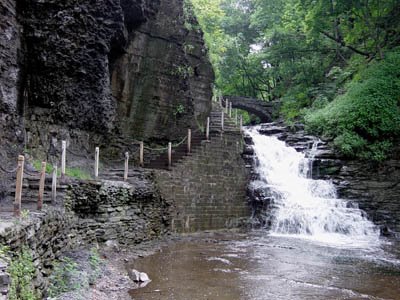
So this, kids, is my route up from downtown Ithaca to Cornells campus. It is both spectacular and kinda scary (in parts). This is all I have time for. I miss people!
Saturday, June 03, 2006
specific discontinuities
It is not that I'm uninterested in or unsympathetic to the concern for finding and elaborating discontinuity, flows, ruptures, etc. I am just concerned that these don't turn into generalizable categories in their own right; I am interested, that is, in the specific application of discontinuity, the specific facts (historical, material) of rupture.
Foucault:
We must ask ourselves what purpose is ultimately served by this suspension of all the accepted unities, if, in the end, we return to the unities we pretended to question at the outset. In fact, the systematic erasure of all given unities enables us first of all to restore to the statement the specificty of its occurence, and to show that discontinuity is one of those great accidents that create cracks not only in the geology of history, but also in the simple facts of the statement; it emerges in its historial irruption; what we try to examine is the incison it makes, that irreducible--and very often tiny--emergence. However banal it may be, however unimportant its consequences may appear to be, however quickly it may be forgotten after its appearance, however little heard or however badly deciphered we may suppose it to be, a statement is always an event that neither the language (langue) nor the meaning can quite exhaust. It is certainly a strange event: first, because on the one hand it is linked to the gesture of writing or to the articulation of speech, and also on the other hand it opens up to itself a residual existence in the field of a memory, or in the materiality of manuscripts, books, or any other form of recording; secondly, because like every event, it is unique, yet subject to repetition, transformaton, and reactivation; thirdly, because it is linked not only to the situations that provoke it, and to the consequences that it gives rise to, but at the same time, and in accordance with a quite different modality, to the statements that precede and follow it. (28 The Archeology of Knowledge).
Foucault:
We must ask ourselves what purpose is ultimately served by this suspension of all the accepted unities, if, in the end, we return to the unities we pretended to question at the outset. In fact, the systematic erasure of all given unities enables us first of all to restore to the statement the specificty of its occurence, and to show that discontinuity is one of those great accidents that create cracks not only in the geology of history, but also in the simple facts of the statement; it emerges in its historial irruption; what we try to examine is the incison it makes, that irreducible--and very often tiny--emergence. However banal it may be, however unimportant its consequences may appear to be, however quickly it may be forgotten after its appearance, however little heard or however badly deciphered we may suppose it to be, a statement is always an event that neither the language (langue) nor the meaning can quite exhaust. It is certainly a strange event: first, because on the one hand it is linked to the gesture of writing or to the articulation of speech, and also on the other hand it opens up to itself a residual existence in the field of a memory, or in the materiality of manuscripts, books, or any other form of recording; secondly, because like every event, it is unique, yet subject to repetition, transformaton, and reactivation; thirdly, because it is linked not only to the situations that provoke it, and to the consequences that it gives rise to, but at the same time, and in accordance with a quite different modality, to the statements that precede and follow it. (28 The Archeology of Knowledge).
Wallace Stevens?


Which Famous Modern American Poet Are You?

You are Wallace Stevens. You love everything, especially the sound of things. Too bad you are so obscure that at times even you don't understand what the hell you have written.
Take this quiz!

Quizilla |
Join
| Make A Quiz | More Quizzes | Grab Code
Subscribe to:
Posts (Atom)