Since I can't come up w/ nothing original, I'm putting up things that don't go together... or do they? hmmmm... so here's a link and a picture. For more info on the lovely pic you can go here.
Thursday, May 25, 2006
Thinginess/Portrait with Stevie Nicks
Since I can't come up w/ nothing original, I'm putting up things that don't go together... or do they? hmmmm... so here's a link and a picture. For more info on the lovely pic you can go here.
Tuesday, May 23, 2006
Monday, May 22, 2006
Teshigahara
I totally forgot about "The Face of Another," which waggish discusses. An alternate title is: "I Have a Stranger's Face." I only vaguely remember scenes, but one does stand out, tho I'm not sure whether it's a nightmare sequence or if it's part of "real" events. The main character is walking down the street completely bandaged as in the pic above. There are crowds of people numbly walking along, shuffling and bumping past him, looking like very normal, proper Japanese middle-class folks, and, as I recall, they're totally ignoring him. It's utterly horrifying, not just in their rejection or lack of recognition of him, but that this lack of recongition is coupled with the sense of their overwhelming almost ominous presence. Yet, I can't quite recall if they are horrified by him, ignore him, or if they too, for a moment, appear with masks. It would make sense if all three were the case. Truama, psychoanalytic awareness, extreme aesthetic/cultural specificity, denial and repression... Japanese cinema post WWll is absolutely fascinating. I can't get enough of it. That and Japanese TV shows, particularly Ultraman. My favorite Ultraman character? Dada, of course. See the resemblance?
The Proustian Questionnaire
From Jacket magazne. With a nod to Sarah.
When did you last die?
Isn't every breath, in and out, a death?
What gets you out of bed in the morning?
Guilt.
What became of your childhood dreams?
I got over them, thank god. Otherwise I'd have 14 kids and be living on a farm in South Dakota.
What sets you apart from from everyone else?
Well, first, I'd like to think it's my ability to see this questionnaire and this particular question as a disgusting form of narcissism, which I nevertheless feel compelled to indulge in, but I doubt that sets me apart.
Second, I can size up everyone in a room's feelings within seconds.
Oh, and I occupy *this* space.
What is missing from your life?
Among other things: financial security.
Do you think that everyone can be an artist?
No. Well, I suppose they *can* but the question's weird. I mean, only artists seem to think everyone should want to be an artist. Do scientists ask this kind of question?
Where do you come from?
If I told you, you wouldn't believe me.
Do you find your lot an enviable one?
Well, I suppose. Is this question supposed to make me feel grateful for all the blessings in my life? How bourgie.
What have you given up?
Furniture, many friendships, feeling sorry for assholes.
What do you do with your money?
Ha!
What household task gives you the most trouble?
cat litter cleaning. Yuck.
What are your favorite pleasures?
Thinking. Good conversation. Hot baths. Reading a good book. Seeing art. Listening to or seeing live music. Moments of insight.
What would you like to receive for your birthday?
As you might have guessed by now, a fucking million dollars. Art from my friends.
Cite three living artists whom you detest.
The guys in Interpol.
What do you stick up for?
Like my Mom always said, I stick up for the underdog.
What are you capable of refusing?
Compliments. I bat them away like pesky houseflies.
What is the most fragile part of your body?
The back of my neck, if by "fragile" you mean sensitive.
What has love made you capable of doing?
Loving. Things that might not have been in my self-interest.
What do other people reproach you for?
Inconsistency. Undue sarcasm. Low self-esteem. Extreme criticalness.
What does art do for you?
Offers a perspective, a possibilty, a politics.
Write your epitaph.
Easy. "Fuck you you fucking Fuck." That or, "I told you I was sick."
In what form would you like to return?
Same as this one but w/ way more money. But I ain't comin' back unless everyone I like comes w/ me. Drinks on me.
When did you last die?
Isn't every breath, in and out, a death?
What gets you out of bed in the morning?
Guilt.
What became of your childhood dreams?
I got over them, thank god. Otherwise I'd have 14 kids and be living on a farm in South Dakota.
What sets you apart from from everyone else?
Well, first, I'd like to think it's my ability to see this questionnaire and this particular question as a disgusting form of narcissism, which I nevertheless feel compelled to indulge in, but I doubt that sets me apart.
Second, I can size up everyone in a room's feelings within seconds.
Oh, and I occupy *this* space.
What is missing from your life?
Among other things: financial security.
Do you think that everyone can be an artist?
No. Well, I suppose they *can* but the question's weird. I mean, only artists seem to think everyone should want to be an artist. Do scientists ask this kind of question?
Where do you come from?
If I told you, you wouldn't believe me.
Do you find your lot an enviable one?
Well, I suppose. Is this question supposed to make me feel grateful for all the blessings in my life? How bourgie.
What have you given up?
Furniture, many friendships, feeling sorry for assholes.
What do you do with your money?
Ha!
What household task gives you the most trouble?
cat litter cleaning. Yuck.
What are your favorite pleasures?
Thinking. Good conversation. Hot baths. Reading a good book. Seeing art. Listening to or seeing live music. Moments of insight.
What would you like to receive for your birthday?
As you might have guessed by now, a fucking million dollars. Art from my friends.
Cite three living artists whom you detest.
The guys in Interpol.
What do you stick up for?
Like my Mom always said, I stick up for the underdog.
What are you capable of refusing?
Compliments. I bat them away like pesky houseflies.
What is the most fragile part of your body?
The back of my neck, if by "fragile" you mean sensitive.
What has love made you capable of doing?
Loving. Things that might not have been in my self-interest.
What do other people reproach you for?
Inconsistency. Undue sarcasm. Low self-esteem. Extreme criticalness.
What does art do for you?
Offers a perspective, a possibilty, a politics.
Write your epitaph.
Easy. "Fuck you you fucking Fuck." That or, "I told you I was sick."
In what form would you like to return?
Same as this one but w/ way more money. But I ain't comin' back unless everyone I like comes w/ me. Drinks on me.
Nebulous objects
This is a nebula. I heard someone on TV (I forget who or what TV program) mention the term "nebulous objects" and it struck my fancy since I've been thinking so much about objects in general. According to the website here: Originally, the word "nebula" referred to almost any extended astronomical object (other than planets and comets). The etymological root of "nebula" means "cloud". As is usual in astronomy, the old terminology survives in modern usage in sometimes confusing ways. We sometimes use the word "nebula" to refer to galaxies, various types of star clusters and various kinds of interstellar dust/gas clouds. More strictly speaking, the word "nebula" should be reserved for gas and dust clouds and not for groups of stars.
But nebulous, I think, has interesting connotations. According to the American Heritage dictionary (I woould look it up in the OED, but can't get it online unless I'm at school, darn it!) nebulous means: Cloudy, misty, or hazy. 2. Lacking definite form or limits; vague: nebulous assurances of future cooperation. 3. Of, relating to, or characteristic of a nebula.
I'm particularly struck by the second definition, which moves from the material haziness given in the physical descriptors of the first definition, to an uncertain state of subjective intention: "nebulous assurances of future cooperation." This sentence seems to move into a kind of politics where "nebulous subjects" or the nebulousness of subjectivity can only give "nebulous assurances." Politics here is then an openness or formlessness that, while it can provide only "cloudy" assurances, is also dynamic and, as indicated by the image above, might even be expressively beautiful. (I use the term "expressive" here in a Deleuzian sense, which would exceed any specificity of the subject). The nebulae that form (or are formed by) galaxies, which stand in uncertain relation to space and time (they continally move and shift) , in the movement of this definition itself, inform or transform our sense of social relations. That is, how we construct our sense of politics and subjective intention is determined by our relationship to objects on the vastest and the most microscopic scales. I am reminded of the surrealist object, as well as the surrealist approach to the object. One of my favorite descriptions of the surrealist method is by the sadly overlooked author, Leonora Carrnington. "The task of the right eye," she tells us, "is to peer into the telescope, while the left eye peers into the microscope." This task of incommensurable vision is, I would think, only potentially performed by an expansion of our concept of subject/object relations. N'est pas?
Sunday, May 21, 2006
experiencing the self
Bear with me on the following. It's a bit Philosophy/Psychoanalysis 101'ish, but I'm trying to go somewhere w/ this, eventually, in terms of, well, in terms of a lot of things: representation (mimesis), female sexuality, visuality, etc. etc.... (Actually, to digress a bit further, this is all stemming from last summer's reading of Martin Jay's Downcast Eyes and Rodolphe Gasche's The Tain of the Mirror. I've been trying to really "get" how visuality and self-reflexivity works all year, but got distracted by "real" coursework. So this post is actually an old one that I finally have time to think through...sorta....:
****
There is a chasm between experience and reflection (cognition, self-consciousness) at the same time that they are constitutive of one another. In the moment of experience -- provided we can call it a "moment"-- the question is: am I one? Let us say that in the experience, "I" is immersed in the moment without reflecting on it during its occurence. Is this wholeness? If I am not thinking of the experience as an experience in that very moment, then there is a lack at the heart of the presumed wholeness of immersive experience. And the something that has been left out or, perhaps, necessarily forgotten is, namely, the self-reflexive self. That part of the self that acknowledges or ruminates on or critiques (sees) the event as it is happening is, thus, absent in the immersive or absorptive experience (think of the experience of good sex as an example of an immersive moment).
If, however, I am doubly "present" in the moment of experience-- ruminating, critiquing, reflecting etc.-- then I am split off from that immersive experience. That split is then also a lack, an absence, i.e., the lack or absence of the presumably non-split self. This doubly split self is, to my mind, reminisent of Lacan's discussion of the gaze. That is to say that the chasm between experience and reflection, which determines subjectivity needs to be re-constituted, for Lacan, in a going beyond the paradoxical nature of the split self or the visible and invisible (Merleau-Ponty's "chiasm"). This is what, I think, in The Four Fundamentals of Psychoanalysis, Lacan refers to as the "derealization of space." That is, the split self is constituted in and by a mimetic space wherein the gaze is located, but not via a straight, one-to-one, (Cartesian or Euclidean) form of representation. In this derealized space the split self appears via the anamorphotic image hiding in the representative figure that slips into sight obliquely, by chance or, as Zizek says, by "looking awry." What determines the split self as the desiring subject is then the scopic drive, but the scopic drive is itself constituted by that which it fails to adequately contain, i.e., the kernel of the Real, the unrepresentable, what Lacan refers to as "the gaze."
Though it's difficult to adequately pin down the definition of the gaze in Lacan, since he seems to continually redefine it, in terms of my idea of what Lacan means by the gaze, I always return to his story of the tin can that a fisherman points out to him floating on the water. The fisherman gleefully asks: Do you see that tin can? Well, it doesn't see you!" The tin can then is the gaze, and we can say that the pyschoanalyst stands in for the tin can in that, by not returning the analysand's gaze, s/he opens up the space of lack wherein fantasy projections and ultimately transference can take place. So going back to the idea that there is a "chasm" between experience and reflection, it might be rethought, along Lacanian lines, as itself the function of the gaze. In other words, the gaze-- that which doesn't recognize the subject-- constitutes the subject as aware of itself from outside itself. (In Lacan's words: "I see myself seeing myself.") Here's a bit more Lacan on the split self and the gaze:
"In the field offered us by Maurice Merleau-Ponty, more or less polarized indeed by the threads of our experience, the scopic field, the ontological status, is presented by its most factitious, not to say most outworn, effects. But it is not between the invisible and the visible we have to pass. The split that concerns us is not the distance that derives from the fact that there are forms imposed by the world towards which the intentionality of phenomenological experience directs us--hence the limits we encounter in the experience of the visible. The gaze is presented to us only in the form of a strange contingency, symbolic of what we find on the horizon, as the thrust of our experience, namely, the lack that constitutes castration anxiety. The eye and the gaze --this is for us the split in which the drive is manifested at the level of the scopic field. In our relation to things, in so far as this relation is constituted by the way of vision, and ordered in the figures of representation, something slips, passes, is transmitted, from stage to stage, and is always to some degree eluded in it--that is what we call the gaze."
****
There is a chasm between experience and reflection (cognition, self-consciousness) at the same time that they are constitutive of one another. In the moment of experience -- provided we can call it a "moment"-- the question is: am I one? Let us say that in the experience, "I" is immersed in the moment without reflecting on it during its occurence. Is this wholeness? If I am not thinking of the experience as an experience in that very moment, then there is a lack at the heart of the presumed wholeness of immersive experience. And the something that has been left out or, perhaps, necessarily forgotten is, namely, the self-reflexive self. That part of the self that acknowledges or ruminates on or critiques (sees) the event as it is happening is, thus, absent in the immersive or absorptive experience (think of the experience of good sex as an example of an immersive moment).
If, however, I am doubly "present" in the moment of experience-- ruminating, critiquing, reflecting etc.-- then I am split off from that immersive experience. That split is then also a lack, an absence, i.e., the lack or absence of the presumably non-split self. This doubly split self is, to my mind, reminisent of Lacan's discussion of the gaze. That is to say that the chasm between experience and reflection, which determines subjectivity needs to be re-constituted, for Lacan, in a going beyond the paradoxical nature of the split self or the visible and invisible (Merleau-Ponty's "chiasm"). This is what, I think, in The Four Fundamentals of Psychoanalysis, Lacan refers to as the "derealization of space." That is, the split self is constituted in and by a mimetic space wherein the gaze is located, but not via a straight, one-to-one, (Cartesian or Euclidean) form of representation. In this derealized space the split self appears via the anamorphotic image hiding in the representative figure that slips into sight obliquely, by chance or, as Zizek says, by "looking awry." What determines the split self as the desiring subject is then the scopic drive, but the scopic drive is itself constituted by that which it fails to adequately contain, i.e., the kernel of the Real, the unrepresentable, what Lacan refers to as "the gaze."
Though it's difficult to adequately pin down the definition of the gaze in Lacan, since he seems to continually redefine it, in terms of my idea of what Lacan means by the gaze, I always return to his story of the tin can that a fisherman points out to him floating on the water. The fisherman gleefully asks: Do you see that tin can? Well, it doesn't see you!" The tin can then is the gaze, and we can say that the pyschoanalyst stands in for the tin can in that, by not returning the analysand's gaze, s/he opens up the space of lack wherein fantasy projections and ultimately transference can take place. So going back to the idea that there is a "chasm" between experience and reflection, it might be rethought, along Lacanian lines, as itself the function of the gaze. In other words, the gaze-- that which doesn't recognize the subject-- constitutes the subject as aware of itself from outside itself. (In Lacan's words: "I see myself seeing myself.") Here's a bit more Lacan on the split self and the gaze:
"In the field offered us by Maurice Merleau-Ponty, more or less polarized indeed by the threads of our experience, the scopic field, the ontological status, is presented by its most factitious, not to say most outworn, effects. But it is not between the invisible and the visible we have to pass. The split that concerns us is not the distance that derives from the fact that there are forms imposed by the world towards which the intentionality of phenomenological experience directs us--hence the limits we encounter in the experience of the visible. The gaze is presented to us only in the form of a strange contingency, symbolic of what we find on the horizon, as the thrust of our experience, namely, the lack that constitutes castration anxiety. The eye and the gaze --this is for us the split in which the drive is manifested at the level of the scopic field. In our relation to things, in so far as this relation is constituted by the way of vision, and ordered in the figures of representation, something slips, passes, is transmitted, from stage to stage, and is always to some degree eluded in it--that is what we call the gaze."
Distribution/Excess/ Technology
An interesting post by someone else called "Last Week." Comments to come.
Friday, April 28, 2006
Strawberry Switchblade
One of my favorite groups from the 80s; my friends and I tried to copy their fashion. (From what I recall, they preceded Boy George's adoption of this style. I think he was actually influenced by them, not vice-versa). Now I realize why we were picked on in high school. Remember now, it was the 80s, and we thought we were punk! Anyway, SS--from Scotland-- besides having the coolest band name ever, were also one of the first groups to combine, in innovative ways, goth and pop. They've also had a huge impact on the Japanese fashion and music scene, and there are still Japanese teens emulating their look. Most importantly their songs are amazing. I need to dig through my tapes....
Wednesday, April 26, 2006
The Politics of the Avant Garde
With notable exceptions, studies of the Russian avant-garde have become, in a Kuhnian sense, "normal science. And yet the work to which it adverts is anything but. This is not an insignificant matter, though it is a not very widely acknowledged one. It is a problem that has always existed and that has never gone away but just seems to have become invisible. Like some otherwise defenseless creature in a hostile environment, the question of the politics of the avant-garde has blended into the tangled undergrowth of facts and names, research grants, footnotes, and scholarly paraphernalia....
The revolutionary avant-garde is not of interest for its normativity. Aleksandr Blok wasn't joking when he summoned Europe to the "bright feast of peace and brotherhood and labor" with the "strings of a Scythian lyre": "Are we to blame if your rib cages burst/beneath our paws' impulsive ardor?" Blok's warning could doubtless be written off as a romantic evocation of the Revolution's most backward aspects--all slave girls , wild horses, and Asiatic jubilation--when the Revolution was really about tractors and planning. But a revolution is a revolution, and the academic researcher padding noiselessly through carpeted libraries or, indeed, faxing documents from one interntional center to another would do well to remember that Aleksandr Rodchenko, El Lissitzky, Varvara Stepanova, Vladimir Maiakovskii, Dziga Vertov, Gustav Klutsis, and the rest, working in conditions of privation to begin with and harsh censorship later, were all, without exception, explicitly commited to working-class revolution--out of which a new order of international socialism would arise. One should not overlook the paradox that the very research which progressively reveals the contours of the Soviet avant-garde is predicated on the defeat of the avant-garde's social vision. By whom, by just which forces, is not quite so easy to say. To echo the sentiments of a thinker little acknowledged in these late days of cultural studies: "What is to be done?"
It is an irony upon a paradox that in setting out to answer the question, in attempting to clarify the politics of the avant garde, there is no other starting point than this unglamorous one, this place where we are. Our starting point consists of these apparent conclusions, this pile of books, this trail of articles: not, after all, the soul of revolutionary Petrograd but the "soul" of the bourgeois academy. The Russian avant-garde, Constructivism, Socialist Realism even, are what they have been made to mean in these pages, in the play of their silences and their affirmations. To ponder the paradox is, in effect, a question of resistance: resisting various normalizations enforced by the history our own culture is writing.
--Paul Wood
Sunday, April 23, 2006
I changed my mind, I want to be an archaeologist
or at least go on a dig. Anyone up for it? Check this out. I mean what could be more fun than crouching for hours in the blinding sun brushing dirt off rocks? I'm serious, that sounds like a blast to me. I love rocks, or anything rocklike. And piecing together ancient shards of pottery or tools or bones, perhaps even an entire building or village and then constructing a reading of a former way of life and set of meanings, fascinating. Well, maybe that last part leans more in the direction of anthropology. Or wait, I think that qualifies as a mix of archaeology/anthropology... Yes, I googled it and found this. And then there's this very informative guide to terms and research here.
Sedimentation.
Or maybe this is another attempt to avoid paper writing? Nah, too obvious.
Sedimentation.
Or maybe this is another attempt to avoid paper writing? Nah, too obvious.
Sunday, April 16, 2006
Writing as a woman
I too have been fascinated by this discussion at several places about women and blogging, which I think is a kind canon formation argument but w/ regard to blogs. It reminded me of this essay by Carla Harryman at However. A relevant quote:
The question is: Whose goal is it to usher anything into the canon? And how, as a writer to engage actively and publicly in literary practice without turning oneself over to false representations? I am by the way talking less about achieving public fame or notoriety than I am about fantasy structures of power that are silencing, that prevent writers for instance from addressing critically their own and other writers’ works. Women must be able to speak critically and analytically about each other’s and others’ (men’s, writers’ different from "herself," critics’, and theorists’) works or we will be misrecognized. However, if such writing about is about canon-formation, then the misrecognitions will persist along with an endless series of misnamings.
What I mean in the most simple sense here is that the writing about needs to attend carefully to difference, to awkwardness, to misfittings rather than to have as a primary goal the fitting of the "innovative" text into conventional categories. After all, the power of the "different" text lies in what it suggests about other ways of seeing and imagining writing. If one wants the implication of a vision to develop, then fitting the radical object into the square peg of patriarchal canon-making narratives is not only an inaccurate way of proceeding but one that reinforces values that the art object itself critiques. I do not mean that mediating language is not necessary for creating readings of and preserving writing but that reductive readings that are about norms and values the texts themselves reject or call into question can produce a kind of textual powerlessness.
The question is: Whose goal is it to usher anything into the canon? And how, as a writer to engage actively and publicly in literary practice without turning oneself over to false representations? I am by the way talking less about achieving public fame or notoriety than I am about fantasy structures of power that are silencing, that prevent writers for instance from addressing critically their own and other writers’ works. Women must be able to speak critically and analytically about each other’s and others’ (men’s, writers’ different from "herself," critics’, and theorists’) works or we will be misrecognized. However, if such writing about is about canon-formation, then the misrecognitions will persist along with an endless series of misnamings.
What I mean in the most simple sense here is that the writing about needs to attend carefully to difference, to awkwardness, to misfittings rather than to have as a primary goal the fitting of the "innovative" text into conventional categories. After all, the power of the "different" text lies in what it suggests about other ways of seeing and imagining writing. If one wants the implication of a vision to develop, then fitting the radical object into the square peg of patriarchal canon-making narratives is not only an inaccurate way of proceeding but one that reinforces values that the art object itself critiques. I do not mean that mediating language is not necessary for creating readings of and preserving writing but that reductive readings that are about norms and values the texts themselves reject or call into question can produce a kind of textual powerlessness.
Monday, April 10, 2006
Monday, April 03, 2006
Thoughts after reading Samuel Delany
For Michael:
The efficacies and (negative) epiphanies of public space. Squeezed out by Capital even as they are created by and through it. It's funny or ironic to be intrigued by any discussion or writing on public space and to have more than a touch of agoraphobia. Many have accused me of being a shut-in, and my most comfortable moments are conversations in my own private space. But this isn't about my neuroses...
The negotiations of space that we as collective individuals take part in -- culminating in a variety of encounters at different cultural levels, whether they be aesthetic, sexual, everyday, or for the joy of pure movement and (potential) contact with other selves, other bodies -- is, well, life. So life happens outside, a la Elsbeth Probyn's Outside Belongings. Disruptions of identity, spatial gaps, insignia, street life. I think of Style Wars.
Exhilaration occurs at the same time as desire for escape. Fantasy space and fear of recognition. Comfort, familiarity. Sickening boredom and stagnation. Um, Detroit. Post-industrial ho-hum but even worse, urban renewal. Like Delany, I too abjure nostalgia and valorization. And like Benjamin I want to ask, where are the spaces inhabited by forgotten futures? Is the image here not like Benjamin's Angel of History? It is, in fact, Detroit's abandoned image of itself, a paradoxical outline of invisibility. Delany writes of contact in semi-permeable public/private space. Recognition without (re)production; his tales of sexual encounters jibe in my memory with Acker's: "I absolutely love to fuck." And Lacan: the space of the other is the site for misrecognition of the self. The confusion of self/other is a derealization of space. Where self becomes permeable, I am marked by the other(s desire). Rimbaud's "I is an other." The urban landscape is a dystopian picaresque rendering me.
Sunday, April 02, 2006
experiencing the self
Bear with me on the following. It's a bit Philosophy/Psychoanalysis 101'ish, but i'm trying to go somewhere w/ this, eventually, in terms of, well, in terms of a lot of things: representation (mimesis), female sexuality, visuality, etc. etc.... (Actually, to digress a bit further, this is all stemming from last summer's reading of Martin Jay's Downcast Eyes and Rodolphe Gasche's The Tain of the Mirror. I've been trying to really "get" how visuality and self-reflexivity works all year, but got distracted by "real" coursework. So this post is actually an old one that I finally have time to think through...sorta....:
****
There is a chasm between experience and reflection (cognition, self-consciousness) at the same time that they are constitutive of one another. In the moment of experience -- provided we can call it a "moment"-- the question is: am I one? Let us say that in the experience, "I" is immersed in the moment without reflecting on it during its occurence. Is this wholeness? If I am not thinking of the experience as an experience in that very moment, then there is a lack at the heart of the presumed wholeness of immersive experience. And the something that has been left out or, perhaps, necessarily forgotten is, namely, the self-reflexive self. That part of the self that acknowledges or ruminates on or critiques (sees) the event as it is happening is, thus, absent in the immersive or absorptive experience (think of the experience of good sex as an example of an immersive moment).
If, however, I am doubly "present" in the moment of experience-- ruminating, critiquing, reflecting etc.-- then I am split off from that immersive experience. That split is then also a lack, an absence, i.e., the lack or absence of the presumably non-split self. This doubly split self is, to my mind, reminisent of Lacan's discussion of the gaze. That is to say that the chasm between experience and reflection, which determines subjectivity needs to be re-constituted, for Lacan, in a going beyond the paradoxical nature of the split self or the visible and invisible (Merleau-Ponty's "chiasm"). This is what, I think, in The Four Fundamentals of Psychoanalysis, Lacan refers to as the "derealization of space." That is, the split self is constituted in and by a mimetic space wherein the gaze is located, but not via a straight, one-to-one, (Cartesian or Euclidean) form of representation. In this derealized space the split self appears via the anamorphotic image hiding in the representative figure that slips into sight obliquely, by chance or, as Zizek says, by "looking awry." What determines the split self as the desiring subject is then the scopic drive, but the scopic drive is itself constituted by that which it fails to adequately contain, i.e., the kernel of the Real, the unrepresentable, what Lacan refers to as "the gaze."
Though it's difficult to adequately pin down the definition of the gaze in Lacan, since he seems to continually redefine it, in terms of my idea of what Lacan means by the gaze, I always return to his story of the tin can that a fisherman points out to him floating on the water. The fisherman gleefully asks: Do you see that tin can? Well, it doesn't see you!" The tin can then is the gaze, and we can say that the pyschoanalyst stands in for the tin can in that, by not returning the analysand's gaze, s/he opens up the space of lack wherein fantasy projections and ultimately transference can take place. So going back to the idea that there is a "chasm" between experience and reflection, it might be rethought, along Lacanian lines, as itself the function of the gaze. In other words, the gaze-- that which doesn't recognize the subject-- constitutes the subject as aware of itself from outside itself. (In Lacan's words: "I see myself seeing myself.") Here's a bit more Lacan on the split self and the gaze:
"In the field offered us by Maurice Merleau-Ponty, more or less polarized indeed by the threads of our experience, the scopic field, the ontological status, is presented by its most factitious, not to say most outworn, effects. But it is not between the invisible and the visible we have to pass. The split that concerns us is not the distance that derives from the fact that there are forms imposed by the world towards which the intentionality of phenomenological experience directs us--hence the limits we encounter in the experience of the visible. The gaze is presented to us only in the form of a strange contingency, symbolic of what we find on the horizon, as the thrust of our experience, namely, the lack that constitutes castration anxiety. The eye and the gaze --this is for us the split in which the drive is manifested at the level of the scopic field. In our relation to things, in so far as this relation is constituted by the way of vision, and ordered in the figures of representation, something slips, passes, is transmitted, from stage to stage, and is always to some degree eluded in it--that is what we call the gaze."
****
There is a chasm between experience and reflection (cognition, self-consciousness) at the same time that they are constitutive of one another. In the moment of experience -- provided we can call it a "moment"-- the question is: am I one? Let us say that in the experience, "I" is immersed in the moment without reflecting on it during its occurence. Is this wholeness? If I am not thinking of the experience as an experience in that very moment, then there is a lack at the heart of the presumed wholeness of immersive experience. And the something that has been left out or, perhaps, necessarily forgotten is, namely, the self-reflexive self. That part of the self that acknowledges or ruminates on or critiques (sees) the event as it is happening is, thus, absent in the immersive or absorptive experience (think of the experience of good sex as an example of an immersive moment).
If, however, I am doubly "present" in the moment of experience-- ruminating, critiquing, reflecting etc.-- then I am split off from that immersive experience. That split is then also a lack, an absence, i.e., the lack or absence of the presumably non-split self. This doubly split self is, to my mind, reminisent of Lacan's discussion of the gaze. That is to say that the chasm between experience and reflection, which determines subjectivity needs to be re-constituted, for Lacan, in a going beyond the paradoxical nature of the split self or the visible and invisible (Merleau-Ponty's "chiasm"). This is what, I think, in The Four Fundamentals of Psychoanalysis, Lacan refers to as the "derealization of space." That is, the split self is constituted in and by a mimetic space wherein the gaze is located, but not via a straight, one-to-one, (Cartesian or Euclidean) form of representation. In this derealized space the split self appears via the anamorphotic image hiding in the representative figure that slips into sight obliquely, by chance or, as Zizek says, by "looking awry." What determines the split self as the desiring subject is then the scopic drive, but the scopic drive is itself constituted by that which it fails to adequately contain, i.e., the kernel of the Real, the unrepresentable, what Lacan refers to as "the gaze."
Though it's difficult to adequately pin down the definition of the gaze in Lacan, since he seems to continually redefine it, in terms of my idea of what Lacan means by the gaze, I always return to his story of the tin can that a fisherman points out to him floating on the water. The fisherman gleefully asks: Do you see that tin can? Well, it doesn't see you!" The tin can then is the gaze, and we can say that the pyschoanalyst stands in for the tin can in that, by not returning the analysand's gaze, s/he opens up the space of lack wherein fantasy projections and ultimately transference can take place. So going back to the idea that there is a "chasm" between experience and reflection, it might be rethought, along Lacanian lines, as itself the function of the gaze. In other words, the gaze-- that which doesn't recognize the subject-- constitutes the subject as aware of itself from outside itself. (In Lacan's words: "I see myself seeing myself.") Here's a bit more Lacan on the split self and the gaze:
"In the field offered us by Maurice Merleau-Ponty, more or less polarized indeed by the threads of our experience, the scopic field, the ontological status, is presented by its most factitious, not to say most outworn, effects. But it is not between the invisible and the visible we have to pass. The split that concerns us is not the distance that derives from the fact that there are forms imposed by the world towards which the intentionality of phenomenological experience directs us--hence the limits we encounter in the experience of the visible. The gaze is presented to us only in the form of a strange contingency, symbolic of what we find on the horizon, as the thrust of our experience, namely, the lack that constitutes castration anxiety. The eye and the gaze --this is for us the split in which the drive is manifested at the level of the scopic field. In our relation to things, in so far as this relation is constituted by the way of vision, and ordered in the figures of representation, something slips, passes, is transmitted, from stage to stage, and is always to some degree eluded in it--that is what we call the gaze."
Monday, March 27, 2006
Great Literary Taunts
In lieu of my own biting sarcasm I offer these spiteful gems:
GREAT LITERARY TAUNTS
"I feel so miserable without you, it's almost like having you here."
--- Stephen Bishop
"A modest little person, with much to be modest about."
--- Winston Churchill (about Clement Atlee)
"I've just learned about his illness. Let's hope it's nothing
trivial." --- Irvin S. Cobb
"I have never killed a man, but I have read many obituaries with
great pleasure." --- Clarence Darrow
"He has never been known to use a word that might send a reader to
the dictionary." --- William Faulkner (about Ernest Hemingway)
"He had delusions of adequacy." --- Walter Kerr
"I've had a perfectly wonderful evening. But this wasn't it." --- Groucho Marx
"They never open their mouths without subtracting from the sum of
human knowledge." --- Thomas Brackett Reed
"He loves nature in spite of what it did to him." --- Forrest Tucker
"I didn't attend the funeral, but I sent a nice letter saying I
approved of it." --- Mark Twain
"His mother should have thrown him away and kept the stork." --- Mae West
"Some cause happiness wherever they go; others whenever they go." --- Oscar Wilde
"He has no enemies, but is intensely disliked by his friends." --- Oscar Wilde
"He has Van Gogh's ear for music." --- Billy Wilde
--
GREAT LITERARY TAUNTS
"I feel so miserable without you, it's almost like having you here."
--- Stephen Bishop
"A modest little person, with much to be modest about."
--- Winston Churchill (about Clement Atlee)
"I've just learned about his illness. Let's hope it's nothing
trivial." --- Irvin S. Cobb
"I have never killed a man, but I have read many obituaries with
great pleasure." --- Clarence Darrow
"He has never been known to use a word that might send a reader to
the dictionary." --- William Faulkner (about Ernest Hemingway)
"He had delusions of adequacy." --- Walter Kerr
"I've had a perfectly wonderful evening. But this wasn't it." --- Groucho Marx
"They never open their mouths without subtracting from the sum of
human knowledge." --- Thomas Brackett Reed
"He loves nature in spite of what it did to him." --- Forrest Tucker
"I didn't attend the funeral, but I sent a nice letter saying I
approved of it." --- Mark Twain
"His mother should have thrown him away and kept the stork." --- Mae West
"Some cause happiness wherever they go; others whenever they go." --- Oscar Wilde
"He has no enemies, but is intensely disliked by his friends." --- Oscar Wilde
"He has Van Gogh's ear for music." --- Billy Wilde
--
Saturday, March 25, 2006
artist/photographer


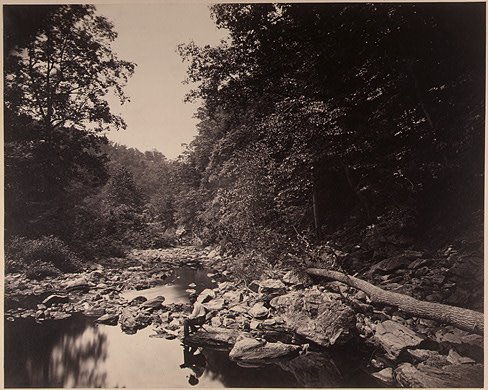
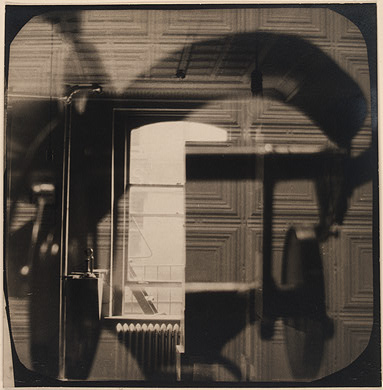
Another artist who used photography to document his ideas and his more material works is David Smith (bottom). I'm thinking of looking at how conceptual artists used the techniques and the mode of production inherent to photography in order to think though their ideas as well as to leave behind a trace of that endeavor. There's a lot more I want to say about this, but for now I just want to throw this up here for future reminder. It also intrigued me to compare this to the early use of photography as a method of capturing both a traumatic historical moment and the artist's contemplation/overcoming of it. The photo on the top is by the 19C photographer John Moran. And here's an intriguing description: "Perhaps as an antidote to the Civil War that ravaged the American landscape and psyche, John Moran made this carefully constructed, idyllic photograph of the Wissahickon Creek, just outside of Philadelphia. He presents an artist, perhaps his brother, the painter Thomas Moran, quietly sketching the beauty of the natural environment. The artist´s central position and his reflection, perfectly mirrored in the still pool of water in the foreground, seem to confirm both his importance and his harmony with his surroundings. The ability of the artist to bring order to his world is further suggested by the delicate retouching in the upper left of the photograph to remove the jarring intrusion of a building into this bucolic vista."
Saturday, March 18, 2006
not-writing
even tho i've been on break, i've been unable to find time (well, more like motivation or maybe even thought-clarity) to write anything on this here blog. so in recompenese to you my dear, non-existent readers, i offer some things i did not write about.
i did not write about Jean Luc Nancy's ideas about community and love , which i think centers around his use of the term "exposure."
i did not write about Paul Mann's "Stupid Undergrounds." an amazing read but, finally, one of those things that, when you're done reading it you get the "is that all there is" blues. and this is simply b/c it leaves you with the feeling that there is indeed nothing left to say beyond pointing to further examples of its truth.
i did not write about any number of weird, violent, quirky "outsider" art practices that i get excited about, on average, every 36 seconds. for example, i did not write about the bands Harry Pussy, To Live and Shave in LA, Ron of Japan, The Beast People, The Pterodactyls, Nautical Almanac, Occassional Detroit, etc etc etc...
i did not write about performance practices that i find fascinating due to their extreme yet somehow beautiful dimensions. i failed to describe Coum Transmissions, the Vienna Actionists, John Duncan, the Badher Meinhof Group, Vito Acconci, Chris Burden, Carolee Schneeman, Yoko Ono....
on the everyday tip -- i did not write about meeting my friend Liz's friend from law school, Dave Choo, who was very funny and smart and nice and made me feel glad to have actually met a new person and who also made me feel less bad about living in and feeling a certain way about Detroit since he appreciated -- he got-- the city and its essense as this paradoxical empty/fullness .
i did not write about my cats.
i did not write about general states of political unrest that depress me and sometimes move me to tears. need i mention them? don't we know all too well where and why they occur? and the all too familiar feeling of frustration in the face of their seeming inevitability?
i did not write about looming and omnipresent career/academia anxieties.
i failed to recap an interesting conversation with my friend Sam about art/music and originality.
i did not express gratitude in writing for my friendships with Sarah, Shashi, Sam, Ryan, Mike, Brad, Michael, John, Julie, Lindsay, and Liz.
i did not relate my excitement or fears about attending Cornell's theory camp this summer.
i did not write about guilt, lust, or loneliness. i did not write about money.
anything else?
i did not write about Jean Luc Nancy's ideas about community and love , which i think centers around his use of the term "exposure."
i did not write about Paul Mann's "Stupid Undergrounds." an amazing read but, finally, one of those things that, when you're done reading it you get the "is that all there is" blues. and this is simply b/c it leaves you with the feeling that there is indeed nothing left to say beyond pointing to further examples of its truth.
i did not write about any number of weird, violent, quirky "outsider" art practices that i get excited about, on average, every 36 seconds. for example, i did not write about the bands Harry Pussy, To Live and Shave in LA, Ron of Japan, The Beast People, The Pterodactyls, Nautical Almanac, Occassional Detroit, etc etc etc...
i did not write about performance practices that i find fascinating due to their extreme yet somehow beautiful dimensions. i failed to describe Coum Transmissions, the Vienna Actionists, John Duncan, the Badher Meinhof Group, Vito Acconci, Chris Burden, Carolee Schneeman, Yoko Ono....
on the everyday tip -- i did not write about meeting my friend Liz's friend from law school, Dave Choo, who was very funny and smart and nice and made me feel glad to have actually met a new person and who also made me feel less bad about living in and feeling a certain way about Detroit since he appreciated -- he got-- the city and its essense as this paradoxical empty/fullness .
i did not write about my cats.
i did not write about general states of political unrest that depress me and sometimes move me to tears. need i mention them? don't we know all too well where and why they occur? and the all too familiar feeling of frustration in the face of their seeming inevitability?
i did not write about looming and omnipresent career/academia anxieties.
i failed to recap an interesting conversation with my friend Sam about art/music and originality.
i did not express gratitude in writing for my friendships with Sarah, Shashi, Sam, Ryan, Mike, Brad, Michael, John, Julie, Lindsay, and Liz.
i did not relate my excitement or fears about attending Cornell's theory camp this summer.
i did not write about guilt, lust, or loneliness. i did not write about money.
anything else?
From Paul Mann's _Stupid Undergrounds_
Apocalyptic cults and youth gangs, garage bands and
wolfpacks, *colleges* and phalansteries, espionage networks
trading in vaporous facts and networks of home shoppers for
illicit goods; monastic, penological, mutant-biomorphic,
and anarcho-terrorist cells; renegade churches, dwarf
communities, no-risk survivalist enclaves, unfunded
quasi-scientific research units, paranoid think tanks,
unregistered political parties, sub-employed workers
councils, endo-exile colonies, glossolaliac fanclubs, acned
anorexic primal hordes; zombie revenants, neo-fakirs,
defrocked priests and detoxing prophets, psychedelic
snake-oil shills, masseurs of undiagnosed symptoms, bitter
excommunicants, faceless narcissists, ideological drag
queens, mystical technophiles, sub-entrepreneurial dealers,
derivative *derivistes*, tireless archivists of phantom
conspiracies, alien abductees, dupe attendants, tardy
primitives, vermin of abandoned factories, hermits, cranks,
opportunists, users, connections, outriders, outpatients,
wannabes, hackers, thieves, squatters, parasites,
saboteurs; wings, wards, warehouses, arcades, hells, hives,
dens, burrows, lofts, flocks, swarms, viruses, tribes,
movements, groupuscules, cenacles, isms, and the endlessly
multiplied hybridization of variant combinations of all
these, and more.... Why this stupid fascination with
stupid undergrounds? What is it about these throwaway
fanzines and unreadable rants, these neo-tattoos and
recycled apocalypses, this mountainous accumulation of
declassified factoids, these bloody smears, this incredible
noise? Why wade through these piles of nano-shit? Why
submit oneself to these hysterical purveyors, these
hypertheories and walls of sound? Why insist on picking
this particular species of nit? [...]
In the stupid underground any innovation
can be, at one and the same time, utterly radical and
worthless in advance. The trajectory past %cliche% is at
stake here as well, a trajectory that takes us not into
further innovation but into repetition itself: the
repetition of a cultural adventure long after its
domestication, but as if it were still an adventure. The
trajectory is thus seldom a straight line into the beyond,
a singular line of flight through becoming-imperceptible,
into the invisible. The complexity of these movements
suggests four trajectories, or four dimensions of the
trajectory as such:
to the apotheosis of stupidity, as sublime becomes
ridiculous as if without transition;
to the violent limit of the tolerable, the
very limit of recuperability;
to disappearance past the boundary of cultural
representation, a disappearance so critical that it
gives the lie to every other form of criticism;
and to what turns out, in the very midst of an
innovative frenzy, to be stupid repetition, an
autonomous, automatic repetition that drains cultural
forms of every meaning, even that of parody: the
stupefying force of repetition, which, we are told,
is the very trace of the death drive.[...]
The stupid underground is available to any ontological
or ideological reformulation,and hence a place to test the following paradox:
all cultural zones are both overdetermined and blank. [...]
Punk nihilism
was never more than the nihilism of the commodity itself.
You should not credit Malcolm McLaren with having realized
this just because he was once pro-situ. All he wanted was
to sell more trousers without boring himself to death;
indeed he is proof that the guy with the flashiest
*ressentiment* sells the most rags. And if he wasn't
bored, can he be said to have advanced the same favor to us? [...]
Everyone there knows all about
recuperation and it makes no difference. One can display
the most stringent self-criticism about the impossibility
of revolt and the next day proclaim the subversive effects
of noise, as if one were Russolo himself, Russolo in the
first place. The stupid underground is marked by the
simultaneous critical understanding of the fatality of
recuperation and a general indifference to the fact; it
ignores what it knows, and knows it. It acts as though it
forgets, until it virtually forgets, what it always
recalls. It responds to every critical reminder, even
those it throws at itself, with a *So what, fuck you.*[...]
[The stupud underground]is merely a symptom of order itself.
Everything has been
recuperated, but what is recuperated and put to death
returns, returns ferociously, and it is the return of its
most immanent dead that most threatens every form of order.
The repressed does not come back as a living being but as
the ghost it always was, and not to free us but to haunt
us. It returns as repetition; when we see it in the
mirror, as our mirror, we pretend not to recognize it. The
fury of the punk or skinhead is the fury of this stupid
repetition, and it is far more destructive than the most
brilliant modernist invention. It ruins everything and
leaves it all still in place, still functioning as if it
mattered, never relieving us of its apparition, never
pretending to go beyond it, draining it of value without
clearing it away. That is why one cannot dismiss it
according to the logic of the new, whereby the only
admissible revolutionary force must conform to the movement
of progress and innovation. The rhetoric of innovation is
parroted by the stupid underground, because it still obeys
the superficial form of the avant-garde. But it obeys it
long after it is dead, and as if that death didn't matter,
as if history had never occurred in the first place, as if
everything retro just suddenly appeared, in all its
original vacuity. As if it were even better, more
powerful, once it is dead, so long as one insists that it
is and pretends that it isn't. It is the blind repetition
of every exhausted logic far past the point of termination
that generates the most virulent negation. The stupid
persistence of the dead has taken the place of the
critical. [...]
'labyrinths and jokes' was originally released on lp in 1998 in a small
edition of only 500 copies. six tracks of diverse and creative noise
from six completely bizarre bands. 1. nautical almanac's anti-system -
started in 1994 as a party killing trash-noise rock band, the nautical
almanac has since developed into a two piece of incredibly talented
machine builders. 2. isis and werewolves - this is punk prog at it's
sloppiest and goofiest. the drummer and guitarist were such lazy
burnout's that the keyboardist left town to create a heavy metal
monster called andrew w.k. the drummer and tape manipulator aaron
dilloway would go on to form the band wolf eyes, while the guitarist
steve kenney moved to new orleans to play in the hard rock outfit metal
wolf. 3. ron of japan - this duo of 15 year old female misfits have
since gone into retirement. but what they innocently recorded in their
bedroom in 1995 ended up being some heavily influential music. 4.
andrew wilkes- krier - before he was known as andrew w.k., andrew was
going under his full name and playing a wide variety of insane noise.
the track here is a dark cloud of droning violins and ghost like
screeches and moans. 5. the mini-systems - the most unhealthy band of
all time. the mini-systems was nate young's project prior to his
forming of wolf eyes. his partner was one anthony miller, a musical
genius who now goes by the name of maximum cloud. at one time they were
the kings of circut-bent junk noise, though drugs and love would
eventually get in the way, leaving the two no choice but to disband. 6.
the beast people - the ugliest, sickest growlers ever! though he won't
admit it to your face, the beast people was a performance art group led
by aaron dilloway of wolf eyes. occasional contributors to the project
included james harper of nautical almanac, andrew w.k., detroit noise
dj andy roach, and nate young. completely psychedelic cave noise.
cut-up growls and screams, recorded completely in the red. fucking
sick! as crude as it gets! on hanson
http://www.coolbeans.com/cb6/HARRY.HTM
http://supervert.com/elibrary/rudolf_schwarzkogler/
Sunday, March 05, 2006
and the oscar goes to...
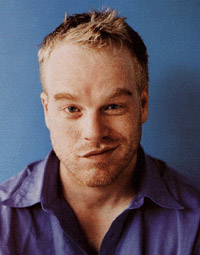
Yay! Philip Seymour Hoffman! I heart Seymour (I prefer to call him "Seymour.)
The Oscars were pretty rad this year: John Stewart, Robert Altman (Lily Tomlin and Meryl Streep were hilarious introducers), all the nominated movies were, I thought, fairly stellar. And, again, PSH won! And he thanked his mom in such a charming way....Plus, he played Capote. So cool.
non-oedipal genealogies/music vs poetry

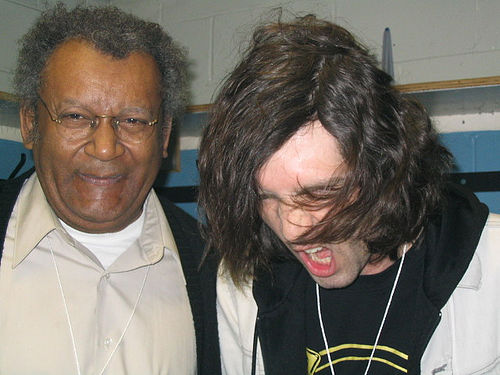
Quickly, since I have waaay too much shit to do to justify blog-posting-- I think musicians could teach (young) poets a lot about incorporating, moving past, learning from their "elders." I am sick of the "kill yr idols" model of innovation. Even though punk coined the term (kill yr idols), in practice, they've really moved away from that reductive phrase; they aren't half so antagonistic about it as young poets seem to be. (The "we vs them" mentality of the poetry world is very simplistic, and I don't know that all the work justifies the arrogance.) From what I've experienced in seeing/hearing people working together on projects across the lame "age-divide," and in conversations about it with musician friends, they have a much healthier and more open sense of what it means to be in relation to their influences -- for example, Nate Young from Wolf Eyes, pictured here with Anthony Braxton. Which reminds me of the funny interview I did with Nate, John, and Aaron; I should *really* fucking publish that one day.
Cross-generational collaboration anyone?
Subscribe to:
Posts (Atom)