I am thinking of [reading Silliman in preparation for his visit]...rhythm of sentences, attention. economy, emotion, materiality. integration. particulars, form. There's something organic or phenomenological about Ron' approach to poetic production, to form, and the economy of production and reception. A way of thinking totality without idealizing in an immaterial or transcendental way. Immanent form, which keeps the part/whole relationship together through a material mode of attention, attention to the materiality of attention and thing attended.
A dog drinking water. Well, I have paid attention to my cat drinking water, listened to the rhythm. Which reminds me now of Zukofsky's use of Reznikoff's "the ceaseless weaving of the uneven water" to describe what he means by "Sincerity." (the sincerity of the line? of the poet? of both together for the reader?) In Reznikoff there's an image (an experiential image, I think) evoked by his single sentence, whereas in Stein it's the sentences themeselves, as they weave together, that are sincere or, for her, emotional. (Tho, certainly, rhythm plays a huge part in Rez's overall structure.) They--the sentences-- are what creates the totality of the form, and they, the sentences/waves, are preserved in their particularity as they work to make up that form. Stein says this can be seen by "anybody listening to any dog's drinking," that we realize/experience that "sentences are not emotional but paragraphs are" by way of what is available in the everyday, at the smallest level of temporal/material units. It took me 'til today to really think this was right. I thought back to the attention I have paid to my cat's rhythmic drinking and how, in my attention to that rhythm, to its variations---slurp, slurp. slurp. slurpslurp, slurp. slurp, slurp, slurp, slurp, slurp. slurpurpurpurp, slrup, slurp.--I *felt* pleasure, love, sympathy, delight, amusement, connection, fascination.
Now what is the "new sentence" in relation to this emotional context? The following explanation seems important and conclusive in light of Ron's overall argument, yet I find it elusive, still: "This continual torquing of sentences [in Bob Perelman's a.k.a.] is a traditional quality of poetry, which in poetry is most often accomplished by linebreaks, and earlier on by rhyme as well. Thus poetic form has moved into the interiors of prose." If verse "moves" into the "interior" of prose, then we have the issue of non-narrative (an inadequate term) as an alternate temporal mode, which establishes meaning in a material way, without closure, through movement and a new way of thinking incorporation. The function of poetry has shifted, the possibilities and requirements of prose have been challenged. The historical, material particulars are not 'redeemed" as they might be in Zuk or Rez, nor are they held together as a phenomenological experience of cubist like perceptions a la Stein. They are "new" because they provide a context for units of language and meaning to interact and to form a multi-referential, ever-expanding whole. That is, "referential focus"--between sentences and paragraphs--and "writing which focus[s] the reader onto the level of the sentence and below, as well as the uits above," "incorporate[s] all the elements of language." What then is the emotional force of this mode of writing and form? What does an open totality feel like?
Monday, October 22, 2007

Sunday, October 21, 2007
My Complaint about Curtis Faville (w/ special thanks to Scott Pakin)
My topic is nothing new. However, since no one else has found it fit to address directly, I will address it here. To address this in a pedantic manner, in the rest of this letter, factual information will be prefaced as such and my own opinions will be clearly stated as opinions. For instance, it is a fact that the impact of Mr. Curtis Faville's adversarial tricks is exactly that predicted by the Book of Revelation. Evil will preside over the land. Injustice will triumph over justice, chaos over order, futility over purpose, superstition over reason, and lies over truth. Only when humanity experiences this Hell on Earth will it fully appreciate that Curtis's viewpoints are geared toward the continuation of social stratification under the rubric of "tradition". Funny, that was the same term that his mercenaries once used to jawbone aimlessly. Curtis will engage in an endless round of finger pointing in the coming days -- not necessarily by direct action, but by convincing his understrappers to evade responsibility. If there's an untold story here, it's that even if one is opposed to mudslinging, overbearing pharisaism (and I am), then surely, he is careless with data, makes all sorts of causal interpretations of things without any real justification, has a way of combining disparate ideas that don't seem to hang together, seems to show a sort of pride in his own biases, gets into all sorts of untoward speculation, and then makes no effort to test out his speculations -- and that's just the short list! A person with a functioning brain does not use both overt and covert deceptions to pilfer the national treasure. Let's remember that.
The key point here is that Curtis would have us believe that children should get into cars with strangers who wave lots of yummy candy at them. Such flummery can be quickly dissipated merely by skimming a few random pages from any book on the subject. He is always prating about how he holds a universal license that allows him to siphon off scarce international capital intended for underdeveloped countries. (He used to say that he does the things he does "for the children", but the evidence is too contrary, so he's given up on that score.)
Efforts to feed on the politics of resentment, alienation, frustration, anger, and fear are not vestiges of a former era. They are the beginnings of a phenomenon which, if permitted to expand unchecked, will turn our country into a destructive, despicable cesspool overrun with scum, disease, and crime. I fear that, over time, Curtis's analects will be seen as uncontested fact, because many people are afraid to establish clear, justifiable definitions of totalitarianism and allotheism so that you can defend a decision to take action when Curtis's forces force us to do things or take stands against our will. Although Curtis has managed to avoid indictment, or even a consensus that he did anything illegal, someone has to be willing to take advantage of a rare opportunity to rage, rage against the dying of the light and encourage others to do the same. Even if it's not polite to do so. Even if it hurts a lot of people's feelings. Even if everyone else is pretending that his ebullitions are Right with a capital R. To end on a more positive note: Many know-nothings have an intense identification with cankered mountebanks.
The key point here is that Curtis would have us believe that children should get into cars with strangers who wave lots of yummy candy at them. Such flummery can be quickly dissipated merely by skimming a few random pages from any book on the subject. He is always prating about how he holds a universal license that allows him to siphon off scarce international capital intended for underdeveloped countries. (He used to say that he does the things he does "for the children", but the evidence is too contrary, so he's given up on that score.)
Efforts to feed on the politics of resentment, alienation, frustration, anger, and fear are not vestiges of a former era. They are the beginnings of a phenomenon which, if permitted to expand unchecked, will turn our country into a destructive, despicable cesspool overrun with scum, disease, and crime. I fear that, over time, Curtis's analects will be seen as uncontested fact, because many people are afraid to establish clear, justifiable definitions of totalitarianism and allotheism so that you can defend a decision to take action when Curtis's forces force us to do things or take stands against our will. Although Curtis has managed to avoid indictment, or even a consensus that he did anything illegal, someone has to be willing to take advantage of a rare opportunity to rage, rage against the dying of the light and encourage others to do the same. Even if it's not polite to do so. Even if it hurts a lot of people's feelings. Even if everyone else is pretending that his ebullitions are Right with a capital R. To end on a more positive note: Many know-nothings have an intense identification with cankered mountebanks.
My Complaint about Ms. Kristine F. Danielson (by Scott Pakin)
In this letter, I will try to describe Ms. Kristine F Danielson's recommendations in such a way that my language will not offend and yet will still convey my message that as far as Kristine's closed-minded adages are concerned, I will not capitulate today, tomorrow, or ever. With this letter, I hope to reverse the devolutionary course Kristine has set for us. But first, I would like to make the following introductory remark: Kristine likes to cite poll results that "prove" that we have no reason to be fearful about the criminally violent trends in our society today and over the past ten to fifteen years. Really? Have you ever been contacted by one of her pollsters? Chances are good that you never have been contacted and never will be. Otherwise, the polls would show that I'm not a psychiatrist. Sometimes, though, I wish I were, so that I could better understand what makes people like Kristine want to palliate and excuse the atrocities of her proxies. If you look soberly and carefully at the evidence all around you, you will honestly find that she really struck a nerve with me when she said that she is the way, the truth, and the light. That lie is a painful reminder that this is not wild speculation. This is not a conspiracy theory. This is documented fact. Kristine thinks that skin color means more than skill and gender is more impressive than genius. However, she should take a step back and look at everything from a different perspective. I like to think I'm a reasonable person, but you just can't reason with feckless killjoys. It's been tried. They don't understand, they can't understand, they don't want to understand, and they will die without understanding why all we want is for them not to open the gates of Hell. Her ethics are as predictable as sunrise. Whenever I follow knowledge like a sinking star beyond the utmost bound of human thought, Kristine's invariant response is to feed blind hatred.
Some readers may doubt that Kristine is rotten enough to waste everyone else's time. So let me provide some evidence. But before I do, let me just say that if you don't think that her henchmen are irascible at best, the downfall of society at worst, then you've missed the whole point of this letter.
Take a good, close look at yourself, Kristine. What you'll probably find is that you're unregenerate. I could accuse her of using intellectually challenged hostes generis humani to get her way, but I wouldn't stoop to that level. The end.
Some readers may doubt that Kristine is rotten enough to waste everyone else's time. So let me provide some evidence. But before I do, let me just say that if you don't think that her henchmen are irascible at best, the downfall of society at worst, then you've missed the whole point of this letter.
Take a good, close look at yourself, Kristine. What you'll probably find is that you're unregenerate. I could accuse her of using intellectually challenged hostes generis humani to get her way, but I wouldn't stoop to that level. The end.
Friday, October 19, 2007
Aphrodite´s child-The four horseman
I remember first hearing this at the Ann Arbor Marshall St. house with Aaron and John and having a moment of pure joy. And I don't even think we were high! This video is pretty silly, but I guess that's the point.
totally wired
possible favorite song lyric of all time: "Can't you see? A butterfly stomach round ground. I drank
a jar of coffee, and then I took some of these!"
The Monks on German TV in 1966
I remember first seeing this mid-90's and being on the edge of my seat.
Sonic Youth - Put Blood In The Music 1989 Part 2 of 3
best/weirdest part--SY talking awkwardly w/ john cale.
Thursday, October 18, 2007
Today...
a copy of Joe Brainards' _I Remember_ came in the mail. I'm in love. It's one of those, "why didn't I write this?" kind of books.
Work "Ethics"
Below I've copied in full an op-ed article in todays NYT by some putz named Roger Cohen. Now I'm not very clear on the global economic issues that France faces in light of the EU, nor do I know much of anything about the strength of the euro in comparison to worker productivity or other national currencies, so even though I've been struggling to come to terms with this more practical kind of knowledge and discourse, I can't yet adequately or confidently comment on these issues. Ever get caught in a conversation with someone who has a background in economics? In my case, that would be my staunchly status quo brother who knows a shit load more than I do about the economy but is still, for all that, totally wrong. It's just that I can't seem to explain to him *why*! It can get brutal, frustrating. Thus, I'm hesitant to engage in any kind of critical anlysis of global capital, a weakness among academic, post-Marxist thinkers that desperately needs to be addressed, I'm more than willing to acknowledge. I often challenge my students to explain the stock market, and yet I'm totally hazy on the subject, which is often my point to them--a la Jameson's claim about the difficulty of cognitively mapping late capitalism, but still, we owe it to ourseleves to have some basic grasp on how the global economy runs. Read the Financial Times, or The Economist, alongside Gramsci or Althusser fer chris' sake!
OK, end of rant.... What struck me as I was reading this tripe was the inherent value the whole world is now demanded to place on something like a "work ethic." An "American" vaule I've always despised, having been chided at several poverty-level wage jobs for having an "inconsistent" one, and which has always reminded me of my poor immigrant family's struggle to believe in the "American Dream" as they ascetically denied themselves much of any joy or pleasure. The American Deam fits nicely into a feudal mentaility from the old country who bred their peasants to be docile work-horses. Come to America, own your own sweatshop! Come to America, work hard, die young! Come to America, live long, work like a dog, leave all your money to your fucked-up, ungrateful kids! Oops, I'm ranting again....
Which leads me to that new "reality" show "Kid Nation." I caught a bit of it the other night and was appalled to see 10 year olds discussing one of their fellow comrades--deciding which one was a "hard worker." The decision left to this group was who they would ultimately award a "gold star" to, which, as it turns out, equaled some kind of 20K scholarship fund, or something like that. Do 10 year olds really need to worry about a work ethic? Do we really need to reinforce the dubious and ideologically suspect link between hard work and economic success to a group of little kids some of whose lips quiver while others literally sob as the votes are being publicly counted for their election to a fantasy town council? So all we can offer as an educational setting to idealistic children is the over-blown fantasy of hard work and competition as a flimsy cover for the principle of eat-or-be-eaten, winner-takes-all, survival of the most cynical or, at best, least reprehensible, all adding up to a "win"? And France needs to grow-up? Yeah, right. Apparently, France doesn't have enough reality TV shows. And they obviously don't begin their indoctrination techniques near early enough.
Hard work, and the concept of a "work ethic" are highly over-rated, but the train keeps rolling. Climb aboard world!
*****************
"Not only is Christine Lagarde France’s finance minister, ready to forsake her native tongue, she is, she says, “happier doing this in English.” With that, right off the bat, she declares in ringing Anglo-Saxon: “We are trying to change the psyche of the French people in relation to work.”
A hopeless task, some might say. Deep in the Gallic soul resides the notion that work is exploitation, a ruse concocted by American robber barons, best regulated and minimized and offset by hours of idleness. The demise of the Soviet Union left France leading the counter-capitalist school.
But Lagarde, 51, tall and striking, is not known as “the American” for nothing. Think of her as the face of a new France ditching its cold-war hangover. The sobriquet reflects her linguistic skills, her background as a highflying executive for the Baker & McKenzie law firm and her Chicago-cultivated candor.
In an interview, Lagarde says that more than two decades at a U.S. corporation taught her: “The more hours you worked, the more hours you billed, the more profit you could generate for yourself and your firm. That was the mantra.”
The equivalent mantra in the French bureaucracy might be: the fewer hours you work, the more vacation you take, the more time you have to grumble about the state of the universe and the smarter you feel, especially compared to workaholic dingbats across the Atlantic with no time for boules.
So Lagarde, appointed four months ago by President Nicolas Sarkozy, is aware that she faces a big challenge: “What was really striking to me when I came back from Chicago in 2005 was that the law on the 35-hour week had passed and been internalized by individuals and, I think, had produced disastrous effects.”
What effects? “People did not really talk about their work. They talked about their long weekends.”
Lagarde’s goal, she says, is to slash France’s chronically highly unemployment — now about 8 percent — to 5 percent by 2012 and increase the proportion of the total population in jobs to 70 percent from 63 percent. Rehabilitating work is central to this ambition.
Tax cuts, the termination of unemployment benefits for those refusing two valid job offers, later retirement, incentives for those working more than 35 hours, a slashing of the bureaucracy associated with job-seeking and improved professional training are among measures enacted or envisaged. Legislation to reverse the 35-hour week is possible.
“I think we have to go around it,” Lagarde says of the law. “To demonstrate that it’s not a holy principle and it can be modified, varied, mitigated and possibly reversed.”
Not without a fight, however. French workers are expected to take to the streets today in what will likely be one of many big strikes against the Sarkozy-Lagarde reforms. Former governments have caved as Bastille-storming specters rose.
Not this time, insists Lagarde. “We certainly have the resolve to see reforms through,” she says. “A significant majority voted in support of a reform program that was completely advocated, advertised, trumpeted.”
France, she suggests, is changing in the image of a president whose approach “is not being constrained by rules, principles, protocol, straitjackets.”
OK, end of rant.... What struck me as I was reading this tripe was the inherent value the whole world is now demanded to place on something like a "work ethic." An "American" vaule I've always despised, having been chided at several poverty-level wage jobs for having an "inconsistent" one, and which has always reminded me of my poor immigrant family's struggle to believe in the "American Dream" as they ascetically denied themselves much of any joy or pleasure. The American Deam fits nicely into a feudal mentaility from the old country who bred their peasants to be docile work-horses. Come to America, own your own sweatshop! Come to America, work hard, die young! Come to America, live long, work like a dog, leave all your money to your fucked-up, ungrateful kids! Oops, I'm ranting again....
Which leads me to that new "reality" show "Kid Nation." I caught a bit of it the other night and was appalled to see 10 year olds discussing one of their fellow comrades--deciding which one was a "hard worker." The decision left to this group was who they would ultimately award a "gold star" to, which, as it turns out, equaled some kind of 20K scholarship fund, or something like that. Do 10 year olds really need to worry about a work ethic? Do we really need to reinforce the dubious and ideologically suspect link between hard work and economic success to a group of little kids some of whose lips quiver while others literally sob as the votes are being publicly counted for their election to a fantasy town council? So all we can offer as an educational setting to idealistic children is the over-blown fantasy of hard work and competition as a flimsy cover for the principle of eat-or-be-eaten, winner-takes-all, survival of the most cynical or, at best, least reprehensible, all adding up to a "win"? And France needs to grow-up? Yeah, right. Apparently, France doesn't have enough reality TV shows. And they obviously don't begin their indoctrination techniques near early enough.
Hard work, and the concept of a "work ethic" are highly over-rated, but the train keeps rolling. Climb aboard world!
*****************
"Not only is Christine Lagarde France’s finance minister, ready to forsake her native tongue, she is, she says, “happier doing this in English.” With that, right off the bat, she declares in ringing Anglo-Saxon: “We are trying to change the psyche of the French people in relation to work.”
A hopeless task, some might say. Deep in the Gallic soul resides the notion that work is exploitation, a ruse concocted by American robber barons, best regulated and minimized and offset by hours of idleness. The demise of the Soviet Union left France leading the counter-capitalist school.
But Lagarde, 51, tall and striking, is not known as “the American” for nothing. Think of her as the face of a new France ditching its cold-war hangover. The sobriquet reflects her linguistic skills, her background as a highflying executive for the Baker & McKenzie law firm and her Chicago-cultivated candor.
In an interview, Lagarde says that more than two decades at a U.S. corporation taught her: “The more hours you worked, the more hours you billed, the more profit you could generate for yourself and your firm. That was the mantra.”
The equivalent mantra in the French bureaucracy might be: the fewer hours you work, the more vacation you take, the more time you have to grumble about the state of the universe and the smarter you feel, especially compared to workaholic dingbats across the Atlantic with no time for boules.
So Lagarde, appointed four months ago by President Nicolas Sarkozy, is aware that she faces a big challenge: “What was really striking to me when I came back from Chicago in 2005 was that the law on the 35-hour week had passed and been internalized by individuals and, I think, had produced disastrous effects.”
What effects? “People did not really talk about their work. They talked about their long weekends.”
Lagarde’s goal, she says, is to slash France’s chronically highly unemployment — now about 8 percent — to 5 percent by 2012 and increase the proportion of the total population in jobs to 70 percent from 63 percent. Rehabilitating work is central to this ambition.
Tax cuts, the termination of unemployment benefits for those refusing two valid job offers, later retirement, incentives for those working more than 35 hours, a slashing of the bureaucracy associated with job-seeking and improved professional training are among measures enacted or envisaged. Legislation to reverse the 35-hour week is possible.
“I think we have to go around it,” Lagarde says of the law. “To demonstrate that it’s not a holy principle and it can be modified, varied, mitigated and possibly reversed.”
Not without a fight, however. French workers are expected to take to the streets today in what will likely be one of many big strikes against the Sarkozy-Lagarde reforms. Former governments have caved as Bastille-storming specters rose.
Not this time, insists Lagarde. “We certainly have the resolve to see reforms through,” she says. “A significant majority voted in support of a reform program that was completely advocated, advertised, trumpeted.”
France, she suggests, is changing in the image of a president whose approach “is not being constrained by rules, principles, protocol, straitjackets.”
Sunday, October 14, 2007
Why Doris Lessing sucks
Sorry, to say (well, not really) I've never been much of a Doris Lessing fan (find her rather boring), but I was felt pretty indifferent to the announcement of her Nobel prize win until I came across this rabid, misinformed, cold war era, anti-communist article she wrote in 1997, which makes me want to gag. "Hi, um, Doris? you're full of shit."
Nothing worse than an ex-commie, (David Horowitz? Whittaker Chambers?) except of course an ex-smoker. And Lessing is both!
http://www.nytimes.com/2007/10/13/opinion/13lessing.html?pagewanted=1&ei=5087&em&en=20e7c24e5f2523ec&ex=1192507200
(I can't make proper links with my new computer yet, so this'll have to do for now.)
Nothing worse than an ex-commie, (David Horowitz? Whittaker Chambers?) except of course an ex-smoker. And Lessing is both!
http://www.nytimes.com/2007/10/13/opinion/13lessing.html?pagewanted=1&ei=5087&em&en=20e7c24e5f2523ec&ex=1192507200
(I can't make proper links with my new computer yet, so this'll have to do for now.)
Sunday, October 07, 2007
privacy and blogs
The subject title to this post may be deceiving. I don't mean to write here about the issues of public knowledge or copyright infringement, or even what kind of subjectivity is produced by blog writing. Why? Because I don't find those questions very compelling, even tho I'm very interested in public sphere theory, and subjectivation. What I want to comment on is my own reluctance to write about my every day life, my thoughts and feelings, daily habits, fears, desires. I've noticed this blog often becomes silent when I'm in a particularly private or contemplative state of mind. When my mood seems to focus on the personal, and I become highyl attuned to my own interiority-- to past issues, to a present sense of time, etc.--the presence of my inner self encroaches in ways I find difficult and bittersweet. Or my desires, at times, feel inchoate, contradictory; they impinge upon my ability to write, which, it seems, I develop in a distanced way, or rather, through a distancing technique. I don't know how people keep private journals. I've tried, and the evidence of my repeated failures are the numerous, half-filled moleskine journals strewn about my apartment. Most of the time, when I read through them I want to vomit. I have a hard time finding my daily life that interesting, and it seems I have an even harder time writing in interesting ways about it.
But there are times when I do wish that this space could be more personal. Not because I feel the need to share my life and thoughts and concerns with others, (tho maybe I do), but for my own frustrated desire to articulate and thus to *see* those confusions manifested, stored, acknowledged, maybe even forgotten. I don't want what I write here to take the form of a self-administered therapy session, yet I do wish for a way to record what I was, at one moment in time, attempting to come to terms with.
I suppose this is all prompted by a realization that this blog does *not* represent what I'm really thinking about and experiencing on a day-to-day level most of the time. And that "innacuracy" bothers me for some reason. But the innacuracy of private thoughts made "public" obviously bothers me even more.
But there are times when I do wish that this space could be more personal. Not because I feel the need to share my life and thoughts and concerns with others, (tho maybe I do), but for my own frustrated desire to articulate and thus to *see* those confusions manifested, stored, acknowledged, maybe even forgotten. I don't want what I write here to take the form of a self-administered therapy session, yet I do wish for a way to record what I was, at one moment in time, attempting to come to terms with.
I suppose this is all prompted by a realization that this blog does *not* represent what I'm really thinking about and experiencing on a day-to-day level most of the time. And that "innacuracy" bothers me for some reason. But the innacuracy of private thoughts made "public" obviously bothers me even more.
Thursday, September 20, 2007
Suspiria (1977), part 1
Possibly my alltime favorite movie. This seems to be from the original Italian cut; I think I've only seen the Americanized (bowdlerized) version. Whateever, the *amazing* Goblin score is as spectacular as ever.
Fleetwood Mac Tusk USC Trojan Marching Band UCLA SUCKS 1979
Good God, I love Fleetwood Mac!And Marching Bands! and the song Tusk!And this video!
Tuesday, September 11, 2007
Powers of 10
By the amazing Chalres and ray Eames, tho I think there's an earlier version of it in black and white.
HENRI CHOPIN LIVE IN FRANCE 2005
My favorite response to this in the comments field: "What the cock cheese is going on here? Acid Rock?
Monday, September 10, 2007
Oh, this is cool

From Extravagant Crowd: Carl van Vechten's Portraits of Women, a portrait of the (no longer infamous)Mercedes de Acosta.
Saturday, September 08, 2007
Friday, September 07, 2007
"What Would Judy Say"
First, a list of terms I'd like to remember and use but often have a hard time with since etymology is a dark and mystifying labyrinth I often find myself wandering aimlessly in:
Apophasis:
"originally and more broadly a method of logical reasoning or argument by denial, a way of telling what something is by telling what it is not, a process-of-elimination way of talking about something by talking about what it isn't.
Apophasis:
"originally and more broadly a method of logical reasoning or argument by denial, a way of telling what something is by telling what it is not, a process-of-elimination way of talking about something by talking about what it isn't.
A useful inductive technique when given a limited universe of possibilities, the exclusion of all but the one remaining is affirmation through negation The familiar guessing-game of "Is it bigger than a bread box?" is an example of apophatic inquiry.
This denotation has generally fallen into disuse and is frequently overlooked, although it is still current in certain contexts, such as mysticism and Negative theology.
An apophatic theology sees God as ineffable and attempts to describe God in terms of what God is not. Apophatic statements refer to transcendence in this context, as opposed to cataphasis referring to immanence.
Anacoluthon:
An anacoluthon is a rhetorical device that can be loosely defined as a change of syntax within a sentence. More specifically, anacoluthons (or "anacolutha") are created when a sentence abruptly changes from one structure to another. Grammatically, anacoluthon is an error; however, in rhetoric it is a figure that shows excitement, confusion, or laziness. In poetics it is sometimes used in dramatic monologues and in verse drama. In prose, anacoluthon is often used instream of consciousness writing, such as that of James Joyce, because it is characteristic of informal human thought.
In its most restrictive meaning, anacoluthon requires that the introductory elements of a sentence lack a proper object or complement. For example, if the beginning of a sentence sets up a subject and verb, but then the sentence changes its structure so that no direct object is given, the result is anacoluthon. Essentially, it requires a change of subject or verb from the stated to an implied term. The sentence must be "without completion" (literally what "anacoluthon" means). A sentence that lacks a head, that supplies instead the complement or object without subject, is anapodoton.
As a figure, anacoluthon directs a reader's attention, especially in poetry, to the syntax itself and highlights the mechanics of the meaning rather than the object of the meaning. It can, therefore, be a distancing technique in some poetry."
**************
I came across the term anacoluthon quite recently in an essay by Celeste Langan on Coleridge, Daniel Schreber, and communication theory, and it occurred to me it might be relevant to Kasey Mohammad's recent posts on catachresis in terms of arrangement or syntax. I suppose that's what happens when you start talking about language and meaning-- terms, definitions, uses start to overlap and resonate. Since I felt unsure about my understanding of these terms and my reliance on Oed/wikipedia definitions, I've been looking around for a better understanding of these rhetorical and etymologically flexible terms. So far, all I've really found are simplistic definitions used for poetry or rhetoric classes. I asked Barrett about anacoluthon and he mentioned that it crops up in a work by Ron Silliman--can't recall the name-- in which it is self-reflexively positioned within a "new sentence" as a definer of the new sentence and as what it purports to define. That is, it is both index and sign, both "inside" and "outside" the poem. Clever, that. Reminds me of conceptual art, or the verbal/visual puns of DuChamp.
Also, and not to step on Kasey's toes here (as if he cares or reads this), I became intrigued by the term and the concept of catachresis, when I came across its use in Judith Butler's Antigone's Claim. I remember being a bit obsessed with Butler's emphasis on Antigone's catachretic speech acts as evidence of the subject's exclusion from, or unrepresentable function within, the legal/political/ social systems and discourses she was both overturning and submitting to. Catachretic meaning(s), then, develop out of the position of the marginalized subject (marginalized as gendered, female, daughter, sister, motherless non-citizen, NoOne), and pushes at the boundaries of the political dimension, a dimension that is rhetorical and poetic as much as it is seemingly contained within a drama about kinship relations. That is, the work, of course, combines dialogue, argument, metaphor, syntax, plot, action, climax, resolution-- all of which unfold precisely in a moment of linguistic, and thus representational crisis. Antigone's claim, --for her brother's body, for the right to legitimately mourn, to chose her destiny, to claim her deed and act of burial-- can only be catachretically stated/represented.
Butler points to Antigone's statement: "Yes, I confess: I will not deny my deed" as not, precisely and crucially, the same as directly claiming the act. To "not deny" is to refuse to "perform a denial" and even as the "Yes, I confess" claims the act, "it also commits another deed in the very claiming, the act of publishing one's deed, a new criminal venture that redoubles and takes the place of the old" (8). This exemplifies the complex condition of language and agency that the marginalized subject exists within. Antigone's tragic insistence on mourning the unmournable--her brother and her nephew--is her "real" claim or, rather, desire, and it is, ultimately, in excess of the (representably) political and social. Yet catachresis is, finally, for Butler--and in opposition to both Hegel's and Lacan's readings of Antigone as a perversion of the public/private dimension or as a symbol of the death drive--a condition of possibility, as it registers the mobility of and in language.
Obviously, Butler's conception of catachresis is primarily rhetorical, not really poetic or, as Kasey (and Anne Boyer) are using it, syntactic, nor is it even, as the standard definitions explain-- metaphorical "abuse." Yet, as a figure of speech/language, catachresis performs a relation to the social and political subject (in public language), which is, I think, a crucial move that a merely "poetic" sense of the term might miss. I suppose my "merely poetic" is unfairly minimizing the significant issue of referentiality and poetic meaning. But I'd like to think that an examination of figures of speech and representability in rhetorical terms can and should be placed alongside poetic descriptions that highlight Jakobson's "message for its own sake," perhaps providing a bridge across critical and discursive gaps. I suppose what I'm trying to say is something like: the separation between the rhetorical and the poetic as methods--as modes of analysis and critical discourses that analyze language and forms in the world--should not be, and cannot be, so strictly separated.
This idea that rhetorical and poetic analysis occupy a blurry boundary resonates, I think, with Butler's argument that the separation of the public/private or the policing of the universal as always and only a public, heteronormative, transparent, rationalized domain that must exclude the private, irrational, particular "other" is ultimately undone by the complexity and mutability of figurative language. As Butler suggests, Antigone "figures the threshold between the public and kinship relations, and her unassimilable act productively haunts the margins within the Law." Catachresis--as an "active trace"--haunts the public domain and its "hasty foreclosures." In a way, Butler is asking, or, rather, I'm prompted to ask by way of thinking through Butler: "where does catachresis take place--what form does it take, what space(s) does it occupy?-- if in some crucial way it depends on the subject who speaks it? Where are "the margins within" located and what are the ways in which we come to know who occupies them ?
Butler on Hegel and the law:
"Hegel has clearly identified the law for which Antigone speaks as the unwritten law of the ancient gods, one that appears only by way of an active trace.... A law for which no origin can be found, a law whose trace can take no form, whose authority is not directly communicable through written language. If it is communicable, this law would emerge through speech, but a speech that cannot be spoken from script and, so, certainly not the script of a play.... Thus the figure of this other law calls into question the literalism of the play, Antigone: no words in this play will give us this law, no words in this play will recite the strictures of this law.
"Does [Antigone], as Lacan suggests, 'push to the limit the realization of something that might be called the pure and simple desire of death as such'? And is her desire merely to persist in criminality to the point of death? Is Lacan right that 'Antigone chooses to be purely and simply the guardian of the being of the criminal as such' or does this criminality assert an unconscious right, marking a legality prior to codification on which the symbolic in its hasty foreclosures must founder, establishing the question of whether there might be new grounds for communicability and for life?" {55 Butler}.
And, further on: "The encrypted word that carries an irrecoverable history, a history that, by virtue of its irrecoverability and its enigmatic afterlife in words, bears a force whose origin and end cannot fully be determined."
Notice that the "encrypted word" and Antigone's encryption or living burial are conflated here in order to suggest that Antigone's future, the future of the play entitled Antigone-- and her "enigmatic afterlife" as a subject-- is uncertain.
And, finally, i want to remember how figuration is so crucial to all this. What do we mean exactly, by a subject that "figures" and "figurative language"? Is figuration an act?
Thursday, September 06, 2007
from Pound's Canto LXXXI
But to have done instead of not doing
              This is not vanity
To have, with decency, knocked
That a Blunt should open
         To have gathered from the air a live tradition
or from a fine old eye the unconquered flame
this is not vanity.
    Here error is all in the not done,
all in the diffidence that faltered . . .
Saturday, September 01, 2007
Steve Reich on WCW's "The Desert Music"
From Perfect Sound Forever. The influence of Williams on Reich is new info to me. I'm intrigued.
"PSF: Did you also have the idea that you wanted to explore the semantics of what was being said?
In those days, I was very interested in American poetry. My interest in William Carlos Williams which surfaced in "Desert Music" was something that goes back to when I was 16. Reading Williams led to reading a lot of younger American poets like Robert Creely and Charles Olson who were very influenced by Williams. Williams himself was influenced by American speech rhythms. The difficulty that I had as a student setting Williams was that I felt that I had set him like you would set an insect in amber. You'd set it alright but he's dead as a doornail. After I discovered all the constantly changing meters in "Tehillim" I thought 'hey, here's a way of dealing with the flexible rhythms in Williams' poetry in "The Desert Music."'
But the tape pieces, it seemed to me, were a way of taking Dr. Williams' advice. Here's American speech rhythm, particularly in the case of the black Pentacostal preacher and later in the black kid who was arrested for murder, then presenting it just as it is and letting the actual rhythm and cadence of the voice form the music.
PSF: So you were also studying the musical tone of their speech?
Yes, absolutely. If you listen to a black preacher, sometimes it's hard to say whether they're singing or speaking. They're exactly in the cusp between speech and song. It's a very mannered kind of speaking. It's almost chanting. So it was perfect for this kind of tape manipulation. Later, when I did "Come Out," to get that one little phrase 'come to out to show them,' I went through ten hours of tapes- boys, police, mothers, everyone you could imagine. This one phrase seemed emblematic. The speech-melody is everything. It then generates all kinds of variations upon itself melodically and on the meaning of the words."Read the whole thing here
AMM... MEV...OHM...Ah...

Cool music-y things:
The electronic improvisational ensemble MEV's blog.
Alvins Curran's (of MEV) website with interesting interviews, essays scores, etc. All the writings are of special interest not just for their musical knowledge or historical contexts, but because of the ways in which they show a musician's interaction with language. In other words, Curran is an interesting writer. For example Curran's short "Biography of Fredric Rzewski":
"Socrates buttonholed Rzewski in the Harvard yard and bluntly asked "Rzewski, why are you so contemporary?" Cage, appearing indignantly from behind a resonant mushroom, objected, "but Socrates, that's my line from the Norton Lecture IV." And Socrates, removing his dark glasses and thoughtfully putting his alto sax on a marble bench, returned: "dear sir, chance operations are only part of this existential mesostic, besides Rzewski's my main man." Then Rzewski, convulsed but elated by this cabal of "Pesci d'Aprile" and with a digital segue faster than MTV, pulled his right hand from under his left armpit and with it the crumpled score of his new opera Das Kapital and flung it - as if Discobolus whirling a frisbee - into the Charles River. When Zeus and Thoreau, both witnesses to this act, swooped down like a pair of mating osprey to grab the sopping score, they braked and split, when they saw the fisherman Martin Buber calmly humming a talmudic air as he reeled in this now fully baptized catch, thinking he'd caught a big carp. Whether this led to his famous book "Oy or Thou" we will never know but the wet opera and some years later the entire archive of the legendary roman legion MEV was tossed down the incinerator shoot in Rzewski's Washington Heights apartment building. A radical proceedure for drying damp music but nonetheless one which quickly reduced the entropy factor by 100% compared to having to perform or listen it. Some have described Rzewski's life as a kind of last month's Time magazine in a hospital emergency room, and others as a page from Plato's Parmenide - both equally incomprehensible and both equally promising a comprehensive understanding of all things. The origins are obscure (Rzewski himself having spent much of his life wondering where he came from) but Slavic scholars claim the word Rzewski refers to a protomusical form of improvisation practiced by pregnant women in regions of the Carpathian Mountains while the Ukranian school found that Rzewski is the Kabbalistic spelling for a secret group of Medieval anarchists who invented the Yiddish language. In any case all agree the the word means peace and trouble, often at the same time. Now to the facts. In l969 Steve ben-Israel was leaving on a special Living Theater mission for Cuba to encourage the Cigar industry there to return to rolling their own; before he left he gave Rzewski a piece of plate glass in the shape of a piano which Frederic (as he was known to his friends) applied a contact mike to and immediately taught himself to play. It was here, that Rzewski heard "music" for the first time, because he was making it as if for the first time and in those unifed times that meant for both him and everyone else. Hence, MUSIC was born in a dank, smelly cavernous old foundery in Transtiberium (now known as the Trastevere quartier of old Rome). This was exactly 31 years after Rzewski himself was born in Westfield Mass. slightly to the southeast of his father's Pharmacy. His childhood was aided by normal polish-american food, the radio and a desire to remake the world from scratch, to do this he helped his father fly to work gathered mushrooms, with his brothers and sisters and sat at the family piano thinking what a strange and mysterious sound was that of the word Chopin (Show Pan) - to be sure, just another polish-american composer like himself, like he would become."
From the music site Furious or Perfect Sound Forever an overview of the compilation "OHM- The Early Gurus of Electronic Music," which has treasure trove of extra writings and interviews not included in the original 3cd set.
And... holy crap! the image above is the album cover for the ensemble --Gruppo di Improvvozasione Nuova Consonanza's album "Nuova Consonanza," which included Ennio Morricone and Fredric Rzewski, among others.
Rad...
Thursday, August 30, 2007
"Reading Arendt in Caracas"
I'll admit I probably should be more suspicious of Hugo Chavez than am. It's just so rare to hear a politican even mention let alone advocate against poverty and for socialized anything these days it's difficult not to forgive him his, um, cult of personality, machismo characteristics. "Anti-chavistas" are even more deserving of suspicion, in my estimation. So when I came across this article by Arendt's biographer, Elisabeth Young-Bruehl, in The Nation, I was uncertain what to expect. The clash would be, to my mind, that liberalist admiration/appropriation for Arendt's political philosophy-- in Venezualan politics-- would make me sad in that it would force me to acknowledge, as it made present--an unresolvable conflict between my post-Marxist leanings and my admiration for Arendt's philosophy.
Actually, the essay is a pretty good balancing act, which of course could be just another way of perpetuating a false objectivity--"fair and balanced"-- in the service of cowardice, but I also think Young-Bruehl is trying to see "both sides" in a way that would make Arendt proud.
I found this anecdote to be amusing/illuminating: "On the day of my arrival at Simon Bolivar University, El Presidente discoursed on TV for an interminable half-hour on Antonio Gramsci before turning to a mixture of grandiose self-reference and policy wonkese."
Check out how that "interminable half-hour" is a little slap for American audiences and politicians. And she manages to criticize Chavez too with the "grandiose self reference." Nice.
But I do have to say-- can you imagine George Bush, or, fuck, Hillary Clinton even mentioning Antonio Gramsci? I'd take grandiose self-refernece for a dollop of Gramsci any day.
Well, maybe...
What Young-Bruehl manages to suggest is that Arendt's vision of--and insistence on-- the political realm is broader than any sense we now have of sclerotic two-party democracies, which merely serve to uphold (and cover over) economic injustices. At least the way I read Young-Bruehl, there's a possibility that the folks that brought her to Caracas (the anti-chavista , pro-Arendt factions) didn't get the response (or the support) from an Arendtian that they expected. But then, neither did the pro-chavistas.
I love it when everyone walks away partly unsatisfied.
Actually, the essay is a pretty good balancing act, which of course could be just another way of perpetuating a false objectivity--"fair and balanced"-- in the service of cowardice, but I also think Young-Bruehl is trying to see "both sides" in a way that would make Arendt proud.
I found this anecdote to be amusing/illuminating: "On the day of my arrival at Simon Bolivar University, El Presidente discoursed on TV for an interminable half-hour on Antonio Gramsci before turning to a mixture of grandiose self-reference and policy wonkese."
Check out how that "interminable half-hour" is a little slap for American audiences and politicians. And she manages to criticize Chavez too with the "grandiose self reference." Nice.
But I do have to say-- can you imagine George Bush, or, fuck, Hillary Clinton even mentioning Antonio Gramsci? I'd take grandiose self-refernece for a dollop of Gramsci any day.
Well, maybe...
What Young-Bruehl manages to suggest is that Arendt's vision of--and insistence on-- the political realm is broader than any sense we now have of sclerotic two-party democracies, which merely serve to uphold (and cover over) economic injustices. At least the way I read Young-Bruehl, there's a possibility that the folks that brought her to Caracas (the anti-chavista , pro-Arendt factions) didn't get the response (or the support) from an Arendtian that they expected. But then, neither did the pro-chavistas.
I love it when everyone walks away partly unsatisfied.
Wednesday, August 29, 2007
The Lord of the Rings (of Boredom)

I tried to watch Lord of The Rings the other night since it was on cable and I never managed to see it in theaters. I really really tried......it was just impossible to sit through. I did find this lass to be very yummy, tho (no idea who the actress or the character is).
Tuesday, August 28, 2007
An Academic Travesty
I''m both glad and horrified that I happened to come across Mark Scroggins's blog post on Norman Finkelstein's tenure denial. I wasn't familar with either the tenure issue or Finkelstein's scholarly work. (Well, at least not *that* Norman Finkelstein , as Scroggins mentions, tho I'm a fan of the *other* Finkelstein.) DePaul Finkelstein's work, as far as I can tell, is so in line with things I've been thinking about/drawn towards I'm a bit shocked--in a good way. I'm going to leave the tenure issue aside. For now, I simply want to post an excerpt from Finkelstein's memorial article on Raul Hilberg in order to point out (really, to remember for myself) two issues he mentions which have become very important to my sense of how one thinks of the Holocaust: 1) the concept of the assembly-line operation that set in motion the destruction of the Jews was developed by Hilberg and 2) the stark, careful (scholarly?) language Hilberg used to describe his subject contributes to the intensity of its meaning at the same time that it points to its banal facticity, and this to my mind aligns with Reznikoff's "ethics" of representation which works as a method by blurring the line between historiography and poetics:
"Hilberg's reputation for mastery of the primary sources was such that my former coauthor (and an authority in her own right on the Nazi holocaust) Ruth Bettina Birn feared their first meeting: no mortal being, she thought, could have stored so many Nuremberg Tribunal documents in his brain. The magnitude of Hilberg's achievement is hard to appreciate today because the scholarly breakthrough has passed into commonplace. His sequential-chronological account of the steps pressing ineluctably from the Nazi definition of Jews to their expropriation, massacre, deportation and assembly-line extermination has been assimilated into the infrastructure of all subsequent scholarship.
Stylistically Hilberg's study might be said to be the opposite of current Holocaust fare: short on adjectives and adverbs such that when he reaches for one it packs unusual intensity. Apart from professional discipline his dry-as-dust rendering was perhaps also meant to capture the desiccated esprit of the bureaucratic - dare I say banal? - process through which millions of Jews were shoved along to their deaths
"Hilberg's reputation for mastery of the primary sources was such that my former coauthor (and an authority in her own right on the Nazi holocaust) Ruth Bettina Birn feared their first meeting: no mortal being, she thought, could have stored so many Nuremberg Tribunal documents in his brain. The magnitude of Hilberg's achievement is hard to appreciate today because the scholarly breakthrough has passed into commonplace. His sequential-chronological account of the steps pressing ineluctably from the Nazi definition of Jews to their expropriation, massacre, deportation and assembly-line extermination has been assimilated into the infrastructure of all subsequent scholarship.
Stylistically Hilberg's study might be said to be the opposite of current Holocaust fare: short on adjectives and adverbs such that when he reaches for one it packs unusual intensity. Apart from professional discipline his dry-as-dust rendering was perhaps also meant to capture the desiccated esprit of the bureaucratic - dare I say banal? - process through which millions of Jews were shoved along to their deaths
Friday, August 24, 2007
Lightning Bolt - The Power Of Salad And Milkshakes
I can't believe this whole doc is on Youtube. How awesome!
Thursday, August 23, 2007
Required reading
Part 1 of two fantastic posts from Ghost in the Wire on Baudrillard and Heidegger. My only beef being the idea that the Lacanian "Real" is somehow equatable or can merely be translated as "reality. That seems not at all right, or at least needs more explication. But whatever, it's a very clarifying read.
Queer Arts

The David Wojnarowicz page at Queer-arts.org is great.

And let us not forget Felix Gonzalez-Torres...
At one time I had some of these blue candies--taken from a pile at the Corcoran in DC (I believe), along with a few big sheets of white paper with gold lettering. Unfortunately, I ate the candy and somehow lost the sheets of paper, which I had intended on framing and hanging in my house. I suppose that's all as it should be; I just wish I could remember what they said.
Wednesday, August 22, 2007
"Poetry and Contingency"
From and essay by Michael Palmer:
"Kant thought he was honoring art when among the predicates of beauty he emphasized and gave prominence to those which established the honor of knowledge: impersonality and universality. This is not the place to inquire whether this was essentially a mistake; all I wish to underline is that Kant, like all philosophers, instead of envisaging the aesthetic problem from the point of view of the artist (the creator), considered art and the beautiful purely from that of the “spectator,” and unconsciously introduced the “spectator” into the concept “beautiful.” It would not have been so bad if this “spectator” had at least been sufficiently familiar to the philosophers of beauty - namely as a great personal fact and experience, as an abundance of vivid authentic experiences, desires, surprises, and delights in the realm of the beautiful! But I fear that the reverse has always been the case; and so they have offered us, from the beginning, definitions in which, as in Kant’s famous definition of the beautiful, a lack of any refined first-hand experience reposes in the shape of a fat worm of error. “That is beautiful,” said Kant, “which gives us pleasure without interest.” Without interest! Compare with this definition one framed by a genuine “spectator” and artist - Stendhal, who once called the beautiful une promesse de bonheur. At any rate he rejected and repudiated the one point about the aesthetic condition which Kant had stressed: le désinteressement. Who is right, Kant or Stendhal?"
Read the rest...
"Kant thought he was honoring art when among the predicates of beauty he emphasized and gave prominence to those which established the honor of knowledge: impersonality and universality. This is not the place to inquire whether this was essentially a mistake; all I wish to underline is that Kant, like all philosophers, instead of envisaging the aesthetic problem from the point of view of the artist (the creator), considered art and the beautiful purely from that of the “spectator,” and unconsciously introduced the “spectator” into the concept “beautiful.” It would not have been so bad if this “spectator” had at least been sufficiently familiar to the philosophers of beauty - namely as a great personal fact and experience, as an abundance of vivid authentic experiences, desires, surprises, and delights in the realm of the beautiful! But I fear that the reverse has always been the case; and so they have offered us, from the beginning, definitions in which, as in Kant’s famous definition of the beautiful, a lack of any refined first-hand experience reposes in the shape of a fat worm of error. “That is beautiful,” said Kant, “which gives us pleasure without interest.” Without interest! Compare with this definition one framed by a genuine “spectator” and artist - Stendhal, who once called the beautiful une promesse de bonheur. At any rate he rejected and repudiated the one point about the aesthetic condition which Kant had stressed: le désinteressement. Who is right, Kant or Stendhal?"
Read the rest...
Tuesday, August 21, 2007
Sunday, August 19, 2007
Medieval Memoria
I feel like if I go far enough into theories of memory I will come out on some other shore having truly understood something. But there's no end to memory....
Despite the title of this post, I can't claim any knowledge of medieval memory. But as I was reading Mary Carruthers's and Frances Yates's selections in Theories of Memory: A Reader (eds. Michael Rossignton and Anne Whitehead) I found an interesting link to my argument (or, more like, a more coherent and informed sense of some feeble idea I've been struggling to articulate) on Reznikoff's long poem Holocaust and the issue of memory. The introduction to Carruthers explains: "The early medieval Memoria informed a conception of reading as 'tropological'; this is reading which turns 'the text onto and into one's self'. Originality and imagination are of less value than a good memory, which enables a reader to internalise another's work. The reader has to 'digest' what they are reading, placing it so securely in their memory that they effectively become its 'new author'. Whereas we consider such assimilation unethical, an example of 'plagiarism' or the theft of intellectual property, in the monasteries of the Middle Ages and Renaissance, it was conceived rather as an ethical dialogue between memories, the sharing and preservation of communal wisdom" (23).
It would be interesting to see the ways in which 'tropological memory' plays out in Reznikoff, (something which I will (or hope to) explore further in a bit) especially as it might be seen as both a device that constructed the work and as a reading practice that brings the experience of the text into proximity. What I find interesting in terms of the idea of proximity is that there's a sense when one reads Holocaust that it is too close--it gets under ones skin in a way that precludes, in fact, making it ones own. Yet I think, for Reznikoff, his approach to the archival works he was condensing, selecting, transforming, entailed a process or method that allowed him to keep memory in proper proximity, while at the same time conveying to the reader its affective and cognitive resonance. This all connects in my mind to the phenomenological approach of Paul Ricoeur in his text Memory, History, Forgetting, where the "duty of memory" approaches its most significant ethical task, i.e., justice. For Ricoeur, the question of the proper use of memory is directly related to its necessary application in the field of justice, for, despite all of the uses and abuses it gives rise to, it is in the field or arena of justice that the individual memory transforms itself into a collective task, or, more precisely, a task performed for the sake of both the individual and the collective. [Of course, mention of the term 'use and abuse' reminds one of Nietzsche's essay "On the Use and Abuse of History for Life," which Ricoeur does mention, but since I don't have the text here with me I can't accurately describe the significance of Nietzsche's essay on Ricoeur's analysis of the abuses of memory as they pertain to the duty of memory and justice. More on that later as well.]
The issue of distance and proximity in relation to a traumatic text, a text which may, either during its construction (for the author), or as a finished product, (for the reader) be experienced as at least somewhat traumatizing seems to require what we might call a tropological method' or approach. This method would 'digest' its subject carefully, selectively, 'ruminating' for neither too long nor for too short a time. Yet there seems to be a difficulty here in terms of balance. The issue of 'managing' and 'organizing' the relation between self and other in terms of this tropological approach seems to mean that 'turning the text into oneself', i.e., memorizing a text until it 'becomes' a part of one's own psyche and memory would 'subectivize' the text into oblivion. Perhaps for the medievalist, since this incorporation was managed through certain techniques, this 'taking into oneself'' is a form of transformation whose goal is a kind of strict accuracy. For instance, the medieval Quintillian recommended re-reading, copying out, annotation and recitation, which were all thought of as proceses of rumination and digestion but whose intention or goal is a level of accurcy and fedility to the text. This is, in effect a kind of incorporation (the Host as the body of Christ, trans-substantiation, etc) which might more accurately be said to transform the reader into the text rather than the other way around. Or at least, one might say that there is a kinship or relation established with the text that, through proper mnemonic techniques, turns the text into a kind of 'second nature' for the reader or memorizer in such a way that the text's meaning and the readers's own moral understanding of the world now unconsciously inform one another.
This in turn points to the ways in which the tropological approach to texts is fundamentally a rhetorical exegesis that ascribes to them a moral dimension. That is the tropological method, as a proper form of incorporation (memorization) not only finds the moral dimension in an analysis of the text, it also implies that there is a moral dimension to the act of memorization itself. What I find intriguing about this "turn" is that there are two necessary components to this transformative incorporation as a moral or ethical act. What I'll call 1) a proper proximity, and, 2) forgetting, which is an inevitable component of this incorporation.
OK, more tomorrow. (Unless I forget!)
Despite the title of this post, I can't claim any knowledge of medieval memory. But as I was reading Mary Carruthers's and Frances Yates's selections in Theories of Memory: A Reader (eds. Michael Rossignton and Anne Whitehead) I found an interesting link to my argument (or, more like, a more coherent and informed sense of some feeble idea I've been struggling to articulate) on Reznikoff's long poem Holocaust and the issue of memory. The introduction to Carruthers explains: "The early medieval Memoria informed a conception of reading as 'tropological'; this is reading which turns 'the text onto and into one's self'. Originality and imagination are of less value than a good memory, which enables a reader to internalise another's work. The reader has to 'digest' what they are reading, placing it so securely in their memory that they effectively become its 'new author'. Whereas we consider such assimilation unethical, an example of 'plagiarism' or the theft of intellectual property, in the monasteries of the Middle Ages and Renaissance, it was conceived rather as an ethical dialogue between memories, the sharing and preservation of communal wisdom" (23).
It would be interesting to see the ways in which 'tropological memory' plays out in Reznikoff, (something which I will (or hope to) explore further in a bit) especially as it might be seen as both a device that constructed the work and as a reading practice that brings the experience of the text into proximity. What I find interesting in terms of the idea of proximity is that there's a sense when one reads Holocaust that it is too close--it gets under ones skin in a way that precludes, in fact, making it ones own. Yet I think, for Reznikoff, his approach to the archival works he was condensing, selecting, transforming, entailed a process or method that allowed him to keep memory in proper proximity, while at the same time conveying to the reader its affective and cognitive resonance. This all connects in my mind to the phenomenological approach of Paul Ricoeur in his text Memory, History, Forgetting, where the "duty of memory" approaches its most significant ethical task, i.e., justice. For Ricoeur, the question of the proper use of memory is directly related to its necessary application in the field of justice, for, despite all of the uses and abuses it gives rise to, it is in the field or arena of justice that the individual memory transforms itself into a collective task, or, more precisely, a task performed for the sake of both the individual and the collective. [Of course, mention of the term 'use and abuse' reminds one of Nietzsche's essay "On the Use and Abuse of History for Life," which Ricoeur does mention, but since I don't have the text here with me I can't accurately describe the significance of Nietzsche's essay on Ricoeur's analysis of the abuses of memory as they pertain to the duty of memory and justice. More on that later as well.]
The issue of distance and proximity in relation to a traumatic text, a text which may, either during its construction (for the author), or as a finished product, (for the reader) be experienced as at least somewhat traumatizing seems to require what we might call a tropological method' or approach. This method would 'digest' its subject carefully, selectively, 'ruminating' for neither too long nor for too short a time. Yet there seems to be a difficulty here in terms of balance. The issue of 'managing' and 'organizing' the relation between self and other in terms of this tropological approach seems to mean that 'turning the text into oneself', i.e., memorizing a text until it 'becomes' a part of one's own psyche and memory would 'subectivize' the text into oblivion. Perhaps for the medievalist, since this incorporation was managed through certain techniques, this 'taking into oneself'' is a form of transformation whose goal is a kind of strict accuracy. For instance, the medieval Quintillian recommended re-reading, copying out, annotation and recitation, which were all thought of as proceses of rumination and digestion but whose intention or goal is a level of accurcy and fedility to the text. This is, in effect a kind of incorporation (the Host as the body of Christ, trans-substantiation, etc) which might more accurately be said to transform the reader into the text rather than the other way around. Or at least, one might say that there is a kinship or relation established with the text that, through proper mnemonic techniques, turns the text into a kind of 'second nature' for the reader or memorizer in such a way that the text's meaning and the readers's own moral understanding of the world now unconsciously inform one another.
This in turn points to the ways in which the tropological approach to texts is fundamentally a rhetorical exegesis that ascribes to them a moral dimension. That is the tropological method, as a proper form of incorporation (memorization) not only finds the moral dimension in an analysis of the text, it also implies that there is a moral dimension to the act of memorization itself. What I find intriguing about this "turn" is that there are two necessary components to this transformative incorporation as a moral or ethical act. What I'll call 1) a proper proximity, and, 2) forgetting, which is an inevitable component of this incorporation.
OK, more tomorrow. (Unless I forget!)
Saturday, August 18, 2007
Quote for the day

"Be free my friends. One for all and all for me, and me for you, and three for five, and six for a quarter" --Groucho Marx in "The Cocoanuts"
Monday, August 13, 2007
Dialogue
St Francis: So I think: it's a failure to realize. How much more dangerous to remain in a "light-hearted" state of mind than to focus on negative possibilities.
The Buddha: A sick power struggle.
St Francis: What he doesn't know. A punishment by an outside that turns back around to bite him in the ass. Therefore there is guilt. And no outside.
The Buddha: Lack of guilt is a false innocence. A domesticity.
St Francis: Sacrifice. Demands. Denial. Coffee cups and soup spoons. Trips to the market. Walking in the city. Closed doors. Phone calls. Works of literature performed as abstract revenge, which paradoxically hold the inevitability of disaster in permanent abeyance.
The Buddha: A revenge fantasy. A lie. Fictional subjectivities collapse into one another's violent desires. But there is only one writer of fiction. Or rather, oneness expands and implodes into a multiplicity of fictions. The writer selves?
St Francis: There are 2 ways of looking at things: realistically and phantasmatically. Yet they are not opposed.
The Buddha: Like structure and non-structure?
St Francis: A structure of opposites, if it is composed of opposing structural possibilities, collapses into profusion. There can be more than one nothing. More than one mise-en-abyme.
The Buddha: OK, The Buddha and St Francis of Assisi face off. A small, stone lion guards over the showdown, obliquely. St Francis occupies one side of a miniaturized diptych-- gold-painted, weathered, medeival. "Lord make me an instrument of Thy Peace." The Buddha stares into the gap between, while the stooped, haloed Saint pronounces a permanent blessing over what looks to be a pile of rocks, but might actually be a gathering of small animals. A cloaked, flattened figure to his (no, the observer's) left looks on. Cloaked figure vs. carved stone lion. We always need, and thus create, observers for our own delusional scenarios.
St Francis: I, on the other hand, have always been envious of "creative types." I can't stand it when people turn their pain into art. I mean, who do they think they are?
The Buddha: Manipulation is the worst form of flattery. Aphorisms are confining.
St Francis: Even to himself?
The Buddha: Yes.
St Francis: I can never decide if generosity is selfish or not. But I am suspicious by nature, so I leave this open to doubt. If one is never sure of another's motives?
The Buddha: In my opinion, the good is outweighed by the bad. Of course, people often mistake this for pessimism, but it's really just an eternal theme, and, therefore, a doubt is an opening. If you understood me, you'd focus on my positive characteristics. So far, only one person has figured this out, though it proved to be too much of an effort.
St Francis: How many people feel their name doesn't suit them?
The Buddha: I don't want to "include history."
St Francis: The longer I sit here the more I can feel myself contract and expand. The ideals of surrealism have always attracted me more than the results and I have a hard time noticing tense shifts, so when I find myself in a pleasurable flow state, it's already too late.
The Buddha: The world is not that insufficient. Recalcitrants. Cats. Ashtray. Words are not objects; they're barely even words.
St Francis: I'm not trying to: include, erase, describe or depict. There's no hope for: understanding, resolution, or reasurance. Narrative has never been my strong suit. I do not long for: beauty, clarity, or enlightement. "No hugging. No learning." I have never liked nor understood the word "joy." The issue of gender is something I often discuss and deploy as a weapon, but it's really a non-starter.
The Buddha: A mere stop-gap for lonelines? A tone of contention? I see the uselessness. The thought of licking his ass turns me on. I rarely. Delight. Dysmorphia.
St Francis: The lower the object the higher I feel, that's why we called it "The Tundra."
The Buddha: Narrative vs. Prose?
St Francis: So I turned it up and drove fast, holding my breath down the long, endless road that ran alongside a pasture of stone and iron, all the while staring straight ahead and gripping the wheel, and at the same time noticing, or rather feeling, a peripheral presence, until it all fused into one.
The Buddha: A sick power struggle.
St Francis: What he doesn't know. A punishment by an outside that turns back around to bite him in the ass. Therefore there is guilt. And no outside.
The Buddha: Lack of guilt is a false innocence. A domesticity.
St Francis: Sacrifice. Demands. Denial. Coffee cups and soup spoons. Trips to the market. Walking in the city. Closed doors. Phone calls. Works of literature performed as abstract revenge, which paradoxically hold the inevitability of disaster in permanent abeyance.
The Buddha: A revenge fantasy. A lie. Fictional subjectivities collapse into one another's violent desires. But there is only one writer of fiction. Or rather, oneness expands and implodes into a multiplicity of fictions. The writer selves?
St Francis: There are 2 ways of looking at things: realistically and phantasmatically. Yet they are not opposed.
The Buddha: Like structure and non-structure?
St Francis: A structure of opposites, if it is composed of opposing structural possibilities, collapses into profusion. There can be more than one nothing. More than one mise-en-abyme.
The Buddha: OK, The Buddha and St Francis of Assisi face off. A small, stone lion guards over the showdown, obliquely. St Francis occupies one side of a miniaturized diptych-- gold-painted, weathered, medeival. "Lord make me an instrument of Thy Peace." The Buddha stares into the gap between, while the stooped, haloed Saint pronounces a permanent blessing over what looks to be a pile of rocks, but might actually be a gathering of small animals. A cloaked, flattened figure to his (no, the observer's) left looks on. Cloaked figure vs. carved stone lion. We always need, and thus create, observers for our own delusional scenarios.
St Francis: I, on the other hand, have always been envious of "creative types." I can't stand it when people turn their pain into art. I mean, who do they think they are?
The Buddha: Manipulation is the worst form of flattery. Aphorisms are confining.
St Francis: Even to himself?
The Buddha: Yes.
St Francis: I can never decide if generosity is selfish or not. But I am suspicious by nature, so I leave this open to doubt. If one is never sure of another's motives?
The Buddha: In my opinion, the good is outweighed by the bad. Of course, people often mistake this for pessimism, but it's really just an eternal theme, and, therefore, a doubt is an opening. If you understood me, you'd focus on my positive characteristics. So far, only one person has figured this out, though it proved to be too much of an effort.
St Francis: How many people feel their name doesn't suit them?
The Buddha: I don't want to "include history."
St Francis: The longer I sit here the more I can feel myself contract and expand. The ideals of surrealism have always attracted me more than the results and I have a hard time noticing tense shifts, so when I find myself in a pleasurable flow state, it's already too late.
The Buddha: The world is not that insufficient. Recalcitrants. Cats. Ashtray. Words are not objects; they're barely even words.
St Francis: I'm not trying to: include, erase, describe or depict. There's no hope for: understanding, resolution, or reasurance. Narrative has never been my strong suit. I do not long for: beauty, clarity, or enlightement. "No hugging. No learning." I have never liked nor understood the word "joy." The issue of gender is something I often discuss and deploy as a weapon, but it's really a non-starter.
The Buddha: A mere stop-gap for lonelines? A tone of contention? I see the uselessness. The thought of licking his ass turns me on. I rarely. Delight. Dysmorphia.
St Francis: The lower the object the higher I feel, that's why we called it "The Tundra."
The Buddha: Narrative vs. Prose?
St Francis: So I turned it up and drove fast, holding my breath down the long, endless road that ran alongside a pasture of stone and iron, all the while staring straight ahead and gripping the wheel, and at the same time noticing, or rather feeling, a peripheral presence, until it all fused into one.
Friday, July 20, 2007
I want to go to Wendover
From the Center for Land Use Interpretation. (The writing her sounds a bit like Robert Smithson's. Go figure.):
"Wendover is the name of a small town on the edge of the mountains and the salt flats. It is located at the point where the Basin and Range of Nevada spill into the Great Salt Lake Desert of Utah. In appearance, it resembles the Arctic: a remote place of barren rock and snow-white alkali. Wendover was established because it was out of the way, a place where people wouldn't want to live. Though there was a small community to service the railroad established at Wendover early on, the first major modern settlement was an airbase, built at the beginning of World War II to train bomber crews (including the crew of the Enola Gay). Through the 1940's and 50's, the land around Wendover was bombed, strafed, and dusted with chemical and biological agents.
"Today, though the region is remote, it is intensely industrialized. Military operations continue in the 3 million surrounding acres of restricted-access lands. Large-scale industries remove salt, and process minerals from the flats, and copper and gold are extracted from giant pits in the mountains. Hazardous waste facilities and obsolete chemical weapons have found refuge in the remote, nearly uninhabitable landscape.
"In Wendover itself, an interstate highway passes through town, making Wendover a pit stop for travelers from San Francisco to New York City, and points in between. The town is bisected by the state line creating two distinct halves: The gambling boom town of Nevada's Wendover, and the stagnated Utah half, dominated by the cluttered remains of the Airbase, which was abandoned by the military in 1977.
It is at this former airbase where the Center for Land Use Interpretation has established the Wendover Residence Program and this segment of the American Land Museum.
Thursday, July 19, 2007
Monday, July 16, 2007
diagnosis of the avant garde?
"People decide that art is either dead or immortal, but no one wants to admit that it might be a little sick."
Read more here.
Read more here.
What a girl wants
1. fresh garden tomatoes, sprinkled with sea salt and olive oil
2. a trip to the zoo
3. a new bottle of perfume...either Route du Thé (from Barneys) or Fracas by Robert Piguet
4. oral sex
2. a trip to the zoo
3. a new bottle of perfume...either Route du Thé (from Barneys) or Fracas by Robert Piguet
4. oral sex
Friday, June 22, 2007
A Favorite Poem
The Pattern
As soon as
I speak, I
speaks. It
wants to
be free but
impassive lies
in the direction
of its
words. let
X equal X, X
also
equals X. I
speak to
hear myself
speak? I
had not thought
that some-
thing had such
undone. It
was an idea
of mine.
--Robert Creeley
As soon as
I speak, I
speaks. It
wants to
be free but
impassive lies
in the direction
of its
words. let
X equal X, X
also
equals X. I
speak to
hear myself
speak? I
had not thought
that some-
thing had such
undone. It
was an idea
of mine.
--Robert Creeley
Thursday, May 10, 2007
TO LIVE AND SHAVE IN LA detroit 2004
OK, just found out To Live and Shave in LA are playing this Thursday at the Mocad. Their first time through since 2004 when I saw them at Detroit Art Space. (Thus, the youtube video.) I think they'll be playing w/o the killer lineup of that set--sans Mark Morgan, Don Fleming, and Andrew WK. I was so blown away by them at that gig I'm afraid of the letdown this time around. Nothin's ever as good the second go-round. Plus, I tend to think of them so differently after getting to know Mark, whereas at that show, I hadn't yet met Mark, tho I had had a few very fun encounters with Rat Bastard when the Laundryroom Squelchers stayed at my house. Crazy! Hearing Mark discuss Tom and touring with that group was very amusing, but there's a way in which not knowing what the fuck I was seeing and hearing that first time will, I think, be diluted by my supposed "knowledge." I don't mean to suggest that I have any real insight into this rag-tag "band," I just mean that I am in love with experiences of coming across something that blows you away with its shear "what the fuck?"ness. I recall feeling absolutely exuberant, joyous after that DAS show. It was a really quite brilliant art/love fest. And so I wonder if, minus that lineup and considering the sense that I know--to a *certain* extent--what to expect...will it be a letdown? I'll let ya know...
Sunday, May 06, 2007
A tidbit on Reznikoff and Objectivism
from LS Dembo's The Monological Jew:
"Reznikoff, for instance, cites a Chinese text of the eleventh century in which it is argued that "Poetry presents the thing in order to convey the feeling. It should be precise abvout the thing and reticent about the feeling." This, Reznikoff tells us, was a very accurate expression of what the Objectivists were trying to do. Later he elaborated on the term, at the same time describing the poetics of Testimony, a two-volume survey of the everyday cruelties of American Life: by "objectivist I suppose a writer may be meant who does not write directly about his feelings but about what he sees and hears; who is restricted almost to the testimony of a witness in a court of law; and who expresses his feelings indirectly by the selection of his subject matter" (117).
"Reznikoff, for instance, cites a Chinese text of the eleventh century in which it is argued that "Poetry presents the thing in order to convey the feeling. It should be precise abvout the thing and reticent about the feeling." This, Reznikoff tells us, was a very accurate expression of what the Objectivists were trying to do. Later he elaborated on the term, at the same time describing the poetics of Testimony, a two-volume survey of the everyday cruelties of American Life: by "objectivist I suppose a writer may be meant who does not write directly about his feelings but about what he sees and hears; who is restricted almost to the testimony of a witness in a court of law; and who expresses his feelings indirectly by the selection of his subject matter" (117).
Right up my philosophical, interdisciplinary alley
From Urbanomic: Philosophical Research and Development:
URBANOMIC proposes to pursue fundamental research and development in logical ontological and abstract matters, outside any institutional framework, with no thematic disciplinary or methodological constraints.
We seek to support a renewal of philosophy through a vigorous repudiation of its insidious contemporary enemies. Firstly, a theorism which reaches from magazine columns to the exalted heights of 'culturally-engaged' academia, the two being distinguished only by the level of indulgence afforded to the authors' interminable interpretative speculation (magazine readers at least having the sincerity of their attention spans). Secondly the fatal overspecialisation and delimitation of philosophy in its academic setting.
Certainly the sphere of popular culture acts as the unconstrained experimental testing ground for deterritorialised symbolic discourses and new sensations. Equally - despite the depredations of the imperatives of business and management - the university is not yet entirely stripped of its ability to provide, under cover of its nominal traditional purposes, a support for independent thought. However in general in the latter, the productive capacity of abstract thought finds itself asphyxiated by supposed disciplinary self-sufficiency, reinforced by the socialisation apparatus of academic propriety. Whereas in the former a superficial relation of 'thought-provoking' relevance demands the novel application of generalised 'theories' to popular topics, destining thought to become exactly as reactive and inconsequential as its 'objects'.
We propose that philosophy can indeed break away from these malign attractors and reclaim a certain autonomy of purpose, but that the potency required for this escape can only be generated by philosophy's maintaining porous boundaries with other disciplines: art, music, science, mathematics...
Not in a relation of application, where philosophy would theorise external 'subjects' by employing its historical resources; but by enriching and expanding these latter through the rigorous and selective analysis and interrogation of local ontologies and vernacular logics.
Given that we oppose equally the wholesale appropriation of abstract thought by the allied postmodern pseudo-theorisms of therapy, capitalist apologetics and management 'science', why do we borrow a trope from industry to describe our activity? By 'Research and Development' we mean to affirm that we do not believe that philosophy in the present must necessarily limit itself to a mere exegetical and scholarly status. Philosophy - as methodical investigation into abstract matter(s) - enhances its pertinence, and highlights its problematic relation to the sciences, by free recourse to abstract-empirical experimentation, supported by suitable technologies. Philosophy would thus conduct materialised 'thought experiments' outside of the methodological presuppositions which circumscribe scientific disciplines. Even if we mean to problematise and question the nature of such an experimental practice, we do not propose to postpone experimentation indefinitely in lieu of supposedly grounding principles, but rather, in addition to ongoing theoretical work, to conduct open-ended experiments the form of whose outcome is not presupposed (amongst which we count the journal COLLAPSE and the URBANOMIC project itself).
However soberly and prudently it may be necessary to proceed, the involuntary passion for thought that is philosophy is always delirious in so far as at every turn it flees from the forces that prescribe (whether in the name of history or contemporaneity, of personal or institutional authenticity, of romantic passion or academic hard-labour) the path it must take.
____
and to subscribe to their journal publication Collapse
URBANOMIC proposes to pursue fundamental research and development in logical ontological and abstract matters, outside any institutional framework, with no thematic disciplinary or methodological constraints.
We seek to support a renewal of philosophy through a vigorous repudiation of its insidious contemporary enemies. Firstly, a theorism which reaches from magazine columns to the exalted heights of 'culturally-engaged' academia, the two being distinguished only by the level of indulgence afforded to the authors' interminable interpretative speculation (magazine readers at least having the sincerity of their attention spans). Secondly the fatal overspecialisation and delimitation of philosophy in its academic setting.
Certainly the sphere of popular culture acts as the unconstrained experimental testing ground for deterritorialised symbolic discourses and new sensations. Equally - despite the depredations of the imperatives of business and management - the university is not yet entirely stripped of its ability to provide, under cover of its nominal traditional purposes, a support for independent thought. However in general in the latter, the productive capacity of abstract thought finds itself asphyxiated by supposed disciplinary self-sufficiency, reinforced by the socialisation apparatus of academic propriety. Whereas in the former a superficial relation of 'thought-provoking' relevance demands the novel application of generalised 'theories' to popular topics, destining thought to become exactly as reactive and inconsequential as its 'objects'.
We propose that philosophy can indeed break away from these malign attractors and reclaim a certain autonomy of purpose, but that the potency required for this escape can only be generated by philosophy's maintaining porous boundaries with other disciplines: art, music, science, mathematics...
Not in a relation of application, where philosophy would theorise external 'subjects' by employing its historical resources; but by enriching and expanding these latter through the rigorous and selective analysis and interrogation of local ontologies and vernacular logics.
Given that we oppose equally the wholesale appropriation of abstract thought by the allied postmodern pseudo-theorisms of therapy, capitalist apologetics and management 'science', why do we borrow a trope from industry to describe our activity? By 'Research and Development' we mean to affirm that we do not believe that philosophy in the present must necessarily limit itself to a mere exegetical and scholarly status. Philosophy - as methodical investigation into abstract matter(s) - enhances its pertinence, and highlights its problematic relation to the sciences, by free recourse to abstract-empirical experimentation, supported by suitable technologies. Philosophy would thus conduct materialised 'thought experiments' outside of the methodological presuppositions which circumscribe scientific disciplines. Even if we mean to problematise and question the nature of such an experimental practice, we do not propose to postpone experimentation indefinitely in lieu of supposedly grounding principles, but rather, in addition to ongoing theoretical work, to conduct open-ended experiments the form of whose outcome is not presupposed (amongst which we count the journal COLLAPSE and the URBANOMIC project itself).
However soberly and prudently it may be necessary to proceed, the involuntary passion for thought that is philosophy is always delirious in so far as at every turn it flees from the forces that prescribe (whether in the name of history or contemporaneity, of personal or institutional authenticity, of romantic passion or academic hard-labour) the path it must take.
____
and to subscribe to their journal publication Collapse
Friday, April 27, 2007
Turkey Vulture?

I swear, I saw a turkey vulture outside our office window yesterday. Luckily, a fellow grad student, Jill, was in her office next door and she confirmed the sighting, otherwise I'm sure everyone would claim I mistook a lousy pigeon for a freaking vulture! But this thing flapped out of the sky and initially perched atop one of the gargoyle-like heads that jut out above the 11th floor windows, until he eventually moved to one of the windowsills a few floors up. Can you imagine gazing out your office window thinking you're about to take in the pleasant, calming scene of a distant city skyline spread before you and instead coming face to face with a vulture? Awesome!
Thursday, April 26, 2007
The Holocaust and the Book
Just came across the following review on Jstor and find it *very* intriguing...
The Holocaust and the Book: Destruction and Preservation. Edited by Jonathan Rose. Amherst: University of Massachusetts Press, 2001. 314 pp. $39.95. ISBN 1-55849-253-4.
This book of fifteen essays, with an introduction by Jonathan Rose, is a testimonial to the importance of the written word in the preservation of a culture and the necessity to record events under even the most harrowing conditions. For readers of Libraries & Culture who are already well informed about libraries and archives in times of war and revolution, The Holocaust and the Book can only deepen their appreciation of the written word and the often heroic efforts involved in its safekeeping.
Rose notes in his introduction that "the story of the Six Million is also the story of the One Hundred Million," the estimated number of books destroyed by the Nazis in Europe over a twelve-year period (1). Beginning with the book burnings in 1933, the essays describe the relentless destruction of Jewish books in Germany, Rome, Salonika, the U.S.S.R., the Netherlands, Poland, Vilna, and Bosnia, presenting a variety of approaches to the topic.
Part 1, "Destruction and Preservation," contains five essays: "The Nazi Attack on 'Un-German' Literature, 1933-1945" by Leonidas E. Hill; "Bloodless Torture: The Books of the Roman Ghetto under the Nazi Occupation" by Stanislao G. Pugliese (see an article on the same topic in L&C 34, no. 3 [summer 1999]); "The Confiscation of Jewish Books in Salonika in the Holocaust" by Yitzchak Kerem; "Embers Plucked from the Fire: The Rescue of Jewish Cultural Treasures in Vilna" by David E. Fishman; and "'The Jewish Question' and Censorship in the U.S.S.R." by Arlen Viktorivich Blium. While the events chronicled in these essays, notably, the Nazi book burnings, have been described before, the authors have dealt with their topics in a fresh way that should appeal to even seasoned historians.
Part 2, "Culture and Resistance," offers three fascinating essays on somewhat lesser known aspects of the topic. "The Secret Voice: Clandestine Fine Printing in the Netherlands, 1940-1945" by Sigrid Pohl Perry surveys several of the major clandestine presses operating during the period and includes some interesting photos. "Reading and Writing during the Holocaust as Described in Yisker Books" by Rosemary Horowitz describes the "memorial" books using source materials written during the war, prepared by immigrant associations to commemorate their communities. The Yisker books drew from diaries, illegal publications, letters, and records kept by Jews in the ghettos, the camps, and in hiding and offer much information about Eastern European Jewish life. The last essay, "Polish Books in Exile: Cultural Booty across Two Continents, through Two Wars" by Sem C. Sutter concerns the evacuation of priceless books and manuscripts that traveled from Poland to France to Quebec and finally back to Poland in 1959.
The title of part 3, "The Reader in the Holocaust: Documents," does not prepare us for the often moving accounts found in the four essays. Dina Abramowicz [End Page 273] writes on the daily difficulties of ghetto life in her essay, "The Library in the Vilna Ghetto," in which the presence of a library represented a rare and peaceful space for reading and reflection; the "Annual Report of the Vilna Ghetto Library, 1941-l942" is included. The second essay, "Library and Reading Room in the Vilna Ghetto, Strashun Street 6," by Herman Kruk, also deals with the matter of readership in the ghetto library. The next essay, "When the Printed Word Celebrates the Human Spirit," was written by Charlotte Guthmann Opfermann, a survivor of Theresienstadt who briefly describes her experience in the camp and the lack of time to read much of anything. Annette Biemond Peck closes the section with her brief essay, "Crying for Freedom: The Written Word as I Experienced It during World War II," about her wartime reading in Amsterdam.
Part 4, "Past and Present," begins with an interesting and provocative essay by John Rodden entitled "Zarathustra as Educator? The Nietzsche Archive in German History." This example of reception history, and the longest essay in the book, deals with the issue of cultural history in Germany, perhaps, as the author states, "a land with too much history" (251). He begins his essay in 1991 in Weimar, home of the Nietzsche Archive, and ranges back through Nietzsche's lifetime and his works before moving on to World War II and the Holocaust and finally to 1991 where he began—a thought-provoking journey. This essay is followed by Andras Riedlmayer's "Convivencia under Fire: Genocide and Book Burning in Bosnia," which reminds us that, even in the 1990s, books as cultural symbols continued to be destroyed. The essay briefly describes the history of book destruction in Bosnia over the last six centuries.
Finally, part 5 provides a useful bibliographic survey, "Jewish Print Culture and the Holocaust" by Joy A. Kingsolver and Andrew B. Wertheimer. It is divided into nine sections: an introduction, "Libraries and Archives," "Publishing," "Alfred Rosenberg and the Einsatztab Reichsleiter Rosenberg," "Jewish Cultural Reconstruction," "Documentation Centers and Archival Resources," "Holocaust Denial and Libraries," "Yisker Bikher," and "Additional Topics." This bibliographic essay is followed by "Notes on Contributors" but, unfortunately, not by an index. However, each of the essays is well documented with notes and, in some cases, bibliographies (in addition to the inclusive bibliographic essay at the end of the book). The use of judiciously selected photos, many courtesy of the National Archives, USHMM Photo Archives, serves to graphically evoke the period under consideration.
While The Holocaust and the Book is an examination of a dark period in history, it is as well a tribute to those who worked to preserve their written heritage throughout and beyond that period. The editor is to be commended for presenting a well-organized and very readable volume of diverse essays, only some of which grew out of the 1996 Drew University conference on "The Holocaust and the Book."
The Holocaust and the Book: Destruction and Preservation. Edited by Jonathan Rose. Amherst: University of Massachusetts Press, 2001. 314 pp. $39.95. ISBN 1-55849-253-4.
This book of fifteen essays, with an introduction by Jonathan Rose, is a testimonial to the importance of the written word in the preservation of a culture and the necessity to record events under even the most harrowing conditions. For readers of Libraries & Culture who are already well informed about libraries and archives in times of war and revolution, The Holocaust and the Book can only deepen their appreciation of the written word and the often heroic efforts involved in its safekeeping.
Rose notes in his introduction that "the story of the Six Million is also the story of the One Hundred Million," the estimated number of books destroyed by the Nazis in Europe over a twelve-year period (1). Beginning with the book burnings in 1933, the essays describe the relentless destruction of Jewish books in Germany, Rome, Salonika, the U.S.S.R., the Netherlands, Poland, Vilna, and Bosnia, presenting a variety of approaches to the topic.
Part 1, "Destruction and Preservation," contains five essays: "The Nazi Attack on 'Un-German' Literature, 1933-1945" by Leonidas E. Hill; "Bloodless Torture: The Books of the Roman Ghetto under the Nazi Occupation" by Stanislao G. Pugliese (see an article on the same topic in L&C 34, no. 3 [summer 1999]); "The Confiscation of Jewish Books in Salonika in the Holocaust" by Yitzchak Kerem; "Embers Plucked from the Fire: The Rescue of Jewish Cultural Treasures in Vilna" by David E. Fishman; and "'The Jewish Question' and Censorship in the U.S.S.R." by Arlen Viktorivich Blium. While the events chronicled in these essays, notably, the Nazi book burnings, have been described before, the authors have dealt with their topics in a fresh way that should appeal to even seasoned historians.
Part 2, "Culture and Resistance," offers three fascinating essays on somewhat lesser known aspects of the topic. "The Secret Voice: Clandestine Fine Printing in the Netherlands, 1940-1945" by Sigrid Pohl Perry surveys several of the major clandestine presses operating during the period and includes some interesting photos. "Reading and Writing during the Holocaust as Described in Yisker Books" by Rosemary Horowitz describes the "memorial" books using source materials written during the war, prepared by immigrant associations to commemorate their communities. The Yisker books drew from diaries, illegal publications, letters, and records kept by Jews in the ghettos, the camps, and in hiding and offer much information about Eastern European Jewish life. The last essay, "Polish Books in Exile: Cultural Booty across Two Continents, through Two Wars" by Sem C. Sutter concerns the evacuation of priceless books and manuscripts that traveled from Poland to France to Quebec and finally back to Poland in 1959.
The title of part 3, "The Reader in the Holocaust: Documents," does not prepare us for the often moving accounts found in the four essays. Dina Abramowicz [End Page 273] writes on the daily difficulties of ghetto life in her essay, "The Library in the Vilna Ghetto," in which the presence of a library represented a rare and peaceful space for reading and reflection; the "Annual Report of the Vilna Ghetto Library, 1941-l942" is included. The second essay, "Library and Reading Room in the Vilna Ghetto, Strashun Street 6," by Herman Kruk, also deals with the matter of readership in the ghetto library. The next essay, "When the Printed Word Celebrates the Human Spirit," was written by Charlotte Guthmann Opfermann, a survivor of Theresienstadt who briefly describes her experience in the camp and the lack of time to read much of anything. Annette Biemond Peck closes the section with her brief essay, "Crying for Freedom: The Written Word as I Experienced It during World War II," about her wartime reading in Amsterdam.
Part 4, "Past and Present," begins with an interesting and provocative essay by John Rodden entitled "Zarathustra as Educator? The Nietzsche Archive in German History." This example of reception history, and the longest essay in the book, deals with the issue of cultural history in Germany, perhaps, as the author states, "a land with too much history" (251). He begins his essay in 1991 in Weimar, home of the Nietzsche Archive, and ranges back through Nietzsche's lifetime and his works before moving on to World War II and the Holocaust and finally to 1991 where he began—a thought-provoking journey. This essay is followed by Andras Riedlmayer's "Convivencia under Fire: Genocide and Book Burning in Bosnia," which reminds us that, even in the 1990s, books as cultural symbols continued to be destroyed. The essay briefly describes the history of book destruction in Bosnia over the last six centuries.
Finally, part 5 provides a useful bibliographic survey, "Jewish Print Culture and the Holocaust" by Joy A. Kingsolver and Andrew B. Wertheimer. It is divided into nine sections: an introduction, "Libraries and Archives," "Publishing," "Alfred Rosenberg and the Einsatztab Reichsleiter Rosenberg," "Jewish Cultural Reconstruction," "Documentation Centers and Archival Resources," "Holocaust Denial and Libraries," "Yisker Bikher," and "Additional Topics." This bibliographic essay is followed by "Notes on Contributors" but, unfortunately, not by an index. However, each of the essays is well documented with notes and, in some cases, bibliographies (in addition to the inclusive bibliographic essay at the end of the book). The use of judiciously selected photos, many courtesy of the National Archives, USHMM Photo Archives, serves to graphically evoke the period under consideration.
While The Holocaust and the Book is an examination of a dark period in history, it is as well a tribute to those who worked to preserve their written heritage throughout and beyond that period. The editor is to be commended for presenting a well-organized and very readable volume of diverse essays, only some of which grew out of the 1996 Drew University conference on "The Holocaust and the Book."
Sunday, April 22, 2007
Who Knew?
Man, the Holocaust is depressing... writing a paper about Reznikoff's Holocaust is really causing me to rethink my focus on trauma and representation. I mean, its super interesting, but I feel like I'm in a fog all day after working on it. I know this sounds fairly flippant but really, I'm starting to think I should focus my future eforts on works a little less dark. I've had enough pain and sadness in my life, why do I need to emerse myself in it as a career? Yet, I find I'm continually drawn to issues of historical trauma, like it's somehow my responsibilty to face them, work on/through them. I've always felt (well, since i can remember) that I was sort of the memory depositor for my family. Like I have been assigned the task of carrying the lost memories of my family (most of whom are dead now), and this sense of responsibility has grown to include the choices and issues I've been focusing on in my academic work. There's this feeling I have that I can't do anything but work to redeem the past--and as grandiose as that may sound, it's not meant to. I don't mean the Past, I mean, like Reznikoff, all the little moments that make up a person's life, all their memories, are what must be--but can never be--preserved. I now have memories that were once my mother's memories--of dresses she wore, boys she dated, fights she had--these memories that filled in my sense of who she was, what she cared about; and I have memories of my grandmother's memories--her passage to America from what was then Autria-Hungary, her struggle to "make it" in Detroit, her shame at her reading disability as a young girl, for which she was beaten and humiliated, since that was, of course, not known in the early 1900's as what we now know to be dyslexia. I feel responsible to and for these memories of others, and I feel haunted and burdened by them at the same time. In some major and terrible way they are what comprises my own sense of self; I don't know why I have always been drawn to other's memories, perhaps because they were the way I found to connect as a child who came into a family that was crumbling when I entered it--the past was what was most alive and enjoyable, it made my relatives happy to talk about the past...well, for the most part. Ah, this isn't helping.....
Friday, March 30, 2007
Tuesday, March 13, 2007
Archive and memory
This is pretty much a "note to self" post.
Derrida notes a distinction, in terms of archiving and memory, between "anamnesis," "mneme" and "hypomnema." Anamnesis is, acording to the OED: "a. The recalling of things past; recollection, reminiscence. b. Liturgiol. That part of the Eucharistic canon in which the sacrifice of Christ is recalled and pleaded." The definition of mneme, on the other hand, is: "The capacity which a substance or organism possesses for retaining after-effects of experience or stimulation undergone by itself or its progenitors." And, finally, hypomnema is (not from the OED, from Wikipedia) a form of material or written memory, in other words, a "technology" of memory. Thus the "archive" is a technology of memory that is neither embodied nor voluntarily spontaneous and related to presence or speech, nor is it immaterial and abstract. It is, precisely, I think, a mediating or prosthetic function/extension that constitutes what can be remembered (re-membered as in put back together, constructed) in the first place. We can see the link here, from Derrida's work in Of Grammatology to Archive Fever. The archive is the "groundless ground."
from Mal d'Archive, Une Impresion Freudienne: "[T]he question of the archive is not, I repeat, a question of the past, the question of a concept dealing with the past which already might either be at our disposal or not at out disposal, an archivable concept of the archive, but rather a question of the future, the very question of the future, question of a response, of a promise and of a responsibility for tomorrow. The archive: if we want to know what this will have meant, we will only know tomorrow. Perhaps. A spectral messianicity is at work in the concept of the archive and like religion, like history, like science itself, this ties it to a very singular experience of the promise."
Yay!
Derrida notes a distinction, in terms of archiving and memory, between "anamnesis," "mneme" and "hypomnema." Anamnesis is, acording to the OED: "a. The recalling of things past; recollection, reminiscence. b. Liturgiol. That part of the Eucharistic canon in which the sacrifice of Christ is recalled and pleaded." The definition of mneme, on the other hand, is: "The capacity which a substance or organism possesses for retaining after-effects of experience or stimulation undergone by itself or its progenitors." And, finally, hypomnema is (not from the OED, from Wikipedia) a form of material or written memory, in other words, a "technology" of memory. Thus the "archive" is a technology of memory that is neither embodied nor voluntarily spontaneous and related to presence or speech, nor is it immaterial and abstract. It is, precisely, I think, a mediating or prosthetic function/extension that constitutes what can be remembered (re-membered as in put back together, constructed) in the first place. We can see the link here, from Derrida's work in Of Grammatology to Archive Fever. The archive is the "groundless ground."
from Mal d'Archive, Une Impresion Freudienne: "[T]he question of the archive is not, I repeat, a question of the past, the question of a concept dealing with the past which already might either be at our disposal or not at out disposal, an archivable concept of the archive, but rather a question of the future, the very question of the future, question of a response, of a promise and of a responsibility for tomorrow. The archive: if we want to know what this will have meant, we will only know tomorrow. Perhaps. A spectral messianicity is at work in the concept of the archive and like religion, like history, like science itself, this ties it to a very singular experience of the promise."
Yay!
Monday, February 19, 2007
Galaxy 500
I don't wanna stay at your party
I don't wanna talk with your friends
I don't wanna vote for your president
I just wanna be your tugboat captain
There's a place I'd like to be
There's a place I'd like to be
There's a place I'd like to be
I don't wanna talk with your friends
I don't wanna vote for your president
I just wanna be your tugboat captain
There's a place I'd like to be
There's a place I'd like to be
There's a place I'd like to be
Monday, February 12, 2007
I heart youtube
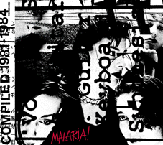
I know, I know, who doesn't. But really, I just found this! Fucking shit!
DAF documentary short
and this Malaria video! (thus pic above). Not my favorite song, but whatever. Ooh, wait, this live performance is way more interesting and a better song....
Oh, and if you don't know who DAF or Malaria is you are a loser. I mean it, a Total Loser.
(Mean comment inspired by a few recent comments field posts on certain poetry blogs aimed at "40 something's." like you are young, cool, or hip. Fucking poetry dork.)
Saturday, February 03, 2007
Memory deux
Josh Corey on Whitman:
"Rereading Song of Myself, I was freshly conscious of the poem as the document of a mystical experience, and the tension between such consummately individual experience and the radically democratic absorption and embodiment of the American polis attempted by the poem: a dialectic of enlightenment in the spiritual sense. Many of the other students were primarily impressed by Whitman's fantastic egotism, but I want to make a case for his radical humility, stemming from an intuition I have that spiritual enlightenment is born of the experience and embracement of one's own thoroughly ordinary and thoroughly mortal life. It's possible to mistake the speaker of Whitman's poem for some kind of superman, but when he claims, "And to die is different from what any one supposed, and luckier," I think the immortality he claims comes from accepting his share in the multitude, and not from some superior self-founded power (though he flirts with this only to find himself "on a verge of the usual mistake"). At least I suspect that's his drift."
Interesting that this resonates so with Wordsworth's The Prelude, which I've been reading for a class on Memory. I wouldn't say that Wordsworth is a "fantastic egoist" or "radically humble," but the relation between immortality and democratic multiplicity is certainly there. That Whitman can impress us with a sense of "radical humility" because he embraces ordinary, mortal life seems right to me. But there's a bit of a paradox or perhaps a difficulty here. What I wonder in terms of how memory functions is whether individual memory, the sense of the self in the past, is itself a "democratic" or democratizing impulse. Memory, as the recollection and re-experience of incidents that accumulate in the interior resources of our consciousness and may be retrieved by our interaction with the contingent world around us that in some way contains them, only has meaning if that individual experience can be "translated" as essentially recognizable by another. Thus the shock of pleasure and recognition when reading Proust. Thus the dual pleasure of reading--the idea that reading someone else's memories are not only comparable or resonant with our own but that, in fact, we experience them as our own in the moment of reading. Wordsworth's Kantian idealism seems crucial here--which I take to be more a result of Coleridge's influence than anything else. The sense that the artistic genius, even as he is a law unto himself, a unique measure of the capacity of nature and the human mind to be in harmony with one another is, in fact, a universal capacity, or potential. Genius is something we can experience, something we feel something about in relation to our own lives.
So what, exactly, does one experience by reading Wordsworth's attempt to immortalize his memories, to engage with the "genius" of and within the work? Is it just a confirmation of experience? Or rather, is it an easy confirmation? The leaps and juxtapositions of Wordsworth's lyric seem to belie any seamless relation between writer and reader. The pleasure of a text that focuses so primarily on memory, alongside of which we are confronted with Wordsworth's questioning of Enlightenment reason (at the same time that he relies on it), and the particularity of the historical and cultural moments that he writes of and within push this idea of democratic idealism to the limit. This is the "memory crisis" that Richard Terdiman writes of as the condition of modernity, which thus demands a writing style and form that engages this tension-- a tension produced by the desire to communicate for and to all at the same time that this is precluded by the opacity of the radical individualism upon which theories of modern democracy are built. The modern subject writing for and to the world (or at least for and to someone) may, in the end, merely confirm the radical particularity of experience as the only possible universal. (and how is that a universal?) The demands of universality cannot be met, they can only be experienced as a desire, at least within the liberal-democratic imaginary. Writing and memory intertwine as a longing to unite past, present, and future beyond the individual. Wordsworth's writing anxiety and his memory crisis are one and the same, yet he writes through (not beyond) them as they are the condition upon which both the failure and the success of the work are built. If he confirms the difficulty of memory and writing, and the impossible desire for a democratic idealism and universality, this series of negatives paradoxically brings great pleasure (to both Wordsworth as the narrator within the poem as well as the reader). It is, to paraphrase Geoffrey Hartman, a shift from a hope in Revolution to the belief in the revolutionary possibilities of hope.
"Rereading Song of Myself, I was freshly conscious of the poem as the document of a mystical experience, and the tension between such consummately individual experience and the radically democratic absorption and embodiment of the American polis attempted by the poem: a dialectic of enlightenment in the spiritual sense. Many of the other students were primarily impressed by Whitman's fantastic egotism, but I want to make a case for his radical humility, stemming from an intuition I have that spiritual enlightenment is born of the experience and embracement of one's own thoroughly ordinary and thoroughly mortal life. It's possible to mistake the speaker of Whitman's poem for some kind of superman, but when he claims, "And to die is different from what any one supposed, and luckier," I think the immortality he claims comes from accepting his share in the multitude, and not from some superior self-founded power (though he flirts with this only to find himself "on a verge of the usual mistake"). At least I suspect that's his drift."
Interesting that this resonates so with Wordsworth's The Prelude, which I've been reading for a class on Memory. I wouldn't say that Wordsworth is a "fantastic egoist" or "radically humble," but the relation between immortality and democratic multiplicity is certainly there. That Whitman can impress us with a sense of "radical humility" because he embraces ordinary, mortal life seems right to me. But there's a bit of a paradox or perhaps a difficulty here. What I wonder in terms of how memory functions is whether individual memory, the sense of the self in the past, is itself a "democratic" or democratizing impulse. Memory, as the recollection and re-experience of incidents that accumulate in the interior resources of our consciousness and may be retrieved by our interaction with the contingent world around us that in some way contains them, only has meaning if that individual experience can be "translated" as essentially recognizable by another. Thus the shock of pleasure and recognition when reading Proust. Thus the dual pleasure of reading--the idea that reading someone else's memories are not only comparable or resonant with our own but that, in fact, we experience them as our own in the moment of reading. Wordsworth's Kantian idealism seems crucial here--which I take to be more a result of Coleridge's influence than anything else. The sense that the artistic genius, even as he is a law unto himself, a unique measure of the capacity of nature and the human mind to be in harmony with one another is, in fact, a universal capacity, or potential. Genius is something we can experience, something we feel something about in relation to our own lives.
So what, exactly, does one experience by reading Wordsworth's attempt to immortalize his memories, to engage with the "genius" of and within the work? Is it just a confirmation of experience? Or rather, is it an easy confirmation? The leaps and juxtapositions of Wordsworth's lyric seem to belie any seamless relation between writer and reader. The pleasure of a text that focuses so primarily on memory, alongside of which we are confronted with Wordsworth's questioning of Enlightenment reason (at the same time that he relies on it), and the particularity of the historical and cultural moments that he writes of and within push this idea of democratic idealism to the limit. This is the "memory crisis" that Richard Terdiman writes of as the condition of modernity, which thus demands a writing style and form that engages this tension-- a tension produced by the desire to communicate for and to all at the same time that this is precluded by the opacity of the radical individualism upon which theories of modern democracy are built. The modern subject writing for and to the world (or at least for and to someone) may, in the end, merely confirm the radical particularity of experience as the only possible universal. (and how is that a universal?) The demands of universality cannot be met, they can only be experienced as a desire, at least within the liberal-democratic imaginary. Writing and memory intertwine as a longing to unite past, present, and future beyond the individual. Wordsworth's writing anxiety and his memory crisis are one and the same, yet he writes through (not beyond) them as they are the condition upon which both the failure and the success of the work are built. If he confirms the difficulty of memory and writing, and the impossible desire for a democratic idealism and universality, this series of negatives paradoxically brings great pleasure (to both Wordsworth as the narrator within the poem as well as the reader). It is, to paraphrase Geoffrey Hartman, a shift from a hope in Revolution to the belief in the revolutionary possibilities of hope.
Friday, February 02, 2007
Memory
Spaces of Remembering
So, if I dream I have you, I have you,
For all our joys are but fantastical.
John Donne, "Elegy X: The Dream" 6
Subscribe to:
Posts (Atom)