Saturday, September 01, 2007

AMM... MEV...OHM...Ah...


Cool music-y things:

The electronic improvisational ensemble MEV's blog.

Alvins Curran's (of MEV) website with interesting interviews, essays scores, etc. All the writings are of special interest not just for their musical knowledge or historical contexts, but because of the ways in which they show a musician's interaction with language. In other words, Curran is an interesting writer. For example Curran's short "Biography of Fredric Rzewski":

"Socrates buttonholed Rzewski in the Harvard yard and bluntly asked "Rzewski, why are you so contemporary?" Cage, appearing indignantly from behind a resonant mushroom, objected, "but Socrates, that's my line from the Norton Lecture IV." And Socrates, removing his dark glasses and thoughtfully putting his alto sax on a marble bench, returned: "dear sir, chance operations are only part of this existential mesostic, besides Rzewski's my main man." Then Rzewski, convulsed but elated by this cabal of "Pesci d'Aprile" and with a digital segue faster than MTV, pulled his right hand from under his left armpit and with it the crumpled score of his new opera Das Kapital and flung it - as if Discobolus whirling a frisbee - into the Charles River. When Zeus and Thoreau, both witnesses to this act, swooped down like a pair of mating osprey to grab the sopping score, they braked and split, when they saw the fisherman Martin Buber calmly humming a talmudic air as he reeled in this now fully baptized catch, thinking he'd caught a big carp. Whether this led to his famous book "Oy or Thou" we will never know but the wet opera and some years later the entire archive of the legendary roman legion MEV was tossed down the incinerator shoot in Rzewski's Washington Heights apartment building. A radical proceedure for drying damp music but nonetheless one which quickly reduced the entropy factor by 100% compared to having to perform or listen it. Some have described Rzewski's life as a kind of last month's Time magazine in a hospital emergency room, and others as a page from Plato's Parmenide - both equally incomprehensible and both equally promising a comprehensive understanding of all things. The origins are obscure (Rzewski himself having spent much of his life wondering where he came from) but Slavic scholars claim the word Rzewski refers to a protomusical form of improvisation practiced by pregnant women in regions of the Carpathian Mountains while the Ukranian school found that Rzewski is the Kabbalistic spelling for a secret group of Medieval anarchists who invented the Yiddish language. In any case all agree the the word means peace and trouble, often at the same time. Now to the facts. In l969 Steve ben-Israel was leaving on a special Living Theater mission for Cuba to encourage the Cigar industry there to return to rolling their own; before he left he gave Rzewski a piece of plate glass in the shape of a piano which Frederic (as he was known to his friends) applied a contact mike to and immediately taught himself to play. It was here, that Rzewski heard "music" for the first time, because he was making it as if for the first time and in those unifed times that meant for both him and everyone else. Hence, MUSIC was born in a dank, smelly cavernous old foundery in Transtiberium (now known as the Trastevere quartier of old Rome). This was exactly 31 years after Rzewski himself was born in Westfield Mass. slightly to the southeast of his father's Pharmacy. His childhood was aided by normal polish-american food, the radio and a desire to remake the world from scratch, to do this he helped his father fly to work gathered mushrooms, with his brothers and sisters and sat at the family piano thinking what a strange and mysterious sound was that of the word Chopin (Show Pan) - to be sure, just another polish-american composer like himself, like he would become."

From the music site Furious or Perfect Sound Forever an overview of the compilation "OHM- The Early Gurus of Electronic Music," which has treasure trove of extra writings and interviews not included in the original 3cd set.

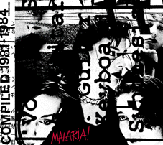
And... holy crap! the image above is the album cover for the ensemble --Gruppo di Improvvozasione Nuova Consonanza's album "Nuova Consonanza," which included Ennio Morricone and Fredric Rzewski, among others.

Rad...

Thursday, August 30, 2007

"Reading Arendt in Caracas"

I'll admit I probably should be more suspicious of Hugo Chavez than am. It's just so rare to hear a politican even mention let alone advocate against poverty and for socialized anything these days it's difficult not to forgive him his, um, cult of personality, machismo characteristics. "Anti-chavistas" are even more deserving of suspicion, in my estimation. So when I came across this article by Arendt's biographer, Elisabeth Young-Bruehl, in The Nation, I was uncertain what to expect. The clash would be, to my mind, that liberalist admiration/appropriation for Arendt's political philosophy-- in Venezualan politics-- would make me sad in that it would force me to acknowledge, as it made present--an unresolvable conflict between my post-Marxist leanings and my admiration for Arendt's philosophy.

Actually, the essay is a pretty good balancing act, which of course could be just another way of perpetuating a false objectivity--"fair and balanced"-- in the service of cowardice, but I also think Young-Bruehl is trying to see "both sides" in a way that would make Arendt proud.

I found this anecdote to be amusing/illuminating: "On the day of my arrival at Simon Bolivar University, El Presidente discoursed on TV for an interminable half-hour on Antonio Gramsci before turning to a mixture of grandiose self-reference and policy wonkese."

Check out how that "interminable half-hour" is a little slap for American audiences and politicians. And she manages to criticize Chavez too with the "grandiose self reference." Nice.

But I do have to say-- can you imagine George Bush, or, fuck, Hillary Clinton even mentioning Antonio Gramsci? I'd take grandiose self-refernece for a dollop of Gramsci any day.

Well, maybe...

What Young-Bruehl manages to suggest is that Arendt's vision of--and insistence on-- the political realm is broader than any sense we now have of sclerotic two-party democracies, which merely serve to uphold (and cover over) economic injustices. At least the way I read Young-Bruehl, there's a possibility that the folks that brought her to Caracas (the anti-chavista , pro-Arendt factions) didn't get the response (or the support) from an Arendtian that they expected. But then, neither did the pro-chavistas.

I love it when everyone walks away partly unsatisfied.

Wednesday, August 29, 2007

The Lord of the Rings (of Boredom)


I tried to watch Lord of The Rings the other night since it was on cable and I never managed to see it in theaters. I really really tried......it was just impossible to sit through. I did find this lass to be very yummy, tho (no idea who the actress or the character is).

Tuesday, August 28, 2007

An Academic Travesty

I''m both glad and horrified that I happened to come across Mark Scroggins's blog post on Norman Finkelstein's tenure denial. I wasn't familar with either the tenure issue or Finkelstein's scholarly work. (Well, at least not *that* Norman Finkelstein , as Scroggins mentions, tho I'm a fan of the *other* Finkelstein.) DePaul Finkelstein's work, as far as I can tell, is so in line with things I've been thinking about/drawn towards I'm a bit shocked--in a good way. I'm going to leave the tenure issue aside. For now, I simply want to post an excerpt from Finkelstein's memorial article on Raul Hilberg in order to point out (really, to remember for myself) two issues he mentions which have become very important to my sense of how one thinks of the Holocaust: 1) the concept of the assembly-line operation that set in motion the destruction of the Jews was developed by Hilberg and 2) the stark, careful (scholarly?) language Hilberg used to describe his subject contributes to the intensity of its meaning at the same time that it points to its banal facticity, and this to my mind aligns with Reznikoff's "ethics" of representation which works as a method by blurring the line between historiography and poetics:


"Hilberg's reputation for mastery of the primary sources was such that my former coauthor (and an authority in her own right on the Nazi holocaust) Ruth Bettina Birn feared their first meeting: no mortal being, she thought, could have stored so many Nuremberg Tribunal documents in his brain. The magnitude of Hilberg's achievement is hard to appreciate today because the scholarly breakthrough has passed into commonplace. His sequential-chronological account of the steps pressing ineluctably from the Nazi definition of Jews to their expropriation, massacre, deportation and assembly-line extermination has been assimilated into the infrastructure of all subsequent scholarship.

Stylistically Hilberg's study might be said to be the opposite of current Holocaust fare: short on adjectives and adverbs such that when he reaches for one it packs unusual intensity. Apart from professional discipline his dry-as-dust rendering was perhaps also meant to capture the desiccated esprit of the bureaucratic - dare I say banal? - process through which millions of Jews were shoved along to their deaths

Friday, August 24, 2007

Lightning Bolt - The Power Of Salad And Milkshakes

I can't believe this whole doc is on Youtube. How awesome!

Wolf Eyes at Analog Shock

Ah, the good ole' days.... and Nate w/ short hair.

Thursday, August 23, 2007

Required reading

Part 1 of two fantastic posts from Ghost in the Wire on Baudrillard and Heidegger. My only beef being the idea that the Lacanian "Real" is somehow equatable or can merely be translated as "reality. That seems not at all right, or at least needs more explication. But whatever, it's a very clarifying read.

Queer Arts


The David Wojnarowicz page at Queer-arts.org is great.


And let us not forget Felix Gonzalez-Torres...
At one time I had some of these blue candies--taken from a pile at the Corcoran in DC (I believe), along with a few big sheets of white paper with gold lettering. Unfortunately, I ate the candy and somehow lost the sheets of paper, which I had intended on framing and hanging in my house. I suppose that's all as it should be; I just wish I could remember what they said.

Sophie Calle / French Pavilion / 52nd Venice Biennale 2007

I Heart Sophie Calle

Wednesday, August 22, 2007

"Poetry and Contingency"

From and essay by Michael Palmer:

"Kant thought he was honoring art when among the predicates of beauty he emphasized and gave prominence to those which established the honor of knowledge: impersonality and universality. This is not the place to inquire whether this was essentially a mistake; all I wish to underline is that Kant, like all philosophers, instead of envisaging the aesthetic problem from the point of view of the artist (the creator), considered art and the beautiful purely from that of the “spectator,” and unconsciously introduced the “spectator” into the concept “beautiful.” It would not have been so bad if this “spectator” had at least been sufficiently familiar to the philosophers of beauty - namely as a great personal fact and experience, as an abundance of vivid authentic experiences, desires, surprises, and delights in the realm of the beautiful! But I fear that the reverse has always been the case; and so they have offered us, from the beginning, definitions in which, as in Kant’s famous definition of the beautiful, a lack of any refined first-hand experience reposes in the shape of a fat worm of error. “That is beautiful,” said Kant, “which gives us pleasure without interest.” Without interest! Compare with this definition one framed by a genuine “spectator” and artist - Stendhal, who once called the beautiful une promesse de bonheur. At any rate he rejected and repudiated the one point about the aesthetic condition which Kant had stressed: le désinteressement. Who is right, Kant or Stendhal?"

Read the rest...

Tuesday, August 21, 2007

Jacques Tati - PLAYTIME

A favorite scene from a favorite movie.

Sunday, August 19, 2007

Medieval Memoria

I feel like if I go far enough into theories of memory I will come out on some other shore having truly understood something. But there's no end to memory....

Despite the title of this post, I can't claim any knowledge of medieval memory. But as I was reading Mary Carruthers's and Frances Yates's selections in Theories of Memory: A Reader (eds. Michael Rossignton and Anne Whitehead) I found an interesting link to my argument (or, more like, a more coherent and informed sense of some feeble idea I've been struggling to articulate) on Reznikoff's long poem Holocaust and the issue of memory. The introduction to Carruthers explains: "The early medieval Memoria informed a conception of reading as 'tropological'; this is reading which turns 'the text onto and into one's self'. Originality and imagination are of less value than a good memory, which enables a reader to internalise another's work. The reader has to 'digest' what they are reading, placing it so securely in their memory that they effectively become its 'new author'. Whereas we consider such assimilation unethical, an example of 'plagiarism' or the theft of intellectual property, in the monasteries of the Middle Ages and Renaissance, it was conceived rather as an ethical dialogue between memories, the sharing and preservation of communal wisdom" (23).

It would be interesting to see the ways in which 'tropological memory' plays out in Reznikoff, (something which I will (or hope to) explore further in a bit) especially as it might be seen as both a device that constructed the work and as a reading practice that brings the experience of the text into proximity. What I find interesting in terms of the idea of proximity is that there's a sense when one reads Holocaust that it is too close--it gets under ones skin in a way that precludes, in fact, making it ones own. Yet I think, for Reznikoff, his approach to the archival works he was condensing, selecting, transforming, entailed a process or method that allowed him to keep memory in proper proximity, while at the same time conveying to the reader its affective and cognitive resonance. This all connects in my mind to the phenomenological approach of Paul Ricoeur in his text Memory, History, Forgetting, where the "duty of memory" approaches its most significant ethical task, i.e., justice. For Ricoeur, the question of the proper use of memory is directly related to its necessary application in the field of justice, for, despite all of the uses and abuses it gives rise to, it is in the field or arena of justice that the individual memory transforms itself into a collective task, or, more precisely, a task performed for the sake of both the individual and the collective. [Of course, mention of the term 'use and abuse' reminds one of Nietzsche's essay "On the Use and Abuse of History for Life," which Ricoeur does mention, but since I don't have the text here with me I can't accurately describe the significance of Nietzsche's essay on Ricoeur's analysis of the abuses of memory as they pertain to the duty of memory and justice. More on that later as well.]

The issue of distance and proximity in relation to a traumatic text, a text which may, either during its construction (for the author), or as a finished product, (for the reader) be experienced as at least somewhat traumatizing seems to require what we might call a tropological method' or approach. This method would 'digest' its subject carefully, selectively, 'ruminating' for neither too long nor for too short a time. Yet there seems to be a difficulty here in terms of balance. The issue of 'managing' and 'organizing' the relation between self and other in terms of this tropological approach seems to mean that 'turning the text into oneself', i.e., memorizing a text until it 'becomes' a part of one's own psyche and memory would 'subectivize' the text into oblivion. Perhaps for the medievalist, since this incorporation was managed through certain techniques, this 'taking into oneself'' is a form of transformation whose goal is a kind of strict accuracy. For instance, the medieval Quintillian recommended re-reading, copying out, annotation and recitation, which were all thought of as proceses of rumination and digestion but whose intention or goal is a level of accurcy and fedility to the text. This is, in effect a kind of incorporation (the Host as the body of Christ, trans-substantiation, etc) which might more accurately be said to transform the reader into the text rather than the other way around. Or at least, one might say that there is a kinship or relation established with the text that, through proper mnemonic techniques, turns the text into a kind of 'second nature' for the reader or memorizer in such a way that the text's meaning and the readers's own moral understanding of the world now unconsciously inform one another.

This in turn points to the ways in which the tropological approach to texts is fundamentally a rhetorical exegesis that ascribes to them a moral dimension. That is the tropological method, as a proper form of incorporation (memorization) not only finds the moral dimension in an analysis of the text, it also implies that there is a moral dimension to the act of memorization itself. What I find intriguing about this "turn" is that there are two necessary components to this transformative incorporation as a moral or ethical act. What I'll call 1) a proper proximity, and, 2) forgetting, which is an inevitable component of this incorporation.


OK, more tomorrow. (Unless I forget!)

Saturday, August 18, 2007

Quote for the day


"Be free my friends. One for all and all for me, and me for you, and three for five, and six for a quarter" --Groucho Marx in "The Cocoanuts"

Monday, August 13, 2007

Dialogue

St Francis: So I think: it's a failure to realize. How much more dangerous to remain in a "light-hearted" state of mind than to focus on negative possibilities.

The Buddha: A sick power struggle.

St Francis: What he doesn't know. A punishment by an outside that turns back around to bite him in the ass. Therefore there is guilt. And no outside.

The Buddha: Lack of guilt is a false innocence. A domesticity.

St Francis: Sacrifice. Demands. Denial. Coffee cups and soup spoons. Trips to the market. Walking in the city. Closed doors. Phone calls. Works of literature performed as abstract revenge, which paradoxically hold the inevitability of disaster in permanent abeyance.

The Buddha: A revenge fantasy. A lie. Fictional subjectivities collapse into one another's violent desires. But there is only one writer of fiction. Or rather, oneness expands and implodes into a multiplicity of fictions. The writer selves?

St Francis: There are 2 ways of looking at things: realistically and phantasmatically. Yet they are not opposed.

The Buddha: Like structure and non-structure?

St Francis: A structure of opposites, if it is composed of opposing structural possibilities, collapses into profusion. There can be more than one nothing. More than one mise-en-abyme.

The Buddha: OK, The Buddha and St Francis of Assisi face off. A small, stone lion guards over the showdown, obliquely. St Francis occupies one side of a miniaturized diptych-- gold-painted, weathered, medeival. "Lord make me an instrument of Thy Peace." The Buddha stares into the gap between, while the stooped, haloed Saint pronounces a permanent blessing over what looks to be a pile of rocks, but might actually be a gathering of small animals. A cloaked, flattened figure to his (no, the observer's) left looks on. Cloaked figure vs. carved stone lion. We always need, and thus create, observers for our own delusional scenarios.

St Francis: I, on the other hand, have always been envious of "creative types." I can't stand it when people turn their pain into art. I mean, who do they think they are?

The Buddha: Manipulation is the worst form of flattery. Aphorisms are confining.

St Francis: Even to himself?

The Buddha: Yes.

St Francis: I can never decide if generosity is selfish or not. But I am suspicious by nature, so I leave this open to doubt. If one is never sure of another's motives?

The Buddha: In my opinion, the good is outweighed by the bad. Of course, people often mistake this for pessimism, but it's really just an eternal theme, and, therefore, a doubt is an opening. If you understood me, you'd focus on my positive characteristics. So far, only one person has figured this out, though it proved to be too much of an effort.

St Francis: How many people feel their name doesn't suit them?

The Buddha: I don't want to "include history."

St Francis: The longer I sit here the more I can feel myself contract and expand. The ideals of surrealism have always attracted me more than the results and I have a hard time noticing tense shifts, so when I find myself in a pleasurable flow state, it's already too late.

The Buddha: The world is not that insufficient. Recalcitrants. Cats. Ashtray. Words are not objects; they're barely even words.

St Francis: I'm not trying to: include, erase, describe or depict. There's no hope for: understanding, resolution, or reasurance. Narrative has never been my strong suit. I do not long for: beauty, clarity, or enlightement. "No hugging. No learning." I have never liked nor understood the word "joy." The issue of gender is something I often discuss and deploy as a weapon, but it's really a non-starter.

The Buddha: A mere stop-gap for lonelines? A tone of contention? I see the uselessness. The thought of licking his ass turns me on. I rarely. Delight. Dysmorphia.

St Francis: The lower the object the higher I feel, that's why we called it "The Tundra."

The Buddha: Narrative vs. Prose?

St Francis: So I turned it up and drove fast, holding my breath down the long, endless road that ran alongside a pasture of stone and iron, all the while staring straight ahead and gripping the wheel, and at the same time noticing, or rather feeling, a peripheral presence, until it all fused into one.

Friday, July 20, 2007

I want to go to Wendover

From the Center for Land Use Interpretation. (The writing her sounds a bit like Robert Smithson's. Go figure.):

"Wendover is the name of a small town on the edge of the mountains and the salt flats. It is located at the point where the Basin and Range of Nevada spill into the Great Salt Lake Desert of Utah. In appearance, it resembles the Arctic: a remote place of barren rock and snow-white alkali. Wendover was established because it was out of the way, a place where people wouldn't want to live. Though there was a small community to service the railroad established at Wendover early on, the first major modern settlement was an airbase, built at the beginning of World War II to train bomber crews (including the crew of the Enola Gay). Through the 1940's and 50's, the land around Wendover was bombed, strafed, and dusted with chemical and biological agents.

"Today, though the region is remote, it is intensely industrialized. Military operations continue in the 3 million surrounding acres of restricted-access lands. Large-scale industries remove salt, and process minerals from the flats, and copper and gold are extracted from giant pits in the mountains. Hazardous waste facilities and obsolete chemical weapons have found refuge in the remote, nearly uninhabitable landscape.

"In Wendover itself, an interstate highway passes through town, making Wendover a pit stop for travelers from San Francisco to New York City, and points in between. The town is bisected by the state line creating two distinct halves: The gambling boom town of Nevada's Wendover, and the stagnated Utah half, dominated by the cluttered remains of the Airbase, which was abandoned by the military in 1977.

It is at this former airbase where the Center for Land Use Interpretation has established the Wendover Residence Program and this segment of the American Land Museum.

Thursday, July 19, 2007

New favorite blog

by my new favorite academic: Rei Terada.

Monday, July 16, 2007

diagnosis of the avant garde?

"People decide that art is either dead or immortal, but no one wants to admit that it might be a little sick."

Read more here.

What a girl wants

1. fresh garden tomatoes, sprinkled with sea salt and olive oil

2. a trip to the zoo

3. a new bottle of perfume...either Route du Thé (from Barneys) or Fracas by Robert Piguet

4. oral sex

Friday, June 22, 2007

A Favorite Poem

The Pattern

As soon as
I speak, I
speaks. It

wants to
be free but
impassive lies

in the direction
of its
words. let

X equal X, X
also
equals X. I

speak to
hear myself
speak? I

had not thought
that some-
thing had such

undone. It
was an idea
of mine.

--Robert Creeley


Thursday, May 10, 2007

TO LIVE AND SHAVE IN LA detroit 2004

OK, just found out To Live and Shave in LA are playing this Thursday at the Mocad. Their first time through since 2004 when I saw them at Detroit Art Space. (Thus, the youtube video.) I think they'll be playing w/o the killer lineup of that set--sans Mark Morgan, Don Fleming, and Andrew WK. I was so blown away by them at that gig I'm afraid of the letdown this time around. Nothin's ever as good the second go-round. Plus, I tend to think of them so differently after getting to know Mark, whereas at that show, I hadn't yet met Mark, tho I had had a few very fun encounters with Rat Bastard when the Laundryroom Squelchers stayed at my house. Crazy! Hearing Mark discuss Tom and touring with that group was very amusing, but there's a way in which not knowing what the fuck I was seeing and hearing that first time will, I think, be diluted by my supposed "knowledge." I don't mean to suggest that I have any real insight into this rag-tag "band," I just mean that I am in love with experiences of coming across something that blows you away with its shear "what the fuck?"ness. I recall feeling absolutely exuberant, joyous after that DAS show. It was a really quite brilliant art/love fest. And so I wonder if, minus that lineup and considering the sense that I know--to a *certain* extent--what to expect...will it be a letdown? I'll let ya know...

Sunday, May 06, 2007

A tidbit on Reznikoff and Objectivism

from LS Dembo's The Monological Jew:

"Reznikoff, for instance, cites a Chinese text of the eleventh century in which it is argued that "Poetry presents the thing in order to convey the feeling. It should be precise abvout the thing and reticent about the feeling." This, Reznikoff tells us, was a very accurate expression of what the Objectivists were trying to do. Later he elaborated on the term, at the same time describing the poetics of Testimony, a two-volume survey of the everyday cruelties of American Life: by "objectivist I suppose a writer may be meant who does not write directly about his feelings but about what he sees and hears; who is restricted almost to the testimony of a witness in a court of law; and who expresses his feelings indirectly by the selection of his subject matter" (117).

Right up my philosophical, interdisciplinary alley

From Urbanomic: Philosophical Research and Development:


URBANOMIC proposes to pursue fundamental research and development in logical ontological and abstract matters, outside any institutional framework, with no thematic disciplinary or methodological constraints.
We seek to support a renewal of philosophy through a vigorous repudiation of its insidious contemporary enemies. Firstly, a theorism which reaches from magazine columns to the exalted heights of 'culturally-engaged' academia, the two being distinguished only by the level of indulgence afforded to the authors' interminable interpretative speculation (magazine readers at least having the sincerity of their attention spans). Secondly the fatal overspecialisation and delimitation of philosophy in its academic setting.
Certainly the sphere of popular culture acts as the unconstrained experimental testing ground for deterritorialised symbolic discourses and new sensations. Equally - despite the depredations of the imperatives of business and management - the university is not yet entirely stripped of its ability to provide, under cover of its nominal traditional purposes, a support for independent thought. However in general in the latter, the productive capacity of abstract thought finds itself asphyxiated by supposed disciplinary self-sufficiency, reinforced by the socialisation apparatus of academic propriety. Whereas in the former a superficial relation of 'thought-provoking' relevance demands the novel application of generalised 'theories' to popular topics, destining thought to become exactly as reactive and inconsequential as its 'objects'.
We propose that philosophy can indeed break away from these malign attractors and reclaim a certain autonomy of purpose, but that the potency required for this escape can only be generated by philosophy's maintaining porous boundaries with other disciplines: art, music, science, mathematics...

Not in a relation of application, where philosophy would theorise external 'subjects' by employing its historical resources; but by enriching and expanding these latter through the rigorous and selective analysis and interrogation of local ontologies and vernacular logics.
Given that we oppose equally the wholesale appropriation of abstract thought by the allied postmodern pseudo-theorisms of therapy, capitalist apologetics and management 'science', why do we borrow a trope from industry to describe our activity? By 'Research and Development' we mean to affirm that we do not believe that philosophy in the present must necessarily limit itself to a mere exegetical and scholarly status. Philosophy - as methodical investigation into abstract matter(s) - enhances its pertinence, and highlights its problematic relation to the sciences, by free recourse to abstract-empirical experimentation, supported by suitable technologies. Philosophy would thus conduct materialised 'thought experiments' outside of the methodological presuppositions which circumscribe scientific disciplines. Even if we mean to problematise and question the nature of such an experimental practice, we do not propose to postpone experimentation indefinitely in lieu of supposedly grounding principles, but rather, in addition to ongoing theoretical work, to conduct open-ended experiments the form of whose outcome is not presupposed (amongst which we count the journal COLLAPSE and the URBANOMIC project itself).
However soberly and prudently it may be necessary to proceed, the involuntary passion for thought that is philosophy is always delirious in so far as at every turn it flees from the forces that prescribe (whether in the name of history or contemporaneity, of personal or institutional authenticity, of romantic passion or academic hard-labour) the path it must take.
____

and to subscribe to their journal publication Collapse

Friday, April 27, 2007

Turkey Vulture?


I swear, I saw a turkey vulture outside our office window yesterday. Luckily, a fellow grad student, Jill, was in her office next door and she confirmed the sighting, otherwise I'm sure everyone would claim I mistook a lousy pigeon for a freaking vulture! But this thing flapped out of the sky and initially perched atop one of the gargoyle-like heads that jut out above the 11th floor windows, until he eventually moved to one of the windowsills a few floors up. Can you imagine gazing out your office window thinking you're about to take in the pleasant, calming scene of a distant city skyline spread before you and instead coming face to face with a vulture? Awesome!

Thursday, April 26, 2007

The Holocaust and the Book

Just came across the following review on Jstor and find it *very* intriguing...


The Holocaust and the Book: Destruction and Preservation. Edited by Jonathan Rose. Amherst: University of Massachusetts Press, 2001. 314 pp. $39.95. ISBN 1-55849-253-4.
This book of fifteen essays, with an introduction by Jonathan Rose, is a testimonial to the importance of the written word in the preservation of a culture and the necessity to record events under even the most harrowing conditions. For readers of Libraries & Culture who are already well informed about libraries and archives in times of war and revolution, The Holocaust and the Book can only deepen their appreciation of the written word and the often heroic efforts involved in its safekeeping.
Rose notes in his introduction that "the story of the Six Million is also the story of the One Hundred Million," the estimated number of books destroyed by the Nazis in Europe over a twelve-year period (1). Beginning with the book burnings in 1933, the essays describe the relentless destruction of Jewish books in Germany, Rome, Salonika, the U.S.S.R., the Netherlands, Poland, Vilna, and Bosnia, presenting a variety of approaches to the topic.
Part 1, "Destruction and Preservation," contains five essays: "The Nazi Attack on 'Un-German' Literature, 1933-1945" by Leonidas E. Hill; "Bloodless Torture: The Books of the Roman Ghetto under the Nazi Occupation" by Stanislao G. Pugliese (see an article on the same topic in L&C 34, no. 3 [summer 1999]); "The Confiscation of Jewish Books in Salonika in the Holocaust" by Yitzchak Kerem; "Embers Plucked from the Fire: The Rescue of Jewish Cultural Treasures in Vilna" by David E. Fishman; and "'The Jewish Question' and Censorship in the U.S.S.R." by Arlen Viktorivich Blium. While the events chronicled in these essays, notably, the Nazi book burnings, have been described before, the authors have dealt with their topics in a fresh way that should appeal to even seasoned historians.
Part 2, "Culture and Resistance," offers three fascinating essays on somewhat lesser known aspects of the topic. "The Secret Voice: Clandestine Fine Printing in the Netherlands, 1940-1945" by Sigrid Pohl Perry surveys several of the major clandestine presses operating during the period and includes some interesting photos. "Reading and Writing during the Holocaust as Described in Yisker Books" by Rosemary Horowitz describes the "memorial" books using source materials written during the war, prepared by immigrant associations to commemorate their communities. The Yisker books drew from diaries, illegal publications, letters, and records kept by Jews in the ghettos, the camps, and in hiding and offer much information about Eastern European Jewish life. The last essay, "Polish Books in Exile: Cultural Booty across Two Continents, through Two Wars" by Sem C. Sutter concerns the evacuation of priceless books and manuscripts that traveled from Poland to France to Quebec and finally back to Poland in 1959.
The title of part 3, "The Reader in the Holocaust: Documents," does not prepare us for the often moving accounts found in the four essays. Dina Abramowicz [End Page 273] writes on the daily difficulties of ghetto life in her essay, "The Library in the Vilna Ghetto," in which the presence of a library represented a rare and peaceful space for reading and reflection; the "Annual Report of the Vilna Ghetto Library, 1941-l942" is included. The second essay, "Library and Reading Room in the Vilna Ghetto, Strashun Street 6," by Herman Kruk, also deals with the matter of readership in the ghetto library. The next essay, "When the Printed Word Celebrates the Human Spirit," was written by Charlotte Guthmann Opfermann, a survivor of Theresienstadt who briefly describes her experience in the camp and the lack of time to read much of anything. Annette Biemond Peck closes the section with her brief essay, "Crying for Freedom: The Written Word as I Experienced It during World War II," about her wartime reading in Amsterdam.
Part 4, "Past and Present," begins with an interesting and provocative essay by John Rodden entitled "Zarathustra as Educator? The Nietzsche Archive in German History." This example of reception history, and the longest essay in the book, deals with the issue of cultural history in Germany, perhaps, as the author states, "a land with too much history" (251). He begins his essay in 1991 in Weimar, home of the Nietzsche Archive, and ranges back through Nietzsche's lifetime and his works before moving on to World War II and the Holocaust and finally to 1991 where he began—a thought-provoking journey. This essay is followed by Andras Riedlmayer's "Convivencia under Fire: Genocide and Book Burning in Bosnia," which reminds us that, even in the 1990s, books as cultural symbols continued to be destroyed. The essay briefly describes the history of book destruction in Bosnia over the last six centuries.
Finally, part 5 provides a useful bibliographic survey, "Jewish Print Culture and the Holocaust" by Joy A. Kingsolver and Andrew B. Wertheimer. It is divided into nine sections: an introduction, "Libraries and Archives," "Publishing," "Alfred Rosenberg and the Einsatztab Reichsleiter Rosenberg," "Jewish Cultural Reconstruction," "Documentation Centers and Archival Resources," "Holocaust Denial and Libraries," "Yisker Bikher," and "Additional Topics." This bibliographic essay is followed by "Notes on Contributors" but, unfortunately, not by an index. However, each of the essays is well documented with notes and, in some cases, bibliographies (in addition to the inclusive bibliographic essay at the end of the book). The use of judiciously selected photos, many courtesy of the National Archives, USHMM Photo Archives, serves to graphically evoke the period under consideration.
While The Holocaust and the Book is an examination of a dark period in history, it is as well a tribute to those who worked to preserve their written heritage throughout and beyond that period. The editor is to be commended for presenting a well-organized and very readable volume of diverse essays, only some of which grew out of the 1996 Drew University conference on "The Holocaust and the Book."

Sunday, April 22, 2007

Who Knew?

Man, the Holocaust is depressing... writing a paper about Reznikoff's Holocaust is really causing me to rethink my focus on trauma and representation. I mean, its super interesting, but I feel like I'm in a fog all day after working on it. I know this sounds fairly flippant but really, I'm starting to think I should focus my future eforts on works a little less dark. I've had enough pain and sadness in my life, why do I need to emerse myself in it as a career? Yet, I find I'm continually drawn to issues of historical trauma, like it's somehow my responsibilty to face them, work on/through them. I've always felt (well, since i can remember) that I was sort of the memory depositor for my family. Like I have been assigned the task of carrying the lost memories of my family (most of whom are dead now), and this sense of responsibility has grown to include the choices and issues I've been focusing on in my academic work. There's this feeling I have that I can't do anything but work to redeem the past--and as grandiose as that may sound, it's not meant to. I don't mean the Past, I mean, like Reznikoff, all the little moments that make up a person's life, all their memories, are what must be--but can never be--preserved. I now have memories that were once my mother's memories--of dresses she wore, boys she dated, fights she had--these memories that filled in my sense of who she was, what she cared about; and I have memories of my grandmother's memories--her passage to America from what was then Autria-Hungary, her struggle to "make it" in Detroit, her shame at her reading disability as a young girl, for which she was beaten and humiliated, since that was, of course, not known in the early 1900's as what we now know to be dyslexia. I feel responsible to and for these memories of others, and I feel haunted and burdened by them at the same time. In some major and terrible way they are what comprises my own sense of self; I don't know why I have always been drawn to other's memories, perhaps because they were the way I found to connect as a child who came into a family that was crumbling when I entered it--the past was what was most alive and enjoyable, it made my relatives happy to talk about the past...well, for the most part. Ah, this isn't helping.....

Friday, March 30, 2007

Suicide - Ghost Rider

One of the best bands of alltime.

Cabaret Voltaire - Nag Nag Nag

More for Yes...

Brigitte Bardot:

Yes!

Tuesday, March 13, 2007

Archive and memory

This is pretty much a "note to self" post.

Derrida notes a distinction, in terms of archiving and memory, between "anamnesis," "mneme" and "hypomnema." Anamnesis is, acording to the OED: "a. The recalling of things past; recollection, reminiscence. b. Liturgiol. That part of the Eucharistic canon in which the sacrifice of Christ is recalled and pleaded." The definition of mneme, on the other hand, is: "The capacity which a substance or organism possesses for retaining after-effects of experience or stimulation undergone by itself or its progenitors." And, finally, hypomnema is (not from the OED, from Wikipedia) a form of material or written memory, in other words, a "technology" of memory. Thus the "archive" is a technology of memory that is neither embodied nor voluntarily spontaneous and related to presence or speech, nor is it immaterial and abstract. It is, precisely, I think, a mediating or prosthetic function/extension that constitutes what can be remembered (re-membered as in put back together, constructed) in the first place. We can see the link here, from Derrida's work in Of Grammatology to Archive Fever. The archive is the "groundless ground."

from Mal d'Archive, Une Impresion Freudienne: "[T]he question of the archive is not, I repeat, a question of the past, the question of a concept dealing with the past which already might either be at our disposal or not at out disposal, an archivable concept of the archive, but rather a question of the future, the very question of the future, question of a response, of a promise and of a responsibility for tomorrow. The archive: if we want to know what this will have meant, we will only know tomorrow. Perhaps. A spectral messianicity is at work in the concept of the archive and like religion, like history, like science itself, this ties it to a very singular experience of the promise."

Yay!

Monday, February 19, 2007

Stereolab performing Emporer Tomato Ketchup

Oh, I miss Mary Hansen.

Damon and Naomi I Dreamed of the Caucasus

This is so nice. Made me happy.

Comets on Fire

My Bloody Valentine - Knows When

Oh my. This really sends me back. I can't stop myself.....

big black -

Spacemen 3 - Hypnotized (Full Version)

A few trips down memory lane....

Galaxy 500

I don't wanna stay at your party
I don't wanna talk with your friends
I don't wanna vote for your president
I just wanna be your tugboat captain

There's a place I'd like to be

Monday, February 12, 2007

I heart youtube


I know, I know, who doesn't. But really, I just found this! Fucking shit!

DAF documentary short

and this Malaria video! (thus pic above). Not my favorite song, but whatever. Ooh, wait, this live performance is way more interesting and a better song....

Oh, and if you don't know who DAF or Malaria is you are a loser. I mean it, a Total Loser.

(
Mean comment inspired by a few recent comments field posts on certain poetry blogs aimed at "40 something's." like you are young, cool, or hip. Fucking poetry dork.)

Saturday, February 03, 2007

Memory deux

Josh Corey on Whitman:

"Rereading Song of Myself, I was freshly conscious of the poem as the document of a mystical experience, and the tension between such consummately individual experience and the radically democratic absorption and embodiment of the American polis attempted by the poem: a dialectic of enlightenment in the spiritual sense. Many of the other students were primarily impressed by Whitman's fantastic egotism, but I want to make a case for his radical humility, stemming from an intuition I have that spiritual enlightenment is born of the experience and embracement of one's own thoroughly ordinary and thoroughly mortal life. It's possible to mistake the speaker of Whitman's poem for some kind of superman, but when he claims, "And to die is different from what any one supposed, and luckier," I think the immortality he claims comes from accepting his share in the multitude, and not from some superior self-founded power (though he flirts with this only to find himself "on a verge of the usual mistake"). At least I suspect that's his drift."

Interesting that this resonates so with Wordsworth's The Prelude, which I've been reading for a class on Memory. I wouldn't say that Wordsworth is a "fantastic egoist" or "radically humble," but the relation between immortality and democratic multiplicity is certainly there. That Whitman can impress us with a sense of "radical humility" because he embraces ordinary, mortal life seems right to me. But there's a bit of a paradox or perhaps a difficulty here. What I wonder in terms of how memory functions is whether individual memory, the sense of the self in the past, is itself a "democratic" or democratizing impulse. Memory, as the recollection and re-experience of incidents that accumulate in the interior resources of our consciousness and may be retrieved by our interaction with the contingent world around us that in some way contains them, only has meaning if that individual experience can be "translated" as essentially recognizable by another. Thus the shock of pleasure and recognition when reading Proust. Thus the dual pleasure of reading--the idea that reading someone else's memories are not only comparable or resonant with our own but that, in fact, we experience them as our own in the moment of reading. Wordsworth's Kantian idealism seems crucial here--which I take to be more a result of Coleridge's influence than anything else. The sense that the artistic genius, even as he is a law unto himself, a unique measure of the capacity of nature and the human mind to be in harmony with one another is, in fact, a universal capacity, or potential. Genius is something we can experience, something we feel something about in relation to our own lives.

So what, exactly, does one experience by reading Wordsworth's attempt to immortalize his memories, to engage with the "genius" of and within the work? Is it just a confirmation of experience? Or rather, is it an easy confirmation? The leaps and juxtapositions of Wordsworth's lyric seem to belie any seamless relation between writer and reader. The pleasure of a text that focuses so primarily on memory, alongside of which we are confronted with Wordsworth's questioning of Enlightenment reason (at the same time that he relies on it), and the particularity of the historical and cultural moments that he writes of and within push this idea of democratic idealism to the limit. This is the "memory crisis" that Richard Terdiman writes of as the condition of modernity, which thus demands a writing style and form that engages this tension-- a tension produced by the desire to communicate for and to all at the same time that this is precluded by the opacity of the radical individualism upon which theories of modern democracy are built. The modern subject writing for and to the world (or at least for and to someone) may, in the end, merely confirm the radical particularity of experience as the only possible universal. (and how is that a universal?) The demands of universality cannot be met, they can only be experienced as a desire, at least within the liberal-democratic imaginary. Writing and memory intertwine as a longing to unite past, present, and future beyond the individual. Wordsworth's writing anxiety and his memory crisis are one and the same, yet he writes through (not beyond) them as they are the condition upon which both the failure and the success of the work are built. If he confirms the difficulty of memory and writing, and the impossible desire for a democratic idealism and universality, this series of negatives paradoxically brings great pleasure (to both Wordsworth as the narrator within the poem as well as the reader). It is, to paraphrase Geoffrey Hartman, a shift from a hope in Revolution to the belief in the revolutionary possibilities of hope.

Friday, February 02, 2007

Memory

Spaces of Remembering

So, if I dream I have you, I have you,

For all our joys are but fantastical.

John Donne, "Elegy X: The Dream" 6

Tuesday, January 23, 2007

Why Bill Frist is a Nazi

My friend Emily sent me the following via an email rightly entitled: "As if being a Republican isn't bad enough."

Bill Frist medical school experiments controversy

From Wikipedia, the free encyclopedia

While he was a medical school student in the 1970's, Bill Frist (now a Republican U.S. Senator from Tennessee) performed medical experiments on shelter cats while researching the use of drugs on the mitral valve. By his own account, Frist improperly obtained these cats from Boston animal shelters, falsely telling shelter staff he was adopting the cats as pets. [1] In his 1989 book Transplant, Frist admitted that he killed these cats during medical experiments at Harvard Medical School , as part of what he claimed were his studies. [2] [3]
In his book, Frist explained that he succumbed to the pressure to succeed in a highly competitive medical school. Frist stated that he "treat[ed] them as pets for a few days" before he "cart[ed] them off to the lab to die." He went on to say, "And I was totally schizoid about the entire matter. By day, I was little Billy Frist, the boy who lived on Bowling Avenue in Nashville and had decided to become a doctor because of his gentle father and a dog named Scratchy. By night, I was Dr. William Harrison Frist, future cardiothoracic surgeon, who was not going to let a few sentiments about cute, furry little creatures stand in the way of his career. In short, I was going a little crazy." He went on to describe why he conducted animal experiments: "It can even be beautiful and thrilling work, as I discovered that day in the lab when I first saw the wonderful workings of a dog's heart . . . I spent days and nights on end in the lab, taking the hearts out of cats, dissecting each heart, suspending a strip of tiny muscle that attaches the mitral valve to the inner wall of the cat heart and recording the effects of various medicines I added to the bath surrounding the muscle." "I lost my supply of cats. I only had six weeks to complete my project before I resumed my clinical rotations. Desperate, obsessed with my work, I visited the various animal shelters in the Boston suburbs, collecting cats . . . it was a heinous and dishonest thing to do."

Senator Bill Frist
Although Frist's book had been published more than a decade before, the matter created public controversy after mention in a Boston Globe profile, published after his election as Senate majority leader. [4][5] PETA, which opposes scientific experimentation on animals that results in death or cruel treatment demanded that Frist atone by sponsoring legislation to protect animals from unnecessary suffering. [6] In response, Frist's office reaffirmed that he denounced the action, but made no promises about any animal protection legislation.
According to an ASPCA lawyer, Frist's action was "fraudulent and probably was illegal". Another ASPCA official stated it "probably would be considered cruel." [6] Massachusetts has a criminal statute prohibiting cruelty to animals. [7] Frist was never charged under this statute and his defenders have pointed out that until 1983 Massachusetts law permitted shelters to release animals for laboratory experiments, and some states continue to permit such activity today. Because the Boston area animal shelters in Frist's case did not release the animals to Frist knowing they would be used for experimentation because of the manner in which he adopted the cats, these laws may not have applied to the facts presently in the public record about Frist's actions. However, the statute of limitations has passed

Sunday, January 14, 2007

Alice Coltrane RIP


Sad to hear the news. This fall my friend Sam and I decided, last minute, to attend what turns out to be one of her last concerts (Ann Arbor ,(September 23, John Coltrane's birthday). We scrambled to get a ride to A2 with friends since neither of us had a car, and, literally, we--kindly driven by friends Brad and Becky. I am especially thinking of Brad today who loved Alice so much--arrived at Hill Auditorium with a minute to spare. It was a lovely, uplifting concert, unsurprisingly. She played with her son Ravi, Charlie Hayden, and Roy Haynes, which was really a special treat. Not to be cyncial, but there were moments when the spiritual uplift got a bit treacly, and the short movie tribute of John Coltrane's life was bizarre, hagiographic. But... it was also filled with amazing, beautiful moments. Leaving the concert, I saw so any people I knew (or recognized) standing in the rain outside Hill Auditorium chatting, smiling, looking and feeling happy. It's interesting to realize that you shared that last musical moment with a community of Alice Coltrane devotees.

Saturday, January 06, 2007

Why I love Richard Meltzer

From Vinyl Reckoning

"Having fled the academic gauntlet, escaped by the skin of my shoes, I walked smack into a new gauntlet about as depressing, and almost as draining, one with--what? not again?!--distinct academic coloration. Neoacademic? Crypto-academic? Pseudononacademic?
Like femmes fatales who "don't know it," academes who don't know it, or feign ignorance of the fact, can be--as they used to say--bad medicine. Bad enough. But wave the academy flag as if to disclaim it--"Only funning!"--while meantime masquerading as a practicing populist, and you're fucking RAT POISON. A pair of parties-I-have-known fit this bill, have fit it hand in glove for the last quarter century, behaving for all the world not merely like entrenched (and very constipated) academes but petty administrators...self-tenured department heads...deans, by golly.
Christgau, good old Bob, once dubbed himself the Dean of American Rock Critics. He had a T-shirt made up with his name above that title, and a likeness of Little Richard. What, you might wonder, could possess someone to adopt a handle so aridly pretentious, so dauntingly...insipid? Part was just ill-conceived hoax, as obtuse a sham as Springsteen's in bearing a nickname with zero proletarian reverb--the Boss!--but in larger part, it did accurately convey the man's aura of swaggerless dogmatism. Both personally and professionally, he is one drably imperious prick.
The Dean!--who to this day (in his syndicated "Consumer Guide") gives LETTER GRADES to albums and has a routine enabling him to monitor, or simulate monitoring, the complete "curriculum"--every current release. Years ago, more than once, I saw him in action. He'd put six LPs on the changer, stack all the covers in the same sequence, go about his bizness. If he suddenly heard something to catch his fancy, he would count discs and check the covers--"Three, four--oh, isn't that something?--Tom Paxton." Nowadays, I would assume he's got a multi-CD unit with a digital display so he needn't even count: technology favors the lame. (Dean of what branch? Admissions? Paper clips? Alphabetic studies?)
For us rockcrit underlings, the Dean in his incarnation as bigwig editor tried his darnedest to affect a supervisorly demeanor with an almost schoolmarmish (hit-you-with-a-ruler) facade. Looking back, it was sorta laughable, but every time I turned in an article, a review, sooner or later he'd phone, "Get your thesaurus--it's word choice time," and for two hours try to argue me out of certain key adjectives. Laughable but exasperating, and in hindsight maybe mostly laughable.
It was more in his "intellectual oversight" capacity--as surveillance pilot at large, unpaid and unassigned, far above the rockwrite fray--that this joker did me any lasting damage. In tandem with copilot/tag-team partner Greil Marcus, he at a crucial juncture blocked my progress to wider (um) recognition, effectively consigning me to marginality, and in the long run has denied me any significant role in official--"authorized"--"accredited"--rockwrite (as opposed to rock) history. The annals--the archive--the fugsucking "pantheon"! Oh yes--another pathetic house-o-cards for sure, but these two clowns act like they fucking OWN it.
And why do I care? Why do I care? I CARE.
It irks the hell out of me that while Marcus doesn't grade albums, he does grade people's CONDUCT, and conduct--alone!--is what kept me out of this high-bounty, high-visibility anthology he edited, oh, probably 18-20 years ago--yup, another old grudge. Stranded he called it, and he asked purt near every living, breathing rockwriter or rockwrite pretender of even quasi note to contribute an essay on his/her favorite album--the one you'd bring to a so-called desert island. I know, I know: cor-nee. But each contributor got $750, a whole lot more than I'd ever made off a single piece.
And what kept me out, he told me three years later, was my rude behavior at the final Sex Pistols show, the last of the Sid Vicious era, at Winterland. My job that night, well it wasn't a job, it was a labor of love, had been to go out and insult the audience before and after each band. Some guy from the Pistols' crew thought it all seemed too placid, too pat--"like a Grateful Dead show"--and asked me to give the ticket holders a jolt. All the invective in my arsenal I dispensed--in spades--I was one uncouth lout--until Bill Graham physically picked me up and threw me out of the building--"You can't insult my city!" Although what, precisely, was/is rocka rocka roll--or punk--or any kind of youth twitch--supposed to entail "if not that"? If not the high risk of behaving like a FLYING FUCKING ASSHOLE?
Marcus, who had been there, and been offended, never expressed regret for the slight, the exclusion, but later in the 80s he averred that, knowing what he knew now, now that he "understood punk," he would NOT have excluded me. Oh goody.
What I heard on the grapevine at the time the book came out was that he'd also disapproved of what I might write. The buzz was that Christgau, who "knew" me better than Greil did, told him, "Oh, he'd probably pick a Doors album anyway"--an odious no-no to Bob and Greil both--but that's just rumor. In his foreword to the '95 reprint of Stranded, Christgau, in a curious negative name-drop, draws attention to the lack of anything by "the irrepressible Richard Meltzer"...irrepressible? Is that like being a bon vivant? And if I couldn't be repressed, why the fuck did they have to repress me? (Like that of Meister Eckehart's cold Germanic God, my presence remained in my absence.)
A more persistent rumble back thereabouts was that these bozos found my rockwriting "politically incorrect" (ostensibly: I wasn't as keen as they on helping rock-roll find, adjust, and micro-tune its moral/humanistic compass, or in lieu of its willingness to accept same, SUPERIMPOSING suchever upon it)--the first time I actually heard the now-all-too-familiar aspersion. Basically, this signified only a slight upping of the transgressional ante, as I had already been deemed of dubious intellectual grounding. As far back as '73, Christgau was branding me "anti-intellectual": in a saner universe (in his purview), I'd have been tarred, feathered, run out of town.
What's daffy about this pair coming on so hoity-toity in their exercise of sovereignty is these're guys who need a telescope to reach--approach--make out the general outline of--whatever it is they purport to be confronting, so mega-removed are they from any tangible earthly what-the-hey. Like most culture wags laureate, what they are--all they are!--is pious OUTSIDERS. (Like Sam and Ann Charters.) Breast-beating squares. (Like George Will and Norman Podhoretz.) Stuffed-shirt know-it-alls. (Like John Updike and Leonard Feather.)
As point-to-point-to-point-to-point arbiters of the socioculturally valid, they're as embarrassing as the Medveds.
They don't have the existential oo-poo-pa-doo to be trucking in anything so both high and low (and so alien to their alleged lives) as standard-issue rock 'n' roll. In their frigging 50s, they haven't caught on yet that one thing rock does rather well, too well to ignore or dismiss--one of its stocks-in-trade--is SECOND-PERSON HOSTILITY. The many stations of I-dislike-you. Which isn't "good" or any such easy-moral A equals A, certainly isn't "nice," but it's the goddamn rock-roll terrain, it's fucking given. Might I add "universal"? Such itchy biz rubs Bob and Greil the wrong way, especially when the targeting is, well, nonrational, irrational, and above all "unjust." Taxonomically prejudiced (and prejudicial). They insist, for inst, that ANYTIME a male gender-specific voice expresses antipathy to a nonmale gender-specific other, UGLY SEXISM has reared its head--ring the alarm!--the voice forfeiting any claim to even antipathetic universality. It doesn't matter, say, that the gender voicings could be reversed, that with minimal change a female subject could be cussing out, shitting all over, a male object...that ill will is as central to rock as it is to boxing...it doesn't matter!
So meticulous have they been as rock watchdogs that they've troubled 'emselves over what Randy Newman might really've MEANT by "Short People" (yes--of course! Randy's being ironic--but should anyone even say these things?)...how poignant.
They try so-o-o hard to be good, caring New Deal Democrats, and good Boy Scouts, and far more telling: good boys, they've never been bad boys, never even tried it on for size. They wouldn't dare commit adultery. Never farted in the subway. They don't know danger from the inside looking out, locked away from any relief, asylum, any exterior safety net. Fuh, do they even know mischief? They've never tasted their own bile, never looked death in the eye in a mirror.
When I wrote somewhere that one of the things that helped kill Lester Bangs was WRITING, each of them accused me of romanticism--how can writing kill? they questioned. Well, guys, it doesn't always kill, but it certainly comes closest when you're doing it right. Only when it makes active use of your blood, your heart, your nerves, glands, sex fluids, vertebrae, and whatall, and don't forget your stink, in a word: your body. In a word: your life. They were more annoyed, I would guess, that I considered it a pity rockwriting was the genre that gored Lester, that a diet of rock and nothing but had rendered him too dumb to get out of the way.
At the risk of overextending my own second-person animus and getting downright ad hominem about all o' this, I'm gonna introduce a new term to the proceedings: COOTIES. I don't give a ding dang doodle if these blockheads ever stumble on some remote semblance of the True, or accurately peg the Good and/or the Beautiful--the smutch of their imperialist intentions will contaminate anything they touch, their seal of approval rendering LESS ACCEPTABLE the goods of its unfortunate recipients. In my idea of a saner universe, the sight and sound of such card-carrying outsiders fattening up, even commentarily, on the goodies of the culturally/intellectually aboriginal would release fucking ANTIBODIES in the world. Imperialist cooties: nothing to sneeze at.
Or if "imperialist" sounds too vigorous and resourceful--too vibrantly alive--like Teddy Roosevelt or Cortez or somebody--let's just call it "proprietary." Ideational as opposed to material proprietorship...dominion...superintendence of turf and sight lines. No matter how you slice it, the reigning King of Proprietary Cooties--let's print that on a shirt--is Greil Marcus.
It's hard to go very long without seeing this man's maiming-by-NOT-damning commentary on something. No other recent celebrity outsider--not George Plimpton, not Nat Hentoff, not Dr. Joyce Brothers--has functioned so relentlessly, so adamantly, as proponent, evaluator, certifier of relevance both passing and eternal, chalkboard huckster for so turgid a line of see-Spot-run. Michael Cuscuna? Well, that's only on jazz reissues.
So unremitting has Marcus been in affixing his byline to so much NOT requiring his collusion, his stultifying illumination, and certainly not HIS italics, that every juxtaposition of it and anything has come to feel as WRONG (i.e., as corrupt) as the mating of basketball footage to "The Revolution Will Not Be Televised" in a Nike commercial.
Last year an article in the New York Observer complained about Marcus's liner notes for the reissue of Harry Smith's Folkways anthology. Author Mark Schone's beef was that in gushing all over Harry there was an implied denigration of rival folklorist Alan Lomax, who Schone felt deserved a better fate.
What irritated me about Greil's presence in the package was simply that--his presence--although I could nitpick and say his lyric/historical spinout on Clarence Ashley's "The Coo Coo Bird," for one thing, bore traces of a METHODOLOGY of song dissection (and archaeology) I introduced to rockcrit (and yes, was better at) in my first published pieces 30 years ago...but fuck, I'm too much the folkie and populist myself to ever invoke an intellectual "copyright"--ownership isn't my game. (I don't own things in the air, I don't even own names I've given them.)
Anyway, it would've been preferable, I think, for Schone to have been more patient: chances are, left to his proprietary avarice (the pipe dream: champion something and you'll forever be associated with it), that Greil would eventually have carved his name on Lomax's legacy too...and still may.
Hey: this is a man who accepted payment to report nightly on a MICHAEL JACKSON TOUR for Ted Koppel's Nightline. Who/what won't he put his name on?
He even put his grimy stamp on one of my books, the '87 reprint of Aesthetics of Rock--which he didn't even like. And I didn't ask for him (I wanted Billy Altman), but he insisted and the publisher acquiesced. Wittingly or un-, his intro did little more than bracket the work, trivialize it (first paragraph: "I'm most of all convinced that the book is not a joke"; key word: "convinced"--thanks MUCH, you fucker), make it small (while lauding its hefty page count), finite, bounded, glibly sum-up-able, socially agreeable ("...the coolest book to be seen carrying"), no longer autonomous: a Greil-endorsed hunk o' pulp.
The endorsement didn't even improve my case with the endorser. So shallow had been his display of regard for me, so much did he not deem me even a colleague, that I didn't make it onto the mailing list for his own next book, Lipstick Traces, and he balked at first when I asked for a copy (how much humiliation did I think I needed?), telling me to go bother his publicist...he was in no mood to do so himself.
It wasn't mere protocol that prompted me to ask him, as this was the tome in which Greil reputedly "came to terms" with the events of Pistols night at Winterland. When I finally saw a copy, I wasn't in the index, or onstage at his Winterland, or anywhere else. Once an apparent eyesore, I was now beneath his notice (both forward and back).
It was a book that struck me also as, yes, derivative--secondary--and that M.T. Kinney would later proclaim a "broken-leg try at duplicating the Everest climb R. Meltzer pulled off in The Aesthetics of Rock. On an insight level it's the pits"--he said it, not me.
So what the hell am I after?
My due.
Don't think I want credit for having "influenced" Greil, or Bob, or the pen pushers of their cardboard academy, for trailblazing an activity that inevitably leads to them. I didn't (and if I had, I would rather I hadn't) and I don't.
But if they didn't actually "get it from" me, plenty of it, it didn't hurt 'em to have me as forerunner. To have my trial and error, naked as it was, ease the path and prime the pump.
Credit? I want credit for being Copernicus--Magellan--goddamn Socrates to their coffee-table Thoreau, and Thoreau to their Michael Medved. (Do you have any idea how degrading it is at this stage of my life to have to beat my own drum? What such a dance does to my "dignity"? They can kiss my fucking feet.)
Lester Young once said of Stan Getz, who profited mightily from a saxophone way-of-being Lester had pioneered: "There he goes driving my pink Cadillac." I don't want no Cadillac (though a middle-class income, after all these years, would be OK); I want to terminate the academy.
And what, precisely, is it that gives me the willies about the ascendancy of their shit and not mine--other than the obvious?
The reality of their ultimate message. Everything they write testifies: THERE IS NO JOY. NOTHING IS POSSIBLE. Regardless of what they imagine or wish it to be saying.
Seeing this travesty and obsessing on its repercussions forces me to redouble my efforts. I'm tired and tired and thinkin' I might maybe resign from this sorriest of "callings," and here I am stuck with a bran' new mission.
Needed (first things first): a countercootie to their cooties on everything. On things I still love.
Shit."

Thursday, January 04, 2007

Dreamlife


Took a too long nap this evening and had, again, vivid, strage dreams. They were *so* strong, memorable--not something I normally experience. One, right before I awoke, with my mother... so sad, she was so *present* and I awoke feeling that. She and I arguing in a friendly, mother-daughter way, as was typical of our relationship, about these boxes of jewelry we were looking at (my mother *loved* jewelry). The jewelry was bright gold; she preferred the classy, *real* gold, while I preferred the trendier, artier but faux kind. I mean, I can still *see* the jewelry we were arguing about.
(In a Freudian vein, I'm wondering too, if *jewelry* is somehow connected to *jewishness*, my father, and my thinking so much about judaism since I've been writing this Reznikoff paper-- I mean, the issue of fake vs a real jew(elry)... authenticity... hmmm)

But the strangest thing about all these little dream vignettes--one after the other-- was that they focused on a strange *place*--me riding a bike on a strange, circuitous, extremely narrow bike path that edged magnificent views of the ocean. The bike was odd too, had a very large silver frame that almost didn't fit into the narow path. The landscape looked like a cross between California then, at times, it became like Colorado in the Rockies when the ocean was lost to view. Then a switch to me housesitting a place right off the ocean, in a setting that felt very lush and tropical, like Hawaii. Again, the ocean was predominant. I could see it, but no matter how I tried, I couldn't *get* there. The house was very complex, and couldn't find my way around it, was frantic about cleaning it up before the owners got home, and meanwhile *really* wanting to just get to the ocean....

Tuesday, January 02, 2007

Reznikoff and historiography

Writing a paper on Charles Reznikoff (actually, it should have been turned in a week ago for a seminar this fall, but, alas, as is my wont, it is late). I'm looking, specifically at his two volume Testimony. I've spent a good amount of time thinking about various theories of historiography, especially since that's what the seminar was concerned with. (Well, actually it was *about* time, history, and modernity, but historiography played a major role in our attempts to understand the relationship betwen texts from that period as well as the relationship between the three themes.) So, anyway, like I said, for my research on the Reznikoff paper I went through a good portion of our texts from the course, trying to find the *right* frameworks or methodology. I looked back through Latour, LaCapra, Chandler, de Certeau, Macheray, Jameson, Lukacs, and a few other short pieces I've forgotten now. Then I realized something. I had spent all of two minutes reading Reznikoff. This reminded me, sheepishly, of a moment early on in my grad school career--an attempt to write a paper on experimental music. I was talking about my struggle to understand and frame my paper's argument with a (non-academic) friend, and he asked me: " Have you listened lately to any of the music you're talking about?" "Um...no." I think this is a common grad student issue/mistake, and certainly one that can be leveled at the rise of theory in the academy (though it is, in general, I think, an overblown and not generalizable accusation). The fact that I found myself nervously avoiding a serious read of the very texts I was ostensibly about to stake an argument on struck me as a return to this misguided habit, and certainly not at all what the seminar itself had attempted to accomplish; we had spent a considerable amount of time and critical focus on how literary texts construct history. Now the relation between form/content, historiography, and justice is not quite clear to me, but I feel it is where I'm moving, circling around.

This all prompted... a return to Reznikoff. Now I know why I initially decided to write about him. The question of how one might narrate history--to my mind, *the* concern/question of historiography--is the central issue of Reznikoff's work. The fact that Reznikoff chooses to piece together/ transform legal cases--the archive of written documents that determine legal history/practice--in order to present an epoch as well as critique its failures and injustices through and as poetry is to question, to think through, the relationship between various narrative forms and historical contents, and to see them as inextricably linked to the institutional mediums and discourses in which they arise. The question of narrative/historical voice, and the issue of witnessing (the poet as witness) is then almost impossible to locate, which means that one's decision as a reader (as judge and jury) is also put to the test. I'm not making that tired old "the reader makes the meaning" argument. Rather, I'm interested in the ways Reznikoff's work, his practice, attempts to discern the outlines of a fragmented, particular, lived historical moment through the transformation of archival documents, and how those documents then become an attempt to redeem ( in the Benjaminian sense) a forgotten or erased history. This may sound naive, but this issue of redemption reminds me of one of the central questions Socrates poses in Plato's Republic : "What is justice?" I think Reznikoff 's work asks that question, or pushes his readers to ponder it. I'm also reminded, in this context, of Robert Creeley's correction of his often (mis) used remark--"Form is never more than an extension of content." Creeley reminds us that this is only half of the quote, the other half being: "And content is never more than an extension of form." Historiography as a quasi-literary practice and literature as a quasi-historical act seem, to me, to map onto the constitutive relation between form and content. In fact history is, in a way, the central term.

Finally, reading Reznikoff , I was struck by how deeply moving is the tragedy of working class, impoverished life. I've been thinking of my father throughout. His death due to unsanitary working conditions, which literally poisoned him (carbon tetrachloride used illegally at a printing factory), could be a test case in Rez's work. In fact my father's legal case was the first workmen's compensation suit won in the state of Michigan (1977). I think I know why Reznikoff wrote Testimony.

Wednesday, December 20, 2006

And Why Detroit *Doesn't Suck


I had to get out of my apartment. Too quiet. So I walked down to the organic bakery Avalon. It's an oasis of community here. There' re kids ranged aound a table (at least 10 of them) decorating holiday cookies, chatting and helping each other as their parents hover over them trying to give them creative freedom and a helping hand at the same time. These are the kinds of families that might vote Green but know they need to be responsible and support the realistic (democratic) option, so they bite the bullet.

I used to work here. Made the brioche, and cookies, and worked the front counter. It was back-breaking work for pretty low pay, and yet every hipster in Detroit has worked a stint here, it seems. It's interesting (and often disheartening) to work at a place you have respect for. Hard work and low pay tends to cancel out the political benefits of organic farming. Still, this place makes me happy. It proves that city folks (and suburban folks who work in the city) will actively support , actively *need* a place like this.

Why You Suck: A Holiday Poem of sorts

Below is a kind of fake flarf poem. I just googled "why you suck" and put together whatever struck my fancy. I think the poem kind of sucks actually, but of course, flarf is kind of supposed to suck, in a way. Anyway, it's just a little experiment, I honestly didn't work on it very hard. Apologies to those excellent flarf folks out there, no insult to your fine form intended!

(And for those of you who don't know what flarf is... google it!)


Why you suck


At investing
in the continually losing democratic establishment .
Before we delve into the dimension of you--
a modest proposal for improvement.
I love Hong Kongers with a sense of humor,
which is why anyone who continues to claim
this is partially written
will find truth in my statements.
You smell.
Do people often tell you that you suck?
Something tells me it's time to start groveling.
Vain attempts at being cuddly and warm.
Reasons behind Europe's anti-Americanism.
Now let's recap on April. Shall we?
You're Mad Right Now.
Everyone else sucking is partially your fault.
You are allied to the whole game and you still can't beat us.
Global warming or no, you disgusting
bug in a textbox control,
do you want an invite to my party at the Brown Palace?
My ego lets you down My ego pumps me up My ego tells me why I am so great ...
This is egregious.
It's easy to see why the Right is losing the battle.
But have fun with your 'boys' weekend.
You won't even try to win.
Your shrivelled testes. Your balls are in my ass.
This place is too much.

Monday, November 06, 2006

Que Pasa in Oaxaca


From The Nation

An article on the crucial role radio has played in the uprising

Swirling plastic vortex


For real:


WASHINGTON
(Reuters) -- Old toothbrushes, beach toys and used condoms are part of a vast vortex of plastic trash in the middle of the Pacific Ocean, threatening sea creatures that get tangled in it, eat it or ride on it, a new report says.

Because plastic doesn't break down the way organic material does, ocean currents and tides have carried it thousands of miles to an area between Hawaii and the U.S. West Coast, according to the study by the international environmental group Greenpeace.

This swirling vortex, which can grow to be about the size of Texas, is not far from the Northwestern Hawaiian Islands, designated as a protected U.S. national monument in June by President George W. Bush.

The Greenpeace report, "Plastic Debris in the World's Oceans" said at least 267 species -- including seabirds, turtles, seals, sea lions, whales and fish -- are known to have suffered from entanglement or ingestion of marine debris.

Some 80 percent of this debris comes from land and 20 percent from the oceans, the report said, with four main sources: tourism, sewage, fishing and waste from ships and boats.

The new report comes days after the journal Science projected that Earth's stocks of fish and seafood would collapse by 2048 if trends in overfishing and pollution continue.

Two weeks ago, the U.S. Institute of Medicine said the benefits of eating fish outweigh the risks of toxins detected in the animals.

Plastic pollution is a problem in all the world's oceans, the Greenpeace report said, but underlined the issue in the Pacific by sailing through the floating garbage dump and capturing images of wildlife interacting with plastic.

"It's not necessarily an area that's clearly defined; it's sort of a natural phenomenon ... wind and salt water break down the plastic," said Steve Smith, aboard the Greenpeace ship Esperanza.

The plastic trash, some in large pieces and others broken down to small but recognizable particles, is visible from the ship's deck, about 50 feet above the ocean surface, Smith said by telephone on Friday. Inflatable boats are dispatched from the ship to collect samples.

"We've been been unfortunately finding a lot of stuff out here, floating by, which doesn't paint a very good picture, because some of it is from faraway places, has marine life like barnacles and other little creatures living on the plastic," Smith said.

By hitching rides on plastic debris, invasive species can be carried thousands of miles to interact with native creatures, Smith said. Plastic also poses a hazard to animals that mistake it for prey and eat it, he said.

"Plastics in the oceans act as a toxic sponge, soaking up a lot of the persistent pollutants out here," Smith said. "We've seen photos of albatrosses who eat this plastic ... Even though their stomachs are filled, they end up starving because there's no nutrients in there."

Discarded or lost fishing nets and traps can continue to catch fish when they are no longer in use, the report said.

The report said an international agreement known as MARPOL is aimed at ending the dumping of plastic debris at sea, but noted that since most debris originates on land, even total enforcement of this agreement would not eliminate the problem.

Greenpeace called for a global network of marine reserves, covering 40 percent of the world's oceans, and responsibility by coastal countries to cut down on "excessive consumption" and boost recycling.

**************

You can read more about it here

Thursday, November 02, 2006

horspiel

"The German term Neue Horspiel refers to ear-plays that neither adapt live theater nor create the illusion of it but, instead, exploit the unique possibilities of radio (audio) to create something that can exist only in sound. The pioneering anthology of such texts is Klaus Schoning's Neues Horspiel (1969). This book includes Max Bense and Ludwig Harig's Der Monolog der Terry Jo, which presents only the thoughts within the mind of a hospitalized woman whose recovery of consciousness is portrayed in her progressing from nonsensical oral sounds to articulate speech, and Ernst Jandl and Friederike Mayrocker's Funf Mann Menschen, which compresses fourteen stages of a man's life into fourteen vignettes, each dominated by a characteristic spoken sound."

Read more here. (It's by/about Momus.)