This is so nice. Made me happy.
Monday, February 19, 2007

Galaxy 500
I don't wanna stay at your party
I don't wanna talk with your friends
I don't wanna vote for your president
I just wanna be your tugboat captain
There's a place I'd like to be
There's a place I'd like to be
There's a place I'd like to be
I don't wanna talk with your friends
I don't wanna vote for your president
I just wanna be your tugboat captain
There's a place I'd like to be
There's a place I'd like to be
There's a place I'd like to be
Monday, February 12, 2007
I heart youtube
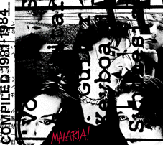
I know, I know, who doesn't. But really, I just found this! Fucking shit!
DAF documentary short
and this Malaria video! (thus pic above). Not my favorite song, but whatever. Ooh, wait, this live performance is way more interesting and a better song....
Oh, and if you don't know who DAF or Malaria is you are a loser. I mean it, a Total Loser.
(Mean comment inspired by a few recent comments field posts on certain poetry blogs aimed at "40 something's." like you are young, cool, or hip. Fucking poetry dork.)
Saturday, February 03, 2007
Memory deux
Josh Corey on Whitman:
"Rereading Song of Myself, I was freshly conscious of the poem as the document of a mystical experience, and the tension between such consummately individual experience and the radically democratic absorption and embodiment of the American polis attempted by the poem: a dialectic of enlightenment in the spiritual sense. Many of the other students were primarily impressed by Whitman's fantastic egotism, but I want to make a case for his radical humility, stemming from an intuition I have that spiritual enlightenment is born of the experience and embracement of one's own thoroughly ordinary and thoroughly mortal life. It's possible to mistake the speaker of Whitman's poem for some kind of superman, but when he claims, "And to die is different from what any one supposed, and luckier," I think the immortality he claims comes from accepting his share in the multitude, and not from some superior self-founded power (though he flirts with this only to find himself "on a verge of the usual mistake"). At least I suspect that's his drift."
Interesting that this resonates so with Wordsworth's The Prelude, which I've been reading for a class on Memory. I wouldn't say that Wordsworth is a "fantastic egoist" or "radically humble," but the relation between immortality and democratic multiplicity is certainly there. That Whitman can impress us with a sense of "radical humility" because he embraces ordinary, mortal life seems right to me. But there's a bit of a paradox or perhaps a difficulty here. What I wonder in terms of how memory functions is whether individual memory, the sense of the self in the past, is itself a "democratic" or democratizing impulse. Memory, as the recollection and re-experience of incidents that accumulate in the interior resources of our consciousness and may be retrieved by our interaction with the contingent world around us that in some way contains them, only has meaning if that individual experience can be "translated" as essentially recognizable by another. Thus the shock of pleasure and recognition when reading Proust. Thus the dual pleasure of reading--the idea that reading someone else's memories are not only comparable or resonant with our own but that, in fact, we experience them as our own in the moment of reading. Wordsworth's Kantian idealism seems crucial here--which I take to be more a result of Coleridge's influence than anything else. The sense that the artistic genius, even as he is a law unto himself, a unique measure of the capacity of nature and the human mind to be in harmony with one another is, in fact, a universal capacity, or potential. Genius is something we can experience, something we feel something about in relation to our own lives.
So what, exactly, does one experience by reading Wordsworth's attempt to immortalize his memories, to engage with the "genius" of and within the work? Is it just a confirmation of experience? Or rather, is it an easy confirmation? The leaps and juxtapositions of Wordsworth's lyric seem to belie any seamless relation between writer and reader. The pleasure of a text that focuses so primarily on memory, alongside of which we are confronted with Wordsworth's questioning of Enlightenment reason (at the same time that he relies on it), and the particularity of the historical and cultural moments that he writes of and within push this idea of democratic idealism to the limit. This is the "memory crisis" that Richard Terdiman writes of as the condition of modernity, which thus demands a writing style and form that engages this tension-- a tension produced by the desire to communicate for and to all at the same time that this is precluded by the opacity of the radical individualism upon which theories of modern democracy are built. The modern subject writing for and to the world (or at least for and to someone) may, in the end, merely confirm the radical particularity of experience as the only possible universal. (and how is that a universal?) The demands of universality cannot be met, they can only be experienced as a desire, at least within the liberal-democratic imaginary. Writing and memory intertwine as a longing to unite past, present, and future beyond the individual. Wordsworth's writing anxiety and his memory crisis are one and the same, yet he writes through (not beyond) them as they are the condition upon which both the failure and the success of the work are built. If he confirms the difficulty of memory and writing, and the impossible desire for a democratic idealism and universality, this series of negatives paradoxically brings great pleasure (to both Wordsworth as the narrator within the poem as well as the reader). It is, to paraphrase Geoffrey Hartman, a shift from a hope in Revolution to the belief in the revolutionary possibilities of hope.
"Rereading Song of Myself, I was freshly conscious of the poem as the document of a mystical experience, and the tension between such consummately individual experience and the radically democratic absorption and embodiment of the American polis attempted by the poem: a dialectic of enlightenment in the spiritual sense. Many of the other students were primarily impressed by Whitman's fantastic egotism, but I want to make a case for his radical humility, stemming from an intuition I have that spiritual enlightenment is born of the experience and embracement of one's own thoroughly ordinary and thoroughly mortal life. It's possible to mistake the speaker of Whitman's poem for some kind of superman, but when he claims, "And to die is different from what any one supposed, and luckier," I think the immortality he claims comes from accepting his share in the multitude, and not from some superior self-founded power (though he flirts with this only to find himself "on a verge of the usual mistake"). At least I suspect that's his drift."
Interesting that this resonates so with Wordsworth's The Prelude, which I've been reading for a class on Memory. I wouldn't say that Wordsworth is a "fantastic egoist" or "radically humble," but the relation between immortality and democratic multiplicity is certainly there. That Whitman can impress us with a sense of "radical humility" because he embraces ordinary, mortal life seems right to me. But there's a bit of a paradox or perhaps a difficulty here. What I wonder in terms of how memory functions is whether individual memory, the sense of the self in the past, is itself a "democratic" or democratizing impulse. Memory, as the recollection and re-experience of incidents that accumulate in the interior resources of our consciousness and may be retrieved by our interaction with the contingent world around us that in some way contains them, only has meaning if that individual experience can be "translated" as essentially recognizable by another. Thus the shock of pleasure and recognition when reading Proust. Thus the dual pleasure of reading--the idea that reading someone else's memories are not only comparable or resonant with our own but that, in fact, we experience them as our own in the moment of reading. Wordsworth's Kantian idealism seems crucial here--which I take to be more a result of Coleridge's influence than anything else. The sense that the artistic genius, even as he is a law unto himself, a unique measure of the capacity of nature and the human mind to be in harmony with one another is, in fact, a universal capacity, or potential. Genius is something we can experience, something we feel something about in relation to our own lives.
So what, exactly, does one experience by reading Wordsworth's attempt to immortalize his memories, to engage with the "genius" of and within the work? Is it just a confirmation of experience? Or rather, is it an easy confirmation? The leaps and juxtapositions of Wordsworth's lyric seem to belie any seamless relation between writer and reader. The pleasure of a text that focuses so primarily on memory, alongside of which we are confronted with Wordsworth's questioning of Enlightenment reason (at the same time that he relies on it), and the particularity of the historical and cultural moments that he writes of and within push this idea of democratic idealism to the limit. This is the "memory crisis" that Richard Terdiman writes of as the condition of modernity, which thus demands a writing style and form that engages this tension-- a tension produced by the desire to communicate for and to all at the same time that this is precluded by the opacity of the radical individualism upon which theories of modern democracy are built. The modern subject writing for and to the world (or at least for and to someone) may, in the end, merely confirm the radical particularity of experience as the only possible universal. (and how is that a universal?) The demands of universality cannot be met, they can only be experienced as a desire, at least within the liberal-democratic imaginary. Writing and memory intertwine as a longing to unite past, present, and future beyond the individual. Wordsworth's writing anxiety and his memory crisis are one and the same, yet he writes through (not beyond) them as they are the condition upon which both the failure and the success of the work are built. If he confirms the difficulty of memory and writing, and the impossible desire for a democratic idealism and universality, this series of negatives paradoxically brings great pleasure (to both Wordsworth as the narrator within the poem as well as the reader). It is, to paraphrase Geoffrey Hartman, a shift from a hope in Revolution to the belief in the revolutionary possibilities of hope.
Friday, February 02, 2007
Memory
Spaces of Remembering
So, if I dream I have you, I have you,
For all our joys are but fantastical.
John Donne, "Elegy X: The Dream" 6
Tuesday, January 23, 2007
Why Bill Frist is a Nazi
My friend Emily sent me the following via an email rightly entitled: "As if being a Republican isn't bad enough."
Bill Frist medical school experiments controversy
From Wikipedia, the free encyclopedia
While he was a medical school student in the 1970's, Bill Frist (now a Republican U.S. Senator from Tennessee) performed medical experiments on shelter cats while researching the use of drugs on the mitral valve. By his own account, Frist improperly obtained these cats from Boston animal shelters, falsely telling shelter staff he was adopting the cats as pets. [1] In his 1989 book Transplant, Frist admitted that he killed these cats during medical experiments at Harvard Medical School , as part of what he claimed were his studies. [2] [3]
In his book, Frist explained that he succumbed to the pressure to succeed in a highly competitive medical school. Frist stated that he "treat[ed] them as pets for a few days" before he "cart[ed] them off to the lab to die." He went on to say, "And I was totally schizoid about the entire matter. By day, I was little Billy Frist, the boy who lived on Bowling Avenue in Nashville and had decided to become a doctor because of his gentle father and a dog named Scratchy. By night, I was Dr. William Harrison Frist, future cardiothoracic surgeon, who was not going to let a few sentiments about cute, furry little creatures stand in the way of his career. In short, I was going a little crazy." He went on to describe why he conducted animal experiments: "It can even be beautiful and thrilling work, as I discovered that day in the lab when I first saw the wonderful workings of a dog's heart . . . I spent days and nights on end in the lab, taking the hearts out of cats, dissecting each heart, suspending a strip of tiny muscle that attaches the mitral valve to the inner wall of the cat heart and recording the effects of various medicines I added to the bath surrounding the muscle." "I lost my supply of cats. I only had six weeks to complete my project before I resumed my clinical rotations. Desperate, obsessed with my work, I visited the various animal shelters in the Boston suburbs, collecting cats . . . it was a heinous and dishonest thing to do."
Senator Bill Frist
Although Frist's book had been published more than a decade before, the matter created public controversy after mention in a Boston Globe profile, published after his election as Senate majority leader. [4][5] PETA, which opposes scientific experimentation on animals that results in death or cruel treatment demanded that Frist atone by sponsoring legislation to protect animals from unnecessary suffering. [6] In response, Frist's office reaffirmed that he denounced the action, but made no promises about any animal protection legislation.
According to an ASPCA lawyer, Frist's action was "fraudulent and probably was illegal". Another ASPCA official stated it "probably would be considered cruel." [6] Massachusetts has a criminal statute prohibiting cruelty to animals. [7] Frist was never charged under this statute and his defenders have pointed out that until 1983 Massachusetts law permitted shelters to release animals for laboratory experiments, and some states continue to permit such activity today. Because the Boston area animal shelters in Frist's case did not release the animals to Frist knowing they would be used for experimentation because of the manner in which he adopted the cats, these laws may not have applied to the facts presently in the public record about Frist's actions. However, the statute of limitations has passed
Bill Frist medical school experiments controversy
From Wikipedia, the free encyclopedia
While he was a medical school student in the 1970's, Bill Frist (now a Republican U.S. Senator from Tennessee) performed medical experiments on shelter cats while researching the use of drugs on the mitral valve. By his own account, Frist improperly obtained these cats from Boston animal shelters, falsely telling shelter staff he was adopting the cats as pets. [1] In his 1989 book Transplant, Frist admitted that he killed these cats during medical experiments at Harvard Medical School , as part of what he claimed were his studies. [2] [3]
In his book, Frist explained that he succumbed to the pressure to succeed in a highly competitive medical school. Frist stated that he "treat[ed] them as pets for a few days" before he "cart[ed] them off to the lab to die." He went on to say, "And I was totally schizoid about the entire matter. By day, I was little Billy Frist, the boy who lived on Bowling Avenue in Nashville and had decided to become a doctor because of his gentle father and a dog named Scratchy. By night, I was Dr. William Harrison Frist, future cardiothoracic surgeon, who was not going to let a few sentiments about cute, furry little creatures stand in the way of his career. In short, I was going a little crazy." He went on to describe why he conducted animal experiments: "It can even be beautiful and thrilling work, as I discovered that day in the lab when I first saw the wonderful workings of a dog's heart . . . I spent days and nights on end in the lab, taking the hearts out of cats, dissecting each heart, suspending a strip of tiny muscle that attaches the mitral valve to the inner wall of the cat heart and recording the effects of various medicines I added to the bath surrounding the muscle." "I lost my supply of cats. I only had six weeks to complete my project before I resumed my clinical rotations. Desperate, obsessed with my work, I visited the various animal shelters in the Boston suburbs, collecting cats . . . it was a heinous and dishonest thing to do."
Senator Bill Frist
Although Frist's book had been published more than a decade before, the matter created public controversy after mention in a Boston Globe profile, published after his election as Senate majority leader. [4][5] PETA, which opposes scientific experimentation on animals that results in death or cruel treatment demanded that Frist atone by sponsoring legislation to protect animals from unnecessary suffering. [6] In response, Frist's office reaffirmed that he denounced the action, but made no promises about any animal protection legislation.
According to an ASPCA lawyer, Frist's action was "fraudulent and probably was illegal". Another ASPCA official stated it "probably would be considered cruel." [6] Massachusetts has a criminal statute prohibiting cruelty to animals. [7] Frist was never charged under this statute and his defenders have pointed out that until 1983 Massachusetts law permitted shelters to release animals for laboratory experiments, and some states continue to permit such activity today. Because the Boston area animal shelters in Frist's case did not release the animals to Frist knowing they would be used for experimentation because of the manner in which he adopted the cats, these laws may not have applied to the facts presently in the public record about Frist's actions. However, the statute of limitations has passed
Sunday, January 14, 2007
Alice Coltrane RIP
.jpg/200px-A_Monastic_Trio_(Alice_Coltrane).jpg)
Sad to hear the news. This fall my friend Sam and I decided, last minute, to attend what turns out to be one of her last concerts (Ann Arbor ,(September 23, John Coltrane's birthday). We scrambled to get a ride to A2 with friends since neither of us had a car, and, literally, we--kindly driven by friends Brad and Becky. I am especially thinking of Brad today who loved Alice so much--arrived at Hill Auditorium with a minute to spare. It was a lovely, uplifting concert, unsurprisingly. She played with her son Ravi, Charlie Hayden, and Roy Haynes, which was really a special treat. Not to be cyncial, but there were moments when the spiritual uplift got a bit treacly, and the short movie tribute of John Coltrane's life was bizarre, hagiographic. But... it was also filled with amazing, beautiful moments. Leaving the concert, I saw so any people I knew (or recognized) standing in the rain outside Hill Auditorium chatting, smiling, looking and feeling happy. It's interesting to realize that you shared that last musical moment with a community of Alice Coltrane devotees.
Saturday, January 06, 2007
Why I love Richard Meltzer
From Vinyl Reckoning
"Having fled the academic gauntlet, escaped by the skin of my shoes, I walked smack into a new gauntlet about as depressing, and almost as draining, one with--what? not again?!--distinct academic coloration. Neoacademic? Crypto-academic? Pseudononacademic?
Like femmes fatales who "don't know it," academes who don't know it, or feign ignorance of the fact, can be--as they used to say--bad medicine. Bad enough. But wave the academy flag as if to disclaim it--"Only funning!"--while meantime masquerading as a practicing populist, and you're fucking RAT POISON. A pair of parties-I-have-known fit this bill, have fit it hand in glove for the last quarter century, behaving for all the world not merely like entrenched (and very constipated) academes but petty administrators...self-tenured department heads...deans, by golly.
Christgau, good old Bob, once dubbed himself the Dean of American Rock Critics. He had a T-shirt made up with his name above that title, and a likeness of Little Richard. What, you might wonder, could possess someone to adopt a handle so aridly pretentious, so dauntingly...insipid? Part was just ill-conceived hoax, as obtuse a sham as Springsteen's in bearing a nickname with zero proletarian reverb--the Boss!--but in larger part, it did accurately convey the man's aura of swaggerless dogmatism. Both personally and professionally, he is one drably imperious prick.
The Dean!--who to this day (in his syndicated "Consumer Guide") gives LETTER GRADES to albums and has a routine enabling him to monitor, or simulate monitoring, the complete "curriculum"--every current release. Years ago, more than once, I saw him in action. He'd put six LPs on the changer, stack all the covers in the same sequence, go about his bizness. If he suddenly heard something to catch his fancy, he would count discs and check the covers--"Three, four--oh, isn't that something?--Tom Paxton." Nowadays, I would assume he's got a multi-CD unit with a digital display so he needn't even count: technology favors the lame. (Dean of what branch? Admissions? Paper clips? Alphabetic studies?)
For us rockcrit underlings, the Dean in his incarnation as bigwig editor tried his darnedest to affect a supervisorly demeanor with an almost schoolmarmish (hit-you-with-a-ruler) facade. Looking back, it was sorta laughable, but every time I turned in an article, a review, sooner or later he'd phone, "Get your thesaurus--it's word choice time," and for two hours try to argue me out of certain key adjectives. Laughable but exasperating, and in hindsight maybe mostly laughable.
It was more in his "intellectual oversight" capacity--as surveillance pilot at large, unpaid and unassigned, far above the rockwrite fray--that this joker did me any lasting damage. In tandem with copilot/tag-team partner Greil Marcus, he at a crucial juncture blocked my progress to wider (um) recognition, effectively consigning me to marginality, and in the long run has denied me any significant role in official--"authorized"--"accredited"--rockwrite (as opposed to rock) history. The annals--the archive--the fugsucking "pantheon"! Oh yes--another pathetic house-o-cards for sure, but these two clowns act like they fucking OWN it.
And why do I care? Why do I care? I CARE.
It irks the hell out of me that while Marcus doesn't grade albums, he does grade people's CONDUCT, and conduct--alone!--is what kept me out of this high-bounty, high-visibility anthology he edited, oh, probably 18-20 years ago--yup, another old grudge. Stranded he called it, and he asked purt near every living, breathing rockwriter or rockwrite pretender of even quasi note to contribute an essay on his/her favorite album--the one you'd bring to a so-called desert island. I know, I know: cor-nee. But each contributor got $750, a whole lot more than I'd ever made off a single piece.
And what kept me out, he told me three years later, was my rude behavior at the final Sex Pistols show, the last of the Sid Vicious era, at Winterland. My job that night, well it wasn't a job, it was a labor of love, had been to go out and insult the audience before and after each band. Some guy from the Pistols' crew thought it all seemed too placid, too pat--"like a Grateful Dead show"--and asked me to give the ticket holders a jolt. All the invective in my arsenal I dispensed--in spades--I was one uncouth lout--until Bill Graham physically picked me up and threw me out of the building--"You can't insult my city!" Although what, precisely, was/is rocka rocka roll--or punk--or any kind of youth twitch--supposed to entail "if not that"? If not the high risk of behaving like a FLYING FUCKING ASSHOLE?
Marcus, who had been there, and been offended, never expressed regret for the slight, the exclusion, but later in the 80s he averred that, knowing what he knew now, now that he "understood punk," he would NOT have excluded me. Oh goody.
What I heard on the grapevine at the time the book came out was that he'd also disapproved of what I might write. The buzz was that Christgau, who "knew" me better than Greil did, told him, "Oh, he'd probably pick a Doors album anyway"--an odious no-no to Bob and Greil both--but that's just rumor. In his foreword to the '95 reprint of Stranded, Christgau, in a curious negative name-drop, draws attention to the lack of anything by "the irrepressible Richard Meltzer"...irrepressible? Is that like being a bon vivant? And if I couldn't be repressed, why the fuck did they have to repress me? (Like that of Meister Eckehart's cold Germanic God, my presence remained in my absence.)
A more persistent rumble back thereabouts was that these bozos found my rockwriting "politically incorrect" (ostensibly: I wasn't as keen as they on helping rock-roll find, adjust, and micro-tune its moral/humanistic compass, or in lieu of its willingness to accept same, SUPERIMPOSING suchever upon it)--the first time I actually heard the now-all-too-familiar aspersion. Basically, this signified only a slight upping of the transgressional ante, as I had already been deemed of dubious intellectual grounding. As far back as '73, Christgau was branding me "anti-intellectual": in a saner universe (in his purview), I'd have been tarred, feathered, run out of town.
What's daffy about this pair coming on so hoity-toity in their exercise of sovereignty is these're guys who need a telescope to reach--approach--make out the general outline of--whatever it is they purport to be confronting, so mega-removed are they from any tangible earthly what-the-hey. Like most culture wags laureate, what they are--all they are!--is pious OUTSIDERS. (Like Sam and Ann Charters.) Breast-beating squares. (Like George Will and Norman Podhoretz.) Stuffed-shirt know-it-alls. (Like John Updike and Leonard Feather.)
As point-to-point-to-point-to-point arbiters of the socioculturally valid, they're as embarrassing as the Medveds.
They don't have the existential oo-poo-pa-doo to be trucking in anything so both high and low (and so alien to their alleged lives) as standard-issue rock 'n' roll. In their frigging 50s, they haven't caught on yet that one thing rock does rather well, too well to ignore or dismiss--one of its stocks-in-trade--is SECOND-PERSON HOSTILITY. The many stations of I-dislike-you. Which isn't "good" or any such easy-moral A equals A, certainly isn't "nice," but it's the goddamn rock-roll terrain, it's fucking given. Might I add "universal"? Such itchy biz rubs Bob and Greil the wrong way, especially when the targeting is, well, nonrational, irrational, and above all "unjust." Taxonomically prejudiced (and prejudicial). They insist, for inst, that ANYTIME a male gender-specific voice expresses antipathy to a nonmale gender-specific other, UGLY SEXISM has reared its head--ring the alarm!--the voice forfeiting any claim to even antipathetic universality. It doesn't matter, say, that the gender voicings could be reversed, that with minimal change a female subject could be cussing out, shitting all over, a male object...that ill will is as central to rock as it is to boxing...it doesn't matter!
So meticulous have they been as rock watchdogs that they've troubled 'emselves over what Randy Newman might really've MEANT by "Short People" (yes--of course! Randy's being ironic--but should anyone even say these things?)...how poignant.
They try so-o-o hard to be good, caring New Deal Democrats, and good Boy Scouts, and far more telling: good boys, they've never been bad boys, never even tried it on for size. They wouldn't dare commit adultery. Never farted in the subway. They don't know danger from the inside looking out, locked away from any relief, asylum, any exterior safety net. Fuh, do they even know mischief? They've never tasted their own bile, never looked death in the eye in a mirror.
When I wrote somewhere that one of the things that helped kill Lester Bangs was WRITING, each of them accused me of romanticism--how can writing kill? they questioned. Well, guys, it doesn't always kill, but it certainly comes closest when you're doing it right. Only when it makes active use of your blood, your heart, your nerves, glands, sex fluids, vertebrae, and whatall, and don't forget your stink, in a word: your body. In a word: your life. They were more annoyed, I would guess, that I considered it a pity rockwriting was the genre that gored Lester, that a diet of rock and nothing but had rendered him too dumb to get out of the way.
At the risk of overextending my own second-person animus and getting downright ad hominem about all o' this, I'm gonna introduce a new term to the proceedings: COOTIES. I don't give a ding dang doodle if these blockheads ever stumble on some remote semblance of the True, or accurately peg the Good and/or the Beautiful--the smutch of their imperialist intentions will contaminate anything they touch, their seal of approval rendering LESS ACCEPTABLE the goods of its unfortunate recipients. In my idea of a saner universe, the sight and sound of such card-carrying outsiders fattening up, even commentarily, on the goodies of the culturally/intellectually aboriginal would release fucking ANTIBODIES in the world. Imperialist cooties: nothing to sneeze at.
Or if "imperialist" sounds too vigorous and resourceful--too vibrantly alive--like Teddy Roosevelt or Cortez or somebody--let's just call it "proprietary." Ideational as opposed to material proprietorship...dominion...superintendence of turf and sight lines. No matter how you slice it, the reigning King of Proprietary Cooties--let's print that on a shirt--is Greil Marcus.
It's hard to go very long without seeing this man's maiming-by-NOT-damning commentary on something. No other recent celebrity outsider--not George Plimpton, not Nat Hentoff, not Dr. Joyce Brothers--has functioned so relentlessly, so adamantly, as proponent, evaluator, certifier of relevance both passing and eternal, chalkboard huckster for so turgid a line of see-Spot-run. Michael Cuscuna? Well, that's only on jazz reissues.
So unremitting has Marcus been in affixing his byline to so much NOT requiring his collusion, his stultifying illumination, and certainly not HIS italics, that every juxtaposition of it and anything has come to feel as WRONG (i.e., as corrupt) as the mating of basketball footage to "The Revolution Will Not Be Televised" in a Nike commercial.
Last year an article in the New York Observer complained about Marcus's liner notes for the reissue of Harry Smith's Folkways anthology. Author Mark Schone's beef was that in gushing all over Harry there was an implied denigration of rival folklorist Alan Lomax, who Schone felt deserved a better fate.
What irritated me about Greil's presence in the package was simply that--his presence--although I could nitpick and say his lyric/historical spinout on Clarence Ashley's "The Coo Coo Bird," for one thing, bore traces of a METHODOLOGY of song dissection (and archaeology) I introduced to rockcrit (and yes, was better at) in my first published pieces 30 years ago...but fuck, I'm too much the folkie and populist myself to ever invoke an intellectual "copyright"--ownership isn't my game. (I don't own things in the air, I don't even own names I've given them.)
Anyway, it would've been preferable, I think, for Schone to have been more patient: chances are, left to his proprietary avarice (the pipe dream: champion something and you'll forever be associated with it), that Greil would eventually have carved his name on Lomax's legacy too...and still may.
Hey: this is a man who accepted payment to report nightly on a MICHAEL JACKSON TOUR for Ted Koppel's Nightline. Who/what won't he put his name on?
He even put his grimy stamp on one of my books, the '87 reprint of Aesthetics of Rock--which he didn't even like. And I didn't ask for him (I wanted Billy Altman), but he insisted and the publisher acquiesced. Wittingly or un-, his intro did little more than bracket the work, trivialize it (first paragraph: "I'm most of all convinced that the book is not a joke"; key word: "convinced"--thanks MUCH, you fucker), make it small (while lauding its hefty page count), finite, bounded, glibly sum-up-able, socially agreeable ("...the coolest book to be seen carrying"), no longer autonomous: a Greil-endorsed hunk o' pulp.
The endorsement didn't even improve my case with the endorser. So shallow had been his display of regard for me, so much did he not deem me even a colleague, that I didn't make it onto the mailing list for his own next book, Lipstick Traces, and he balked at first when I asked for a copy (how much humiliation did I think I needed?), telling me to go bother his publicist...he was in no mood to do so himself.
It wasn't mere protocol that prompted me to ask him, as this was the tome in which Greil reputedly "came to terms" with the events of Pistols night at Winterland. When I finally saw a copy, I wasn't in the index, or onstage at his Winterland, or anywhere else. Once an apparent eyesore, I was now beneath his notice (both forward and back).
It was a book that struck me also as, yes, derivative--secondary--and that M.T. Kinney would later proclaim a "broken-leg try at duplicating the Everest climb R. Meltzer pulled off in The Aesthetics of Rock. On an insight level it's the pits"--he said it, not me.
So what the hell am I after?
My due.
Don't think I want credit for having "influenced" Greil, or Bob, or the pen pushers of their cardboard academy, for trailblazing an activity that inevitably leads to them. I didn't (and if I had, I would rather I hadn't) and I don't.
But if they didn't actually "get it from" me, plenty of it, it didn't hurt 'em to have me as forerunner. To have my trial and error, naked as it was, ease the path and prime the pump.
Credit? I want credit for being Copernicus--Magellan--goddamn Socrates to their coffee-table Thoreau, and Thoreau to their Michael Medved. (Do you have any idea how degrading it is at this stage of my life to have to beat my own drum? What such a dance does to my "dignity"? They can kiss my fucking feet.)
Lester Young once said of Stan Getz, who profited mightily from a saxophone way-of-being Lester had pioneered: "There he goes driving my pink Cadillac." I don't want no Cadillac (though a middle-class income, after all these years, would be OK); I want to terminate the academy.
And what, precisely, is it that gives me the willies about the ascendancy of their shit and not mine--other than the obvious?
The reality of their ultimate message. Everything they write testifies: THERE IS NO JOY. NOTHING IS POSSIBLE. Regardless of what they imagine or wish it to be saying.
Seeing this travesty and obsessing on its repercussions forces me to redouble my efforts. I'm tired and tired and thinkin' I might maybe resign from this sorriest of "callings," and here I am stuck with a bran' new mission.
Needed (first things first): a countercootie to their cooties on everything. On things I still love.
Shit."
"Having fled the academic gauntlet, escaped by the skin of my shoes, I walked smack into a new gauntlet about as depressing, and almost as draining, one with--what? not again?!--distinct academic coloration. Neoacademic? Crypto-academic? Pseudononacademic?
Like femmes fatales who "don't know it," academes who don't know it, or feign ignorance of the fact, can be--as they used to say--bad medicine. Bad enough. But wave the academy flag as if to disclaim it--"Only funning!"--while meantime masquerading as a practicing populist, and you're fucking RAT POISON. A pair of parties-I-have-known fit this bill, have fit it hand in glove for the last quarter century, behaving for all the world not merely like entrenched (and very constipated) academes but petty administrators...self-tenured department heads...deans, by golly.
Christgau, good old Bob, once dubbed himself the Dean of American Rock Critics. He had a T-shirt made up with his name above that title, and a likeness of Little Richard. What, you might wonder, could possess someone to adopt a handle so aridly pretentious, so dauntingly...insipid? Part was just ill-conceived hoax, as obtuse a sham as Springsteen's in bearing a nickname with zero proletarian reverb--the Boss!--but in larger part, it did accurately convey the man's aura of swaggerless dogmatism. Both personally and professionally, he is one drably imperious prick.
The Dean!--who to this day (in his syndicated "Consumer Guide") gives LETTER GRADES to albums and has a routine enabling him to monitor, or simulate monitoring, the complete "curriculum"--every current release. Years ago, more than once, I saw him in action. He'd put six LPs on the changer, stack all the covers in the same sequence, go about his bizness. If he suddenly heard something to catch his fancy, he would count discs and check the covers--"Three, four--oh, isn't that something?--Tom Paxton." Nowadays, I would assume he's got a multi-CD unit with a digital display so he needn't even count: technology favors the lame. (Dean of what branch? Admissions? Paper clips? Alphabetic studies?)
For us rockcrit underlings, the Dean in his incarnation as bigwig editor tried his darnedest to affect a supervisorly demeanor with an almost schoolmarmish (hit-you-with-a-ruler) facade. Looking back, it was sorta laughable, but every time I turned in an article, a review, sooner or later he'd phone, "Get your thesaurus--it's word choice time," and for two hours try to argue me out of certain key adjectives. Laughable but exasperating, and in hindsight maybe mostly laughable.
It was more in his "intellectual oversight" capacity--as surveillance pilot at large, unpaid and unassigned, far above the rockwrite fray--that this joker did me any lasting damage. In tandem with copilot/tag-team partner Greil Marcus, he at a crucial juncture blocked my progress to wider (um) recognition, effectively consigning me to marginality, and in the long run has denied me any significant role in official--"authorized"--"accredited"--rockwrite (as opposed to rock) history. The annals--the archive--the fugsucking "pantheon"! Oh yes--another pathetic house-o-cards for sure, but these two clowns act like they fucking OWN it.
And why do I care? Why do I care? I CARE.
It irks the hell out of me that while Marcus doesn't grade albums, he does grade people's CONDUCT, and conduct--alone!--is what kept me out of this high-bounty, high-visibility anthology he edited, oh, probably 18-20 years ago--yup, another old grudge. Stranded he called it, and he asked purt near every living, breathing rockwriter or rockwrite pretender of even quasi note to contribute an essay on his/her favorite album--the one you'd bring to a so-called desert island. I know, I know: cor-nee. But each contributor got $750, a whole lot more than I'd ever made off a single piece.
And what kept me out, he told me three years later, was my rude behavior at the final Sex Pistols show, the last of the Sid Vicious era, at Winterland. My job that night, well it wasn't a job, it was a labor of love, had been to go out and insult the audience before and after each band. Some guy from the Pistols' crew thought it all seemed too placid, too pat--"like a Grateful Dead show"--and asked me to give the ticket holders a jolt. All the invective in my arsenal I dispensed--in spades--I was one uncouth lout--until Bill Graham physically picked me up and threw me out of the building--"You can't insult my city!" Although what, precisely, was/is rocka rocka roll--or punk--or any kind of youth twitch--supposed to entail "if not that"? If not the high risk of behaving like a FLYING FUCKING ASSHOLE?
Marcus, who had been there, and been offended, never expressed regret for the slight, the exclusion, but later in the 80s he averred that, knowing what he knew now, now that he "understood punk," he would NOT have excluded me. Oh goody.
What I heard on the grapevine at the time the book came out was that he'd also disapproved of what I might write. The buzz was that Christgau, who "knew" me better than Greil did, told him, "Oh, he'd probably pick a Doors album anyway"--an odious no-no to Bob and Greil both--but that's just rumor. In his foreword to the '95 reprint of Stranded, Christgau, in a curious negative name-drop, draws attention to the lack of anything by "the irrepressible Richard Meltzer"...irrepressible? Is that like being a bon vivant? And if I couldn't be repressed, why the fuck did they have to repress me? (Like that of Meister Eckehart's cold Germanic God, my presence remained in my absence.)
A more persistent rumble back thereabouts was that these bozos found my rockwriting "politically incorrect" (ostensibly: I wasn't as keen as they on helping rock-roll find, adjust, and micro-tune its moral/humanistic compass, or in lieu of its willingness to accept same, SUPERIMPOSING suchever upon it)--the first time I actually heard the now-all-too-familiar aspersion. Basically, this signified only a slight upping of the transgressional ante, as I had already been deemed of dubious intellectual grounding. As far back as '73, Christgau was branding me "anti-intellectual": in a saner universe (in his purview), I'd have been tarred, feathered, run out of town.
What's daffy about this pair coming on so hoity-toity in their exercise of sovereignty is these're guys who need a telescope to reach--approach--make out the general outline of--whatever it is they purport to be confronting, so mega-removed are they from any tangible earthly what-the-hey. Like most culture wags laureate, what they are--all they are!--is pious OUTSIDERS. (Like Sam and Ann Charters.) Breast-beating squares. (Like George Will and Norman Podhoretz.) Stuffed-shirt know-it-alls. (Like John Updike and Leonard Feather.)
As point-to-point-to-point-to-point arbiters of the socioculturally valid, they're as embarrassing as the Medveds.
They don't have the existential oo-poo-pa-doo to be trucking in anything so both high and low (and so alien to their alleged lives) as standard-issue rock 'n' roll. In their frigging 50s, they haven't caught on yet that one thing rock does rather well, too well to ignore or dismiss--one of its stocks-in-trade--is SECOND-PERSON HOSTILITY. The many stations of I-dislike-you. Which isn't "good" or any such easy-moral A equals A, certainly isn't "nice," but it's the goddamn rock-roll terrain, it's fucking given. Might I add "universal"? Such itchy biz rubs Bob and Greil the wrong way, especially when the targeting is, well, nonrational, irrational, and above all "unjust." Taxonomically prejudiced (and prejudicial). They insist, for inst, that ANYTIME a male gender-specific voice expresses antipathy to a nonmale gender-specific other, UGLY SEXISM has reared its head--ring the alarm!--the voice forfeiting any claim to even antipathetic universality. It doesn't matter, say, that the gender voicings could be reversed, that with minimal change a female subject could be cussing out, shitting all over, a male object...that ill will is as central to rock as it is to boxing...it doesn't matter!
So meticulous have they been as rock watchdogs that they've troubled 'emselves over what Randy Newman might really've MEANT by "Short People" (yes--of course! Randy's being ironic--but should anyone even say these things?)...how poignant.
They try so-o-o hard to be good, caring New Deal Democrats, and good Boy Scouts, and far more telling: good boys, they've never been bad boys, never even tried it on for size. They wouldn't dare commit adultery. Never farted in the subway. They don't know danger from the inside looking out, locked away from any relief, asylum, any exterior safety net. Fuh, do they even know mischief? They've never tasted their own bile, never looked death in the eye in a mirror.
When I wrote somewhere that one of the things that helped kill Lester Bangs was WRITING, each of them accused me of romanticism--how can writing kill? they questioned. Well, guys, it doesn't always kill, but it certainly comes closest when you're doing it right. Only when it makes active use of your blood, your heart, your nerves, glands, sex fluids, vertebrae, and whatall, and don't forget your stink, in a word: your body. In a word: your life. They were more annoyed, I would guess, that I considered it a pity rockwriting was the genre that gored Lester, that a diet of rock and nothing but had rendered him too dumb to get out of the way.
At the risk of overextending my own second-person animus and getting downright ad hominem about all o' this, I'm gonna introduce a new term to the proceedings: COOTIES. I don't give a ding dang doodle if these blockheads ever stumble on some remote semblance of the True, or accurately peg the Good and/or the Beautiful--the smutch of their imperialist intentions will contaminate anything they touch, their seal of approval rendering LESS ACCEPTABLE the goods of its unfortunate recipients. In my idea of a saner universe, the sight and sound of such card-carrying outsiders fattening up, even commentarily, on the goodies of the culturally/intellectually aboriginal would release fucking ANTIBODIES in the world. Imperialist cooties: nothing to sneeze at.
Or if "imperialist" sounds too vigorous and resourceful--too vibrantly alive--like Teddy Roosevelt or Cortez or somebody--let's just call it "proprietary." Ideational as opposed to material proprietorship...dominion...superintendence of turf and sight lines. No matter how you slice it, the reigning King of Proprietary Cooties--let's print that on a shirt--is Greil Marcus.
It's hard to go very long without seeing this man's maiming-by-NOT-damning commentary on something. No other recent celebrity outsider--not George Plimpton, not Nat Hentoff, not Dr. Joyce Brothers--has functioned so relentlessly, so adamantly, as proponent, evaluator, certifier of relevance both passing and eternal, chalkboard huckster for so turgid a line of see-Spot-run. Michael Cuscuna? Well, that's only on jazz reissues.
So unremitting has Marcus been in affixing his byline to so much NOT requiring his collusion, his stultifying illumination, and certainly not HIS italics, that every juxtaposition of it and anything has come to feel as WRONG (i.e., as corrupt) as the mating of basketball footage to "The Revolution Will Not Be Televised" in a Nike commercial.
Last year an article in the New York Observer complained about Marcus's liner notes for the reissue of Harry Smith's Folkways anthology. Author Mark Schone's beef was that in gushing all over Harry there was an implied denigration of rival folklorist Alan Lomax, who Schone felt deserved a better fate.
What irritated me about Greil's presence in the package was simply that--his presence--although I could nitpick and say his lyric/historical spinout on Clarence Ashley's "The Coo Coo Bird," for one thing, bore traces of a METHODOLOGY of song dissection (and archaeology) I introduced to rockcrit (and yes, was better at) in my first published pieces 30 years ago...but fuck, I'm too much the folkie and populist myself to ever invoke an intellectual "copyright"--ownership isn't my game. (I don't own things in the air, I don't even own names I've given them.)
Anyway, it would've been preferable, I think, for Schone to have been more patient: chances are, left to his proprietary avarice (the pipe dream: champion something and you'll forever be associated with it), that Greil would eventually have carved his name on Lomax's legacy too...and still may.
Hey: this is a man who accepted payment to report nightly on a MICHAEL JACKSON TOUR for Ted Koppel's Nightline. Who/what won't he put his name on?
He even put his grimy stamp on one of my books, the '87 reprint of Aesthetics of Rock--which he didn't even like. And I didn't ask for him (I wanted Billy Altman), but he insisted and the publisher acquiesced. Wittingly or un-, his intro did little more than bracket the work, trivialize it (first paragraph: "I'm most of all convinced that the book is not a joke"; key word: "convinced"--thanks MUCH, you fucker), make it small (while lauding its hefty page count), finite, bounded, glibly sum-up-able, socially agreeable ("...the coolest book to be seen carrying"), no longer autonomous: a Greil-endorsed hunk o' pulp.
The endorsement didn't even improve my case with the endorser. So shallow had been his display of regard for me, so much did he not deem me even a colleague, that I didn't make it onto the mailing list for his own next book, Lipstick Traces, and he balked at first when I asked for a copy (how much humiliation did I think I needed?), telling me to go bother his publicist...he was in no mood to do so himself.
It wasn't mere protocol that prompted me to ask him, as this was the tome in which Greil reputedly "came to terms" with the events of Pistols night at Winterland. When I finally saw a copy, I wasn't in the index, or onstage at his Winterland, or anywhere else. Once an apparent eyesore, I was now beneath his notice (both forward and back).
It was a book that struck me also as, yes, derivative--secondary--and that M.T. Kinney would later proclaim a "broken-leg try at duplicating the Everest climb R. Meltzer pulled off in The Aesthetics of Rock. On an insight level it's the pits"--he said it, not me.
So what the hell am I after?
My due.
Don't think I want credit for having "influenced" Greil, or Bob, or the pen pushers of their cardboard academy, for trailblazing an activity that inevitably leads to them. I didn't (and if I had, I would rather I hadn't) and I don't.
But if they didn't actually "get it from" me, plenty of it, it didn't hurt 'em to have me as forerunner. To have my trial and error, naked as it was, ease the path and prime the pump.
Credit? I want credit for being Copernicus--Magellan--goddamn Socrates to their coffee-table Thoreau, and Thoreau to their Michael Medved. (Do you have any idea how degrading it is at this stage of my life to have to beat my own drum? What such a dance does to my "dignity"? They can kiss my fucking feet.)
Lester Young once said of Stan Getz, who profited mightily from a saxophone way-of-being Lester had pioneered: "There he goes driving my pink Cadillac." I don't want no Cadillac (though a middle-class income, after all these years, would be OK); I want to terminate the academy.
And what, precisely, is it that gives me the willies about the ascendancy of their shit and not mine--other than the obvious?
The reality of their ultimate message. Everything they write testifies: THERE IS NO JOY. NOTHING IS POSSIBLE. Regardless of what they imagine or wish it to be saying.
Seeing this travesty and obsessing on its repercussions forces me to redouble my efforts. I'm tired and tired and thinkin' I might maybe resign from this sorriest of "callings," and here I am stuck with a bran' new mission.
Needed (first things first): a countercootie to their cooties on everything. On things I still love.
Shit."
Thursday, January 04, 2007
Dreamlife

Took a too long nap this evening and had, again, vivid, strage dreams. They were *so* strong, memorable--not something I normally experience. One, right before I awoke, with my mother... so sad, she was so *present* and I awoke feeling that. She and I arguing in a friendly, mother-daughter way, as was typical of our relationship, about these boxes of jewelry we were looking at (my mother *loved* jewelry). The jewelry was bright gold; she preferred the classy, *real* gold, while I preferred the trendier, artier but faux kind. I mean, I can still *see* the jewelry we were arguing about.
(In a Freudian vein, I'm wondering too, if *jewelry* is somehow connected to *jewishness*, my father, and my thinking so much about judaism since I've been writing this Reznikoff paper-- I mean, the issue of fake vs a real jew(elry)... authenticity... hmmm)
But the strangest thing about all these little dream vignettes--one after the other-- was that they focused on a strange *place*--me riding a bike on a strange, circuitous, extremely narrow bike path that edged magnificent views of the ocean. The bike was odd too, had a very large silver frame that almost didn't fit into the narow path. The landscape looked like a cross between California then, at times, it became like Colorado in the Rockies when the ocean was lost to view. Then a switch to me housesitting a place right off the ocean, in a setting that felt very lush and tropical, like Hawaii. Again, the ocean was predominant. I could see it, but no matter how I tried, I couldn't *get* there. The house was very complex, and couldn't find my way around it, was frantic about cleaning it up before the owners got home, and meanwhile *really* wanting to just get to the ocean....
(In a Freudian vein, I'm wondering too, if *jewelry* is somehow connected to *jewishness*, my father, and my thinking so much about judaism since I've been writing this Reznikoff paper-- I mean, the issue of fake vs a real jew(elry)... authenticity... hmmm)
But the strangest thing about all these little dream vignettes--one after the other-- was that they focused on a strange *place*--me riding a bike on a strange, circuitous, extremely narrow bike path that edged magnificent views of the ocean. The bike was odd too, had a very large silver frame that almost didn't fit into the narow path. The landscape looked like a cross between California then, at times, it became like Colorado in the Rockies when the ocean was lost to view. Then a switch to me housesitting a place right off the ocean, in a setting that felt very lush and tropical, like Hawaii. Again, the ocean was predominant. I could see it, but no matter how I tried, I couldn't *get* there. The house was very complex, and couldn't find my way around it, was frantic about cleaning it up before the owners got home, and meanwhile *really* wanting to just get to the ocean....
Tuesday, January 02, 2007
Reznikoff and historiography
Writing a paper on Charles Reznikoff (actually, it should have been turned in a week ago for a seminar this fall, but, alas, as is my wont, it is late). I'm looking, specifically at his two volume Testimony. I've spent a good amount of time thinking about various theories of historiography, especially since that's what the seminar was concerned with. (Well, actually it was *about* time, history, and modernity, but historiography played a major role in our attempts to understand the relationship betwen texts from that period as well as the relationship between the three themes.) So, anyway, like I said, for my research on the Reznikoff paper I went through a good portion of our texts from the course, trying to find the *right* frameworks or methodology. I looked back through Latour, LaCapra, Chandler, de Certeau, Macheray, Jameson, Lukacs, and a few other short pieces I've forgotten now. Then I realized something. I had spent all of two minutes reading Reznikoff. This reminded me, sheepishly, of a moment early on in my grad school career--an attempt to write a paper on experimental music. I was talking about my struggle to understand and frame my paper's argument with a (non-academic) friend, and he asked me: " Have you listened lately to any of the music you're talking about?" "Um...no." I think this is a common grad student issue/mistake, and certainly one that can be leveled at the rise of theory in the academy (though it is, in general, I think, an overblown and not generalizable accusation). The fact that I found myself nervously avoiding a serious read of the very texts I was ostensibly about to stake an argument on struck me as a return to this misguided habit, and certainly not at all what the seminar itself had attempted to accomplish; we had spent a considerable amount of time and critical focus on how literary texts construct history. Now the relation between form/content, historiography, and justice is not quite clear to me, but I feel it is where I'm moving, circling around.
This all prompted... a return to Reznikoff. Now I know why I initially decided to write about him. The question of how one might narrate history--to my mind, *the* concern/question of historiography--is the central issue of Reznikoff's work. The fact that Reznikoff chooses to piece together/ transform legal cases--the archive of written documents that determine legal history/practice--in order to present an epoch as well as critique its failures and injustices through and as poetry is to question, to think through, the relationship between various narrative forms and historical contents, and to see them as inextricably linked to the institutional mediums and discourses in which they arise. The question of narrative/historical voice, and the issue of witnessing (the poet as witness) is then almost impossible to locate, which means that one's decision as a reader (as judge and jury) is also put to the test. I'm not making that tired old "the reader makes the meaning" argument. Rather, I'm interested in the ways Reznikoff's work, his practice, attempts to discern the outlines of a fragmented, particular, lived historical moment through the transformation of archival documents, and how those documents then become an attempt to redeem ( in the Benjaminian sense) a forgotten or erased history. This may sound naive, but this issue of redemption reminds me of one of the central questions Socrates poses in Plato's Republic : "What is justice?" I think Reznikoff 's work asks that question, or pushes his readers to ponder it. I'm also reminded, in this context, of Robert Creeley's correction of his often (mis) used remark--"Form is never more than an extension of content." Creeley reminds us that this is only half of the quote, the other half being: "And content is never more than an extension of form." Historiography as a quasi-literary practice and literature as a quasi-historical act seem, to me, to map onto the constitutive relation between form and content. In fact history is, in a way, the central term.
Finally, reading Reznikoff , I was struck by how deeply moving is the tragedy of working class, impoverished life. I've been thinking of my father throughout. His death due to unsanitary working conditions, which literally poisoned him (carbon tetrachloride used illegally at a printing factory), could be a test case in Rez's work. In fact my father's legal case was the first workmen's compensation suit won in the state of Michigan (1977). I think I know why Reznikoff wrote Testimony.
This all prompted... a return to Reznikoff. Now I know why I initially decided to write about him. The question of how one might narrate history--to my mind, *the* concern/question of historiography--is the central issue of Reznikoff's work. The fact that Reznikoff chooses to piece together/ transform legal cases--the archive of written documents that determine legal history/practice--in order to present an epoch as well as critique its failures and injustices through and as poetry is to question, to think through, the relationship between various narrative forms and historical contents, and to see them as inextricably linked to the institutional mediums and discourses in which they arise. The question of narrative/historical voice, and the issue of witnessing (the poet as witness) is then almost impossible to locate, which means that one's decision as a reader (as judge and jury) is also put to the test. I'm not making that tired old "the reader makes the meaning" argument. Rather, I'm interested in the ways Reznikoff's work, his practice, attempts to discern the outlines of a fragmented, particular, lived historical moment through the transformation of archival documents, and how those documents then become an attempt to redeem ( in the Benjaminian sense) a forgotten or erased history. This may sound naive, but this issue of redemption reminds me of one of the central questions Socrates poses in Plato's Republic : "What is justice?" I think Reznikoff 's work asks that question, or pushes his readers to ponder it. I'm also reminded, in this context, of Robert Creeley's correction of his often (mis) used remark--"Form is never more than an extension of content." Creeley reminds us that this is only half of the quote, the other half being: "And content is never more than an extension of form." Historiography as a quasi-literary practice and literature as a quasi-historical act seem, to me, to map onto the constitutive relation between form and content. In fact history is, in a way, the central term.
Finally, reading Reznikoff , I was struck by how deeply moving is the tragedy of working class, impoverished life. I've been thinking of my father throughout. His death due to unsanitary working conditions, which literally poisoned him (carbon tetrachloride used illegally at a printing factory), could be a test case in Rez's work. In fact my father's legal case was the first workmen's compensation suit won in the state of Michigan (1977). I think I know why Reznikoff wrote Testimony.
Wednesday, December 20, 2006
And Why Detroit *Doesn't Suck

I had to get out of my apartment. Too quiet. So I walked down to the organic bakery Avalon. It's an oasis of community here. There' re kids ranged aound a table (at least 10 of them) decorating holiday cookies, chatting and helping each other as their parents hover over them trying to give them creative freedom and a helping hand at the same time. These are the kinds of families that might vote Green but know they need to be responsible and support the realistic (democratic) option, so they bite the bullet.
I used to work here. Made the brioche, and cookies, and worked the front counter. It was back-breaking work for pretty low pay, and yet every hipster in Detroit has worked a stint here, it seems. It's interesting (and often disheartening) to work at a place you have respect for. Hard work and low pay tends to cancel out the political benefits of organic farming. Still, this place makes me happy. It proves that city folks (and suburban folks who work in the city) will actively support , actively *need* a place like this.
Why You Suck: A Holiday Poem of sorts
Below is a kind of fake flarf poem. I just googled "why you suck" and put together whatever struck my fancy. I think the poem kind of sucks actually, but of course, flarf is kind of supposed to suck, in a way. Anyway, it's just a little experiment, I honestly didn't work on it very hard. Apologies to those excellent flarf folks out there, no insult to your fine form intended!
(And for those of you who don't know what flarf is... google it!)
Why you suck
At investing
in the continually losing democratic establishment .
Before we delve into the dimension of you--
a modest proposal for improvement.
I love Hong Kongers with a sense of humor,
which is why anyone who continues to claim
this is partially written
will find truth in my statements.
You smell.
Do people often tell you that you suck?
Something tells me it's time to start groveling.
Vain attempts at being cuddly and warm.
Reasons behind Europe's anti-Americanism.
Now let's recap on April. Shall we?
You're Mad Right Now.
Everyone else sucking is partially your fault.
You are allied to the whole game and you still can't beat us.
Global warming or no, you disgusting
bug in a textbox control,
do you want an invite to my party at the Brown Palace?
My ego lets you down My ego pumps me up My ego tells me why I am so great ...
This is egregious.
It's easy to see why the Right is losing the battle.
But have fun with your 'boys' weekend.
You won't even try to win.
Your shrivelled testes. Your balls are in my ass.
This place is too much.
(And for those of you who don't know what flarf is... google it!)
Why you suck
At investing
in the continually losing democratic establishment .
Before we delve into the dimension of you--
a modest proposal for improvement.
I love Hong Kongers with a sense of humor,
which is why anyone who continues to claim
this is partially written
will find truth in my statements.
You smell.
Do people often tell you that you suck?
Something tells me it's time to start groveling.
Vain attempts at being cuddly and warm.
Reasons behind Europe's anti-Americanism.
Now let's recap on April. Shall we?
You're Mad Right Now.
Everyone else sucking is partially your fault.
You are allied to the whole game and you still can't beat us.
Global warming or no, you disgusting
bug in a textbox control,
do you want an invite to my party at the Brown Palace?
My ego lets you down My ego pumps me up My ego tells me why I am so great ...
This is egregious.
It's easy to see why the Right is losing the battle.
But have fun with your 'boys' weekend.
You won't even try to win.
Your shrivelled testes. Your balls are in my ass.
This place is too much.
Monday, November 06, 2006

Swirling plastic vortex

For real:
WASHINGTON (Reuters) -- Old toothbrushes, beach toys and used condoms are part of a vast vortex of plastic trash in the middle of the Pacific Ocean, threatening sea creatures that get tangled in it, eat it or ride on it, a new report says.
Because plastic doesn't break down the way organic material does, ocean currents and tides have carried it thousands of miles to an area between Hawaii and the U.S. West Coast, according to the study by the international environmental group Greenpeace.
This swirling vortex, which can grow to be about the size of Texas, is not far from the Northwestern Hawaiian Islands, designated as a protected U.S. national monument in June by President George W. Bush.
The Greenpeace report, "Plastic Debris in the World's Oceans" said at least 267 species -- including seabirds, turtles, seals, sea lions, whales and fish -- are known to have suffered from entanglement or ingestion of marine debris.
Some 80 percent of this debris comes from land and 20 percent from the oceans, the report said, with four main sources: tourism, sewage, fishing and waste from ships and boats.
The new report comes days after the journal Science projected that Earth's stocks of fish and seafood would collapse by 2048 if trends in overfishing and pollution continue.
Two weeks ago, the U.S. Institute of Medicine said the benefits of eating fish outweigh the risks of toxins detected in the animals.
Plastic pollution is a problem in all the world's oceans, the Greenpeace report said, but underlined the issue in the Pacific by sailing through the floating garbage dump and capturing images of wildlife interacting with plastic.
"It's not necessarily an area that's clearly defined; it's sort of a natural phenomenon ... wind and salt water break down the plastic," said Steve Smith, aboard the Greenpeace ship Esperanza.
The plastic trash, some in large pieces and others broken down to small but recognizable particles, is visible from the ship's deck, about 50 feet above the ocean surface, Smith said by telephone on Friday. Inflatable boats are dispatched from the ship to collect samples.
"We've been been unfortunately finding a lot of stuff out here, floating by, which doesn't paint a very good picture, because some of it is from faraway places, has marine life like barnacles and other little creatures living on the plastic," Smith said.
By hitching rides on plastic debris, invasive species can be carried thousands of miles to interact with native creatures, Smith said. Plastic also poses a hazard to animals that mistake it for prey and eat it, he said.
"Plastics in the oceans act as a toxic sponge, soaking up a lot of the persistent pollutants out here," Smith said. "We've seen photos of albatrosses who eat this plastic ... Even though their stomachs are filled, they end up starving because there's no nutrients in there."
Discarded or lost fishing nets and traps can continue to catch fish when they are no longer in use, the report said.
The report said an international agreement known as MARPOL is aimed at ending the dumping of plastic debris at sea, but noted that since most debris originates on land, even total enforcement of this agreement would not eliminate the problem.
Greenpeace called for a global network of marine reserves, covering 40 percent of the world's oceans, and responsibility by coastal countries to cut down on "excessive consumption" and boost recycling.
**************
You can read more about it here
Thursday, November 02, 2006
horspiel
"The German term Neue Horspiel refers to ear-plays that neither adapt live theater nor create the illusion of it but, instead, exploit the unique possibilities of radio (audio) to create something that can exist only in sound. The pioneering anthology of such texts is Klaus Schoning's Neues Horspiel (1969). This book includes Max Bense and Ludwig Harig's Der Monolog der Terry Jo, which presents only the thoughts within the mind of a hospitalized woman whose recovery of consciousness is portrayed in her progressing from nonsensical oral sounds to articulate speech, and Ernst Jandl and Friederike Mayrocker's Funf Mann Menschen, which compresses fourteen stages of a man's life into fourteen vignettes, each dominated by a characteristic spoken sound."
Read more here. (It's by/about Momus.)
Read more here. (It's by/about Momus.)
Sunday, October 29, 2006
Silence
I have no comment to make about my recent silence except to say that I think it was partly a wish for anonymity.
Critical interlude:
Anonymity? Like you're famous, right?
No, wrong. I merely wish for a secret space, perhaps even from myself.
Oooh, profound!!!
Fuck you.
The end
I took this from Juliana Spahr's blog:
from Slavoj Zizek's essay "Neighbors and Other Monsters: a Plea for Ethical Violence" in the Neighbor: Three Inquires into Political Philosophy.
Today, we seem effectively to be at the opposite point from the ideology of the 1960s: the mottos of spontaneity, creative self-expression, and so on, are taken over by the System; in other words, the old logic of the system reproducing itself through repressing and rigidly channeling the subject's spontaneous impetuses is left behind. Nonalienated spontaneity, self-expression, self-realization, they all directly serve the system, which is why pitiless self-censorship is a sine qua non of emancipatory politics. Especially in the domain of poetic art, this means that one should totally reject any attitude of self-expression, of displaying one's innermost emotional turmoil, desires, and dreams.True art has nothing whatsoever to do with disgusting emotional exhibitionism--insofar as the standard notion of "poetic spirit" is the ability to display one's intimate turmoil, what Vladimir Mayakovski said about himself with regard to his turn from personal poetry to political propaganda in verse ("I had to step on the throat of my Muse") is the constitutive gesture of a true poet. If there is a thing that provokes disgust in a true poet, it is the scene of a close friend opening up his heart, spilling out all the dirt of his inner life. p. 135
Critical interlude:
Anonymity? Like you're famous, right?
No, wrong. I merely wish for a secret space, perhaps even from myself.
Oooh, profound!!!
Fuck you.
The end
I took this from Juliana Spahr's blog:
from Slavoj Zizek's essay "Neighbors and Other Monsters: a Plea for Ethical Violence" in the Neighbor: Three Inquires into Political Philosophy.
Today, we seem effectively to be at the opposite point from the ideology of the 1960s: the mottos of spontaneity, creative self-expression, and so on, are taken over by the System; in other words, the old logic of the system reproducing itself through repressing and rigidly channeling the subject's spontaneous impetuses is left behind. Nonalienated spontaneity, self-expression, self-realization, they all directly serve the system, which is why pitiless self-censorship is a sine qua non of emancipatory politics. Especially in the domain of poetic art, this means that one should totally reject any attitude of self-expression, of displaying one's innermost emotional turmoil, desires, and dreams.True art has nothing whatsoever to do with disgusting emotional exhibitionism--insofar as the standard notion of "poetic spirit" is the ability to display one's intimate turmoil, what Vladimir Mayakovski said about himself with regard to his turn from personal poetry to political propaganda in verse ("I had to step on the throat of my Muse") is the constitutive gesture of a true poet. If there is a thing that provokes disgust in a true poet, it is the scene of a close friend opening up his heart, spilling out all the dirt of his inner life. p. 135
Tuesday, August 29, 2006
what I'm thinkin' on these days....
From Astradur Eysteinsson's The Concept of Modernism:
"Adorno has sought a solution to a paradox mentioned earlier in this chapter; he has gone far toward reconciling the oppositional conceptions of modernism as, on the one hand, an autonomous aesthetic practice and, on the other, a historical-cultural force. But on at least one level, it seems to me, this solution may have been bought at too high a price. While Adorno's outright rejection of intentionality and the validity of authorial-subjective expression may be justified, he goes too far in erasing the notion of any kind of social consciousness behind the creation of the work. Artists and writers, according to Adorno, should not think of themselves as critical agents, they should concentrate on formal matters, for what is socially determinant in works of art 'is content that articulates itself in formal structures'. Through the socially unconscious wielding of form, history would find its way into works of art, since it is an inherent part of them, whereby the works constitute themselves as an unconscious historiography of their age. There is a sense in which this certainly holds true, but as a general rule it borders on an essentialist reflection theory, and even though we may agree that form, in one way or another, is always historical, we do not have to share Adorno's rejection of artists and writers, such as Brecht, who self-consciously use their formal constructions as vehicles of more 'obtrusively' foregrounded social issues" (44).
I think he (Eysteinsson) doesn't quite get right how the dialectical relationship between the artist and the work, according to Adorno, does in fact include a socially conscious intentionality even as it inscribes this relationship formally. That is, Adorno is concerned with the relations of production, and the construction of works of art takes place within and outside these relations. Adorno's description of the modern artwork's evolution puts dialectical materialism at the service of Kantian aesthetics (or vice versa). There is a critical dynamic at work in the construction of the aesthetic object that includes both its maker and the objective reality of its form:
and here's Adorno in Aesthetic Theory:
"In emphatic opposition to the illusion of the organic nature of art, the material concept of the modern implies a conscious control over its means. Even here material production and artistic production converge"( 35).
and:
"[T]he artists's metier never originates wholly out of a single work. No artist approaches his work with nothing but the eyes, ears, or linguistic capacity for just it. The realization of a specific work always presupposes qualities gained beyond the spell of the work's specification; only dilettantes confuse orginality with tabula rasa. Although it appears to be merely subjective, the totum of forces invested in the work is the potential presence of the collective according to the level of available productive forces: Windowless, it contains the monad. This is most strikingly evident in the critical corrections made by artists. In every improvement to which he is compelled, often enough in conflict with what he considers his primary impulse, the artist works as social agent, indifferent to society's own consciousness. He embodies the social forces of production without necessarily being bound by the censorship dictated by the relations of production, which he continually criticizes by following the rigors of his metier. In the many particular situations with which the work confronts its author there are always many available suultions, but the multiplicity of solutions is finite and surveyable as a whole. Metier sets boundaries against the bad infinity in works. It makes concrete what, in the language of Hegel's Logic, might be called the abstract possibility of artworks. Therefore every authentic artist is obsessed with technical procedures; the fetishism of means also has a legitimate aspect" (44-45).
"Adorno has sought a solution to a paradox mentioned earlier in this chapter; he has gone far toward reconciling the oppositional conceptions of modernism as, on the one hand, an autonomous aesthetic practice and, on the other, a historical-cultural force. But on at least one level, it seems to me, this solution may have been bought at too high a price. While Adorno's outright rejection of intentionality and the validity of authorial-subjective expression may be justified, he goes too far in erasing the notion of any kind of social consciousness behind the creation of the work. Artists and writers, according to Adorno, should not think of themselves as critical agents, they should concentrate on formal matters, for what is socially determinant in works of art 'is content that articulates itself in formal structures'. Through the socially unconscious wielding of form, history would find its way into works of art, since it is an inherent part of them, whereby the works constitute themselves as an unconscious historiography of their age. There is a sense in which this certainly holds true, but as a general rule it borders on an essentialist reflection theory, and even though we may agree that form, in one way or another, is always historical, we do not have to share Adorno's rejection of artists and writers, such as Brecht, who self-consciously use their formal constructions as vehicles of more 'obtrusively' foregrounded social issues" (44).
I think he (Eysteinsson) doesn't quite get right how the dialectical relationship between the artist and the work, according to Adorno, does in fact include a socially conscious intentionality even as it inscribes this relationship formally. That is, Adorno is concerned with the relations of production, and the construction of works of art takes place within and outside these relations. Adorno's description of the modern artwork's evolution puts dialectical materialism at the service of Kantian aesthetics (or vice versa). There is a critical dynamic at work in the construction of the aesthetic object that includes both its maker and the objective reality of its form:
and here's Adorno in Aesthetic Theory:
"In emphatic opposition to the illusion of the organic nature of art, the material concept of the modern implies a conscious control over its means. Even here material production and artistic production converge"( 35).
and:
"[T]he artists's metier never originates wholly out of a single work. No artist approaches his work with nothing but the eyes, ears, or linguistic capacity for just it. The realization of a specific work always presupposes qualities gained beyond the spell of the work's specification; only dilettantes confuse orginality with tabula rasa. Although it appears to be merely subjective, the totum of forces invested in the work is the potential presence of the collective according to the level of available productive forces: Windowless, it contains the monad. This is most strikingly evident in the critical corrections made by artists. In every improvement to which he is compelled, often enough in conflict with what he considers his primary impulse, the artist works as social agent, indifferent to society's own consciousness. He embodies the social forces of production without necessarily being bound by the censorship dictated by the relations of production, which he continually criticizes by following the rigors of his metier. In the many particular situations with which the work confronts its author there are always many available suultions, but the multiplicity of solutions is finite and surveyable as a whole. Metier sets boundaries against the bad infinity in works. It makes concrete what, in the language of Hegel's Logic, might be called the abstract possibility of artworks. Therefore every authentic artist is obsessed with technical procedures; the fetishism of means also has a legitimate aspect" (44-45).
Thursday, August 24, 2006

Monday, August 21, 2006
The Camo-life

I "stole" this image of a piece by the Dutch artist Guda Koster from Ashley Benigno's blog. It's from an exhibit in Amsterdam in 2004. Check out more of Guda's work.
From Daniel Deronda
For Shashi
"It happened that the very vividness of his impressions had often made him the more enigmatic to his friends, and had contributed to an apparent idefiniteness in his sentiments. His early-awakened sensibility and reflectiveness had developed into a many-sided sympathy, which threatened to hinder any persistent course of action: as soon as he took up any antagonism, though only in thought, he seemed to himself like the Sabine warriors in the memorable story--with nothing to meet his spear but flesh of his flesh, and objects he loved. His imagination had so wrought itself to the habit of seeing things as they probably appeared to others, that a strong partisanship, unless it were against an immediate oppression, had become an insincerity for him. His plenteous, flexible sympathy had ended by falling into one current with that reflective analysis which tends to neutralize sympathy. Few men were able to keep themselves clearer of vices than he; yet he hated vices mildly, being used to think of them less in the abstract than as a part of mixed human natures having an individual history, which it was the bent of his mind to trace with understanding and pity. With the same innate balance he was fervently democratic in his feeling for the multitude, and yet, through his affections and imagination, intensely conservative; voracious of speculations on government and religion, yet loath to part with long-sanctioned forms which, for him, were quick with memories and sentiments that no argument could lay dead. We fall on the leaning side; and Deronda suspected himself of loving too well the losing causes of the world. Martyrdom changes sides, and he was in danger of changing with it, having a strong repugnance to taking up that cue of success which the order of the world often forces upon us and makes it treason against the common weal to reject. And yet his fear of falling into an unreasoning narrow hatred made a check for him: he apologized for the heirs of privilege; he shrank ioth dislike from the loser's bitterness and the denunciatory tone of the unaccepted innovator. A too reflective and diffuse sympathy was in danger of paralyzing in him that indignation against wrong and that selectness of fellowship which are the conditions of moral force; and in the last few years of confirmed manhood he had become so keenly aware of this that what he most longed for was either some external event, or some inward light, that would urge him into an definite line of action, and compress his wandering energy. He was ceasing to care for knowledge--he had no ambition for practice--unless they could be gathered up into one current with his emotions; and he dreaded, as if it were a dwelling-place for lost souls, that dead anatomy of culture which turns the universe into a mere ceaseless answer to queries, and knows not everything, but everything else about everything--as if one should be ignorant of nothing concerning the scent of violets except the scent itself for which one has no nostril. But how and whence was the needed event to come? --the influence that would justify partiality, and making him what he longed to be yet was unable to make himself--an organic part of social life, instead of roaming in it like a yearning disembodied spirit, stirred with a vague social passion, but without fixed local habitation to render fellowship real? To make a little difference for the better was what he was contented to live without; but how make it? It is one thing to see the road, another to cut it. He found some of the fault in his birth and the way he had been brought up, which had laid no special demands on him and given him no fixed relationships except one of a doubtful kind; but he did not attempt to hide from himself that he had fallen into a meditative numbness, and was gliding farther and farther from that life of practically energetic sentiment which he would have proclaimed (if he had been inclined to proclaim anything) to the best of all life, and for himself the only life worth living. He wanted some way of keeping emotion and its progeny of sentiments--which make the savours of life--substantial and strong in the face of a reflectiveness that threatened to nullify all differences. To pound the objects of sentiment into small dust, yet keep sentiment alive and active, was something like the recipe for making cannon--to first take a round hole and then enclose it with iron; whatever you do keeping fast hold of the round hole. Yet how to distinguish what our will may wisely save in its completeness, from the heaping of cat-mummies and the expensive cult of enshrined putrefactions?"
"It happened that the very vividness of his impressions had often made him the more enigmatic to his friends, and had contributed to an apparent idefiniteness in his sentiments. His early-awakened sensibility and reflectiveness had developed into a many-sided sympathy, which threatened to hinder any persistent course of action: as soon as he took up any antagonism, though only in thought, he seemed to himself like the Sabine warriors in the memorable story--with nothing to meet his spear but flesh of his flesh, and objects he loved. His imagination had so wrought itself to the habit of seeing things as they probably appeared to others, that a strong partisanship, unless it were against an immediate oppression, had become an insincerity for him. His plenteous, flexible sympathy had ended by falling into one current with that reflective analysis which tends to neutralize sympathy. Few men were able to keep themselves clearer of vices than he; yet he hated vices mildly, being used to think of them less in the abstract than as a part of mixed human natures having an individual history, which it was the bent of his mind to trace with understanding and pity. With the same innate balance he was fervently democratic in his feeling for the multitude, and yet, through his affections and imagination, intensely conservative; voracious of speculations on government and religion, yet loath to part with long-sanctioned forms which, for him, were quick with memories and sentiments that no argument could lay dead. We fall on the leaning side; and Deronda suspected himself of loving too well the losing causes of the world. Martyrdom changes sides, and he was in danger of changing with it, having a strong repugnance to taking up that cue of success which the order of the world often forces upon us and makes it treason against the common weal to reject. And yet his fear of falling into an unreasoning narrow hatred made a check for him: he apologized for the heirs of privilege; he shrank ioth dislike from the loser's bitterness and the denunciatory tone of the unaccepted innovator. A too reflective and diffuse sympathy was in danger of paralyzing in him that indignation against wrong and that selectness of fellowship which are the conditions of moral force; and in the last few years of confirmed manhood he had become so keenly aware of this that what he most longed for was either some external event, or some inward light, that would urge him into an definite line of action, and compress his wandering energy. He was ceasing to care for knowledge--he had no ambition for practice--unless they could be gathered up into one current with his emotions; and he dreaded, as if it were a dwelling-place for lost souls, that dead anatomy of culture which turns the universe into a mere ceaseless answer to queries, and knows not everything, but everything else about everything--as if one should be ignorant of nothing concerning the scent of violets except the scent itself for which one has no nostril. But how and whence was the needed event to come? --the influence that would justify partiality, and making him what he longed to be yet was unable to make himself--an organic part of social life, instead of roaming in it like a yearning disembodied spirit, stirred with a vague social passion, but without fixed local habitation to render fellowship real? To make a little difference for the better was what he was contented to live without; but how make it? It is one thing to see the road, another to cut it. He found some of the fault in his birth and the way he had been brought up, which had laid no special demands on him and given him no fixed relationships except one of a doubtful kind; but he did not attempt to hide from himself that he had fallen into a meditative numbness, and was gliding farther and farther from that life of practically energetic sentiment which he would have proclaimed (if he had been inclined to proclaim anything) to the best of all life, and for himself the only life worth living. He wanted some way of keeping emotion and its progeny of sentiments--which make the savours of life--substantial and strong in the face of a reflectiveness that threatened to nullify all differences. To pound the objects of sentiment into small dust, yet keep sentiment alive and active, was something like the recipe for making cannon--to first take a round hole and then enclose it with iron; whatever you do keeping fast hold of the round hole. Yet how to distinguish what our will may wisely save in its completeness, from the heaping of cat-mummies and the expensive cult of enshrined putrefactions?"
Wednesday, August 16, 2006
I'm *it*
I was tagged by Kasey. (Hi Kasey!).
1. What is a book that changed your life?
There are so many... I'll just go with the first two that come immediately to mind, and are diametrically opposed. Plato's Republic, read at age 18 in an intro to political theory course in college. It was a big reason behind my decision to major in pol. theory, and my secret desire to be a philosopher king (queen). And Mary Daly's Beyond God the Father, which I read in my early twenties and which nicely conflicted with my lingering patriarchal/religious sentiments.
2. What is a book you've read more than once?
I try to read everything at least twice; there's all this stuff you miss the first time around, so this is hard to answer. But a few that I have read over the years so many times I've lost count: all the Little House on the Prairie books ( I mean from age 7 to about 13 I read them over and over and over, and I still read them once in a while), all the Louisa May Alcott books, Jane Eyre, The Godfather (I have no idea why, but I was really into mafia shit when I was teenager), The Queen's Confesssion (a cheesy but very entertaining book by the romance novelist Victoria Holt about Marie Antoinette. It's a page turner. And I learned a lot about the historical facts and characters surrounding the French Revolution. Seriously. Historical biographies rule.) Anna Karenina, Foucault's Madness and Civilization, Swann's Way. MFK Fisher's The Gastronomical Me.
3. What is a book you'd want with you on a desert island?
Proust I guess, tho I don't really have an essential book.
4. What is a book that made you giddy?
Swann's Way. Those amazing sentences.
5. What is a book that made you sad?
Well, Paul Bowles's A Sheltering Sky made me depressed. Does that count?
6. What is a book you wish had been written?
Whenever I'm reading a good book I wish I'd written it.
7. What is a book you wish had never been written?
The bible.
8. What is a book you're currently reading?
I'm generally in the habit of reading several at once. Right now it's: The Portable Hannah Arendt, Daniel Deronda, Clark Coolidge's Space, Fredric Jameson's A Singulsr Modernity, Raymond Williams's Marxism and Literature.
9. What is one book you've been meaning to read?
Ha! Let's make this easier. Here's my Amazon wishlist
10. Now tag five bloggers.
Michael Schmidt, Shashi Thandra, Mr. Waggish, Kaplan Harris, Sarah Ruddy
Saturday, August 05, 2006

Saturday, July 22, 2006
"Walking We Ask Questions"
The subject line is from an interview with the Marxist economist and theorist John Holloway who is mentioned over at Long Sunday. (My favorite blog of the moment.) Holloway wrote the book Change the World Without Taking Power, which has been compared to Hardt and Negri's Empire. After reading the Long Sunday post on Althusser I'm left a bit confused....I've taken it for granted, in my relatively paltry notions of marxist politics, that structural change must happen by taking over the mechanisms of the state, at least initially. So I find Holloway's refusal/problematization of this both interesting and, well, problematic. Holloway's Marxism (affiliated with Adorno's negative dialectics, tho I have my doubts)--termed "Open Marxism"--reminds me of Lenin's defense of tactical uses of governmental programs, procedures, and structures. Of course, the "compromise" that was supposed to last for a few short years turned into a huge beauraucratic nightmare, but it's difficult to say that this is inherent in state takeovers of power. Mightn't it reside with the historical fact of continued forms of imperialism and capitalism and Cold War diviseness? That is to say, the failure to entirely acheive the "dictatorship of the proletariat" as one stage on the way to the "withering away" or abolishing of the state couldn't be acheived, not because statism is inherently corrupting but because the international scene prevented it. When Cold War ideologues decried the world revolutionary plans of communist ideology in order to inspire fear in the hearts of bourgeois Americans, they were, of course, partly right.
It would seem that the difficulty in determining who's "right" or "wrong" lies in the fact that as (budding) literary/cultural critics, we are trained to know, at least somewhat well, marxist theory while the history of marxist politics, in all its various contexts, is left in cloudy background. This is not to say that there isn't a significant gap betwen the two, that they should necesarily be studied always in tandem, or that one "proves" the limits or possibilites of the other. Yet it might be a fruitful area of study to think the historical development and relation between Marxist theory and political practice.
Anyway, I havent' even read Holloway's book (yet), so maybe I'll end up agreeing!
It would seem that the difficulty in determining who's "right" or "wrong" lies in the fact that as (budding) literary/cultural critics, we are trained to know, at least somewhat well, marxist theory while the history of marxist politics, in all its various contexts, is left in cloudy background. This is not to say that there isn't a significant gap betwen the two, that they should necesarily be studied always in tandem, or that one "proves" the limits or possibilites of the other. Yet it might be a fruitful area of study to think the historical development and relation between Marxist theory and political practice.
Anyway, I havent' even read Holloway's book (yet), so maybe I'll end up agreeing!
Friday, July 21, 2006
Meaningful coincidences

As is often the case when I'm unable to sleep but very tired I turned on the radio tonight. The local NPR affiliate was playing some lovely violinist (I didn't catch the name) whose work melded classical and "ethnic" styles. It set me to thinking, given recent horrible events in the Middle East, of one of my favorite musical experiences--seeing a performance of the Egyptian National Orchestra. It also goes by the name of the Oum Kalthoum Orchestra after the famous Egyptian singer, Oum Kalthoum. (There are various spellings of her name. You can also read about her here as Umm Kulthoum.) I did some searching online to see what else was available about her and, behold! a nice overview at Perfect Sound Forever.
Oddest thing--the main source for the article is a book written by one "Virginia Danielson." That was, in fact, my mother's name. It seems that this Virginia wrote a book called The Voice of Egypt. The mention of her and her writing on Oum struck me as quite meaningful, in light of recent events:
"In the 1960's, Riad el-Sounbatti was still writing songs such as "A'qllak Eih" (1961), which is full of Kalthoum's virtuosic, inventive, variations on the same line or phrase. The second half, at first, sounds as though it is a new song. It contains passages of exquisite vulnerability, her voice plaintive while violin, kanun, and ney drift around it as sea-gulls do above the ocean. "El Hob Kedah," also from 1961, is another strong contribution from el-Sounbatti. "Al Atlal" (1966) is a particularly famous work from this period. The text is a love poem, but the words were commonly given other interpretations. Virginia Danielson writes: "Several of the climactic lines took on political meaning: 'Give me my freedom, set free my hands! I have given freely, I have held back nothing. Ah, how your chains have made my wrist bleed. . . .' In 1966, these lines were perceived by some as addressed to the repressive measures of 'Abd al-Nasir's government. After the Egyptian defeat of 1967, they took on a wider meaning, suggestive of the bondage in which many Egyptians felt the entire Arab world to be held." (Voice of Egypt, p. 180) The title itself translates as "The Ruins" or "The Traces." The piece draws heavily on Western classical music, but long stretches of it rock or swing with Arabic rhythms. Instrumentation includes a violin section, a prominently featured upright bass, and kanun. Though late in her career, Kalthoum's singing is quite powerful throughout this work, which is extremely dramatic even by her standards. Kalthoum's vocal delivery is relatively straight, with few obvious improvisatory digressions."
Now, this isn't all about me, of course, but I just want to point out that the song Virginia Danielson writes about as having resonant political meaning for the entire Arab world, Al Atlal, was written in 1966, the year of my birth. More important is the point that Oum's ouevre was and remains so meaningful and resonant for the Arab world. The experience of sitting in an audience filled with Middle Eastern peoples from various countries all singing and clapping along and shouting out requests for familiar songs was an incredibly joyous and moving experience. That love of music, at the deepest and most emotional level, was absolutely something my mother (and father) transmitted to me. My mother, though she didn't see that particular performance, would have so understood and sympathized with the audience's joy and participatory passion. It was one of her great gifts, that deep, visceral connection to music--a gift, I think, often lost on American audiences.
At the moment I write this the music has stopped for the NPR news updates, primarily concerning Lebanon. The report isn't about joy and solidarity and music, but of tears and cries of pain and suffering. Perhaps the coincidence of my meandering thoughts and discoveries is not such a happy one; if anything it is a moving and painful reminder of the many things that are lost in war. I wonder if anyone in Lebanon or Palestine or Iraq is listening to Oum singing "Al Atlal" tonight.
Thursday, July 20, 2006
Aeshetics of Resistance cont.
"Inseperable from economic advantage was the superiority of knowledge. Ownership involved greed, and the advantaged tried as long as possible to block the road to education for the have-nots. The privileges of the ruling class could not be eliminated until we gained insight into the conditions and acquired fundamental knowledge. We kept getting repulsed over and over because our ability to think, deduce, and conclude was insufficiently developed. This state of affairs began changing with the realization that the upper classes essentially opposed our thirst for knowledge. Ever since, our most important goal was to conquer an education, a skill in every field of research, by using any means, cunning and strength of mind. From the very outset, our studying was rebellion. We gathered material to defend ourselves and prepare a conquest. Seldom haphazardly, mostly because we continued with the things we understood, we moved from one object to the next, fending off weariness and familiar perspectives as well as the constant argument that we could not be up to the strain of self-education at the end of a workday. While our numb minds often had to squeeze out of a void and relearn nimbleness after monotony, we did not want paid labor to be either derogated or despised. In rejecting the opinion that it was a special acheivement for people like us to deal with artistic, scientific, and scholarly problems, we wished to maintain ourselves in work that did not belong to us. When Coppi's father, in a dark suit shiny from many brushings, a collarless shirt, a beret pulled way back from the forehead, with a battered briefcase under his arm, entered the kitchen and stood by the table, we all felt the day hanging down on us and the huge gap we had to overcome before laying claim to imagination, excessive mental pressure, or meditative leisure. Once, we had furiously refused to admit that reading a book, going to an art gallery, a concert hall, a theater would require extra sweat and racking of the mind. Meanwhile our attempts to escape speechlessness were among the functions of our lives, the things we thereby found were first articulations, they were basic patterns for overcoming muteness and measuring the steps into a cultural realm. Our idea of culture rarely coincided with what constituted a gigantic resevoir of goods, of pent-up inventions and illuminations. As have-nots we initially approached the accumulations with anxiety, with awe, until it dawned on us that we had to fill all these things with our own evaluations, that the overall concept might be useful only when expressing something about the conditions of our lives as well as about the difficulties and peculiarities of our thought processes. The topic had been taken up by Lunacharsky, Tretyakov, Trotsky, whose books we were familiar with; we also knew about the initiative that had emerged during the twenties for educating workers-writers, and in study groups we had discussed the statements that Marx, Engels, and Lenin made about cultural issues. All these things may have been informative, stimulating, and perhaps also indicative of the future, but they did not chime with the totality we were striving for, instead they expressed traditional notions, conventions that ultimately did not renounce the standards of the dominant class. We too, as we were told by progressives, should benefit from what was known as culture, we recognized the greatness and power of many works, we began understanding how the social stratifications, contradictions, and conflicts were mirrored in the artistic product of eras, but we did not yet acheive an image that included us as ourselves, everything that was supposed to jibe with us was a conglomerate of forms and styles borrowed from various sources. Whatever we read into completed things could only confront us with our own exclusion, and we were in the midst of discovering timeless and powerful things, we ran the risk of estrangement from our own class. Our using new names, new associations aroused the distrust of those who had been so violently raped by the predominance of bourgeois ideology that they did not even contemplate gaining any access to intellectual levels. Yet we only had to glance at their faces to recall the expressive power concealed in them. Before nineteen thirty-three, when I sometimes visted my father during lunch breaks at work, a representative of an educational alliance might be lecturing or reading poetry in the canteen, and I realized how impossible it was to establish a link to intellectual regions in this way. There the workers sat over their metal boxes, their thermos bottles, their sandwiches unwrapped from greasy paper, their ears half deaf from the smashing of metal and the riveting hammers, with only twenty minutes alloted them for eating, and the reason they kept averting their faces from the speaker and crouching deep over the table was not that they had to wolf down their food, but that they were embarassed at failing to make head or tail of the well-meaning presentation they were offered. When they subsequently applauded, about to dash back to the factory halls, they clapped out of politeness, he, the artist, got something from them, but they left empty-handed. This was so, as I already understood, because nothing could impress us from outside, from above so long as we were prisoners, any attempt to grant us a vista could only be awkward, we wanted no rations, no doled-out patchwork, we wanted the totality, and this totality was not to be a traditional thing, it had to be newly created" (45-46).
The Aesthetics of Resistance
Reading Peter Weiss's The Aesthetics of Resistance. (I should be reading for the Anderson seminar, but I'm squeezing in the time to "do my own thing.") Weiss's' book is truly absolutely amazing, heartrending, historically and politically thought-provoking. I am upset that only the first volume has been translated.
I feel the urge to transcribe something from it, although, due to the form--it's pretty much a series of huge, seamlessly melded paragraphs, no chapter divides, quasi-Proustian sentences, but ones that continually shift out of and into different descriptive registers--it's difficult to extract a moment. Actually, that's not quite right. The sentences and paragraphs both shift dramatically and meld almost imperceptibly, so that one an easily lose the shift, thus becoming disoriented, and/or one is jarred by a sudden transition. I really think this is a remarkable and new way to enact the dialectical possibilities of the novel. As Jameson notes in his very helpful introduction (well, helpful for Jameson), the novel, through its dialectical approach to form and content, is a form of pedagogy, (a totalizing pedagogy, if you will), or what Jameson calls "a proletarian Bildungsroman, a pedagogy of the subaltern" (x). The pedagogical theme is quite explicit in the novel; the workers and resistance leaders struggle for freedom is centrally connected to a struggle to understand and reformulate, for themselves, the meaning of art. This is all enacted through a series of dialogues that weave discusions on history, art, labor, and politics into each paragraph. Thus, volume 1 begins with a collective dialogue that weaves together the specific time period of the narrative (Germany/Europe of the 1930's and the Communist/Socialist underground resistance to fascism) to long, descriptive passages on (in vol. 1) the Pergamom Altar, a museum piece around which Weiss threads a dialogue and disquisition on exploitation and hope.
First let me quote from the Jameson introduction, which I think explains the form and significance of this dialectical apprach as a movement between continuity and discontinuity in the novel much better than I have been attempting here (and which I think is similar to my interest in the possibilites of perfection/imperfection). Since it's quite lengthy, I'll put up a quote from Weiss in another post :
"But this materialism is also reinforced by the sharp mental reversal administered by such a view: we do not normally connect the Spanish Civil War with the classical past, and, even more fundamentally, we do not often see the history of oppressed classes as a continuity: continuities are always on the side of "culture," that is to say, on the side of the modes of living of the dominant classes. To invert these ideological priorities is thus not necessarily to revive an idealist conception of history, so much as to administer a materialist shock to just such categories and sterotypes. Thus Walter Benjamin recommends a dual procedure: ' For the materialist dialectician discontinuity must be the regulative idea of the tradition of the ruling classes (essentially the bourgeoisie), continuity that of the oppressed classes (the proletariat)'.
[...]
In fact, it is precisely the idea of the methodological reversal which will provide the key to so many bewildering twists and turns in Peter Weiss's aesthetic analysis here: nor, given the agon-organized structure of his dialectical thought generally, should there be any surprise in the way in which the sympathetic contemplation of a given aesthetic position suddenly and without warning generates the emergence of a not always predictable opposite.
Yet the first moves are logical enough: the bloody triumph of the Olympians over the giants is a celebration and a warning, and transposes and expresses the power of the Attalid dynasty that commissioned the frieze. And just as this translation of human rulers into divine ones effaces history with a vision of the sheer eternity of power, so also the sculptors must make of the frieze itself a superhuman artifact, from which all traces of production must be removed: stylistic perfection, then, also serves the ideology of the masters. Yet this shift of attention toward the production of the work reminds us that class struggle can also be identified there, in the pulling and hauling of unskilled labor under the direction of the builders and master sculptors. Nor is the monitory effect of the frieze some merely "historical" one, which present-day viewers can abstract in the name of pure aesthetic reception ... [T]his reactivation of historical memory opens an access to the Alexandrian period generally, and in particular to Pergamum's own failed revolution, the uprising of Aristonicus, and even, ironically, all the way back up to the nineteenth century and the ideological reasons for the newly united German empire to 'buy' the newly excavated altar and transport it to Berlin. These seemingly extraneous historical footnotes are not only part and parcel of our reinterpretations: 'And after a lengthy silence, Heilmann said that works like those stemming from Pergamum had to be constantly reinterpreted until a reversal was gained and the earth-born awoke from darkness and slavery to show themselves in their true appearance' (1:44/1:53). More that that, I think we have to conclude that, for such an analyses from below, the split between form and content, between intrinsic and extrinsic, the aesthetic and its context, has not yet taken place. It is only for the bourgeois spectator or reader that it exists, only there that at best it has to be struggled against and overcome. It is the structure of bourgeois daily life and subjectivity, and the collective division of labor and privileges of power which tacitly underpin that structure, which exclude the unity of the work of art as something that can no longer be perceived or conceived, that escape the bourgeois categories of perception and reception, let alone analysis. A true 'aesthetics' of resistance therefore will not seek to 'correct' bourgeois aesthetics or to resolve its antinomies and dilemmas: it will rather search out that other social position from which those dilemmas do not emerge in the first place. The difficulties under which that other, proletarian aesthetic education labors, however, are of a different kind: not the philosphical or conceptual antinomies of form and content, but rather those of subalternity: fatigue after work, lack of access to knowledge and information, repudiation of the aesthetic of class privilege, underdevelopment, finally, of a stubborn will to appropriate the acheivements of the dominant class--aesthetic as well as scientific and technological--in the interests of building a new social order. In the present instance one may say that the very existence of the project of a proletarian aesthetic education is a sign that this will already exists" (xliv/xlv italics added).
I feel the urge to transcribe something from it, although, due to the form--it's pretty much a series of huge, seamlessly melded paragraphs, no chapter divides, quasi-Proustian sentences, but ones that continually shift out of and into different descriptive registers--it's difficult to extract a moment. Actually, that's not quite right. The sentences and paragraphs both shift dramatically and meld almost imperceptibly, so that one an easily lose the shift, thus becoming disoriented, and/or one is jarred by a sudden transition. I really think this is a remarkable and new way to enact the dialectical possibilities of the novel. As Jameson notes in his very helpful introduction (well, helpful for Jameson), the novel, through its dialectical approach to form and content, is a form of pedagogy, (a totalizing pedagogy, if you will), or what Jameson calls "a proletarian Bildungsroman, a pedagogy of the subaltern" (x). The pedagogical theme is quite explicit in the novel; the workers and resistance leaders struggle for freedom is centrally connected to a struggle to understand and reformulate, for themselves, the meaning of art. This is all enacted through a series of dialogues that weave discusions on history, art, labor, and politics into each paragraph. Thus, volume 1 begins with a collective dialogue that weaves together the specific time period of the narrative (Germany/Europe of the 1930's and the Communist/Socialist underground resistance to fascism) to long, descriptive passages on (in vol. 1) the Pergamom Altar, a museum piece around which Weiss threads a dialogue and disquisition on exploitation and hope.
First let me quote from the Jameson introduction, which I think explains the form and significance of this dialectical apprach as a movement between continuity and discontinuity in the novel much better than I have been attempting here (and which I think is similar to my interest in the possibilites of perfection/imperfection). Since it's quite lengthy, I'll put up a quote from Weiss in another post :
"But this materialism is also reinforced by the sharp mental reversal administered by such a view: we do not normally connect the Spanish Civil War with the classical past, and, even more fundamentally, we do not often see the history of oppressed classes as a continuity: continuities are always on the side of "culture," that is to say, on the side of the modes of living of the dominant classes. To invert these ideological priorities is thus not necessarily to revive an idealist conception of history, so much as to administer a materialist shock to just such categories and sterotypes. Thus Walter Benjamin recommends a dual procedure: ' For the materialist dialectician discontinuity must be the regulative idea of the tradition of the ruling classes (essentially the bourgeoisie), continuity that of the oppressed classes (the proletariat)'.
[...]
In fact, it is precisely the idea of the methodological reversal which will provide the key to so many bewildering twists and turns in Peter Weiss's aesthetic analysis here: nor, given the agon-organized structure of his dialectical thought generally, should there be any surprise in the way in which the sympathetic contemplation of a given aesthetic position suddenly and without warning generates the emergence of a not always predictable opposite.
Yet the first moves are logical enough: the bloody triumph of the Olympians over the giants is a celebration and a warning, and transposes and expresses the power of the Attalid dynasty that commissioned the frieze. And just as this translation of human rulers into divine ones effaces history with a vision of the sheer eternity of power, so also the sculptors must make of the frieze itself a superhuman artifact, from which all traces of production must be removed: stylistic perfection, then, also serves the ideology of the masters. Yet this shift of attention toward the production of the work reminds us that class struggle can also be identified there, in the pulling and hauling of unskilled labor under the direction of the builders and master sculptors. Nor is the monitory effect of the frieze some merely "historical" one, which present-day viewers can abstract in the name of pure aesthetic reception ... [T]his reactivation of historical memory opens an access to the Alexandrian period generally, and in particular to Pergamum's own failed revolution, the uprising of Aristonicus, and even, ironically, all the way back up to the nineteenth century and the ideological reasons for the newly united German empire to 'buy' the newly excavated altar and transport it to Berlin. These seemingly extraneous historical footnotes are not only part and parcel of our reinterpretations: 'And after a lengthy silence, Heilmann said that works like those stemming from Pergamum had to be constantly reinterpreted until a reversal was gained and the earth-born awoke from darkness and slavery to show themselves in their true appearance' (1:44/1:53). More that that, I think we have to conclude that, for such an analyses from below, the split between form and content, between intrinsic and extrinsic, the aesthetic and its context, has not yet taken place. It is only for the bourgeois spectator or reader that it exists, only there that at best it has to be struggled against and overcome. It is the structure of bourgeois daily life and subjectivity, and the collective division of labor and privileges of power which tacitly underpin that structure, which exclude the unity of the work of art as something that can no longer be perceived or conceived, that escape the bourgeois categories of perception and reception, let alone analysis. A true 'aesthetics' of resistance therefore will not seek to 'correct' bourgeois aesthetics or to resolve its antinomies and dilemmas: it will rather search out that other social position from which those dilemmas do not emerge in the first place. The difficulties under which that other, proletarian aesthetic education labors, however, are of a different kind: not the philosphical or conceptual antinomies of form and content, but rather those of subalternity: fatigue after work, lack of access to knowledge and information, repudiation of the aesthetic of class privilege, underdevelopment, finally, of a stubborn will to appropriate the acheivements of the dominant class--aesthetic as well as scientific and technological--in the interests of building a new social order. In the present instance one may say that the very existence of the project of a proletarian aesthetic education is a sign that this will already exists" (xliv/xlv italics added).
Sunday, July 16, 2006
It's official. I *am* a Melancholic
From Eric Santner's On Creaturely Life:
"The melancholic disposition is caught up in a 'desperate attempt to protect itself from the lost object and to adhere to it at least in its absence, so it might be said that the withdrawal of melancholic libido has no other purpose than to make viable an appropriation in a situation in which none is really possible. From this point of view, melancholy would be not so much the regressive reaction to the loss of the love object as the imaginative capacity to make an unobtainable object appear as if lost. If the libido behaves as if a loss had occurred although nothing has in fact been lost this is because the libido stages a simulation where what cannot be lost because it has never been possessed appears as lost, and what could never be possessed because it has never perhaps existed may be appropriated in so far as it is lost'. In this way melancholy comes very close to the modality of perversion that Freud called fetishism, that ingenious strategy of unconscious mental life that both avows and disavows a perception (of the missing maternal phallus) in a single symptomatic act or formation. 'Similarly' Agamben writes, 'in melancholia the object is neither appropriated nor lost, but both possessed and lost at the same time'" (91).
The inter-quote is from Agamben's Stanzas: Word and Phantasm in Western Culture.
"The melancholic disposition is caught up in a 'desperate attempt to protect itself from the lost object and to adhere to it at least in its absence, so it might be said that the withdrawal of melancholic libido has no other purpose than to make viable an appropriation in a situation in which none is really possible. From this point of view, melancholy would be not so much the regressive reaction to the loss of the love object as the imaginative capacity to make an unobtainable object appear as if lost. If the libido behaves as if a loss had occurred although nothing has in fact been lost this is because the libido stages a simulation where what cannot be lost because it has never been possessed appears as lost, and what could never be possessed because it has never perhaps existed may be appropriated in so far as it is lost'. In this way melancholy comes very close to the modality of perversion that Freud called fetishism, that ingenious strategy of unconscious mental life that both avows and disavows a perception (of the missing maternal phallus) in a single symptomatic act or formation. 'Similarly' Agamben writes, 'in melancholia the object is neither appropriated nor lost, but both possessed and lost at the same time'" (91).
The inter-quote is from Agamben's Stanzas: Word and Phantasm in Western Culture.
Sonic portraits


I want these albums described below. They're on sale at Stormy Records. Maybe I should get off their mailing list; its too tempting. That being the case, I'll pass it on.
The photographs are Jeff Wall's "A Sudden Gust of Wind (After Hokusai)" and Hiroshi Sugimoto's "North Atlantic Ocean-Cape Breton Island." These aren't the album covers, just images by the photographers who inspired the music. I love the idea of music made in contemplative response to photography....
CHARTIER, RICHARD & TAYLOR DEUPREE Specification Fifteen Line US CD $14.99 LINE is proud to present the first full-length collaboration by Richard Chartier and Taylor Deupree since 1999's Spec. (12k). For this collaboration, sound artists Richard Chartier and Taylor Deupree were invited by the Hirshhorn Museum and Sculpture Garden, Washington, DC, to create a new live work inspired by the Seascapes series of renowned Japanese photographer Hiroshi Sugimoto on the occasion of his retrospective exhibition. The result is this live recording, Specification.Fifteen. This work premiered on March 30, 2006 in front of the curved panoramic window of the Museum's Lerner Room as the sun set across the city1s skyline. Specification.Fifteen evokes the stillness and opposing yet related spaces of Sugimoto's Seascapes, which suggest infinitesimal change and variation under a seemingly uniform surface. Mystery of mysteries, water and air are right there before us in the sea. Every time I view the sea, I feel a calming sense of security, as if visiting my ancestral home; I embark on a voyage of seeing.
NOTO, ALVA For Line US CD $14.99
This Alva Noto CD brings together disparate recordings created throughout the last four years, unified under a theme of dedication. All nine studies share the history of being made specifically for someone or for a project that for one reason or another remained open ended. 'Wall Anfang' for example, opens with the voice sample 'there must be a reason why it is so clear in my mind.' When we realize the person speaking is pioneering contemporary Canadian photographer Jeff Wall, we may understand the rising high tone that introduces the track as the imitation of a photo-flash warming up to be triggered. The track was originally prepared for a documentary about Wall, who became famous for his large scale light boxes that cast white light evenly through his photographs. Like this balanced light, the track presents a purity of thought, that spirals inside and out, the voice of Wall breaking only impartially this conjecture of sound, while adding an atmosphere of introspection and study to the piece. The percussive, almost marimba-like sounds of the track 'jr' echo the woodcutting of Japanese printmaker Katsushika Hokusai, (whose work Wall allegorized in his photograph A Sudden Gust of Wind (after Hokusai),1993). The stark, poised three point intervals of sound bring to mind the intricate and exquisitely considered compositions of Hokusai's style of Ukiyo-e pictures of the floating world. Jhonn Balance's premature death in 2004 gave way to multiple dedications to his life and music by people who took influence from his activities in Coil. The track 'odradek' was originally prepared for the tribute record ...It Just Is (In Memoriam: Jhonn Balance). Nicolai worked with Balance when commissioning him for the award-winning release 20' to 2000 a CD set for the last 20 minutes of the year 1999. These diverse engagements come to rest within this release. Like the image that seals the font cover of the CD, that depicts liquid oscillating with various frequencies, we are reminded that sound can give form to image and to thought and that it may continue to resonate in absences, particles, or processes until a point of final closure.
Constitutionalism/Universality/Aspectivalism
For Amanda Anderson's seminar this week we are reading James Tully's Strange Multiplicity: Constitutionalism in an Age of Diversity. So far (I'm about half-way through), I'm finding it a stunning and compelling read. In particular, it's critique of universalist perspecitivalism (what I think of as both a Kantian and Cartesian one-to-one, transcendent, universal viewpoint) is opposed to a multiple, aspectival mode of thinking/seeing, which is seen as a more just form of approaching cultural recognition and therefore more effective for present and future forms of governance, constitution-making and reforming. I was struck by this, not just for its own importance culturally and politically, but because it seemed to be modeled on the opposition that postmodern aesthetics perform. Interestingly, Tully locates this aspectivalism and its influence on certain aesthetic practices (i.e., landart) with the storytelling (narrative), artmaking, and governing practices developed in aboriginal cultures. He notes: "Jamake Highwater, a Blackfoot-American philosopher, explains that this ability of reflective disequilibrium, which is common to Aboriginal cultures, has been learned by twentieth-century European artists and writers through their interaction with 'primitive art' and slowly introduced into European cultures under the name 'post-modern'" (28 italics added).
The notion of an aesthetic "reflective disequilibium" providing purchase on ways of rethinking cultural politics and forms of governance is, again, crucial in its own riht, of course, but in that it's totally inline with my interest in conceptual art... Exciting! With that in mind, I'd like to place part of an essay by Smithson alongside some quotes from Tully. (This isn't necessarily the best example of Smithson's writings on perspective, but I don't have my collected essays with me, so it'll have to do.):
An excerpt from Smithson's "A Crystal Land":
We arrived at the Great Notch Quarry, which is situated "about three hundred yards south west of the Great Notch station of the Erie Rail road." The quarry resembled the moon. A gray factory in the midst of it all, looked like architecture designed by Robert Morris. A big sign on one building said, THIS IS A HARD HAT AREA. We started claimbing over the files and ran into a 'rockhound', who came on, I thought, like Mr.Wizard, and who gave us all kinds of rock-hound-type information in an authoritative manner. We got a rundown on all the quarries that were closed to the public, as well as those that were open.
The walls of the quarry did look dangerous. Cracked, broken, shattered; the walls threatened to come crashing down. Fragmentation, corrosion, decomposition, disintegration, rock creep debris, slides, mud flow, avalanche were everywhere in evidence. The gray sky seemed to swallow up the heaps around us. Fractures and faults spilled forth sediment, crushed conglomerates, eroded debris and sandstone. It was an arid region, bleached and dry. An infinity of surfaces spread in every direction. A chaos of cracks surrounded us.
On the top of a promontory stood there motionless rockdrill against the blank which was the sky. High-tention towers transported electric cable over the quarry. Dismantled parts of steam shovels, tread machines and trucks were lined up in random groups. Such objects interrupted the depositions of waste that formed the general condition of the place. What vegetation there was seemed partially demolished. Newly made boulders eclipsed parts of a wire and pipe fence. Railroad tracks passed by the quarry, the ties formed a redundant sequence of modules, while the steel tracks projected the modules into an imperfect vanishing point.
On the way back to Manhattan, we drove through the Jersey Meadows, or more accurately the Jersey Swamps-a good location for a movie about life on mars. It even has a network of canals that are chocked by acres of tall reeds. Radio towers are scattered throughout these bleak place. Drive-inns, motels and gas stations exist along the highway, and behind them are smoldering garbage dumps. South, toward Newark and Bayonne, the smoke stacks of heavy industry add to the general air pollution.
As we drove throughout the Lincoln Tunnel, we talked about going on another trip, to Franklin Furnace; there one might find minerals that glow under ultra violet light or 'black light'. The countless cream colored square tiles on the walls of the tunnel sped by, until a sigh announcing New York broke the tiles' order.
Industry and arid wastelands that are "unlocatable" or that produce an "infinity of surfaces" are in effect returning land and space to multipying forms of vision and material complexity. It is as though the universalizing perspective necessary to justify the expansion of modes and forms of capitalist production, and the unifying vision that operates as the all-seeing eye, which guards the strict division of labor, is in a losing a battle against nature. Or that the cultural uniformity of "Nowhereland" (the moon, Mars, space, i.e., the universalist perspective of Euro-Western cultures) cannot bear up under the weight of "the avalanche everywhere in evidence."
Now Tully:
"As a consequence of the overlap, interaction, and negotiation of cultures, the experience of cultural difference is internal to cultures. This is the most difficult aspect of the new concept to grasp. On the older, essentialist view, the 'other' and the experiences of otherness were by definition associated with another culture. One's own culture provided an identity in the form of a seamless background or horizon against which one determined where one stood on fundamental questions (whether this identity was 'British' , 'modern', 'woman', or whatever). Having an identity consisted in being oriented in this essential space, whereas the loss of such a fixed horizon was equated with an 'identity crisis'; with the loss of all horizons. On the aspectival view, cultural horizons change as one moves about, just like natural horizons. The experience of otherness is internal to one's own identity, which consists in being oriented in an aspectival intercultural space constituted by the three features mentioned above" (13).
For Tully, the "three features"that all claims to cultural diversity and recognition have in common, despite their internal and external differences (and this is in terms of their constitutional or political demands) are: 1) "demands for cultural recognition are aspirations for appropriate forms of self government." 2) "The second similarity is the complementary claim that the basic laws and institutions of modern societies, and their authoritative traditions of interpretation, are unjust insofar as they thwart the forms of self government appropriate to the recognition of cultural diversity. and 3) The final similarity[...]is the ground of both the aspiration to culturally appropriate forms of self rule and the claim of injustice. It is the assumption that culture is an irreducible and constitutive aspect of politics. The diverse ways in which citizens think about, speak, act and relate to others in participating in a constitutional association (both the abilities they exercise and the practices in which they exercise them), whether they are making, following, or going against the rules and conventions in any instance, are always to some extent the expression of their different cultures. A constitution can seek to impose one cultural practice, one way of rule following, or it can recognize a diversity of cultural ways of being a citizen, but it cannot eliminate, overcome or transcend this cultural dimension of politics."
More to come....
The notion of an aesthetic "reflective disequilibium" providing purchase on ways of rethinking cultural politics and forms of governance is, again, crucial in its own riht, of course, but in that it's totally inline with my interest in conceptual art... Exciting! With that in mind, I'd like to place part of an essay by Smithson alongside some quotes from Tully. (This isn't necessarily the best example of Smithson's writings on perspective, but I don't have my collected essays with me, so it'll have to do.):
An excerpt from Smithson's "A Crystal Land":
We arrived at the Great Notch Quarry, which is situated "about three hundred yards south west of the Great Notch station of the Erie Rail road." The quarry resembled the moon. A gray factory in the midst of it all, looked like architecture designed by Robert Morris. A big sign on one building said, THIS IS A HARD HAT AREA. We started claimbing over the files and ran into a 'rockhound', who came on, I thought, like Mr.Wizard, and who gave us all kinds of rock-hound-type information in an authoritative manner. We got a rundown on all the quarries that were closed to the public, as well as those that were open.
The walls of the quarry did look dangerous. Cracked, broken, shattered; the walls threatened to come crashing down. Fragmentation, corrosion, decomposition, disintegration, rock creep debris, slides, mud flow, avalanche were everywhere in evidence. The gray sky seemed to swallow up the heaps around us. Fractures and faults spilled forth sediment, crushed conglomerates, eroded debris and sandstone. It was an arid region, bleached and dry. An infinity of surfaces spread in every direction. A chaos of cracks surrounded us.
On the top of a promontory stood there motionless rockdrill against the blank which was the sky. High-tention towers transported electric cable over the quarry. Dismantled parts of steam shovels, tread machines and trucks were lined up in random groups. Such objects interrupted the depositions of waste that formed the general condition of the place. What vegetation there was seemed partially demolished. Newly made boulders eclipsed parts of a wire and pipe fence. Railroad tracks passed by the quarry, the ties formed a redundant sequence of modules, while the steel tracks projected the modules into an imperfect vanishing point.
On the way back to Manhattan, we drove through the Jersey Meadows, or more accurately the Jersey Swamps-a good location for a movie about life on mars. It even has a network of canals that are chocked by acres of tall reeds. Radio towers are scattered throughout these bleak place. Drive-inns, motels and gas stations exist along the highway, and behind them are smoldering garbage dumps. South, toward Newark and Bayonne, the smoke stacks of heavy industry add to the general air pollution.
As we drove throughout the Lincoln Tunnel, we talked about going on another trip, to Franklin Furnace; there one might find minerals that glow under ultra violet light or 'black light'. The countless cream colored square tiles on the walls of the tunnel sped by, until a sigh announcing New York broke the tiles' order.
Industry and arid wastelands that are "unlocatable" or that produce an "infinity of surfaces" are in effect returning land and space to multipying forms of vision and material complexity. It is as though the universalizing perspective necessary to justify the expansion of modes and forms of capitalist production, and the unifying vision that operates as the all-seeing eye, which guards the strict division of labor, is in a losing a battle against nature. Or that the cultural uniformity of "Nowhereland" (the moon, Mars, space, i.e., the universalist perspective of Euro-Western cultures) cannot bear up under the weight of "the avalanche everywhere in evidence."
Now Tully:
"As a consequence of the overlap, interaction, and negotiation of cultures, the experience of cultural difference is internal to cultures. This is the most difficult aspect of the new concept to grasp. On the older, essentialist view, the 'other' and the experiences of otherness were by definition associated with another culture. One's own culture provided an identity in the form of a seamless background or horizon against which one determined where one stood on fundamental questions (whether this identity was 'British' , 'modern', 'woman', or whatever). Having an identity consisted in being oriented in this essential space, whereas the loss of such a fixed horizon was equated with an 'identity crisis'; with the loss of all horizons. On the aspectival view, cultural horizons change as one moves about, just like natural horizons. The experience of otherness is internal to one's own identity, which consists in being oriented in an aspectival intercultural space constituted by the three features mentioned above" (13).
For Tully, the "three features"that all claims to cultural diversity and recognition have in common, despite their internal and external differences (and this is in terms of their constitutional or political demands) are: 1) "demands for cultural recognition are aspirations for appropriate forms of self government." 2) "The second similarity is the complementary claim that the basic laws and institutions of modern societies, and their authoritative traditions of interpretation, are unjust insofar as they thwart the forms of self government appropriate to the recognition of cultural diversity. and 3) The final similarity[...]is the ground of both the aspiration to culturally appropriate forms of self rule and the claim of injustice. It is the assumption that culture is an irreducible and constitutive aspect of politics. The diverse ways in which citizens think about, speak, act and relate to others in participating in a constitutional association (both the abilities they exercise and the practices in which they exercise them), whether they are making, following, or going against the rules and conventions in any instance, are always to some extent the expression of their different cultures. A constitution can seek to impose one cultural practice, one way of rule following, or it can recognize a diversity of cultural ways of being a citizen, but it cannot eliminate, overcome or transcend this cultural dimension of politics."
More to come....
Subscribe to:
Posts (Atom)