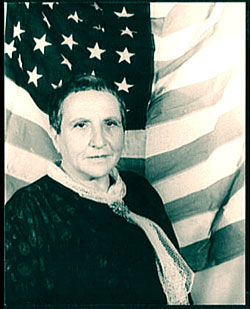
Someone on the Hansen Records/American Tapes message board just sent this youtube video (youtube rules!) of Sandy Denny. If you're not familiar with her...well, now there's this and then there's Google. I'll just say that she was an amazing, beautiful folksinger/songwriter from Britain who played a major part in the 60's folk scene and was in the band Fairport Convention for the good albums. She is, I think, better than Joan Baez and sadly overlooked.
Friday, July 14, 2006
Sandy Denny
Someone on the Hansen Records/American Tapes message board just sent this youtube video (youtube rules!) of Sandy Denny. If you're not familiar with her...well, now there's this and then there's Google. I'll just say that she was an amazing, beautiful folksinger/songwriter from Britain who played a major part in the 60's folk scene and was in the band Fairport Convention for the good albums. She is, I think, better than Joan Baez and sadly overlooked.
Monday, July 10, 2006
Fragments on Proust
These are very disconnected fragments/thoughts on Proust, which I wrote last year. I'm not sure why I'm resurrecting them. (I blame Justin!) But maybe something will come of it. Plus, there's never a bad time to think about Proust or look over past ideas. It's amazing the overcomplicated garbage the mind struggles to produce then weed through.
Beginning to prepare a presentation on Proust (Swann's Way). And, of course, I want to disuss too many things... Love, perversity, jealousy/desire, inversion (i.e the homosexual), time, object, light, nature/artifice, class relations, textuality, music and the refrain arghhh...
There's this: Thinking about Deleuze's notion of the refrain and Proust... also this: would that work in organizing some a sense of heirarchy among these issues: " These elective affinities between love and textuality exist because love and text are two of our most fundamental social acts. We make love and we make texts, and we make both in a seemingly endless series of imaginative variations." - Jerome McGann, _The Textual Condition_.
A sense of presence and absence, of course memory or mnemonics is key to all of this. So a psychoanalytic take on Proust's desires and his textual unfolding of those desires sees time as repetition. How does repetition work in terms of the fudamental fluidity to all these concepts in there relation to one another and to a sense of subjective and objective historical time? The refrain is fluid and yet calls up (back) emotions due to its continued presentness. Idea for a presentation: Psychoacoustics of Love: The Refrain, Class, and Jealousy in Proust. That's kind of a joke.
But what can be made of the relationship between aesthetic forms in Proust? Music, painting, poetry... the movement and influence betwen these, seems related to the levelling of Swann's mind ostensibely produced by the effect of his love for Odette (low class) and his disinterested love of the higher classes. Thus, aesthetics and social forms are paralelled with the levelling he performs in his mind in terms of the flow of time, somehow. All are one or co-eval in Swann's mind. Bergson and Freud's ideas of repetition might be key here. And/or Deleuze's _Difference and Repetition_ (which I haven't read yet). And what might this have to do with sexuality and the formal qualities of the text, the way it's written? Is there , perhaps a palimsestual effect? So that the line of music, in its fluidity (and what it is able to call up), and love itself are developed through these layers of aesthetic mediations?
From Roger Shattuck's _The Work and Its Author_: "No single theory or approach will make Proust easily and quickly available to all inquiring minds. The very resistance of his work to simplification and analysis constitutes its most evident general characteristic. Beyond this feature, however, we discover endless contradictions in the Search. Walt Whitman lived at peace with the fact that he contradicted himself. He said that he contained multitudes. Proust asks the next question. How much of his multitudinous self can a person be or embody at one time? The first answer is plain common sense: it all depends. It depends on many things, from chance and volition to memory and forgetting. The second answer is categorical. No matter how we go about it, we cannot be all of ourselves all at once. Narrow light beams of perception and of recollection illuminate the present and the past in vivid fragments. The clarity of those fragments is sometimes very great. They may even overlap and reinforce one another. However, to summon our entire self into simultaneous existence lies beyond our powers. We live by synechdoche, by cycles of being. More profoundly than any other novelist, Proust perceived this state of things and worked as an economist of the personality. In himself and in others he observed its fluctuations and partial realizations. Through habit and convention we may find security in "the immobility of the things around us." Yet it affords only temporary refuge. We yield with excitement, apprehension, and a deeper sense of existence to the great wheeling motion of experience. On a single page Proust refers to that endless shifting process as both "the secret of the future" and "the darkness we can never penetrate." He also has a word for it: our lot is "intermittence," the only steady state we know. Problem is though, this assumed somewhat unproblematically, an author behind the work."
Quote from Village Voice Literary supplement article (October 2003) on Proust and translation:
"I want to try to translate my own soul," he wrote, "if it doesn't die in the meantime." The article emphasizes Proust's complete self-absorption as the very method that allowed him to convey the world around him. But what of the critique and satire? These imply or require a distance. Proust himself said (somewhere) that his viewpoint/writing was telescopic in nature. "Longtemps, je me suis couché de bonne heure" (Proust). "For a long time I used to go to bed early" (Moncrieff). " For a long time, I went to bed early" (Davis). Michael has brilliantly pointed out to me the differences b/w the two translations. The Voice article defends the Davis as more accurate, true to the original. But, upon closer examination, as Michael notes, with Proust's temporal intent in mind, the Moncreiff seems to convey the *repetition* of the event, even in its historical nature, more adequately. "I used to go..." implies a past that is repeated "more than once", it has a sense of that "continuous present' of Stein's, whereas "I went" is cut off, unrepeatable and unreachable.
**********
I want to bring in succession and simultaneity to my analysis of Proust (these are also significant terms, and can be developed for a reading of Joyce ,or almost any other modernist text, of course). Sucession, the linearity of temporality, is related to music. Think about the notion of meter and timing mentioned in Proust (the bobbing of a head to rythms of music) the listening to music itself that plays such a prominent role in Proust is a trope pointing to a method of negotiating (parceling out) time. It is also relating a type of negotiated time to an affective response. Music, (metered time) is a spaced and temporalized event that creates a rhythm (a rhythmic space ?) allowing for feelings. Then there is the concept of simultaneity asociated with the visual arts. These are in effect false divisions to some extent, as both visual and musical arts take place in the space of time. Time and space are concomitant, or necessarily related, so if visual works seem simultaneously graspable (can be apprehended all at once) this can actually be broken down into a series of succesive moments. By the same token, successive notes occupy spaces, not just virtually or metaphorically, but in that music or sonic elements require physical space to reverberate in and by or through which they are produced (the piano or the violin are physical spaces). So then, Proust's immobility of the object approaches what Roger Shattuck calls the "intermittence" of the totality that shines through the successive and simultaneous pairings of the arts that Proust attempts to mnemonically recall. Through various aesthetically rendered images --the sonata fragment, the church spire, Odette's face as a Boticelli --the totality inscribed in the figure is the total picture of sight and sound, or space and meter. Thus we have a rhythm of the image, and/or the portrait of a sonic fragment; a conjoining of presumably separable aesthetic techniques through the mnemonic faculty of both sides of the aesthetic coin.
Extracted from "Running Backwards Into the Future" at: http://www.mystae.com/streams/science/running2.html I have found this:
"The alternations of generation and decay, the evolutions ever beginning over and over again, the infinite repetition of the cycles of celestial spheres - this all represents merely a certain fundamental deficit, in which materiality consists. Fill up this deficit: at once you suppress space and time, that is to say, the endlessly renewed oscillations around a stable equilibrium always aimed at, never reached. Things re-enter into each other. What was extended in space is contracted into pure Form. And past-present and future shrink into a single moment, which is eternity." [Henri Bergson, Creative Evolution]
To look at the Vinteuil sonata as a fragment is to look at it in terms of memory, and the relation here would be that it 'represents' the fragmentation of memory as well. It is then, not only a metaphor but a metonym. Perhaps?
Is reading in Proust (is reading Proust) entropic, i.e a virtual experience of moving towards a state of irreversable equilibrium? If this is the case, then the becoming of time, the discreteness of events experienced within the novel, and repeated by both involuntary memory-- the presence of the past evoked by repeated images and refrains-- are all a becoming-entropic. The instability, gaps and interruptions of temporality (the non-linearity of the present as it "contains" fragments of the past) is a movement toward that stillness that de Man speaks of which is the reading space. The lived time or elan vital must then contain the becoming-entropic in order to reach the still point that contains the space for reading. And if entropy is irreversable then the immobility of the object necessary to achieve memory (to search for it) is then ......
***********
I can't recall now exactly where I was headed with the entropy claim above. D'oh! But I do think there might be something to my idea despite the fact that I don't think entropy can be defined as heading toward an "irreversible equilibrium." I think the use made in communication or information theory of entropy might be applicable to what I'm trying to do in relation to Proust and the refrain. Wikipedia source on that issue: http://en.wikipedia.org/wiki/Information_entropy
******
The Bergsonian concept of duree, or "lived time", in relation succession and simultaneity is analogous to the relation between mind and body, or the psychological and the physiological. For Bergson the example of aphasia (the loss of speech capacity as a physical fact) proved a theory of independnece b/w mind and body:"From this observation Bergson concluded that memory, and so mind, or soul, is independent of body and makes use of it to carry out its own purposes." Bergson's notion of elan vital (duree) opposes mechanistic time There are two profoundly different ways of knowing, he claimed. The one, which reaches its furthest development in science, is analytic, spatializing, and conceptualizing, tending to see things as solid and discontinuous. The other is an intuition that is global, immediate, reaching into the heart of a thing by sympathy. The first is useful for getting things done, for acting on the world, but it fails to reach the essential reality of things precisely because it leaves out duration and its perpetual flux, which is inexpressible and to be grasped only by intuition. Bergson's entire work may be considered as an extended exploration of the meaning and implications of his intuition of duration as constituting the innermost reality of everything.
Beginning to prepare a presentation on Proust (Swann's Way). And, of course, I want to disuss too many things... Love, perversity, jealousy/desire, inversion (i.e the homosexual), time, object, light, nature/artifice, class relations, textuality, music and the refrain arghhh...
There's this: Thinking about Deleuze's notion of the refrain and Proust... also this: would that work in organizing some a sense of heirarchy among these issues: " These elective affinities between love and textuality exist because love and text are two of our most fundamental social acts. We make love and we make texts, and we make both in a seemingly endless series of imaginative variations." - Jerome McGann, _The Textual Condition_.
A sense of presence and absence, of course memory or mnemonics is key to all of this. So a psychoanalytic take on Proust's desires and his textual unfolding of those desires sees time as repetition. How does repetition work in terms of the fudamental fluidity to all these concepts in there relation to one another and to a sense of subjective and objective historical time? The refrain is fluid and yet calls up (back) emotions due to its continued presentness. Idea for a presentation: Psychoacoustics of Love: The Refrain, Class, and Jealousy in Proust. That's kind of a joke.
But what can be made of the relationship between aesthetic forms in Proust? Music, painting, poetry... the movement and influence betwen these, seems related to the levelling of Swann's mind ostensibely produced by the effect of his love for Odette (low class) and his disinterested love of the higher classes. Thus, aesthetics and social forms are paralelled with the levelling he performs in his mind in terms of the flow of time, somehow. All are one or co-eval in Swann's mind. Bergson and Freud's ideas of repetition might be key here. And/or Deleuze's _Difference and Repetition_ (which I haven't read yet). And what might this have to do with sexuality and the formal qualities of the text, the way it's written? Is there , perhaps a palimsestual effect? So that the line of music, in its fluidity (and what it is able to call up), and love itself are developed through these layers of aesthetic mediations?
From Roger Shattuck's _The Work and Its Author_: "No single theory or approach will make Proust easily and quickly available to all inquiring minds. The very resistance of his work to simplification and analysis constitutes its most evident general characteristic. Beyond this feature, however, we discover endless contradictions in the Search. Walt Whitman lived at peace with the fact that he contradicted himself. He said that he contained multitudes. Proust asks the next question. How much of his multitudinous self can a person be or embody at one time? The first answer is plain common sense: it all depends. It depends on many things, from chance and volition to memory and forgetting. The second answer is categorical. No matter how we go about it, we cannot be all of ourselves all at once. Narrow light beams of perception and of recollection illuminate the present and the past in vivid fragments. The clarity of those fragments is sometimes very great. They may even overlap and reinforce one another. However, to summon our entire self into simultaneous existence lies beyond our powers. We live by synechdoche, by cycles of being. More profoundly than any other novelist, Proust perceived this state of things and worked as an economist of the personality. In himself and in others he observed its fluctuations and partial realizations. Through habit and convention we may find security in "the immobility of the things around us." Yet it affords only temporary refuge. We yield with excitement, apprehension, and a deeper sense of existence to the great wheeling motion of experience. On a single page Proust refers to that endless shifting process as both "the secret of the future" and "the darkness we can never penetrate." He also has a word for it: our lot is "intermittence," the only steady state we know. Problem is though, this assumed somewhat unproblematically, an author behind the work."
Quote from Village Voice Literary supplement article (October 2003) on Proust and translation:
"I want to try to translate my own soul," he wrote, "if it doesn't die in the meantime." The article emphasizes Proust's complete self-absorption as the very method that allowed him to convey the world around him. But what of the critique and satire? These imply or require a distance. Proust himself said (somewhere) that his viewpoint/writing was telescopic in nature. "Longtemps, je me suis couché de bonne heure" (Proust). "For a long time I used to go to bed early" (Moncrieff). " For a long time, I went to bed early" (Davis). Michael has brilliantly pointed out to me the differences b/w the two translations. The Voice article defends the Davis as more accurate, true to the original. But, upon closer examination, as Michael notes, with Proust's temporal intent in mind, the Moncreiff seems to convey the *repetition* of the event, even in its historical nature, more adequately. "I used to go..." implies a past that is repeated "more than once", it has a sense of that "continuous present' of Stein's, whereas "I went" is cut off, unrepeatable and unreachable.
**********
I want to bring in succession and simultaneity to my analysis of Proust (these are also significant terms, and can be developed for a reading of Joyce ,or almost any other modernist text, of course). Sucession, the linearity of temporality, is related to music. Think about the notion of meter and timing mentioned in Proust (the bobbing of a head to rythms of music) the listening to music itself that plays such a prominent role in Proust is a trope pointing to a method of negotiating (parceling out) time. It is also relating a type of negotiated time to an affective response. Music, (metered time) is a spaced and temporalized event that creates a rhythm (a rhythmic space ?) allowing for feelings. Then there is the concept of simultaneity asociated with the visual arts. These are in effect false divisions to some extent, as both visual and musical arts take place in the space of time. Time and space are concomitant, or necessarily related, so if visual works seem simultaneously graspable (can be apprehended all at once) this can actually be broken down into a series of succesive moments. By the same token, successive notes occupy spaces, not just virtually or metaphorically, but in that music or sonic elements require physical space to reverberate in and by or through which they are produced (the piano or the violin are physical spaces). So then, Proust's immobility of the object approaches what Roger Shattuck calls the "intermittence" of the totality that shines through the successive and simultaneous pairings of the arts that Proust attempts to mnemonically recall. Through various aesthetically rendered images --the sonata fragment, the church spire, Odette's face as a Boticelli --the totality inscribed in the figure is the total picture of sight and sound, or space and meter. Thus we have a rhythm of the image, and/or the portrait of a sonic fragment; a conjoining of presumably separable aesthetic techniques through the mnemonic faculty of both sides of the aesthetic coin.
Extracted from "Running Backwards Into the Future" at: http://www.mystae.com/streams/science/running2.html I have found this:
"The alternations of generation and decay, the evolutions ever beginning over and over again, the infinite repetition of the cycles of celestial spheres - this all represents merely a certain fundamental deficit, in which materiality consists. Fill up this deficit: at once you suppress space and time, that is to say, the endlessly renewed oscillations around a stable equilibrium always aimed at, never reached. Things re-enter into each other. What was extended in space is contracted into pure Form. And past-present and future shrink into a single moment, which is eternity." [Henri Bergson, Creative Evolution]
To look at the Vinteuil sonata as a fragment is to look at it in terms of memory, and the relation here would be that it 'represents' the fragmentation of memory as well. It is then, not only a metaphor but a metonym. Perhaps?
Is reading in Proust (is reading Proust) entropic, i.e a virtual experience of moving towards a state of irreversable equilibrium? If this is the case, then the becoming of time, the discreteness of events experienced within the novel, and repeated by both involuntary memory-- the presence of the past evoked by repeated images and refrains-- are all a becoming-entropic. The instability, gaps and interruptions of temporality (the non-linearity of the present as it "contains" fragments of the past) is a movement toward that stillness that de Man speaks of which is the reading space. The lived time or elan vital must then contain the becoming-entropic in order to reach the still point that contains the space for reading. And if entropy is irreversable then the immobility of the object necessary to achieve memory (to search for it) is then ......
***********
I can't recall now exactly where I was headed with the entropy claim above. D'oh! But I do think there might be something to my idea despite the fact that I don't think entropy can be defined as heading toward an "irreversible equilibrium." I think the use made in communication or information theory of entropy might be applicable to what I'm trying to do in relation to Proust and the refrain. Wikipedia source on that issue: http://en.wikipedia.org/wiki/Information_entropy
******
The Bergsonian concept of duree, or "lived time", in relation succession and simultaneity is analogous to the relation between mind and body, or the psychological and the physiological. For Bergson the example of aphasia (the loss of speech capacity as a physical fact) proved a theory of independnece b/w mind and body:"From this observation Bergson concluded that memory, and so mind, or soul, is independent of body and makes use of it to carry out its own purposes." Bergson's notion of elan vital (duree) opposes mechanistic time There are two profoundly different ways of knowing, he claimed. The one, which reaches its furthest development in science, is analytic, spatializing, and conceptualizing, tending to see things as solid and discontinuous. The other is an intuition that is global, immediate, reaching into the heart of a thing by sympathy. The first is useful for getting things done, for acting on the world, but it fails to reach the essential reality of things precisely because it leaves out duration and its perpetual flux, which is inexpressible and to be grasped only by intuition. Bergson's entire work may be considered as an extended exploration of the meaning and implications of his intuition of duration as constituting the innermost reality of everything.
Saturday, July 08, 2006
Perfection/Imperfection
From Frederick Copleston's A History of Philosophy:
"Vauvenargues treats of the passions which, 'as Mr. Locke says', are all founded on pleasure and pain. These last are to be referred respectively to perfection and imperfection. That is, man is naturally attached to his being, and if his being were in no way imperfect but developed itself always without hindrance or imperfection, he would feel nothing but pleasure. As it is, we experience both pleasure and pain; and 'it is from the experience of these two contraries that we derive the idea of good and evil'. The passions (at least those which come 'by the organ of reflection' and are not immediate impressions of sense) are founded on 'the love of being or of the perfection of being, or on the feeling of our imperfection'. For example, there are people in whom the feeling of their imperfection is more vivid than the feeling of perfection, of capacity, of power. We then find passions such as anxiety, melancholy and so on. Great passions arise from the union of these two feelings, that of our power and that of our imperfection and weakness. For 'the feeling of our miseries impels us to go out of ourselves, and the feeling of our resources encourages us to do so and carries us thereto in hope'" (26).
Granted, Vauvenargues's definition of the relation between perfection and imperfection, which for him is equivalent to good/evil axis, seems to be antithetical to my claim that imperfection is not a pejorative, but that isn't my point of interest, for the moment. (After all, we don't know what he means by 'good' or 'evil'.) What I find resonant is the last sentence-- that, as constitutive of one another, the 'passions' of perfection and imperfection impel a departure, a 'becoming outside' of ourselves. Is this necessary relation then a founding desire for community? A foundation for a politics? A psychological motive for investment in ourselves in and as other(s)? I love the possibilites of this imbrication.
"Vauvenargues treats of the passions which, 'as Mr. Locke says', are all founded on pleasure and pain. These last are to be referred respectively to perfection and imperfection. That is, man is naturally attached to his being, and if his being were in no way imperfect but developed itself always without hindrance or imperfection, he would feel nothing but pleasure. As it is, we experience both pleasure and pain; and 'it is from the experience of these two contraries that we derive the idea of good and evil'. The passions (at least those which come 'by the organ of reflection' and are not immediate impressions of sense) are founded on 'the love of being or of the perfection of being, or on the feeling of our imperfection'. For example, there are people in whom the feeling of their imperfection is more vivid than the feeling of perfection, of capacity, of power. We then find passions such as anxiety, melancholy and so on. Great passions arise from the union of these two feelings, that of our power and that of our imperfection and weakness. For 'the feeling of our miseries impels us to go out of ourselves, and the feeling of our resources encourages us to do so and carries us thereto in hope'" (26).
Granted, Vauvenargues's definition of the relation between perfection and imperfection, which for him is equivalent to good/evil axis, seems to be antithetical to my claim that imperfection is not a pejorative, but that isn't my point of interest, for the moment. (After all, we don't know what he means by 'good' or 'evil'.) What I find resonant is the last sentence-- that, as constitutive of one another, the 'passions' of perfection and imperfection impel a departure, a 'becoming outside' of ourselves. Is this necessary relation then a founding desire for community? A foundation for a politics? A psychological motive for investment in ourselves in and as other(s)? I love the possibilites of this imbrication.
Friday, July 07, 2006
Dusty Groove

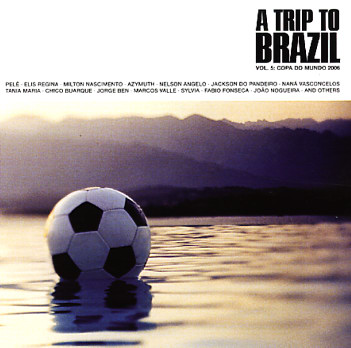
I know I said I was going to put upstuff about 1) Brent Edwards talk and 2) musings on Proust and temporality, but for now I want to direct your attention to the Dusty Groove website. DG is a record distribution/store out of Chicago and their fab listings of new arrivals in the soul/funk vein are to drool over. And isn't this album cover awesome!? How fitting (except no Brazil in the finals this year...)
Tuesday, July 04, 2006
Monday, July 03, 2006
Love, friendship, community
An interesting discussion at Long Sunday on Hannah Arendt and her controversial response to Gershom Scholem's admonishment that she did not have Ahabath Israel-- "love of the Jewish People." ( I've always admired Arendt in this instance, it led, in great part, to my larger interest in her work--what are the conditions that the mind must engage in in order for it, for "us," to think of/against/with/beyond "our own.") This aligns interestingly with Kasey Mohammad's response on limetree to Lisa Robertson's recent journal post on friendship and community at the Poetry Foundation. (It's really worthwhile reading her posts in their entirety; she is truly amazing, one of my idols, and Kasey's response is very interesting, illuminating.)
Williams on Stein
"Either, we have been taught to think, the mind moves in a logical sequence to a definite end which is its goal, or it will embrace movement without goal other than movement itself for an end and hail "transition" only as supreme.
Take your choice, both resorts are an improper description of the mind in fullest play.
If the attention could envision the whole of writing, let us say, at one time, moving over it in swift and accurate pursuit of the modern imperative at the instant when it is most to the fore, something of what actually takes place under an optimum of intelligence could be observed. It is an alertness not to let go of a possibility of movement in our fearful bedazzlement with some concrete and fixed present. The goal is to keep a beleaguered line of understanding which has movement from breaking down and becoming a hole into which we sink decoratively to rest."
You can read it in its entirety here
Wednesday, June 28, 2006
Sites of imperfection
This is an old post I've been saving as a draft for some (no) reason. I actually forgot about it, and since I feel too lazy to write anything new.... I have examples to add from Benjamin and Darwin, but that'll have to wait since I don't have the books here in Ithaca.
The dialectic of public/private space is key to understanding Benjamin's style and theory. Interior spaces: the mind, apartments, rooms, dreams, are always immediately and complexly juxtaposed and interwoven within and alongside public frames of reference. What I find very interesting about the use of space is the half-finished or incomplete quality not only of the spatial dialectic employed but the material incompleteness of the spaces he chooses to focus on, i.e., their constructedness. The incompleteness or the open-ended construction of his work and the works he valorizes are what I would call, sites of imperfection. Imperfection is not meant here in the pejorative sense; rather, it is a pre-condition for the evolution of forms. By aligning imperfection with incompletion a series of dialectical constellations appear: interiority/exteriority: complete/incomplete, open/closed, these all have different,yet complementary, spatial valences. Thus, as correspondences, these constellations produce the mutable forms of Benjamin's critical/aesthetic work; they serve as both critical content and aesthetic form; that is, the works politics as well as its poetics is an ever-evolving (and necessarily imperfect) mode of production/construction--a dialectical evolution of form and content.
To my mind, the efficacy of multiple sites of imperfection is all over, to begin with, Darwin's theory of evolution. This is nowhere, as far as I know, explicitly stated in Darwin's theory. That is, he doesn't ever simply say evolution = imperfection. But it is everywhere implied. (It was in Cannon Schmitt's seinar on epistemologies of evolution that I first started thinking about imperfection as a useful tool for approaching aesthetic/cultural forms.) And it is in the radical forms of the avant garde that I think we may be able to put the concept to use. There are a lot of implications here, which I will try to unfold at some point. For now I'll just make a sweeping and general claim: for Benjamin, the perception/cognition of these imperfect sites produces modernity as the ground for new forms of living. Thus we have Benjamin the Surrealist.
(Justin, I'd like to hear what you have to say on this. I had you in mind when I wrote it, in a way.)
The dialectic of public/private space is key to understanding Benjamin's style and theory. Interior spaces: the mind, apartments, rooms, dreams, are always immediately and complexly juxtaposed and interwoven within and alongside public frames of reference. What I find very interesting about the use of space is the half-finished or incomplete quality not only of the spatial dialectic employed but the material incompleteness of the spaces he chooses to focus on, i.e., their constructedness. The incompleteness or the open-ended construction of his work and the works he valorizes are what I would call, sites of imperfection. Imperfection is not meant here in the pejorative sense; rather, it is a pre-condition for the evolution of forms. By aligning imperfection with incompletion a series of dialectical constellations appear: interiority/exteriority: complete/incomplete, open/closed, these all have different,yet complementary, spatial valences. Thus, as correspondences, these constellations produce the mutable forms of Benjamin's critical/aesthetic work; they serve as both critical content and aesthetic form; that is, the works politics as well as its poetics is an ever-evolving (and necessarily imperfect) mode of production/construction--a dialectical evolution of form and content.
To my mind, the efficacy of multiple sites of imperfection is all over, to begin with, Darwin's theory of evolution. This is nowhere, as far as I know, explicitly stated in Darwin's theory. That is, he doesn't ever simply say evolution = imperfection. But it is everywhere implied. (It was in Cannon Schmitt's seinar on epistemologies of evolution that I first started thinking about imperfection as a useful tool for approaching aesthetic/cultural forms.) And it is in the radical forms of the avant garde that I think we may be able to put the concept to use. There are a lot of implications here, which I will try to unfold at some point. For now I'll just make a sweeping and general claim: for Benjamin, the perception/cognition of these imperfect sites produces modernity as the ground for new forms of living. Thus we have Benjamin the Surrealist.
(Justin, I'd like to hear what you have to say on this. I had you in mind when I wrote it, in a way.)
Monday, June 26, 2006
"Lacking the Machinery"
"There are those who argue that people can never understand consciousness. The mystery is too deep. Colin McGinn, a philosopher from Rutgers University, argues that because our brains are products of evolution, they have cognitive limitations. Just as rats and monkeys cannot even conceive of quantum mechanics, humans may be prohibited from understanding certain aspects of existence, such as the relation between mind and matter. He says that for humans to grasp how subjective experience arises from matter might be like "slugs trying to do Freudian psychoanalysis--they just don't have the conceptual equipment." Consciousness, in other words, may remain forever beyond human understanding."
From one of my favorite sites, Cyberarts .
A Sad Day for Sad Bears

I love the BBC News.... Here's a lovely little article on Bruno the Bear. My favorite line: "The shooting has happened. The bear is dead." Why do I find this both tragic and funny? It sounds like a line out of a Herzog movie--so German. And I can't help thinking about The World According to Garp and the story of the Viennese bears....
Bruno the bear shot dead in Alps
Wild bears once roamed widely across much of Europe
Hunters in the Bavarian Alps have shot dead a brown bear called Bruno after spending weeks trying to find it.
Earlier the German authorities had said the bear could be shot because it posed a danger to humans.
"The shooting has happened. The bear is dead," said Bavaria's government bear expert Manfred Woelfl. Hunters found it early on Monday near Spitzingsee.
The bear had been blamed for killing dozens of sheep. It had crossed the Alps into Germany from Italy in May.
In the German town of Kochel it had also raided a beehive and a rabbit hutch.
A pack of Finnish tracking dogs was brought in to capture Bruno alive, but they failed to corner it. The plan was to shoot the bear with a narcotic dart.
Bruno was the first wild bear to be sighted in Germany since 1835.
The animal was part of an Italian programme to reintroduce bears to the Alps.
Sunday, June 25, 2006
blogs I should have been reading
Michael mentioned the Theoria blog to me a while back and I was like, "yeah, yeah, I'm sure it's brilliant." Well, it is. I extra like it b/c I found it by googling Habermas and Cassirer and found that he (or she, don't know) detests, for the most part, Habsey. Good. I was just starting to waver.....
More on why Habermas sucks when I return from theory camp.
The ABC's of Kant
I'll start with R (taken from Howard Caygill's _A Kant Dictionary_):
reflective judgement
In the first and second introductions to Critique of Judgement Kant distinguishes between determinant and reflective forms of judgment. Judgement in general is described as 'the faculty of thinking the particular as contained under the universal', and if the universal is already given 'then the judgement which subsumes the particular under it is determinant (CJ sec IV). If, on the other hand, 'only the particular is given and the universal has to be found for it, then the judgement is simply reflective (ibid). The reflective judgement 'is compelled to ascend from the particular in nature to the universal' and is, Kant says, 'in need of a principle'. This principle cannot be universal, since this would make the judgement determinant, but is located by Kant in judgement proposing to itself the reflective principle of the 'finality of nature'. In the FI sec V-'Of Reflective Judgment'-Kant is rather more specific. He suggests that judgment be regarded either as a capacity for reflecting on a given representation according to a principle, or as a capacity for making concepts determinant by means of an empirical representation. The former 'compare[s] and combine[s] given representations either with other representations, or with one's cognitive powers...', while the latter schematizes given concepts. In the former case, where no apprpriate concept is given the judgement proceeds reflectively, *either* by means of comparing and combining concepts with each other according to the 'universal but at the same time undefined principle of a purposive, systematic ordering of nature'-the 'technic of nature'-*or* by comparison and combination with the harmonious play of the cognitive powers (sec V). The former yields reflective teleological judgements the latter reflective aesthetic judgements The analytic and dialectic of these judgements form the two major sections of CJ.
Kant hints on occasion in CJ that reflective judgements are in some sense prior to determinate judgement. It is they which form a bridge between the realms of theoretical and practical reason and their judgements. This suggestion proved immensely fertile, with writers such as Schelling (1800) and Nietzsche (1901) attempting to develop further Kant's allusive hints of a potential post-critical metaphysics based on reflective judgement. The theme has returned to prominence in the work of Arendt (1989)-who conceives of political judgement on the basis of reflective judgement-and also Lyotard (1983), who has used the reflective judgement as a means of questioning the dogmatic, determinant structures of judgement prevalent in modern societies. Both thinkers are struck by the potential enhancement of freedom implied in making judgements in the absence of a given law.
reflective judgement
In the first and second introductions to Critique of Judgement Kant distinguishes between determinant and reflective forms of judgment. Judgement in general is described as 'the faculty of thinking the particular as contained under the universal', and if the universal is already given 'then the judgement which subsumes the particular under it is determinant (CJ sec IV). If, on the other hand, 'only the particular is given and the universal has to be found for it, then the judgement is simply reflective (ibid). The reflective judgement 'is compelled to ascend from the particular in nature to the universal' and is, Kant says, 'in need of a principle'. This principle cannot be universal, since this would make the judgement determinant, but is located by Kant in judgement proposing to itself the reflective principle of the 'finality of nature'. In the FI sec V-'Of Reflective Judgment'-Kant is rather more specific. He suggests that judgment be regarded either as a capacity for reflecting on a given representation according to a principle, or as a capacity for making concepts determinant by means of an empirical representation. The former 'compare[s] and combine[s] given representations either with other representations, or with one's cognitive powers...', while the latter schematizes given concepts. In the former case, where no apprpriate concept is given the judgement proceeds reflectively, *either* by means of comparing and combining concepts with each other according to the 'universal but at the same time undefined principle of a purposive, systematic ordering of nature'-the 'technic of nature'-*or* by comparison and combination with the harmonious play of the cognitive powers (sec V). The former yields reflective teleological judgements the latter reflective aesthetic judgements The analytic and dialectic of these judgements form the two major sections of CJ.
Kant hints on occasion in CJ that reflective judgements are in some sense prior to determinate judgement. It is they which form a bridge between the realms of theoretical and practical reason and their judgements. This suggestion proved immensely fertile, with writers such as Schelling (1800) and Nietzsche (1901) attempting to develop further Kant's allusive hints of a potential post-critical metaphysics based on reflective judgement. The theme has returned to prominence in the work of Arendt (1989)-who conceives of political judgement on the basis of reflective judgement-and also Lyotard (1983), who has used the reflective judgement as a means of questioning the dogmatic, determinant structures of judgement prevalent in modern societies. Both thinkers are struck by the potential enhancement of freedom implied in making judgements in the absence of a given law.
Friday, June 23, 2006
friendly fighting
Considering that part of the seminar I'm taking with Amanda Anderson is concerned with the possibility and efficacy of political discourse, communication, argument etc., I found this quote from Montaigne interesting. Before I transcribe it I also want to mention that it was interesting that, recently, I fell into a discussion with a group of students here, the majority of whom happened to be from other countries--Australia, France, Ireland, Germany, Britain (and others, none of whom are in my seminar, as a matter of fac--in which we discussed "impolite" argument. (It was in response to a lecture by Bruno Bosteels about Badiou where quite a few folks had difficulty Bosteel's argument but felt constrained by the forum--one is supposed to be polite, but how to get one's disagreement across without, at some level, risking precisely that.) Everyone agreed that it was more fun, interesting, even honest to ask a fairly aggressive and straightforward question. I think that this does indeed have soemthing to do with the crowd I was talking to--their being primarily European ; Americans are so afraid of argument. To be an interlocutor sometimes requires, we agreed, disagreeing for the sake of learning. So here's Montaigne on the subject (in the context of friendship, which puts a different spin on it, perhaps):
I can put up with being roughly handled by my friends'You are an idiot! You are raving!' Among gentlemen I like people express themselves heartily, their words follow wherever their thoughts lead. We ought to toughen and fortify our ears against being seduced by the sound of polite words. I like strong, intimate, manly fellowship which rejoices in sharp vigorous exchanges just as love rejoices in bites and scratches which draw blood. It is not strong enough nor magnanimous enough if it is not argumentative, if it is all politeness and art; if it is afraid of clashes and walks hobbled. *Neque eim disputari sine reprehensione potest* [It is impossible to debate without refuting].
Doesn't this sound homoerotic, even sado-masochistic?... Paper idea: The Homoerotic Discourse of Friendship and Debate in Montaigne's Essays.
I can put up with being roughly handled by my friends'You are an idiot! You are raving!' Among gentlemen I like people express themselves heartily, their words follow wherever their thoughts lead. We ought to toughen and fortify our ears against being seduced by the sound of polite words. I like strong, intimate, manly fellowship which rejoices in sharp vigorous exchanges just as love rejoices in bites and scratches which draw blood. It is not strong enough nor magnanimous enough if it is not argumentative, if it is all politeness and art; if it is afraid of clashes and walks hobbled. *Neque eim disputari sine reprehensione potest* [It is impossible to debate without refuting].
Doesn't this sound homoerotic, even sado-masochistic?... Paper idea: The Homoerotic Discourse of Friendship and Debate in Montaigne's Essays.
Monday, June 19, 2006
The view
Saturday, June 03, 2006
specific discontinuities
It is not that I'm uninterested in or unsympathetic to the concern for finding and elaborating discontinuity, flows, ruptures, etc. I am just concerned that these don't turn into generalizable categories in their own right; I am interested, that is, in the specific application of discontinuity, the specific facts (historical, material) of rupture.
Foucault:
We must ask ourselves what purpose is ultimately served by this suspension of all the accepted unities, if, in the end, we return to the unities we pretended to question at the outset. In fact, the systematic erasure of all given unities enables us first of all to restore to the statement the specificty of its occurence, and to show that discontinuity is one of those great accidents that create cracks not only in the geology of history, but also in the simple facts of the statement; it emerges in its historial irruption; what we try to examine is the incison it makes, that irreducible--and very often tiny--emergence. However banal it may be, however unimportant its consequences may appear to be, however quickly it may be forgotten after its appearance, however little heard or however badly deciphered we may suppose it to be, a statement is always an event that neither the language (langue) nor the meaning can quite exhaust. It is certainly a strange event: first, because on the one hand it is linked to the gesture of writing or to the articulation of speech, and also on the other hand it opens up to itself a residual existence in the field of a memory, or in the materiality of manuscripts, books, or any other form of recording; secondly, because like every event, it is unique, yet subject to repetition, transformaton, and reactivation; thirdly, because it is linked not only to the situations that provoke it, and to the consequences that it gives rise to, but at the same time, and in accordance with a quite different modality, to the statements that precede and follow it. (28 The Archeology of Knowledge).
Foucault:
We must ask ourselves what purpose is ultimately served by this suspension of all the accepted unities, if, in the end, we return to the unities we pretended to question at the outset. In fact, the systematic erasure of all given unities enables us first of all to restore to the statement the specificty of its occurence, and to show that discontinuity is one of those great accidents that create cracks not only in the geology of history, but also in the simple facts of the statement; it emerges in its historial irruption; what we try to examine is the incison it makes, that irreducible--and very often tiny--emergence. However banal it may be, however unimportant its consequences may appear to be, however quickly it may be forgotten after its appearance, however little heard or however badly deciphered we may suppose it to be, a statement is always an event that neither the language (langue) nor the meaning can quite exhaust. It is certainly a strange event: first, because on the one hand it is linked to the gesture of writing or to the articulation of speech, and also on the other hand it opens up to itself a residual existence in the field of a memory, or in the materiality of manuscripts, books, or any other form of recording; secondly, because like every event, it is unique, yet subject to repetition, transformaton, and reactivation; thirdly, because it is linked not only to the situations that provoke it, and to the consequences that it gives rise to, but at the same time, and in accordance with a quite different modality, to the statements that precede and follow it. (28 The Archeology of Knowledge).
Wallace Stevens?
Which Famous Modern American Poet Are You?
You are Wallace Stevens. You love everything, especially the sound of things. Too bad you are so obscure that at times even you don't understand what the hell you have written.
Take this quiz!
Quizilla |
Join
| Make A Quiz | More Quizzes | Grab Code
Wednesday, May 31, 2006
Turbulence House

Geoff Huth (whose blog and work I love) mentions the house featured on the cover of last Sunday's NYTimes magazine. I set it aside to read and now really need to get to it. The house was designed by Steven Holl who, among other things, also designed the Cranbrook Institute of Science. (Click on his name to see more beautiful pictures of the house.) I was just wandering around Cranbrook a few days ago, but I somehow missed the science institute; I'm inspired to go back, pronto. Even more interesting is the fact that Turbulence House is owned by the artist Richard Tuttle and the poet Mei Mei Berssenbrugge. I love both of them, but I didn't know they were a couple. Now I realize how "in conversation" their work's are both with each other and with concepts of architecture. Here's a work by Berssenbrugge that must be in direct conversation with the space and physical/intellectual sensations produced in and around Turbulence House:
You could be thinking about your physical placement, what can be a continuum and what is chance. You place yourself innately on a mesa. There are blue hills at each horizon, the light falls copiously onto your open space, the path of the sun and the planets are proportioned around you.
The source of the balance is a sense perception. Your perception of your location is not contingent, but accords with an idea of location inside you, that turns in you like a gyroscope, as you are moving.
I believe in this sense perception of place, because I experience it.
It may be a sense of the shape of a space, or of the balance of features of the space, or it may be a sense of a point on the earth in relation to forces in the earth, which may be affected by stars and planets. Or, it may be in relation to stars and planets.
November 9.
So that the place would sit in me, its wide space with sun, as what it would be in my memory of this time. And how it would be perceived is a matrix of how you were with some people around you, not agents but catalyst or fuel for the perception of light on a wide space, so free as to be impersonal in the company, implacable and impersonal.
November 10.
She would remember that it was a place of the wind. She would think that she would remember the site of sun, and light without sound or without value, but her body is pushed and drawn on by the force of wind on the ridge, every day, so that someday she would remember that she had lived in wind.
The wind can be in the future, a direction, as if there were time, because it comes from somewhere. Because it draws you somewhere, it is the time or space that is the next thing somewhere among the materials of a space or at a time. Because it might be seen as an expression of the forces making it, which push on you or draw from you, it is an expression to everything it is not, and you are reminded you are what it is not, and this expression deters you or abstains from you as a space, when the wind is pushing all night or on a sunny day against the windows and walls of your house.
Then, this expression of being what something is not, joins you with a piece of leaning yellow grass in low sun, or it abstains you from the expression, as if you are more becoming in your mind what you are looking at than what you are feeling.
November 11.
You would be able to see the meaning or whole of the space between the objects on the table, which before had been random space between the fork and the salt crystal.
Now you can see the meaning or the whole of the space between rods of illuminated streaks of clouds at sunset, zooming this way and that, and the volume and vector between them. From you to the horizon gains a meaning. Something happens to you, it is time moving, and you can see them as a whole thing and not the space between one cloud and another that appear on the same plane because of the same color of light on them.
November 12.
We walked in the dry riverbed. Water had left the sand in sweeps of lines and currents, fronds of tamarack drifted in. I want to call it pollen of tamarack drifting into patterns of sand made by currents of water, lift drifts of events in time. But it is more like the bits of tamarack frond, broken by the current and drifting into patterns or record was the time, because of there being something besides a pattern to perceive time by means of.
A skin of tufts of yellow grasses on a hillside threw off the lateral light, and threw down their delicate shadows. The flank of a hill suggesting a living creature.
November 13.
You can see the complexity of autumn plants and trees in the canyon below you. It is late autumn. The yellow and brown jumble of the foliage. Most of the leaves have fallen from the trees and bushes into heaps and drifts on either side of the stream. We are accustomed to think of disorganization and of increasing disorganization as a vector toward entropy. The pleasurable complexity of matter in the canyon would seem to be entropic, except for its beauty. It looks like death. It seems entropic, but it is not entropic, as biological death may not be. And I wonder if the beauty is an innate apprehension of the ongoingness, or "other" than entropy, of that sight?
November 14.
I see the honey moon rise from a bare horizon, after the sunset behind a mountain. I was waiting for the moon. It was a test and not a knowledge of the movement of the risings, by which I am try- ing to judge where I am on this plain. We are trying to understand if the moon sets in a different place than the sun, the sun which is moving and moving down the horizon. Soon, its colored glow will silhouette a mountain called The Wave.
Arrests at Gay Pride March in Moscow
Doug Ireland reports on recent events in Moscow, and a lovely quote from Moscow's Mayor Luzhkov: ”I believe that such a parade is inadmissible in our country above all for moral considerations. People should not make public their deviations.“
Friendship and Thinking
I "stole" this from Spurious (see blogroll) and feel compelled to reproduce it here after a great conversation with Shashi last night that exactly touched on these themes (a continuation of the experience and self-reflexivity discussion as well as my/some of our ongoing issues w/ writing).
Blocks and Breaks
First sign of a thinker: the insistence there is a gap between them and their thought. Who are they after all? 'I'm not very interesting', said X. to W. and I two years ago, 'but the book's interesting'. He insisted on that. But W. and I scared him when we asked him to become our leader.
Another sign: the thinker experiences blocks and breaks when it comes to writing. Sometimes they write, and it is like the flash of lightning: everything is written, and all at once. But that 'sometimes' follows the darkness of many years. For a long time, there was no writing; and then - there it is, all at once. To write as by a single stroke - what does that mean? To write after thinking - but thinking is not the word, unless thinking happens in those blocks, those breaks. Unless thinking begins by facing its impossibility and then enduring it, riding it, that same impossibility, folding it into something that might be lived.
Not like us, I said to W., everything is possible for us. But for them, thinking is a risk, it is exposure. A kind of aloneness, that separates them from others, even if it allows them to return - even if it is all about return. I tell W. for the hundredth time about my two great conversations with Y., when he spoke of the category of repetition in Kierkegaard. The first time, with great urgency, on an afternoon when the sun blazed down. It changed everything for me, I told W. And then the second time, the following year, when he spoke to me of his relationship with his son. Pure repetition, he said, with incalculable joy. Did I understand him? I'm not sure. But he set fire to the word repetition; henceforward it would blaze, and Kierkegaard's book became the urbook, the first book, from which others had cooled and fallen.
And the third time we could have spoken? W. and I remember it well. W. was speaking to Y, and I was not. Someone else - who was it? - insisted on talking to me. I was aghast; I moved my chair closer to W. and Y., I tried to overhear, to participate, but I had no chance. It was a great conversation, said W., unhelpfully. A great conversation! But I was being monopolised; someone thought I had something to offer. Couldn't she see I had nothing to offer? Me, of all people! When all I wanted was to be drawn again into the circle of conversation. To listen as new words were set on fire; as books of philosophy became those scorched paths through which the thinker - thought in person - had blazed.
And a third sign, which is always marvellous to W. and I: the thinker has an absolute pellucidity with respect to their ordinary life. It was like looking into the clearest of rivers, I said to W. after speaking to X. And it was true: how frankly and absolutely X. spoke of himself, and to everyone who asked. Frankly, absolutely: as though life was something to look through, and not to live. Or that life was lived at another level, at that of blocks, of breaks - a level of which we had no idea.
Complete seriousness, said W., not like us. He was right: we are the apes of thought. Complete seriousness! But isn't there a sense for them, the thinkers, that there is a lightness in seriousness; that thinking is a kind of beatitude. What will W. and I know of the infinite pleasure of thought, thought's laughter, which laughs in the eyes of the thinker? They know more about joy than us, I said to W. There's no doubt about that. The play of thought, the game of thought: Blanchot's phrase of which W. and I always remind ourselves.
Remember what he wrote about Bataille, says W. for the hundredth time. We remember: absolute seriousness, absolute play, both at once. And I remember Blanchot's letters to Bataille (those that Bataille did not burn): almost contentless, expressing solicitude, expressing friendship, as friendship became a name for the play of thought between them.
Blocks and breaks: but now thought was a kind of turning, that orientation where speech, too heavy with itself, was turned to the other. A kind of shuttling (though Bataille's letters do not survive) where speech lightens itself as it slips from the one to the other. Speech? Is that the word? Rather, the 'there is' of speech as it returns from the impossibility endured by thought. As it returns after the longest absence, having traversed the greatest distance, but still young, younger than either thinker, announcing only itself, and the possibility of the impossible.
And now we remember Z., around whom the room becomes quiet. She speaks, and everyone is quiet. Here is a thinker; here is thought, in person. She lives differently to us, we know that. She lives a different life, and silence is a sign of that difference. What does it mean, that she does not speak? What does it mean, when her speech is light, quiet? Everyone in the room knows: what is spoken so lightly burns with the greatest urgency. The room is blazing, but these flames are like those of the aurora borealis. Thought is here; thinking is here, and we are touched by a cold and fiery hand by what it is impossible to think.
Touched: and it seems for a moment that we have faces with which to face the impossible; that we can be brought there, to the edge of cold and fire. The dross is burnt away; the whole of our lives become clear and still, like pools of water in Northern forests. The play of light across us, across the whole of our lives: we live; we are alive. Everyone in the room knows it. The room - but this is scarcely a room. An expanse - we lean in, listening. She speaks so quietly, and we must be more quiet than her speech. To be that quiet! To listen, with the whole of our being!
Thought is here, we know that. Thought that needs nothing to think, that thinks itself, like a star that has burned its substance away. Philosophy is burning. All thought is burning. And don't we each burn from that same burning? Hasn't it set something of ourselves alight? Wow, I said to W. when we came out. We sat in the courtyard, completely quiet. No more chattering. No apishness. Wow: I said nothing, I said everything. To share what had happened was only to repeat that non-word.
Blocks and Breaks
First sign of a thinker: the insistence there is a gap between them and their thought. Who are they after all? 'I'm not very interesting', said X. to W. and I two years ago, 'but the book's interesting'. He insisted on that. But W. and I scared him when we asked him to become our leader.
Another sign: the thinker experiences blocks and breaks when it comes to writing. Sometimes they write, and it is like the flash of lightning: everything is written, and all at once. But that 'sometimes' follows the darkness of many years. For a long time, there was no writing; and then - there it is, all at once. To write as by a single stroke - what does that mean? To write after thinking - but thinking is not the word, unless thinking happens in those blocks, those breaks. Unless thinking begins by facing its impossibility and then enduring it, riding it, that same impossibility, folding it into something that might be lived.
Not like us, I said to W., everything is possible for us. But for them, thinking is a risk, it is exposure. A kind of aloneness, that separates them from others, even if it allows them to return - even if it is all about return. I tell W. for the hundredth time about my two great conversations with Y., when he spoke of the category of repetition in Kierkegaard. The first time, with great urgency, on an afternoon when the sun blazed down. It changed everything for me, I told W. And then the second time, the following year, when he spoke to me of his relationship with his son. Pure repetition, he said, with incalculable joy. Did I understand him? I'm not sure. But he set fire to the word repetition; henceforward it would blaze, and Kierkegaard's book became the urbook, the first book, from which others had cooled and fallen.
And the third time we could have spoken? W. and I remember it well. W. was speaking to Y, and I was not. Someone else - who was it? - insisted on talking to me. I was aghast; I moved my chair closer to W. and Y., I tried to overhear, to participate, but I had no chance. It was a great conversation, said W., unhelpfully. A great conversation! But I was being monopolised; someone thought I had something to offer. Couldn't she see I had nothing to offer? Me, of all people! When all I wanted was to be drawn again into the circle of conversation. To listen as new words were set on fire; as books of philosophy became those scorched paths through which the thinker - thought in person - had blazed.
And a third sign, which is always marvellous to W. and I: the thinker has an absolute pellucidity with respect to their ordinary life. It was like looking into the clearest of rivers, I said to W. after speaking to X. And it was true: how frankly and absolutely X. spoke of himself, and to everyone who asked. Frankly, absolutely: as though life was something to look through, and not to live. Or that life was lived at another level, at that of blocks, of breaks - a level of which we had no idea.
Complete seriousness, said W., not like us. He was right: we are the apes of thought. Complete seriousness! But isn't there a sense for them, the thinkers, that there is a lightness in seriousness; that thinking is a kind of beatitude. What will W. and I know of the infinite pleasure of thought, thought's laughter, which laughs in the eyes of the thinker? They know more about joy than us, I said to W. There's no doubt about that. The play of thought, the game of thought: Blanchot's phrase of which W. and I always remind ourselves.
Remember what he wrote about Bataille, says W. for the hundredth time. We remember: absolute seriousness, absolute play, both at once. And I remember Blanchot's letters to Bataille (those that Bataille did not burn): almost contentless, expressing solicitude, expressing friendship, as friendship became a name for the play of thought between them.
Blocks and breaks: but now thought was a kind of turning, that orientation where speech, too heavy with itself, was turned to the other. A kind of shuttling (though Bataille's letters do not survive) where speech lightens itself as it slips from the one to the other. Speech? Is that the word? Rather, the 'there is' of speech as it returns from the impossibility endured by thought. As it returns after the longest absence, having traversed the greatest distance, but still young, younger than either thinker, announcing only itself, and the possibility of the impossible.
And now we remember Z., around whom the room becomes quiet. She speaks, and everyone is quiet. Here is a thinker; here is thought, in person. She lives differently to us, we know that. She lives a different life, and silence is a sign of that difference. What does it mean, that she does not speak? What does it mean, when her speech is light, quiet? Everyone in the room knows: what is spoken so lightly burns with the greatest urgency. The room is blazing, but these flames are like those of the aurora borealis. Thought is here; thinking is here, and we are touched by a cold and fiery hand by what it is impossible to think.
Touched: and it seems for a moment that we have faces with which to face the impossible; that we can be brought there, to the edge of cold and fire. The dross is burnt away; the whole of our lives become clear and still, like pools of water in Northern forests. The play of light across us, across the whole of our lives: we live; we are alive. Everyone in the room knows it. The room - but this is scarcely a room. An expanse - we lean in, listening. She speaks so quietly, and we must be more quiet than her speech. To be that quiet! To listen, with the whole of our being!
Thought is here, we know that. Thought that needs nothing to think, that thinks itself, like a star that has burned its substance away. Philosophy is burning. All thought is burning. And don't we each burn from that same burning? Hasn't it set something of ourselves alight? Wow, I said to W. when we came out. We sat in the courtyard, completely quiet. No more chattering. No apishness. Wow: I said nothing, I said everything. To share what had happened was only to repeat that non-word.
Friday, May 26, 2006
Zizek on the Jew as symptom and Fascist social fantasy
From _The Sublime Object of Ideology_:
[...] At first sight it could seem that what is pertinent in an analysis of ideology is only the way it functions as a discourse, the way the series of floating signifiers is totalized, transformed by a unified field through the interventions of certain 'nodal points'. Briefly: the way the discursive mechanisms constitute the field of ideological meaning; in this perspective the enjoyment-in-signifier would be simply pre-ideological, irrelevant for ideology as a social bond. But the case of so-called 'totalitarianism' demonstrates what applies to every ideology, to ideology as such: the last support of the ideological effect (of the way an ideological network of signifiers 'holds' us) is the non-sensical, pre-ideological kernel of enjoyment. In ideology 'all is not ideology (that is ideological meaning)', but it is this very surplus which is the last support of ideology. That is why we could say that there are two complementary procedures of the 'criticism of ideology':
-one is *discursive*, the 'symptomal reading' of the ideological text bringing 'deconstruction' of the spontaneous experience of its meaning--that is, demonstrating how a given ideologcal field is a result of a montage of heterogeneous 'floating signifiers', of their totalization through the intervention of certain 'nodal points';--the other aims at extracting the kernel *enjoyment*, at articulating the way in which--beyond the field of meaning but at the same time internal to it--ideology implies, manipulates, produces a pre-ideological enjoyment structured in fantasy.
To exempify this necessity of supplementing the analysis of discourse with the logic of enjoyment we have only to look again at the special case of ideology, which is perhaps the purest incarnation of ideology as such: anti-semitism. To put it bluntly: 'Society doesn't exist', and the Jew is its symptom.
On the level of discourse analysis, it is not difficult to articulate the network of symbolic overdetermination invested in the figure of the Jew. First, there is displacement: the basic trick of anti-semitism is to displace social antagonism into antagonism between the sound social texture, social body, and the Jew as the force corroding it, the force of corruption. Thus it is not society itself which is 'impossible', based on antagonism--the source of corruption is located in a particular entity, the Jew. This displacement is made possible by the association of Jews with financial dealings: the source of exploitation and of class antagonism is located not in the basic relation between the working and ruling classes but in the relation between the 'productive' forces (workers, organizers of production...) and the merchants who exploit the 'productive' classes, replacing organic co-operation with class struggle.
This displacement is, of course, supported by condensation: the figure of the Jew condenses opposing features, features associated with lower and upper classes: Jews are supposed to be dirty and intellectual, volumptuous and impotent, and so on. What gives energy, so to speak, to the displacement is therefore the way the figure of the Jew condenses a series of heterogeneous antagonisms: economic (Jew as profiteer), political, (Jew as schemer, retainer of a secret power), moral-religious (Jew as corrupt anti-Christian), sexual (Jew as seducer of our innocent girls).... In short, it can easily be shown how the figure of the Jew is a symptom in the sense of coded message, a cypher, a disfigured representation of social antagonism; by undoing this work of displacement/condensation, we can determine its meaning.
But this logic of metaphoric-metonymic displacement is not sufficent to explain how the figure of the Jew captures our desire; to penetrate its fascinating force, we must take into account the way 'Jew' enters the framework of fantasy structuring our enjoyment. Fantasy is basically a scenario filling out the empty space of a fundamental impossibility, a screen masking a void. 'There is no sexual relationship', and this impossibility is filled out by the fascinating fantasy-scenario -- that is why fantasy is, in the last resort, always a fantasy of the sexual relationship, a staging of it. As such, fantasy is not to be interpreted, only 'traversed': all we have to do is experience how there is nothing 'behind' it, and how fantasy masks precisely this 'nothing'. (But there is a lot behind a symptom, a whole network of symbolic overdetermination, which is why the symptom involves its interpretation.)
It is now clear how we can use this notion of fantasy in the domain of ideology proper: here also 'there is no class relationship', society is always traversed by a antagonistic split which cannot be integrated into the symbolic order. And the stake of social-ideological fantasy is to construct a vision of society which *does* exist, a society which is not split by an antagonistic division, a society in which the relation between its parts is organic, complementary. The clearest case is, of course, the corporatist vision of Society as an organic Whole, a social Body in which different classes are like extremities, members each contributing to the Whole according to its function--we may say that 'Society as a corporate Body' is the fundamental ideological fantasy. How then do we take account of the distance between this corporatist vision and the factual society split by antagonistic struggles? The answer is, of course, the Jew: an external element, a foreign body introducing corruption into the sound social fabric. In short 'Jew' is a fetish which simultaneously denies and embodies the structural impossibility of 'Society': it is as if in the figure of the Jew this impossibility has acquired a positive, palpable existence--and that is why it marks the eruption of enjoyment in the social field.
The notion of sexual fantasy is therefore a necessary counterpart to the concept of antagonism: fantasy is precisely the way the antagonistic fissure is masked. In other words, *fantasy is a means for an ideology to take its own failure into account in advance.* The thesis of Laclau and Mouffe that 'Society doesn't exist', that the Social is always an inconsistent field structured around a constitutive impossibility, traversed by a central 'antagonism'-this implies that every process of identification conferring on us a fixed socio-symbolic identity is ultimately doomed to fail. The function of ideological fantasy is to mask this inconsistency, the fact that 'Society doesn't exist',and thus to compensate us for the failed identification.
The 'Jew' is the means, for Fascism, of taking into account, of representing its own impossibility: in its positive presence, it is only the embodiment of the ultimate impossibility of the totalitarian project--of its immanent limit. This is why it is insufficient t designate the totalitarian project as impossible, utopian, wanting to establish a totally transparent and homogeneous society--the problem is that in a way, totalitarian ideology *knows it*, recognizes it in advance:in the figure of the 'Jew' it includes this knowledge in its edifice. The whole Fascist ideology is structured as a struggle against the element which holds the place of the immanent impossibility of the Fascist project: the 'Jew' is nothing but the fetishistic embodiment of a certain fundamental blockage.
The'criticism of ideology' must therefore invert the linking of causality as perceived by the totalitarian gaze: far from being the positive cause of social antagonism, the 'Jew' is just the embodiment of a certain blockage--of the impossibility which prevents society from its full identity as a closed, homogeneous totality. Far from being the positive cause of social negativity, *the'Jew is a point at which social negativity as such assumes positive existence.* In this way we can articulate another formula of the basic procedure of the 'criticism of ideology',supplementing the one given above: to detect, in a given ideological edifice, the element which represents within its own impossibility. Society is not prevented from acheiving its full identity because of Jews: it is prevented by its own antagonistic nature, by its own immanent blockage, and it 'projects'this internal negativity into the figure of the 'Jew'. In other words, what is excluded from the Symbolic (from the frame of the corporatist socio-symbolic order) returns in the Real as a paranoid construction of the 'Jew'.
We can also see, now how 'going through' the social fantasy is likewise correlative to identification with a symptom. Jews are clearly a social symptom: the point at which immanent social antagonism assumes a positive form, erupts on to the social surface, the point at which it becomes obvious that society 'doesn't work', that the social mechanism 'creaks'. If we look at it through the frame of (corporatist) fantasy, the 'Jew' appears as an intruder who introduces from outside disorder, decomposition and corruption of the social edifice--it appears as an outward positive cause whose elimination would enable us to restore order, stability and identity. But in 'going through the fantasy' we must in the same move identify the symptom: we must recognize in the properties atrributed to 'Jew' the necessary product of our very social system; we must recognze in the 'excesses' attributed to 'Jews' the truth about ourslves. (124-128)
[...] At first sight it could seem that what is pertinent in an analysis of ideology is only the way it functions as a discourse, the way the series of floating signifiers is totalized, transformed by a unified field through the interventions of certain 'nodal points'. Briefly: the way the discursive mechanisms constitute the field of ideological meaning; in this perspective the enjoyment-in-signifier would be simply pre-ideological, irrelevant for ideology as a social bond. But the case of so-called 'totalitarianism' demonstrates what applies to every ideology, to ideology as such: the last support of the ideological effect (of the way an ideological network of signifiers 'holds' us) is the non-sensical, pre-ideological kernel of enjoyment. In ideology 'all is not ideology (that is ideological meaning)', but it is this very surplus which is the last support of ideology. That is why we could say that there are two complementary procedures of the 'criticism of ideology':
-one is *discursive*, the 'symptomal reading' of the ideological text bringing 'deconstruction' of the spontaneous experience of its meaning--that is, demonstrating how a given ideologcal field is a result of a montage of heterogeneous 'floating signifiers', of their totalization through the intervention of certain 'nodal points';--the other aims at extracting the kernel *enjoyment*, at articulating the way in which--beyond the field of meaning but at the same time internal to it--ideology implies, manipulates, produces a pre-ideological enjoyment structured in fantasy.
To exempify this necessity of supplementing the analysis of discourse with the logic of enjoyment we have only to look again at the special case of ideology, which is perhaps the purest incarnation of ideology as such: anti-semitism. To put it bluntly: 'Society doesn't exist', and the Jew is its symptom.
On the level of discourse analysis, it is not difficult to articulate the network of symbolic overdetermination invested in the figure of the Jew. First, there is displacement: the basic trick of anti-semitism is to displace social antagonism into antagonism between the sound social texture, social body, and the Jew as the force corroding it, the force of corruption. Thus it is not society itself which is 'impossible', based on antagonism--the source of corruption is located in a particular entity, the Jew. This displacement is made possible by the association of Jews with financial dealings: the source of exploitation and of class antagonism is located not in the basic relation between the working and ruling classes but in the relation between the 'productive' forces (workers, organizers of production...) and the merchants who exploit the 'productive' classes, replacing organic co-operation with class struggle.
This displacement is, of course, supported by condensation: the figure of the Jew condenses opposing features, features associated with lower and upper classes: Jews are supposed to be dirty and intellectual, volumptuous and impotent, and so on. What gives energy, so to speak, to the displacement is therefore the way the figure of the Jew condenses a series of heterogeneous antagonisms: economic (Jew as profiteer), political, (Jew as schemer, retainer of a secret power), moral-religious (Jew as corrupt anti-Christian), sexual (Jew as seducer of our innocent girls).... In short, it can easily be shown how the figure of the Jew is a symptom in the sense of coded message, a cypher, a disfigured representation of social antagonism; by undoing this work of displacement/condensation, we can determine its meaning.
But this logic of metaphoric-metonymic displacement is not sufficent to explain how the figure of the Jew captures our desire; to penetrate its fascinating force, we must take into account the way 'Jew' enters the framework of fantasy structuring our enjoyment. Fantasy is basically a scenario filling out the empty space of a fundamental impossibility, a screen masking a void. 'There is no sexual relationship', and this impossibility is filled out by the fascinating fantasy-scenario -- that is why fantasy is, in the last resort, always a fantasy of the sexual relationship, a staging of it. As such, fantasy is not to be interpreted, only 'traversed': all we have to do is experience how there is nothing 'behind' it, and how fantasy masks precisely this 'nothing'. (But there is a lot behind a symptom, a whole network of symbolic overdetermination, which is why the symptom involves its interpretation.)
It is now clear how we can use this notion of fantasy in the domain of ideology proper: here also 'there is no class relationship', society is always traversed by a antagonistic split which cannot be integrated into the symbolic order. And the stake of social-ideological fantasy is to construct a vision of society which *does* exist, a society which is not split by an antagonistic division, a society in which the relation between its parts is organic, complementary. The clearest case is, of course, the corporatist vision of Society as an organic Whole, a social Body in which different classes are like extremities, members each contributing to the Whole according to its function--we may say that 'Society as a corporate Body' is the fundamental ideological fantasy. How then do we take account of the distance between this corporatist vision and the factual society split by antagonistic struggles? The answer is, of course, the Jew: an external element, a foreign body introducing corruption into the sound social fabric. In short 'Jew' is a fetish which simultaneously denies and embodies the structural impossibility of 'Society': it is as if in the figure of the Jew this impossibility has acquired a positive, palpable existence--and that is why it marks the eruption of enjoyment in the social field.
The notion of sexual fantasy is therefore a necessary counterpart to the concept of antagonism: fantasy is precisely the way the antagonistic fissure is masked. In other words, *fantasy is a means for an ideology to take its own failure into account in advance.* The thesis of Laclau and Mouffe that 'Society doesn't exist', that the Social is always an inconsistent field structured around a constitutive impossibility, traversed by a central 'antagonism'-this implies that every process of identification conferring on us a fixed socio-symbolic identity is ultimately doomed to fail. The function of ideological fantasy is to mask this inconsistency, the fact that 'Society doesn't exist',and thus to compensate us for the failed identification.
The 'Jew' is the means, for Fascism, of taking into account, of representing its own impossibility: in its positive presence, it is only the embodiment of the ultimate impossibility of the totalitarian project--of its immanent limit. This is why it is insufficient t designate the totalitarian project as impossible, utopian, wanting to establish a totally transparent and homogeneous society--the problem is that in a way, totalitarian ideology *knows it*, recognizes it in advance:in the figure of the 'Jew' it includes this knowledge in its edifice. The whole Fascist ideology is structured as a struggle against the element which holds the place of the immanent impossibility of the Fascist project: the 'Jew' is nothing but the fetishistic embodiment of a certain fundamental blockage.
The'criticism of ideology' must therefore invert the linking of causality as perceived by the totalitarian gaze: far from being the positive cause of social antagonism, the 'Jew' is just the embodiment of a certain blockage--of the impossibility which prevents society from its full identity as a closed, homogeneous totality. Far from being the positive cause of social negativity, *the'Jew is a point at which social negativity as such assumes positive existence.* In this way we can articulate another formula of the basic procedure of the 'criticism of ideology',supplementing the one given above: to detect, in a given ideological edifice, the element which represents within its own impossibility. Society is not prevented from acheiving its full identity because of Jews: it is prevented by its own antagonistic nature, by its own immanent blockage, and it 'projects'this internal negativity into the figure of the 'Jew'. In other words, what is excluded from the Symbolic (from the frame of the corporatist socio-symbolic order) returns in the Real as a paranoid construction of the 'Jew'.
We can also see, now how 'going through' the social fantasy is likewise correlative to identification with a symptom. Jews are clearly a social symptom: the point at which immanent social antagonism assumes a positive form, erupts on to the social surface, the point at which it becomes obvious that society 'doesn't work', that the social mechanism 'creaks'. If we look at it through the frame of (corporatist) fantasy, the 'Jew' appears as an intruder who introduces from outside disorder, decomposition and corruption of the social edifice--it appears as an outward positive cause whose elimination would enable us to restore order, stability and identity. But in 'going through the fantasy' we must in the same move identify the symptom: we must recognize in the properties atrributed to 'Jew' the necessary product of our very social system; we must recognze in the 'excesses' attributed to 'Jews' the truth about ourslves. (124-128)
anti-semitism
I would just like to state, for the record, that using the term "yenta" and implying that it ascribes an inhuman or ratlike quality to a person (i.e. a woman) is, um, well, not only totally anti-semitic it's misogynistic as well. There's really no excuse for this kind of thing. I understand that the negative connotation is, in part, derived from the Yiddish etymology of the word, but for non-Jews (or for that matter Jews) to use it "against" someone is waaay over the line. The complex relationship many Jews have --post Holocaust-- to the (loss of) the Yiddish language is a very sensitive one, historically and psychologically. Thus, I have posted the long piece below on the subject in hopes that some kind of knowledge can be gained from my own negative and offended feelings on the use of Yiddish in anti-semitic ways, even if it's used by non-Jews "against" non-Jews, perhaps especially so. A couple other things. Beer which calls itself "He'brew" and which has an image on the carton of a hooked nosed Jew is repulsive, reaffirming Jewish stereotypes, and I question the desire for Jews to drink from this tainted well. And, just so ya know, Judaism and the "Passion" have nothing to do with one another. As Sarah would say... I'm just sayin' is all.
(Oh, and apologies for the f'ed up lineation. It'd take too long to juggle the lines properly.)
Published in the Jewish Quarterly, no.170, Summer 1998.
Popular wisdom has it that the Yiddish language is
making a comeback in the United States and elsewhere.
While I see no evidence of such a renaissance,
there is definitely a Yiddish phenomenon in American culture.
People are yearning for a connection to Yiddish as never before
- or, at least,differently from ever before.
I would like to try and describe the form of
this yearning, suggest a psychological reason for it,
and offer some speculations about the future.
Yiddish culture in America - like Gaul -
is divided into three parts:erudite, informed
and popular. Although my experiences at the university
level are fundamental to all my ideas about Yiddish,
I will focus on informed and popular cultural manifestations.
Concerning informed Yiddish culture, I notice
two remarkable developments:the proliferation
of communal activity, such as Yiddish festivals, and
Yiddish postings on the Web, notably the bulletin
board 'Mendele'. While notexclusively American
in its membership, Mendele was started in the US and,
from what I can tell, most of its membership is in
the US. Democratic inconcept and practice,
Mendele has a life of its own: participants freely
post news, questions, comments and responses to
other postings. The level of knowledge ranges
from ameratses to bekiyes; the temperature ranges from cool
to incendiary.
Last June, I followed a particularly engrossing
discussion on Mendele. The stimulus for this
exchange was an article by Michael Chabon in the June/July
1997 issue of Civilization, the magazine of the
Smithsonian Institute. Entitled
'Guidebook to a Land of Ghosts', the essay was
a meditation on the poignant irrelevance of
Uriel and Beatrice Weinreich's 1958 Say it in
Yiddish. Chabon, who does not know Yiddish,
mused about the futility of such phrases as:
What is the flight number?
I need something for a tourniquet
and
Can I go by boat/ferry to . . .?
Where and when, in 1958 and subsequently, would
these expressions ever have been useful? Chabon asks.
After playing around for a while with the notion
of a Mediterranean Yiddishland or one in Alaska
(or Alyeska), he gets to the heart of his argument:
The Weinreichs are taking us home, to the
'old country'. To Europe. In this Europe the
millions of Jews who were never killed produced
grandchildren, and great-grandchildren,
and great-great-grandchildren. The countryside
retains large pockets of country people whose first
language is still Yiddish, and in the cities
there are many more for whom Yiddish is the
language of kitchen and family, of theater and
poetry and scholarship. A surprisingly large
number of these people are my relations...
For my relatives, although they will know some English,
I will want to trot out a few appropriate Yiddish
phrases, more than anything as a way of
re-establishing the tenuous connection between us.
These words resonated deeply for me: I remember
vividly how, as I started my academic career,
my colleagues would go off every summer to
Germany, Austria or Norway, and I would be reminded
that there was no Yiddishland that I could go to.
Already 20 years ago, I worried that perhaps I
was perpetuating a dream by teaching my students
the Yiddish words for 'marshmallow' and 'stereo'.
Chabon concludes this sombre contemplation by wondering what it means to
come 'from a culture that no longer exists' and to speak 'a language that
may die in this generation'. Perhaps it was these words that inflamed
Mendele's readers; perhaps it was the very idea of questioning the total
vibrancy of Yiddish. In any case, there was a hue and cry that went on for
days and that contained, in addition to a response from Mr Chabon himself,
such comments as:
How many hundreds, even thousands, of labourers must be employed by
Yiddish-speaking Hasidim in the New York area in service industries,
retail and domestic work, or any number of other sectors of an
often-underground Hasidic economy (such as the cash-only construction
trades)? . . . How many such workers - and one thinks especially of
shabes-goyim - might benefit immensely, might draw tremendous advantage,
from learning those basic Yiddish skills that would allow them to
significantly alter the emotional and psychological footing on which they
must interact with their Yiddish-speaking employers? (Ron Robboy)
and:
Listen up friend Chabon. A number of us have gotten together and created a
dictionary of chemistry, in Yiddish!! (I hope it will come out in a short
time) . . . And who needs it . . . ?? WE need it because it is our Yiddish
CULTURE . . . for the same reason that the Guide for travellers is needed
. . . throughout the world . . . (Mendy Fliegler)
I think that the Mendele controversy illuminates the current situation.
Some Mendelyaner feel compelled to defend not only the existence of Yiddish
but also its growth. Yet the very argument is flawed; the need to assert
that a language is thriving implies doubt. No one makes comparable
pronouncements about Spanish, Chinese, or even Flemish.
Rabboy, in his reply to Chabon, quotes Max Weinreich's marvellous bon mot,
'A language is a dialect with an army and a navy.' But - even without a
military establishment - no one disputes the independence of Yiddish. No one
disputes that, pace Weinreich, Yiddish has continued to exist in goles (in
the Diaspora) for a millennium.
At issue is the future. What will happen next? Dictionaries of chemistry do
not prove that a language is flowering. The effort to produce such works
indicates that those who love Yiddish cannot bear to acknowledge that an era
has ended. Yiddish is not the only language that is endangered. Of the 175
American Indian languages still extant today in the United States, only 20
are now spoken by mothers to their babies, and an additional 55 are used by
ten or fewer tribal members. Linguists estimate that, because of increased
communication and a globalized economy, about half of the world's 6,000
languages are expected to become extinct within the next century. But Chabon
puts his finger on the ultimate cause and the anguished refusal to accept
the truth: Yiddish did not die out because of television or the European
Economic Community - it was murdered. Like the survivors themselves, Yiddish
is tenacious and plucky, filled with insight and information. But tenacity
and pluckiness do not bestow immortality; only speakers can do that, and
only as long as they and their culture are one.
I now want to propose a psychoanalytic explanation for the argument that
Yiddish is just fine, thank you. Those who continue to speak the language
and those who love it are mourning its death throes. As mourners, we are
behaving in ways well recognized by practitioners and well delineated by
theorists. You may be thinking that the loss of a language or a culture is
something quite different from the loss of a person, and of course it is.
Yet the notion that people mourn objects and ideas as well as people is not
new. At the beginning of his seminal 1917 paper, 'Mourning and Melancholia'
(Volume XIV of the Standard Edition), Freud noted: 'Mourning is regularly
the reaction to the loss of a loved person, or to the loss of some
abstraction which has taken the place of one, such as one's country,
liberty, an ideal, and so on.' More recently, Heinz Kohut suggested that
cultural possessions can provide psychological sustenance, especially in
times of crisis.
Psychoanalytic literature contains diverse descriptions of the mourning
process, but all writers on the subject agree that denial is a typical first
response to loss. Although twentieth-century Americans often use the words
'in denial' pejoratively, denial is a powerful psychological tool; denial
can help cushion a blow that, if faced squarely, would be intolerable.
The most influential psychoanalytic writer on mourning is Britain's John
Bowlby. Bowlby came to his ideas about mourning from his work with infants
and their responses to separation from their parents. Amplifying his
observations with information from animal behaviour studies, he eventually
reached generalizations about the larger subject of separation and mourning
in adults. (See, for example, his paper, 'Process of Mourning',
International Journal of Psycho-Analysis, XLII, Parts 4-5, 1961.) Bowlby
divides the mourning process into three fluid stages: (1) attempted recovery
of the lost loved one, (2) disorganization and despair, and (3)
reorganization. In the first phase - attempted recovery - the mourner
remains focused on the absent person. Repeated efforts are made to achieve
reunion, and when these endeavours fail, as they must in the case of death,
the griever frequently fantasizes that reconnection will yet occur. Anger,
weeping, protest and accusations all mark this first stage. As infants,
every one of us learned that crying and other displays of distress usually
succeed in bringing back the truant parent; these demonstrations also
admonished the parent against future wandering. Weeping, protest, anger and
the demand for reunion are thus adaptive infant responses to temporary loss.
These behaviours have been reinforced - either by evolution or learning -
precisely because they are effective in communicating that the missing
parent had better return immediately.
Adults employ these same strategies when separation results from death,
although the gambits look superficially different: 'It can't be true that
you are gone. How dare you leave me! You can't leave me - I'll die without
you. If you come back, I'll never yell at you again. It's all the hospital's
fault! It can't be true that I'll never see you again. It can't be true.'
My understanding of the Yiddish Chemical Dictionary follows Bowlby's
insights. For many people who love Yiddish and who love those who spoke it,
the response to its demise is simply denial: 'Of course Yiddish cannot be
dying. It never has and it never will.'
The loss of the language is particularly intense because its speakers
perished catastrophically and unnaturally. The continued vitality of Yiddish
commemorates the dead and constitutes a small victory over the huge and
hideous injustice of history. Michael Chabon and his ilk, who threaten to
explode the fantasy, are the targets of accusation, protest and rage. In
contrast to those who want to pretend that Yiddish persists as it always
has, others - and these are the people I have encountered most frequently -
see the language as the symbol of a saintly, satisfied, impossibly perfect
society that existed at some point in the vague past. These romantics are
concerned principally with locating the cultural moments and places where
nostalgia and idealization may be nurtured. I suspect that the current
enthusiasm for klezmer music stems partly from the longing for a past that
is simple and freylekh (joyous), albeit sometimes in a minor key. Ditto for
the Yiddish-flavoured festivals that celebrate food, paper cutting and
wedding recreations.
Still other fans of Yiddish identify with its precarious position. In the
words of Ruth Wisse (Commentary, November 1997), they are 'Jewish (and
non-Jewish) spokesmen for gays and lesbians, feminists and neo-Trotskyites
[who] freely identify their sense of personal injury with the cause of
Yiddish' precisely because it was the language of millions of martyrs. Like
the consumers of klezmer-yiddishkayt, they seem not to care about how
Yiddish evolved over centuries and how it burst into the twentieth century
with its contradictions, conflicts, heady developments and difficult
choices. They seem not to be curious about the existence of Yiddish-speaking
manufacturers, linguists, political theorists, physicians and athletes.
Remembrance and cultural transmission are fine in themselves. But when they
are consistently isolated from other aspects of Eastern European Jewish
existence, they create a distorted picture of life in that time and place.
As Bowlby would see it, this distortion is precious to those who cling to
it. The notion that everything connected with Yiddish and Eastern European
Jewry must be joyous and/or funny, even slapstick, is another form of
denial, a denial of death, and even of pain: 'That world must have been lots
of fun, filled with music, celebrations, and great food. Certainly it has no
connection to suffering.' How else are we to understand the year-round
dreydl (Hanukah top) and giant pickle that functioned as leitmotivs in a
recent production of 'Shlemiel the First,' based on a story by Isaac
Bashevis Singer?
I am well acquainted with the denial phase of mourning. I spent years and
years believing that, if I kept teaching the Yiddish for 'marshmallow ' and
'stereo', there would one day be a practical use for these words. Like a
small child demanding the return of her mother, I stamped my foot at the
slipping away of mameloshn, as if my refusal to accept what was before my
eyes would reverse reality. Now, however, I inhabit the changeable space
between the second and third stages of mourning.
It was during the writing of my Singer biography that I finally admitted to
myself that I could no longer hope for the continuity of Yiddish. I decided
that I wanted to use Bashevis's life as a means of illustrating, not only
his own sophistication, but also that of his culture. I naively assumed that
anyone who could view his work as the stuff of giant pickles was acting out
of ignorance. If readers had the proper information, they would surely
revise their opinions about Singer, about the Yiddish language, and about
the culture of Eastern European Jewry. Nothing doing. Instead of realizing
that Bashevis was much more than a benign, vegetarian, pigeon-feeding old
grandfather, people started asking me why I hated him. This inability to
accept Bashevis's personality in all its complexity has a strange reflection
in Dvorah Telushkin's memoir of her relationship with him, Master of Dreams
(New York: William Morrow, 1997). Throughout the book, she attempts to
create a Yiddish accent, which consists of using a 'v' for every 'w', as in
'vhen' and 'vhy', and a double 'e' in 'we', which therefore emerges as
'vee'. Few of the reviews even alluded to this tacky and inaccurate
manoeuvre, let alone questioned it. Telushkin's book further highlights the
sad scene I have outlined. The picture includes aficionados who deny that
Yiddish is in trouble, admirers who appreciate the language because its
speakers suffered, and lovers of a simplicity that simply never existed.
Is Yiddish in America finished, then? I don't think so. We have the YIVO
(Institute for Jewish Research), the Forverts, and the National Yiddish Book
Center. Moreover, Yiddish does indeed have a place where it is thriving and
where transmission is organic and natural. That place is the English
language.
My favourite examples of an evolving Yiddish literature are writings that
blend English and Yiddish into a new entity. First, just consider Singer's
translations of his own work into English. At some point during his long
years in New York, I believe he actually began to think in English; then he
wrote in a Yiddish style that translated smoothly into English. Certainly,
his later works are far less idiomatic than his earlier ones. He even
stipulated that his oeuvre be canonized in English.
The capacity to blend English with Yiddish, or to move fluidly between
English and Yiddish, however, depends on knowledge of both languages. The
problem we are facing today is precisely that only a shrinking number of
people still possess that knowledge. Moreover, the possibilities for
developing near-native fluency in Yiddish are on the wane, at least in the
secular world. Still, a sensibility to the flavour of Yiddish wondrously
persists. People who read Singer at his best in translation can savour that
flavour, as can, for that matter, people who read certain works by Saul
Bellow. I have also been seeing the spirit of Yiddish in English, in the
work of authors who do not know Yiddish, for several years. This is a corpus
that, however small and pale in comparison to the original, nonetheless
provides a form of access to the realm of Yiddish.
A wonderful example can be found in the writings of Steve Stern. While
several stories illustrate his debt to Yiddish, Stern explicitly credits the
language and Eastern European Jewish culture with expanding, indeed
unleashing, his creativity in 'The Ghost and Saul Bozoff', which appears in
the collection Lazar Malkin Enters Heaven (New York: Viking, 1986). An
effete young writer, Saul is transformed when he encounters the ghost of
Leah Rosenthal, who transmits to him a wealth of literary subjects from her
own experience, including 'a perpetual blizzard of feathers in the
pillow-making sweatshop, eternal spring in the paper-flower factory, clothes
hung in the airshafts like flags at a naval regatta . . . flaming bodies
that plummeted from the Triangle Shirtwaist Company like a flight of
phoenixes.'
Since reading Stern, I've noticed many additional hints of Yiddish in the
writing of Anglophone authors who do not know the language. Art Spiegelman,
in Maus I and II (New York: Pantheon, 1986 and 1991) has his father Vladek
speak two types of English: he is Vladek, the native speaker of Yiddish, and
he is Vladek the immigrant, grappling with English. The European battling
for his life utters an impassioned plea to his wife: 'Until the last moment
we must struggle together! I need you! And you'll see that together we'll
survive.' But the immigrant who is retelling the story concludes: 'This
always I told to her.' He tells his American-born son: 'Help yourself for a
little cereal . . . Okay, if not, is not. Only just try then a piece from
this fruit cake . . . I want only you'll enjoy here the summer with me.'
The technique of rendering native and non-native speech in English is
certainly not new; Henry Roth did it superbly in Call it Sleep. But there
the point was to show that the same person who butchered English was also
capable of eloquence. For Roth, it was a clever way of highlighting the
immigrant plight while simultaneously reminding the reader that being
limited in English by no means signified lack of refinement. Spiegelman's
use of a similar technique, by contrast, suggests that Vladek was once
effective and courageous but that now he is a weak old man, forced to
communicate in ways that Artie finds both ludicrous and infuriating.
Nonetheless, Spiegelman's content emphasizes the modernity and initiative
that thrived in pre-Holocaust Jewish Eastern Europe, even as his form is
quintessentially American.
In another moving example, Pearl Abraham's poignant novel, The Romance
Reader (New York: Riverhead Books, 1995; London: Quartet, 1996) uses what
might be called Hasidic English to contrast the values of the protagonist's
Satmer father with the young woman's own search for freedom through secular
literature. The father puts it bluntly: 'The Jews escaped slavery in Egypt
because of three things,' he says, quoting from the Humash, swaying as if
he's studying. 'Name, dress, and language. You two call each other by your
goyishe names, Rachel instead of Ruchel; you speak a goyishe language; and
now you're changing the way you dress. I will not have any of that in this
house. This is a hasidishe home.' The prose is not Yiddish, of course, but
the echo of Yiddish lies beneath the surface. And, with this method, Abraham
creates an American novel that evokes the stultifying atmosphere of
old-world Hasidism and at the same time convincingly portrays the quest to
escape.
Where to draw the line with respect to authenticity and aesthetic
acceptability is another matter. To use food as a cultural illustration, I
recently read that, the more accepted an ethnic dish becomes, the larger
(i.e. the more American) its size. Enormous, doughy bagels available at
Dunkin Donuts and on American Airlines prove the point. Once a food has been
adopted, it can be adapted to the majority culture's needs and tastes, as in
chicken croissants, blueberry bagels and, in Arizona, Navajo bagels.
So what does it mean when the Yiddish language, the Holocaust, and the Golem
all appear in a novel by an Irish-American? I am not making this up: the
work is Pete Hamill's Snow in August (New York: Warner, 1997). Set in the
mid-1940s, the book concerns an unusual friendship. At the age of 11,
Michael Devlin is a good Irish Catholic youngster with more than his share
of woe. Rabbi Judah Hirsch is a Holocaust survivor from Prague, now
presiding over a Brooklyn shul that has seen much better days. Both Michael
and the rabbi have endured great loss - Michael's father has been killed in
the war and the rabbi has lost his wife in the camps. The two also share the
experience of being persecuted by a local roughneck, Frankie McCarthy, and
his cronies. After they meet in a bashert (fated) kind of way, Michael and
the rabbi arrange a project of reciprocal education: the rabbi will teach
Michael Yiddish and Michael will tutor the rabbi in baseball. Michael
discovers the Golem and the rabbi not only discovers Jackie Robinson but
also attends a game in Ebbets Field.
At the end of the novel, as the rabbi lies in the hospital after an
antisemitic incident at the hands of Frankie McCarthy's gang, Michael
succeeds in bringing the Golem to life in Brooklyn. After 'whispering an Our
Father', the boy utters the proper incantations and is rewarded with a Golem
who is 'as dark as Jackie Robinson'. The Golem quickly takes care of
Frankie's gang, heals the rabbi and smuggles him out of the hospital and
back to the synagogue, along the way restoring the sanctuary to its former
glory. Not content with that, the Golem fills the space with the six million
kdoyshim (martrys), including the rabbi's wife, Leah. Husband and wife,
reunited at last, step out onto the roof to dance the dance that Hitler had
prevented.
What is wrong here? Hamill records with admirable accuracy Michael's Yiddish
lessons and his subsequent use of the language. He has done his homework on
Jewish folklore and history. Hamill grew up among Jews in Brooklyn and,
according to a recent interview in Tikkun magazine, wrote the novel 'as a
thank you to Jewish culture, because it taught [him] three things that [he]
wanted to pass along. Moral intelligence, irony, and tenacity'. But the book
fails because its flavour is inauthentic. It is a literary blueberry bagel.
No writer familiar with Yiddishkayt would have a character say an 'Our
Father' and then call up a Golem who looks like Jackie Robinson.
But it is precisely the failure to distinguish between what is authentic and
what is not that forms the plight of Yiddish in American culture today.
Snow in August is being made into a film, and I imagine it has a chance of
being successful. Many people will probably agree with Pulitzer Prize winner
Frank McCourt, author of Angela's Ashes, who says of the book: 'When you
finish that roller-coaster last chapter you'll wonder if the shade of Isaac
Bashevis Singer whispered in his ear.'
Like the bagel, Yiddishkayt has entered the American mainstream, although
its cultural translation scarcely resembles the original. But I can report
that the love of Yiddish, vulgarized and filled with error though it may be,
continues unabated and right up to the minute. As I was writing these
remarks, I found the following advertisement in a fancy food shop near UCLA:
He'Brew - The Chosen Beer. Gourmet kosher microbrew with chutzpah. Shmaltz
Brewing Company is committed to crafting great beer and great shtik for the
Jewish community and beyond . . . L'Chaim! To shmooze with Global
Headquarters . . . surf www.shmaltz.com.
Janet Hadda
Janet Hadda is Professor of Yiddish at the University of California,
Los Angeles, and a practising psychoanalyst. Her latest book is Isaac
Bashevis Singer: A life (Oxford University Press).
A different version of this paper was delivered at a conference in
April 1998 on 'Yiddish in the Contemporary World' held by the Oxford
Institute for Yiddish Studies; it will also be included in a book of
the same name (edited by Dr Gennady Estraikh and Dr Mikhail Krutikov)
to be published in January 1999 by Legenda Press of the University of
Oxford.
(Oh, and apologies for the f'ed up lineation. It'd take too long to juggle the lines properly.)
Published in the Jewish Quarterly, no.170, Summer 1998.
Popular wisdom has it that the Yiddish language is
making a comeback in the United States and elsewhere.
While I see no evidence of such a renaissance,
there is definitely a Yiddish phenomenon in American culture.
People are yearning for a connection to Yiddish as never before
- or, at least,differently from ever before.
I would like to try and describe the form of
this yearning, suggest a psychological reason for it,
and offer some speculations about the future.
Yiddish culture in America - like Gaul -
is divided into three parts:erudite, informed
and popular. Although my experiences at the university
level are fundamental to all my ideas about Yiddish,
I will focus on informed and popular cultural manifestations.
Concerning informed Yiddish culture, I notice
two remarkable developments:the proliferation
of communal activity, such as Yiddish festivals, and
Yiddish postings on the Web, notably the bulletin
board 'Mendele'. While notexclusively American
in its membership, Mendele was started in the US and,
from what I can tell, most of its membership is in
the US. Democratic inconcept and practice,
Mendele has a life of its own: participants freely
post news, questions, comments and responses to
other postings. The level of knowledge ranges
from ameratses to bekiyes; the temperature ranges from cool
to incendiary.
Last June, I followed a particularly engrossing
discussion on Mendele. The stimulus for this
exchange was an article by Michael Chabon in the June/July
1997 issue of Civilization, the magazine of the
Smithsonian Institute. Entitled
'Guidebook to a Land of Ghosts', the essay was
a meditation on the poignant irrelevance of
Uriel and Beatrice Weinreich's 1958 Say it in
Yiddish. Chabon, who does not know Yiddish,
mused about the futility of such phrases as:
What is the flight number?
I need something for a tourniquet
and
Can I go by boat/ferry to . . .?
Where and when, in 1958 and subsequently, would
these expressions ever have been useful? Chabon asks.
After playing around for a while with the notion
of a Mediterranean Yiddishland or one in Alaska
(or Alyeska), he gets to the heart of his argument:
The Weinreichs are taking us home, to the
'old country'. To Europe. In this Europe the
millions of Jews who were never killed produced
grandchildren, and great-grandchildren,
and great-great-grandchildren. The countryside
retains large pockets of country people whose first
language is still Yiddish, and in the cities
there are many more for whom Yiddish is the
language of kitchen and family, of theater and
poetry and scholarship. A surprisingly large
number of these people are my relations...
For my relatives, although they will know some English,
I will want to trot out a few appropriate Yiddish
phrases, more than anything as a way of
re-establishing the tenuous connection between us.
These words resonated deeply for me: I remember
vividly how, as I started my academic career,
my colleagues would go off every summer to
Germany, Austria or Norway, and I would be reminded
that there was no Yiddishland that I could go to.
Already 20 years ago, I worried that perhaps I
was perpetuating a dream by teaching my students
the Yiddish words for 'marshmallow' and 'stereo'.
Chabon concludes this sombre contemplation by wondering what it means to
come 'from a culture that no longer exists' and to speak 'a language that
may die in this generation'. Perhaps it was these words that inflamed
Mendele's readers; perhaps it was the very idea of questioning the total
vibrancy of Yiddish. In any case, there was a hue and cry that went on for
days and that contained, in addition to a response from Mr Chabon himself,
such comments as:
How many hundreds, even thousands, of labourers must be employed by
Yiddish-speaking Hasidim in the New York area in service industries,
retail and domestic work, or any number of other sectors of an
often-underground Hasidic economy (such as the cash-only construction
trades)? . . . How many such workers - and one thinks especially of
shabes-goyim - might benefit immensely, might draw tremendous advantage,
from learning those basic Yiddish skills that would allow them to
significantly alter the emotional and psychological footing on which they
must interact with their Yiddish-speaking employers? (Ron Robboy)
and:
Listen up friend Chabon. A number of us have gotten together and created a
dictionary of chemistry, in Yiddish!! (I hope it will come out in a short
time) . . . And who needs it . . . ?? WE need it because it is our Yiddish
CULTURE . . . for the same reason that the Guide for travellers is needed
. . . throughout the world . . . (Mendy Fliegler)
I think that the Mendele controversy illuminates the current situation.
Some Mendelyaner feel compelled to defend not only the existence of Yiddish
but also its growth. Yet the very argument is flawed; the need to assert
that a language is thriving implies doubt. No one makes comparable
pronouncements about Spanish, Chinese, or even Flemish.
Rabboy, in his reply to Chabon, quotes Max Weinreich's marvellous bon mot,
'A language is a dialect with an army and a navy.' But - even without a
military establishment - no one disputes the independence of Yiddish. No one
disputes that, pace Weinreich, Yiddish has continued to exist in goles (in
the Diaspora) for a millennium.
At issue is the future. What will happen next? Dictionaries of chemistry do
not prove that a language is flowering. The effort to produce such works
indicates that those who love Yiddish cannot bear to acknowledge that an era
has ended. Yiddish is not the only language that is endangered. Of the 175
American Indian languages still extant today in the United States, only 20
are now spoken by mothers to their babies, and an additional 55 are used by
ten or fewer tribal members. Linguists estimate that, because of increased
communication and a globalized economy, about half of the world's 6,000
languages are expected to become extinct within the next century. But Chabon
puts his finger on the ultimate cause and the anguished refusal to accept
the truth: Yiddish did not die out because of television or the European
Economic Community - it was murdered. Like the survivors themselves, Yiddish
is tenacious and plucky, filled with insight and information. But tenacity
and pluckiness do not bestow immortality; only speakers can do that, and
only as long as they and their culture are one.
I now want to propose a psychoanalytic explanation for the argument that
Yiddish is just fine, thank you. Those who continue to speak the language
and those who love it are mourning its death throes. As mourners, we are
behaving in ways well recognized by practitioners and well delineated by
theorists. You may be thinking that the loss of a language or a culture is
something quite different from the loss of a person, and of course it is.
Yet the notion that people mourn objects and ideas as well as people is not
new. At the beginning of his seminal 1917 paper, 'Mourning and Melancholia'
(Volume XIV of the Standard Edition), Freud noted: 'Mourning is regularly
the reaction to the loss of a loved person, or to the loss of some
abstraction which has taken the place of one, such as one's country,
liberty, an ideal, and so on.' More recently, Heinz Kohut suggested that
cultural possessions can provide psychological sustenance, especially in
times of crisis.
Psychoanalytic literature contains diverse descriptions of the mourning
process, but all writers on the subject agree that denial is a typical first
response to loss. Although twentieth-century Americans often use the words
'in denial' pejoratively, denial is a powerful psychological tool; denial
can help cushion a blow that, if faced squarely, would be intolerable.
The most influential psychoanalytic writer on mourning is Britain's John
Bowlby. Bowlby came to his ideas about mourning from his work with infants
and their responses to separation from their parents. Amplifying his
observations with information from animal behaviour studies, he eventually
reached generalizations about the larger subject of separation and mourning
in adults. (See, for example, his paper, 'Process of Mourning',
International Journal of Psycho-Analysis, XLII, Parts 4-5, 1961.) Bowlby
divides the mourning process into three fluid stages: (1) attempted recovery
of the lost loved one, (2) disorganization and despair, and (3)
reorganization. In the first phase - attempted recovery - the mourner
remains focused on the absent person. Repeated efforts are made to achieve
reunion, and when these endeavours fail, as they must in the case of death,
the griever frequently fantasizes that reconnection will yet occur. Anger,
weeping, protest and accusations all mark this first stage. As infants,
every one of us learned that crying and other displays of distress usually
succeed in bringing back the truant parent; these demonstrations also
admonished the parent against future wandering. Weeping, protest, anger and
the demand for reunion are thus adaptive infant responses to temporary loss.
These behaviours have been reinforced - either by evolution or learning -
precisely because they are effective in communicating that the missing
parent had better return immediately.
Adults employ these same strategies when separation results from death,
although the gambits look superficially different: 'It can't be true that
you are gone. How dare you leave me! You can't leave me - I'll die without
you. If you come back, I'll never yell at you again. It's all the hospital's
fault! It can't be true that I'll never see you again. It can't be true.'
My understanding of the Yiddish Chemical Dictionary follows Bowlby's
insights. For many people who love Yiddish and who love those who spoke it,
the response to its demise is simply denial: 'Of course Yiddish cannot be
dying. It never has and it never will.'
The loss of the language is particularly intense because its speakers
perished catastrophically and unnaturally. The continued vitality of Yiddish
commemorates the dead and constitutes a small victory over the huge and
hideous injustice of history. Michael Chabon and his ilk, who threaten to
explode the fantasy, are the targets of accusation, protest and rage. In
contrast to those who want to pretend that Yiddish persists as it always
has, others - and these are the people I have encountered most frequently -
see the language as the symbol of a saintly, satisfied, impossibly perfect
society that existed at some point in the vague past. These romantics are
concerned principally with locating the cultural moments and places where
nostalgia and idealization may be nurtured. I suspect that the current
enthusiasm for klezmer music stems partly from the longing for a past that
is simple and freylekh (joyous), albeit sometimes in a minor key. Ditto for
the Yiddish-flavoured festivals that celebrate food, paper cutting and
wedding recreations.
Still other fans of Yiddish identify with its precarious position. In the
words of Ruth Wisse (Commentary, November 1997), they are 'Jewish (and
non-Jewish) spokesmen for gays and lesbians, feminists and neo-Trotskyites
[who] freely identify their sense of personal injury with the cause of
Yiddish' precisely because it was the language of millions of martyrs. Like
the consumers of klezmer-yiddishkayt, they seem not to care about how
Yiddish evolved over centuries and how it burst into the twentieth century
with its contradictions, conflicts, heady developments and difficult
choices. They seem not to be curious about the existence of Yiddish-speaking
manufacturers, linguists, political theorists, physicians and athletes.
Remembrance and cultural transmission are fine in themselves. But when they
are consistently isolated from other aspects of Eastern European Jewish
existence, they create a distorted picture of life in that time and place.
As Bowlby would see it, this distortion is precious to those who cling to
it. The notion that everything connected with Yiddish and Eastern European
Jewry must be joyous and/or funny, even slapstick, is another form of
denial, a denial of death, and even of pain: 'That world must have been lots
of fun, filled with music, celebrations, and great food. Certainly it has no
connection to suffering.' How else are we to understand the year-round
dreydl (Hanukah top) and giant pickle that functioned as leitmotivs in a
recent production of 'Shlemiel the First,' based on a story by Isaac
Bashevis Singer?
I am well acquainted with the denial phase of mourning. I spent years and
years believing that, if I kept teaching the Yiddish for 'marshmallow ' and
'stereo', there would one day be a practical use for these words. Like a
small child demanding the return of her mother, I stamped my foot at the
slipping away of mameloshn, as if my refusal to accept what was before my
eyes would reverse reality. Now, however, I inhabit the changeable space
between the second and third stages of mourning.
It was during the writing of my Singer biography that I finally admitted to
myself that I could no longer hope for the continuity of Yiddish. I decided
that I wanted to use Bashevis's life as a means of illustrating, not only
his own sophistication, but also that of his culture. I naively assumed that
anyone who could view his work as the stuff of giant pickles was acting out
of ignorance. If readers had the proper information, they would surely
revise their opinions about Singer, about the Yiddish language, and about
the culture of Eastern European Jewry. Nothing doing. Instead of realizing
that Bashevis was much more than a benign, vegetarian, pigeon-feeding old
grandfather, people started asking me why I hated him. This inability to
accept Bashevis's personality in all its complexity has a strange reflection
in Dvorah Telushkin's memoir of her relationship with him, Master of Dreams
(New York: William Morrow, 1997). Throughout the book, she attempts to
create a Yiddish accent, which consists of using a 'v' for every 'w', as in
'vhen' and 'vhy', and a double 'e' in 'we', which therefore emerges as
'vee'. Few of the reviews even alluded to this tacky and inaccurate
manoeuvre, let alone questioned it. Telushkin's book further highlights the
sad scene I have outlined. The picture includes aficionados who deny that
Yiddish is in trouble, admirers who appreciate the language because its
speakers suffered, and lovers of a simplicity that simply never existed.
Is Yiddish in America finished, then? I don't think so. We have the YIVO
(Institute for Jewish Research), the Forverts, and the National Yiddish Book
Center. Moreover, Yiddish does indeed have a place where it is thriving and
where transmission is organic and natural. That place is the English
language.
My favourite examples of an evolving Yiddish literature are writings that
blend English and Yiddish into a new entity. First, just consider Singer's
translations of his own work into English. At some point during his long
years in New York, I believe he actually began to think in English; then he
wrote in a Yiddish style that translated smoothly into English. Certainly,
his later works are far less idiomatic than his earlier ones. He even
stipulated that his oeuvre be canonized in English.
The capacity to blend English with Yiddish, or to move fluidly between
English and Yiddish, however, depends on knowledge of both languages. The
problem we are facing today is precisely that only a shrinking number of
people still possess that knowledge. Moreover, the possibilities for
developing near-native fluency in Yiddish are on the wane, at least in the
secular world. Still, a sensibility to the flavour of Yiddish wondrously
persists. People who read Singer at his best in translation can savour that
flavour, as can, for that matter, people who read certain works by Saul
Bellow. I have also been seeing the spirit of Yiddish in English, in the
work of authors who do not know Yiddish, for several years. This is a corpus
that, however small and pale in comparison to the original, nonetheless
provides a form of access to the realm of Yiddish.
A wonderful example can be found in the writings of Steve Stern. While
several stories illustrate his debt to Yiddish, Stern explicitly credits the
language and Eastern European Jewish culture with expanding, indeed
unleashing, his creativity in 'The Ghost and Saul Bozoff', which appears in
the collection Lazar Malkin Enters Heaven (New York: Viking, 1986). An
effete young writer, Saul is transformed when he encounters the ghost of
Leah Rosenthal, who transmits to him a wealth of literary subjects from her
own experience, including 'a perpetual blizzard of feathers in the
pillow-making sweatshop, eternal spring in the paper-flower factory, clothes
hung in the airshafts like flags at a naval regatta . . . flaming bodies
that plummeted from the Triangle Shirtwaist Company like a flight of
phoenixes.'
Since reading Stern, I've noticed many additional hints of Yiddish in the
writing of Anglophone authors who do not know the language. Art Spiegelman,
in Maus I and II (New York: Pantheon, 1986 and 1991) has his father Vladek
speak two types of English: he is Vladek, the native speaker of Yiddish, and
he is Vladek the immigrant, grappling with English. The European battling
for his life utters an impassioned plea to his wife: 'Until the last moment
we must struggle together! I need you! And you'll see that together we'll
survive.' But the immigrant who is retelling the story concludes: 'This
always I told to her.' He tells his American-born son: 'Help yourself for a
little cereal . . . Okay, if not, is not. Only just try then a piece from
this fruit cake . . . I want only you'll enjoy here the summer with me.'
The technique of rendering native and non-native speech in English is
certainly not new; Henry Roth did it superbly in Call it Sleep. But there
the point was to show that the same person who butchered English was also
capable of eloquence. For Roth, it was a clever way of highlighting the
immigrant plight while simultaneously reminding the reader that being
limited in English by no means signified lack of refinement. Spiegelman's
use of a similar technique, by contrast, suggests that Vladek was once
effective and courageous but that now he is a weak old man, forced to
communicate in ways that Artie finds both ludicrous and infuriating.
Nonetheless, Spiegelman's content emphasizes the modernity and initiative
that thrived in pre-Holocaust Jewish Eastern Europe, even as his form is
quintessentially American.
In another moving example, Pearl Abraham's poignant novel, The Romance
Reader (New York: Riverhead Books, 1995; London: Quartet, 1996) uses what
might be called Hasidic English to contrast the values of the protagonist's
Satmer father with the young woman's own search for freedom through secular
literature. The father puts it bluntly: 'The Jews escaped slavery in Egypt
because of three things,' he says, quoting from the Humash, swaying as if
he's studying. 'Name, dress, and language. You two call each other by your
goyishe names, Rachel instead of Ruchel; you speak a goyishe language; and
now you're changing the way you dress. I will not have any of that in this
house. This is a hasidishe home.' The prose is not Yiddish, of course, but
the echo of Yiddish lies beneath the surface. And, with this method, Abraham
creates an American novel that evokes the stultifying atmosphere of
old-world Hasidism and at the same time convincingly portrays the quest to
escape.
Where to draw the line with respect to authenticity and aesthetic
acceptability is another matter. To use food as a cultural illustration, I
recently read that, the more accepted an ethnic dish becomes, the larger
(i.e. the more American) its size. Enormous, doughy bagels available at
Dunkin Donuts and on American Airlines prove the point. Once a food has been
adopted, it can be adapted to the majority culture's needs and tastes, as in
chicken croissants, blueberry bagels and, in Arizona, Navajo bagels.
So what does it mean when the Yiddish language, the Holocaust, and the Golem
all appear in a novel by an Irish-American? I am not making this up: the
work is Pete Hamill's Snow in August (New York: Warner, 1997). Set in the
mid-1940s, the book concerns an unusual friendship. At the age of 11,
Michael Devlin is a good Irish Catholic youngster with more than his share
of woe. Rabbi Judah Hirsch is a Holocaust survivor from Prague, now
presiding over a Brooklyn shul that has seen much better days. Both Michael
and the rabbi have endured great loss - Michael's father has been killed in
the war and the rabbi has lost his wife in the camps. The two also share the
experience of being persecuted by a local roughneck, Frankie McCarthy, and
his cronies. After they meet in a bashert (fated) kind of way, Michael and
the rabbi arrange a project of reciprocal education: the rabbi will teach
Michael Yiddish and Michael will tutor the rabbi in baseball. Michael
discovers the Golem and the rabbi not only discovers Jackie Robinson but
also attends a game in Ebbets Field.
At the end of the novel, as the rabbi lies in the hospital after an
antisemitic incident at the hands of Frankie McCarthy's gang, Michael
succeeds in bringing the Golem to life in Brooklyn. After 'whispering an Our
Father', the boy utters the proper incantations and is rewarded with a Golem
who is 'as dark as Jackie Robinson'. The Golem quickly takes care of
Frankie's gang, heals the rabbi and smuggles him out of the hospital and
back to the synagogue, along the way restoring the sanctuary to its former
glory. Not content with that, the Golem fills the space with the six million
kdoyshim (martrys), including the rabbi's wife, Leah. Husband and wife,
reunited at last, step out onto the roof to dance the dance that Hitler had
prevented.
What is wrong here? Hamill records with admirable accuracy Michael's Yiddish
lessons and his subsequent use of the language. He has done his homework on
Jewish folklore and history. Hamill grew up among Jews in Brooklyn and,
according to a recent interview in Tikkun magazine, wrote the novel 'as a
thank you to Jewish culture, because it taught [him] three things that [he]
wanted to pass along. Moral intelligence, irony, and tenacity'. But the book
fails because its flavour is inauthentic. It is a literary blueberry bagel.
No writer familiar with Yiddishkayt would have a character say an 'Our
Father' and then call up a Golem who looks like Jackie Robinson.
But it is precisely the failure to distinguish between what is authentic and
what is not that forms the plight of Yiddish in American culture today.
Snow in August is being made into a film, and I imagine it has a chance of
being successful. Many people will probably agree with Pulitzer Prize winner
Frank McCourt, author of Angela's Ashes, who says of the book: 'When you
finish that roller-coaster last chapter you'll wonder if the shade of Isaac
Bashevis Singer whispered in his ear.'
Like the bagel, Yiddishkayt has entered the American mainstream, although
its cultural translation scarcely resembles the original. But I can report
that the love of Yiddish, vulgarized and filled with error though it may be,
continues unabated and right up to the minute. As I was writing these
remarks, I found the following advertisement in a fancy food shop near UCLA:
He'Brew - The Chosen Beer. Gourmet kosher microbrew with chutzpah. Shmaltz
Brewing Company is committed to crafting great beer and great shtik for the
Jewish community and beyond . . . L'Chaim! To shmooze with Global
Headquarters . . . surf www.shmaltz.com.
Janet Hadda
Janet Hadda is Professor of Yiddish at the University of California,
Los Angeles, and a practising psychoanalyst. Her latest book is Isaac
Bashevis Singer: A life (Oxford University Press).
A different version of this paper was delivered at a conference in
April 1998 on 'Yiddish in the Contemporary World' held by the Oxford
Institute for Yiddish Studies; it will also be included in a book of
the same name (edited by Dr Gennady Estraikh and Dr Mikhail Krutikov)
to be published in January 1999 by Legenda Press of the University of
Oxford.
Thursday, May 25, 2006
Thinginess/Portrait with Stevie Nicks
Tuesday, May 23, 2006
Monday, May 22, 2006
Teshigahara
I totally forgot about "The Face of Another," which waggish discusses. An alternate title is: "I Have a Stranger's Face." I only vaguely remember scenes, but one does stand out, tho I'm not sure whether it's a nightmare sequence or if it's part of "real" events. The main character is walking down the street completely bandaged as in the pic above. There are crowds of people numbly walking along, shuffling and bumping past him, looking like very normal, proper Japanese middle-class folks, and, as I recall, they're totally ignoring him. It's utterly horrifying, not just in their rejection or lack of recognition of him, but that this lack of recongition is coupled with the sense of their overwhelming almost ominous presence. Yet, I can't quite recall if they are horrified by him, ignore him, or if they too, for a moment, appear with masks. It would make sense if all three were the case. Truama, psychoanalytic awareness, extreme aesthetic/cultural specificity, denial and repression... Japanese cinema post WWll is absolutely fascinating. I can't get enough of it. That and Japanese TV shows, particularly Ultraman. My favorite Ultraman character? Dada, of course. See the resemblance?
The Proustian Questionnaire
From Jacket magazne. With a nod to Sarah.
When did you last die?
Isn't every breath, in and out, a death?
What gets you out of bed in the morning?
Guilt.
What became of your childhood dreams?
I got over them, thank god. Otherwise I'd have 14 kids and be living on a farm in South Dakota.
What sets you apart from from everyone else?
Well, first, I'd like to think it's my ability to see this questionnaire and this particular question as a disgusting form of narcissism, which I nevertheless feel compelled to indulge in, but I doubt that sets me apart.
Second, I can size up everyone in a room's feelings within seconds.
Oh, and I occupy *this* space.
What is missing from your life?
Among other things: financial security.
Do you think that everyone can be an artist?
No. Well, I suppose they *can* but the question's weird. I mean, only artists seem to think everyone should want to be an artist. Do scientists ask this kind of question?
Where do you come from?
If I told you, you wouldn't believe me.
Do you find your lot an enviable one?
Well, I suppose. Is this question supposed to make me feel grateful for all the blessings in my life? How bourgie.
What have you given up?
Furniture, many friendships, feeling sorry for assholes.
What do you do with your money?
Ha!
What household task gives you the most trouble?
cat litter cleaning. Yuck.
What are your favorite pleasures?
Thinking. Good conversation. Hot baths. Reading a good book. Seeing art. Listening to or seeing live music. Moments of insight.
What would you like to receive for your birthday?
As you might have guessed by now, a fucking million dollars. Art from my friends.
Cite three living artists whom you detest.
The guys in Interpol.
What do you stick up for?
Like my Mom always said, I stick up for the underdog.
What are you capable of refusing?
Compliments. I bat them away like pesky houseflies.
What is the most fragile part of your body?
The back of my neck, if by "fragile" you mean sensitive.
What has love made you capable of doing?
Loving. Things that might not have been in my self-interest.
What do other people reproach you for?
Inconsistency. Undue sarcasm. Low self-esteem. Extreme criticalness.
What does art do for you?
Offers a perspective, a possibilty, a politics.
Write your epitaph.
Easy. "Fuck you you fucking Fuck." That or, "I told you I was sick."
In what form would you like to return?
Same as this one but w/ way more money. But I ain't comin' back unless everyone I like comes w/ me. Drinks on me.
When did you last die?
Isn't every breath, in and out, a death?
What gets you out of bed in the morning?
Guilt.
What became of your childhood dreams?
I got over them, thank god. Otherwise I'd have 14 kids and be living on a farm in South Dakota.
What sets you apart from from everyone else?
Well, first, I'd like to think it's my ability to see this questionnaire and this particular question as a disgusting form of narcissism, which I nevertheless feel compelled to indulge in, but I doubt that sets me apart.
Second, I can size up everyone in a room's feelings within seconds.
Oh, and I occupy *this* space.
What is missing from your life?
Among other things: financial security.
Do you think that everyone can be an artist?
No. Well, I suppose they *can* but the question's weird. I mean, only artists seem to think everyone should want to be an artist. Do scientists ask this kind of question?
Where do you come from?
If I told you, you wouldn't believe me.
Do you find your lot an enviable one?
Well, I suppose. Is this question supposed to make me feel grateful for all the blessings in my life? How bourgie.
What have you given up?
Furniture, many friendships, feeling sorry for assholes.
What do you do with your money?
Ha!
What household task gives you the most trouble?
cat litter cleaning. Yuck.
What are your favorite pleasures?
Thinking. Good conversation. Hot baths. Reading a good book. Seeing art. Listening to or seeing live music. Moments of insight.
What would you like to receive for your birthday?
As you might have guessed by now, a fucking million dollars. Art from my friends.
Cite three living artists whom you detest.
The guys in Interpol.
What do you stick up for?
Like my Mom always said, I stick up for the underdog.
What are you capable of refusing?
Compliments. I bat them away like pesky houseflies.
What is the most fragile part of your body?
The back of my neck, if by "fragile" you mean sensitive.
What has love made you capable of doing?
Loving. Things that might not have been in my self-interest.
What do other people reproach you for?
Inconsistency. Undue sarcasm. Low self-esteem. Extreme criticalness.
What does art do for you?
Offers a perspective, a possibilty, a politics.
Write your epitaph.
Easy. "Fuck you you fucking Fuck." That or, "I told you I was sick."
In what form would you like to return?
Same as this one but w/ way more money. But I ain't comin' back unless everyone I like comes w/ me. Drinks on me.
Nebulous objects
This is a nebula. I heard someone on TV (I forget who or what TV program) mention the term "nebulous objects" and it struck my fancy since I've been thinking so much about objects in general. According to the website here: Originally, the word "nebula" referred to almost any extended astronomical object (other than planets and comets). The etymological root of "nebula" means "cloud". As is usual in astronomy, the old terminology survives in modern usage in sometimes confusing ways. We sometimes use the word "nebula" to refer to galaxies, various types of star clusters and various kinds of interstellar dust/gas clouds. More strictly speaking, the word "nebula" should be reserved for gas and dust clouds and not for groups of stars.
But nebulous, I think, has interesting connotations. According to the American Heritage dictionary (I woould look it up in the OED, but can't get it online unless I'm at school, darn it!) nebulous means: Cloudy, misty, or hazy. 2. Lacking definite form or limits; vague: nebulous assurances of future cooperation. 3. Of, relating to, or characteristic of a nebula.
I'm particularly struck by the second definition, which moves from the material haziness given in the physical descriptors of the first definition, to an uncertain state of subjective intention: "nebulous assurances of future cooperation." This sentence seems to move into a kind of politics where "nebulous subjects" or the nebulousness of subjectivity can only give "nebulous assurances." Politics here is then an openness or formlessness that, while it can provide only "cloudy" assurances, is also dynamic and, as indicated by the image above, might even be expressively beautiful. (I use the term "expressive" here in a Deleuzian sense, which would exceed any specificity of the subject). The nebulae that form (or are formed by) galaxies, which stand in uncertain relation to space and time (they continally move and shift) , in the movement of this definition itself, inform or transform our sense of social relations. That is, how we construct our sense of politics and subjective intention is determined by our relationship to objects on the vastest and the most microscopic scales. I am reminded of the surrealist object, as well as the surrealist approach to the object. One of my favorite descriptions of the surrealist method is by the sadly overlooked author, Leonora Carrnington. "The task of the right eye," she tells us, "is to peer into the telescope, while the left eye peers into the microscope." This task of incommensurable vision is, I would think, only potentially performed by an expansion of our concept of subject/object relations. N'est pas?
Sunday, May 21, 2006
experiencing the self
Bear with me on the following. It's a bit Philosophy/Psychoanalysis 101'ish, but I'm trying to go somewhere w/ this, eventually, in terms of, well, in terms of a lot of things: representation (mimesis), female sexuality, visuality, etc. etc.... (Actually, to digress a bit further, this is all stemming from last summer's reading of Martin Jay's Downcast Eyes and Rodolphe Gasche's The Tain of the Mirror. I've been trying to really "get" how visuality and self-reflexivity works all year, but got distracted by "real" coursework. So this post is actually an old one that I finally have time to think through...sorta....:
****
There is a chasm between experience and reflection (cognition, self-consciousness) at the same time that they are constitutive of one another. In the moment of experience -- provided we can call it a "moment"-- the question is: am I one? Let us say that in the experience, "I" is immersed in the moment without reflecting on it during its occurence. Is this wholeness? If I am not thinking of the experience as an experience in that very moment, then there is a lack at the heart of the presumed wholeness of immersive experience. And the something that has been left out or, perhaps, necessarily forgotten is, namely, the self-reflexive self. That part of the self that acknowledges or ruminates on or critiques (sees) the event as it is happening is, thus, absent in the immersive or absorptive experience (think of the experience of good sex as an example of an immersive moment).
If, however, I am doubly "present" in the moment of experience-- ruminating, critiquing, reflecting etc.-- then I am split off from that immersive experience. That split is then also a lack, an absence, i.e., the lack or absence of the presumably non-split self. This doubly split self is, to my mind, reminisent of Lacan's discussion of the gaze. That is to say that the chasm between experience and reflection, which determines subjectivity needs to be re-constituted, for Lacan, in a going beyond the paradoxical nature of the split self or the visible and invisible (Merleau-Ponty's "chiasm"). This is what, I think, in The Four Fundamentals of Psychoanalysis, Lacan refers to as the "derealization of space." That is, the split self is constituted in and by a mimetic space wherein the gaze is located, but not via a straight, one-to-one, (Cartesian or Euclidean) form of representation. In this derealized space the split self appears via the anamorphotic image hiding in the representative figure that slips into sight obliquely, by chance or, as Zizek says, by "looking awry." What determines the split self as the desiring subject is then the scopic drive, but the scopic drive is itself constituted by that which it fails to adequately contain, i.e., the kernel of the Real, the unrepresentable, what Lacan refers to as "the gaze."
Though it's difficult to adequately pin down the definition of the gaze in Lacan, since he seems to continually redefine it, in terms of my idea of what Lacan means by the gaze, I always return to his story of the tin can that a fisherman points out to him floating on the water. The fisherman gleefully asks: Do you see that tin can? Well, it doesn't see you!" The tin can then is the gaze, and we can say that the pyschoanalyst stands in for the tin can in that, by not returning the analysand's gaze, s/he opens up the space of lack wherein fantasy projections and ultimately transference can take place. So going back to the idea that there is a "chasm" between experience and reflection, it might be rethought, along Lacanian lines, as itself the function of the gaze. In other words, the gaze-- that which doesn't recognize the subject-- constitutes the subject as aware of itself from outside itself. (In Lacan's words: "I see myself seeing myself.") Here's a bit more Lacan on the split self and the gaze:
"In the field offered us by Maurice Merleau-Ponty, more or less polarized indeed by the threads of our experience, the scopic field, the ontological status, is presented by its most factitious, not to say most outworn, effects. But it is not between the invisible and the visible we have to pass. The split that concerns us is not the distance that derives from the fact that there are forms imposed by the world towards which the intentionality of phenomenological experience directs us--hence the limits we encounter in the experience of the visible. The gaze is presented to us only in the form of a strange contingency, symbolic of what we find on the horizon, as the thrust of our experience, namely, the lack that constitutes castration anxiety. The eye and the gaze --this is for us the split in which the drive is manifested at the level of the scopic field. In our relation to things, in so far as this relation is constituted by the way of vision, and ordered in the figures of representation, something slips, passes, is transmitted, from stage to stage, and is always to some degree eluded in it--that is what we call the gaze."
****
There is a chasm between experience and reflection (cognition, self-consciousness) at the same time that they are constitutive of one another. In the moment of experience -- provided we can call it a "moment"-- the question is: am I one? Let us say that in the experience, "I" is immersed in the moment without reflecting on it during its occurence. Is this wholeness? If I am not thinking of the experience as an experience in that very moment, then there is a lack at the heart of the presumed wholeness of immersive experience. And the something that has been left out or, perhaps, necessarily forgotten is, namely, the self-reflexive self. That part of the self that acknowledges or ruminates on or critiques (sees) the event as it is happening is, thus, absent in the immersive or absorptive experience (think of the experience of good sex as an example of an immersive moment).
If, however, I am doubly "present" in the moment of experience-- ruminating, critiquing, reflecting etc.-- then I am split off from that immersive experience. That split is then also a lack, an absence, i.e., the lack or absence of the presumably non-split self. This doubly split self is, to my mind, reminisent of Lacan's discussion of the gaze. That is to say that the chasm between experience and reflection, which determines subjectivity needs to be re-constituted, for Lacan, in a going beyond the paradoxical nature of the split self or the visible and invisible (Merleau-Ponty's "chiasm"). This is what, I think, in The Four Fundamentals of Psychoanalysis, Lacan refers to as the "derealization of space." That is, the split self is constituted in and by a mimetic space wherein the gaze is located, but not via a straight, one-to-one, (Cartesian or Euclidean) form of representation. In this derealized space the split self appears via the anamorphotic image hiding in the representative figure that slips into sight obliquely, by chance or, as Zizek says, by "looking awry." What determines the split self as the desiring subject is then the scopic drive, but the scopic drive is itself constituted by that which it fails to adequately contain, i.e., the kernel of the Real, the unrepresentable, what Lacan refers to as "the gaze."
Though it's difficult to adequately pin down the definition of the gaze in Lacan, since he seems to continually redefine it, in terms of my idea of what Lacan means by the gaze, I always return to his story of the tin can that a fisherman points out to him floating on the water. The fisherman gleefully asks: Do you see that tin can? Well, it doesn't see you!" The tin can then is the gaze, and we can say that the pyschoanalyst stands in for the tin can in that, by not returning the analysand's gaze, s/he opens up the space of lack wherein fantasy projections and ultimately transference can take place. So going back to the idea that there is a "chasm" between experience and reflection, it might be rethought, along Lacanian lines, as itself the function of the gaze. In other words, the gaze-- that which doesn't recognize the subject-- constitutes the subject as aware of itself from outside itself. (In Lacan's words: "I see myself seeing myself.") Here's a bit more Lacan on the split self and the gaze:
"In the field offered us by Maurice Merleau-Ponty, more or less polarized indeed by the threads of our experience, the scopic field, the ontological status, is presented by its most factitious, not to say most outworn, effects. But it is not between the invisible and the visible we have to pass. The split that concerns us is not the distance that derives from the fact that there are forms imposed by the world towards which the intentionality of phenomenological experience directs us--hence the limits we encounter in the experience of the visible. The gaze is presented to us only in the form of a strange contingency, symbolic of what we find on the horizon, as the thrust of our experience, namely, the lack that constitutes castration anxiety. The eye and the gaze --this is for us the split in which the drive is manifested at the level of the scopic field. In our relation to things, in so far as this relation is constituted by the way of vision, and ordered in the figures of representation, something slips, passes, is transmitted, from stage to stage, and is always to some degree eluded in it--that is what we call the gaze."
Distribution/Excess/ Technology
An interesting post by someone else called "Last Week." Comments to come.
Subscribe to:
Posts (Atom)