Sunday, April 02, 2006

experiencing the self

Bear with me on the following. It's a bit Philosophy/Psychoanalysis 101'ish, but i'm trying to go somewhere w/ this, eventually, in terms of, well, in terms of a lot of things: representation (mimesis), female sexuality, visuality, etc. etc.... (Actually, to digress a bit further, this is all stemming from last summer's reading of Martin Jay's Downcast Eyes and Rodolphe Gasche's The Tain of the Mirror. I've been trying to really "get" how visuality and self-reflexivity works all year, but got distracted by "real" coursework. So this post is actually an old one that I finally have time to think through...sorta....:
****

There is a chasm between experience and reflection (cognition, self-consciousness) at the same time that they are constitutive of one another. In the moment of experience -- provided we can call it a "moment"-- the question is: am I one? Let us say that in the experience, "I" is immersed in the moment without reflecting on it during its occurence. Is this wholeness? If I am not thinking of the experience as an experience in that very moment, then there is a lack at the heart of the presumed wholeness of immersive experience. And the something that has been left out or, perhaps, necessarily forgotten is, namely, the self-reflexive self. That part of the self that acknowledges or ruminates on or critiques (sees) the event as it is happening is, thus, absent in the immersive or absorptive experience (think of the experience of good sex as an example of an immersive moment).

If, however, I am doubly "present" in the moment of experience-- ruminating, critiquing, reflecting etc.-- then I am split off from that immersive experience. That split is then also a lack, an absence, i.e., the lack or absence of the presumably non-split self. This doubly split self is, to my mind, reminisent of Lacan's discussion of the gaze. That is to say that the chasm between experience and reflection, which determines subjectivity needs to be re-constituted, for Lacan, in a going beyond the paradoxical nature of the split self or the visible and invisible (Merleau-Ponty's "chiasm"). This is what, I think, in The Four Fundamentals of Psychoanalysis, Lacan refers to as the "derealization of space." That is, the split self is constituted in and by a mimetic space wherein the gaze is located, but not via a straight, one-to-one, (Cartesian or Euclidean) form of representation. In this derealized space the split self appears via the anamorphotic image hiding in the representative figure that slips into sight obliquely, by chance or, as Zizek says, by "looking awry." What determines the split self as the desiring subject is then the scopic drive, but the scopic drive is itself constituted by that which it fails to adequately contain, i.e., the kernel of the Real, the unrepresentable, what Lacan refers to as "the gaze."

Though it's difficult to adequately pin down the definition of the gaze in Lacan, since he seems to continually redefine it, in terms of my idea of what Lacan means by the gaze, I always return to his story of the tin can that a fisherman points out to him floating on the water. The fisherman gleefully asks: Do you see that tin can? Well, it doesn't see you!" The tin can then is the gaze, and we can say that the pyschoanalyst stands in for the tin can in that, by not returning the analysand's gaze, s/he opens up the space of lack wherein fantasy projections and ultimately transference can take place. So going back to the idea that there is a "chasm" between experience and reflection, it might be rethought, along Lacanian lines, as itself the function of the gaze. In other words, the gaze-- that which doesn't recognize the subject-- constitutes the subject as aware of itself from outside itself. (In Lacan's words: "I see myself seeing myself.") Here's a bit more Lacan on the split self and the gaze:

"In the field offered us by Maurice Merleau-Ponty, more or less polarized indeed by the threads of our experience, the scopic field, the ontological status, is presented by its most factitious, not to say most outworn, effects. But it is not between the invisible and the visible we have to pass. The split that concerns us is not the distance that derives from the fact that there are forms imposed by the world towards which the intentionality of phenomenological experience directs us--hence the limits we encounter in the experience of the visible. The gaze is presented to us only in the form of a strange contingency, symbolic of what we find on the horizon, as the thrust of our experience, namely, the lack that constitutes castration anxiety. The eye and the gaze --this is for us the split in which the drive is manifested at the level of the scopic field. In our relation to things, in so far as this relation is constituted by the way of vision, and ordered in the figures of representation, something slips, passes, is transmitted, from stage to stage, and is always to some degree eluded in it--that is what we call the gaze."

Monday, March 27, 2006

Great Literary Taunts

In lieu of my own biting sarcasm I offer these spiteful gems:

GREAT LITERARY TAUNTS

"I feel so miserable without you, it's almost like having you here."
--- Stephen Bishop

"A modest little person, with much to be modest about."
--- Winston Churchill (about Clement Atlee)

"I've just learned about his illness. Let's hope it's nothing
trivial." --- Irvin S. Cobb

"I have never killed a man, but I have read many obituaries with
great pleasure." --- Clarence Darrow

"He has never been known to use a word that might send a reader to
the dictionary." --- William Faulkner (about Ernest Hemingway)

"He had delusions of adequacy." --- Walter Kerr

"I've had a perfectly wonderful evening. But this wasn't it." --- Groucho Marx

"They never open their mouths without subtracting from the sum of
human knowledge." --- Thomas Brackett Reed

"He loves nature in spite of what it did to him." --- Forrest Tucker

"I didn't attend the funeral, but I sent a nice letter saying I
approved of it." --- Mark Twain

"His mother should have thrown him away and kept the stork." --- Mae West

"Some cause happiness wherever they go; others whenever they go." --- Oscar Wilde

"He has no enemies, but is intensely disliked by his friends." --- Oscar Wilde

"He has Van Gogh's ear for music." --- Billy Wilde
--

Saturday, March 25, 2006

artist/photographer


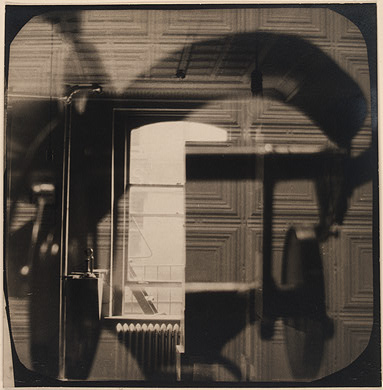
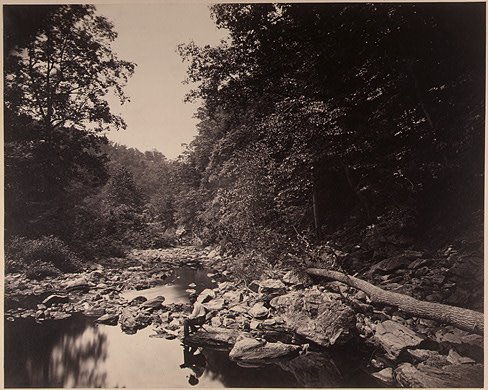
Another artist who used photography to document his ideas and his more material works is David Smith (bottom). I'm thinking of looking at how conceptual artists used the techniques and the mode of production inherent to photography in order to think though their ideas as well as to leave behind a trace of that endeavor. There's a lot more I want to say about this, but for now I just want to throw this up here for future reminder. It also intrigued me to compare this to the early use of photography as a method of capturing both a traumatic historical moment and the artist's contemplation/overcoming of it. The photo on the top is by the 19C photographer John Moran. And here's an intriguing description: "Perhaps as an antidote to the Civil War that ravaged the American landscape and psyche, John Moran made this carefully constructed, idyllic photograph of the Wissahickon Creek, just outside of Philadelphia. He presents an artist, perhaps his brother, the painter Thomas Moran, quietly sketching the beauty of the natural environment. The artist´s central position and his reflection, perfectly mirrored in the still pool of water in the foreground, seem to confirm both his importance and his harmony with his surroundings. The ability of the artist to bring order to his world is further suggested by the delicate retouching in the upper left of the photograph to remove the jarring intrusion of a building into this bucolic vista."

Saturday, March 18, 2006

not-writing

even tho i've been on break, i've been unable to find time (well, more like motivation or maybe even thought-clarity) to write anything on this here blog. so in recompenese to you my dear, non-existent readers, i offer some things i did not write about.

i did not write about Jean Luc Nancy's ideas about community and love , which i think centers around his use of the term "exposure."

i did not write about Paul Mann's "Stupid Undergrounds." an amazing read but, finally, one of those things that, when you're done reading it you get the "is that all there is" blues. and this is simply b/c it leaves you with the feeling that there is indeed nothing left to say beyond pointing to further examples of its truth.

i did not write about any number of weird, violent, quirky "outsider" art practices that i get excited about, on average, every 36 seconds. for example, i did not write about the bands Harry Pussy, To Live and Shave in LA, Ron of Japan, The Beast People, The Pterodactyls, Nautical Almanac, Occassional Detroit, etc etc etc...

i did not write about performance practices that i find fascinating due to their extreme yet somehow beautiful dimensions. i failed to describe Coum Transmissions, the Vienna Actionists, John Duncan, the Badher Meinhof Group, Vito Acconci, Chris Burden, Carolee Schneeman, Yoko Ono....

on the everyday tip -- i did not write about meeting my friend Liz's friend from law school, Dave Choo, who was very funny and smart and nice and made me feel glad to have actually met a new person and who also made me feel less bad about living in and feeling a certain way about Detroit since he appreciated -- he got-- the city and its essense as this paradoxical empty/fullness .

i did not write about my cats.

i did not write about general states of political unrest that depress me and sometimes move me to tears. need i mention them? don't we know all too well where and why they occur? and the all too familiar feeling of frustration in the face of their seeming inevitability?

i did not write about looming and omnipresent career/academia anxieties.

i failed to recap an interesting conversation with my friend Sam about art/music and originality.

i did not express gratitude in writing for my friendships with Sarah, Shashi, Sam, Ryan, Mike, Brad, Michael, John, Julie, Lindsay, and Liz.

i did not relate my excitement or fears about attending Cornell's theory camp this summer.

i did not write about guilt, lust, or loneliness. i did not write about money.

anything else?

From Paul Mann's _Stupid Undergrounds_

Apocalyptic cults and youth gangs, garage bands and
wolfpacks, *colleges* and phalansteries, espionage networks
trading in vaporous facts and networks of home shoppers for
illicit goods; monastic, penological, mutant-biomorphic,
and anarcho-terrorist cells; renegade churches, dwarf
communities, no-risk survivalist enclaves, unfunded
quasi-scientific research units, paranoid think tanks,
unregistered political parties, sub-employed workers
councils, endo-exile colonies, glossolaliac fanclubs, acned
anorexic primal hordes; zombie revenants, neo-fakirs,
defrocked priests and detoxing prophets, psychedelic
snake-oil shills, masseurs of undiagnosed symptoms, bitter
excommunicants, faceless narcissists, ideological drag
queens, mystical technophiles, sub-entrepreneurial dealers,
derivative *derivistes*, tireless archivists of phantom
conspiracies, alien abductees, dupe attendants, tardy
primitives, vermin of abandoned factories, hermits, cranks,
opportunists, users, connections, outriders, outpatients,
wannabes, hackers, thieves, squatters, parasites,
saboteurs; wings, wards, warehouses, arcades, hells, hives,
dens, burrows, lofts, flocks, swarms, viruses, tribes,
movements, groupuscules, cenacles, isms, and the endlessly
multiplied hybridization of variant combinations of all
these, and more.... Why this stupid fascination with
stupid undergrounds? What is it about these throwaway
fanzines and unreadable rants, these neo-tattoos and
recycled apocalypses, this mountainous accumulation of
declassified factoids, these bloody smears, this incredible
noise? Why wade through these piles of nano-shit? Why
submit oneself to these hysterical purveyors, these
hypertheories and walls of sound? Why insist on picking
this particular species of nit? [...]

In the stupid underground any innovation
can be, at one and the same time, utterly radical and
worthless in advance. The trajectory past %cliche% is at
stake here as well, a trajectory that takes us not into
further innovation but into repetition itself: the
repetition of a cultural adventure long after its
domestication, but as if it were still an adventure. The
trajectory is thus seldom a straight line into the beyond,
a singular line of flight through becoming-imperceptible,
into the invisible. The complexity of these movements
suggests four trajectories, or four dimensions of the
trajectory as such:

to the apotheosis of stupidity, as sublime becomes
ridiculous as if without transition;

to the violent limit of the tolerable, the
very limit of recuperability;

to disappearance past the boundary of cultural
representation, a disappearance so critical that it
gives the lie to every other form of criticism;

and to what turns out, in the very midst of an
innovative frenzy, to be stupid repetition, an
autonomous, automatic repetition that drains cultural
forms of every meaning, even that of parody: the
stupefying force of repetition, which, we are told,
is the very trace of the death drive.[...]

The stupid underground is available to any ontological
or ideological reformulation,and hence a place to test the following paradox:
all cultural zones are both overdetermined and blank. [...]

Punk nihilism
was never more than the nihilism of the commodity itself.
You should not credit Malcolm McLaren with having realized
this just because he was once pro-situ. All he wanted was
to sell more trousers without boring himself to death;
indeed he is proof that the guy with the flashiest
*ressentiment* sells the most rags. And if he wasn't
bored, can he be said to have advanced the same favor to us? [...]
Everyone there knows all about
recuperation and it makes no difference. One can display
the most stringent self-criticism about the impossibility
of revolt and the next day proclaim the subversive effects
of noise, as if one were Russolo himself, Russolo in the
first place. The stupid underground is marked by the
simultaneous critical understanding of the fatality of
recuperation and a general indifference to the fact; it
ignores what it knows, and knows it. It acts as though it
forgets, until it virtually forgets, what it always
recalls. It responds to every critical reminder, even
those it throws at itself, with a *So what, fuck you.*[...]


[The stupud underground]is merely a symptom of order itself.
Everything has been
recuperated, but what is recuperated and put to death
returns, returns ferociously, and it is the return of its
most immanent dead that most threatens every form of order.
The repressed does not come back as a living being but as
the ghost it always was, and not to free us but to haunt
us. It returns as repetition; when we see it in the
mirror, as our mirror, we pretend not to recognize it. The
fury of the punk or skinhead is the fury of this stupid
repetition, and it is far more destructive than the most
brilliant modernist invention. It ruins everything and
leaves it all still in place, still functioning as if it
mattered, never relieving us of its apparition, never
pretending to go beyond it, draining it of value without
clearing it away. That is why one cannot dismiss it
according to the logic of the new, whereby the only
admissible revolutionary force must conform to the movement
of progress and innovation. The rhetoric of innovation is
parroted by the stupid underground, because it still obeys
the superficial form of the avant-garde. But it obeys it
long after it is dead, and as if that death didn't matter,
as if history had never occurred in the first place, as if
everything retro just suddenly appeared, in all its
original vacuity. As if it were even better, more
powerful, once it is dead, so long as one insists that it
is and pretends that it isn't. It is the blind repetition
of every exhausted logic far past the point of termination
that generates the most virulent negation. The stupid
persistence of the dead has taken the place of the
critical. [...]

'labyrinths and jokes' was originally released on lp in 1998 in a small
edition of only 500 copies. six tracks of diverse and creative noise
from six completely bizarre bands. 1. nautical almanac's anti-system -
started in 1994 as a party killing trash-noise rock band, the nautical
almanac has since developed into a two piece of incredibly talented
machine builders. 2. isis and werewolves - this is punk prog at it's
sloppiest and goofiest. the drummer and guitarist were such lazy
burnout's that the keyboardist left town to create a heavy metal
monster called andrew w.k. the drummer and tape manipulator aaron
dilloway would go on to form the band wolf eyes, while the guitarist
steve kenney moved to new orleans to play in the hard rock outfit metal
wolf. 3. ron of japan - this duo of 15 year old female misfits have
since gone into retirement. but what they innocently recorded in their
bedroom in 1995 ended up being some heavily influential music. 4.
andrew wilkes- krier - before he was known as andrew w.k., andrew was
going under his full name and playing a wide variety of insane noise.
the track here is a dark cloud of droning violins and ghost like
screeches and moans. 5. the mini-systems - the most unhealthy band of
all time. the mini-systems was nate young's project prior to his
forming of wolf eyes. his partner was one anthony miller, a musical
genius who now goes by the name of maximum cloud. at one time they were
the kings of circut-bent junk noise, though drugs and love would
eventually get in the way, leaving the two no choice but to disband. 6.
the beast people - the ugliest, sickest growlers ever! though he won't
admit it to your face, the beast people was a performance art group led
by aaron dilloway of wolf eyes. occasional contributors to the project
included james harper of nautical almanac, andrew w.k., detroit noise
dj andy roach, and nate young. completely psychedelic cave noise.
cut-up growls and screams, recorded completely in the red. fucking
sick! as crude as it gets! on hanson

http://www.coolbeans.com/cb6/HARRY.HTM

http://supervert.com/elibrary/rudolf_schwarzkogler/

Sunday, March 05, 2006

and the oscar goes to...


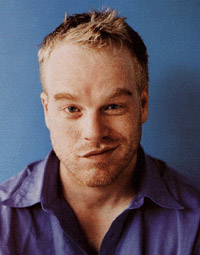
Yay! Philip Seymour Hoffman! I heart Seymour (I prefer to call him "Seymour.)

The Oscars were pretty rad this year: John Stewart, Robert Altman (Lily Tomlin and Meryl Streep were hilarious introducers), all the nominated movies were, I thought, fairly stellar. And, again, PSH won! And he thanked his mom in such a charming way....Plus, he played Capote. So cool.

non-oedipal genealogies/music vs poetry


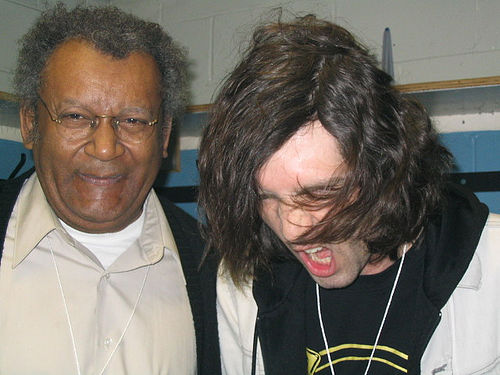
Quickly, since I have waaay too much shit to do to justify blog-posting-- I think musicians could teach (young) poets a lot about incorporating, moving past, learning from their "elders." I am sick of the "kill yr idols" model of innovation. Even though punk coined the term (kill yr idols), in practice, they've really moved away from that reductive phrase; they aren't half so antagonistic about it as young poets seem to be. (The "we vs them" mentality of the poetry world is very simplistic, and I don't know that all the work justifies the arrogance.) From what I've experienced in seeing/hearing people working together on projects across the lame "age-divide," and in conversations about it with musician friends, they have a much healthier and more open sense of what it means to be in relation to their influences -- for example, Nate Young from Wolf Eyes, pictured here with Anthony Braxton. Which reminds me of the funny interview I did with Nate, John, and Aaron; I should *really* fucking publish that one day.

Cross-generational collaboration anyone?

Sunday, February 19, 2006

podcast heaven

If you're like me and you love finding buried musical treasure, but don't have the time or $ to search through dusty thrift store bins or flood-damaged record store overstock crates, then you will appreciate my friends John and Tovah Olson's podcasts -- straight outta Ypsilanti MI. (In case you were wondering, John is in the band Wolf Eyes and he and Tovah also perform as Dead Machines. If you're going to be in NYC in March you should check them out at the NoFunFest in Brooklyn.) This first show could be classified under the category "creepy Christian music."

http://inzane.podOmatic.com/entry/2006-02-18T20_06_16-08_00

Saturday, February 18, 2006

beckett/adorno

this extra long quote is my response to a blogpost i read recently, which compared that "desiderata" poem with beckett's _Waiting for Godot_. Here's what adorno has to say about the meaning of beckett's works. (Plus, this'll motivate me to start putting adorno quotes here.)

"In recent years it has been fashionable to accuse Samule Beckett of simply repeating his basic idea; he exposed himself to this accusation in a provocative fashion. In this his consciousness was correct that the need for progress was inextricable from its impossibility. The gesture of walking in place at the end of Godot, which is the fundamental motif of the whole of his work, reacts precisely to this situation. Without exception, his response is violent. His work is the extrapolation of a negative kairos. The fulfilled moment reverses into a perpetual repetition that converges with desolation. His narratives, which he sardonically calls novels, no more offer objective descriptions of social reality than -- as the widespread misunderstanding supposes -- they present the reduction of life to basic human relationships, that minimum of existence that subsists in extremis. These novels do, however, touch on fundamental layers of experience hic et nunc, which are brought together in a paradoxical dynamic at a standstill. The narratives are marked as much by an objectively motivated loss of the object as by its correlative, the impoverishment of the subject. Beckett draws the lesson from montage and documentation, from all the attempts to free oneself from the illusion of a subjectivity that bestows meaning. Even where reality finds entry into the narrative, precisely at those points at which reality threatens to suppress what the literary subject once performed, it is evident that there is something uncanny about this reality. Its disproportion to the powerless subject, which makes it incommensurable with experience, renders reality unreal with a vengeance. The surplus of reality amounts to its collapse; by striking the subject dead, reality itself becomes deathly; this transition is the artfulnesss of all antiart, and in Beckett it is pushed to the point of the manifest annihilation of reality" (Aesthetic Theory 31).

hanatarash/adorno


so here's what i'm thinkin'. we're supposed to bring an "example" to class next week, some kind of aethestic work that we can use to read w/ (or maybe against) adorno's _Aesthetic Theory_. I said I was going to bring some form of music and BW said, um, well, maybe you shouldn't do some kind of "throbbing gristle" thing, but i said, oh but i am! then i decided not to bring TG even tho i lurv them so much... instead i'm going to use the japanese noise band/performance group Hanatarash (the two guys went on to form the more famous noise band, The Boredoms). i'm going to borrow this amazing video from my friend mike of one of their infamous early shows (@ 1984). It features the main dude, yamatsuka eye, geared up in tight tshirt and pants with elbow and knee pads, in this enormous factory space, throwing around something like a mace while also jumping into and picking up huge green metal barrels. he then proceeds to take various sized plates of glass and crashes them all around, stacks of sapporo beer cases follow and, like, a thousand beer bottles get tossed into the mix. it is fucking amazing, especially since Eye is about 5 feet tall and around 130 pounds. all the while the other dude who plays drums, i forget his name, is making an infernal racket. the best part is the end where they show the floor littered with billions of shards of glass and some guys trying to clean it up with an inadequate little broom and one dustpan.

i'm going to turn this into a sophisticated analysis of adorno's critique of art after auschwitz (in this case art after hiroshima) and the negation of pleasure as a form of pleasure. what, you think i can't?

This is a pic of Yamatsuka Eye in Hanatarash (or Hanatarashi, as they're also sometimes called -- it means "Snot-nose(d))

Friday, February 17, 2006

odalisqued

do yourself a favor and read Anne Boyer's post entitled "there is no such thing as a value free science."

Thursday, February 16, 2006

politicizing aesthetics

[T]he hidden haunts of production (Konvolut X Marx 662).

Such high ideals of bourgeois society as that of the free, self-determining individual, freedom and equality of all citizens in the exercise of their political rights, and equality of all in the eyes of the law are now seen to be nothing but correlative concepts of the fetishism of the commodity….Only by keeping the people unconscious of the real contents of those basic relations of the existing social order…only through the fetishistic transformation of the social relations between the class of capitalists and the class of wage laborers, resulting in the ‘free and unhampered’ sale of the ‘commodity labor-power’ to the owner of ‘capital’, is it possible in this society to speak of freedom and equality (Konvolut X Marx 663).

I’d like to pick through some passages from Benjamin’s “The Author as Producer,” as I think it sets up a pretty clear rubric for situating not only Benjamin’s own work, but what we might think of as the political efficacy of the avant garde in general.

Of crucial importance to me at this stage are three issues: 1.the class position of the artist and how that intersects with other subject positions she or he might occupy; 2. the aesthetic/formal value of the work as political, but not merely determined by its political correctness and; 3. the particular (site) space and (historical moment) time the work arises out of and the available discourses it thus engages in. To judge the work against this set of criteria provides limits to what we can consider avant garde art since Social Realism let’s say, or “political” bands in our present day like Rage Against the Machine are not exemplary in this instance as they are too overtly and didactically political (and these two examples, across time and space prove this is still an issue). The relationship between political and aesthetic modes of representation available at particular times and how they intersect is of crucial significance as formal possibilities. Objectively, that is, we can examine different forms of art available in relation to democracy as opposed to totalitarian dictatorships and question how or whether they are “successful” aesthetically and politically. Another question that follows: what modes of response are available during times of crisis and how do these modes of representation differ depending on the crises they respond to or derive from? Benjamin’s work serves as an exemplary response to a particular moment in German history where the cultural tradition of Romantic idealism and the bourgeois Jewish intellectual are on the historical ropes. Where Benjamin looks for answers (i.e. in the relation between mass commodities and avant garde forms) is significant. How he conceives of his work - as a non-totalizable form of (intellectual) labor—even more so. Furthermore, the relation between the labor congealed in the commodity object is thought through non-mimetic or non-representational art, which means that the horizon of the work is not reducible to a “Mass culture Benjamin” or an “avant garde Benjamin;” these are false oppositions, oppositions which hold up, I would argue, false barriers between the avant garde and mass culture as a whole.

What should be examined is what this bringing together of the commodity as a hidden receptacle of human value and the formal experiments of the avant garde has to say about those social/cultural forms available to people as political subjects. Benjamin’s dialectical methodology and aesthetic/political/philosophic practice offers a series of approaches for rethinking the base superstructure relation that is non-reductive, or not limited to a strictly causal relationship. Benjamin himself offers a clear directive in “Author as Producer” by delineating the relation of literary work to political agency by asking: where does the work stand, or what position does it occupy in relation to the larger social forces of which it is inevitably a part? Benjamin, like Shklovsky, provides a non-reductive way to see art as both autonomous and in that very autonomy, socially engaged. So we have to look at practices in the work, (and perhaps focus less on the figures that we romantically worry about as having or not having play or agency). Rethinking the narrative of exclusion means, for me, focusing on how works are produced – what methods are available – as well as the subjects who make them, which means that this narrative of exclusion is also not reducible to a straight cause and effect schema. As Cohen points out, Benjamin’s theoretical importance should be thought of along the lines of reformulating the vulgar Marxist theoretical apparatus in ways similar to Althusser’s focus on structural possibilities and limits.

The issue of who is/was neglected/excluded might then be more effectively approached by examining how the work does or does not fit into the parameters of acceptable bourgeois culture and/or avant garde forms and genres. What gets neglected might give us a critical purchase on what’s at stake in new forms; by looking at what kind of work is not classifiable in any particular category, we can wonder: what buttons does it push, what symptom of denial and repression does it trigger, and what happens to its efficacy if it is eventually canonized and accepted, how is that narrated? The narrative we might construct out of that debate around canon formation and avant garde exclusions is then perhaps symptomatic of how political exclusions function as well.

So Sarah’s “Why Benjamin anyway” gets a little different twist here. Why Benjamin now? Why is he such hot shit? Who’s capitalizing on it and why? What does an avant garde critic do for academia? There seems to be a lot of resistance to thinking of and working with Benjamin as affiliated with the avant garde. Why?

Frankly, I found the pounding out of an extremely nuanced and exegetical reading of Benjamin in Miriam Hansen (although we didn’t read her for this class I’m still traumatized by last semester’s reading of her analysis of Benjamin) and Cohen, while useful at times, veered into the terrain of terribly boring and frustrating. I bring this up to ask: are we missing the forest for the trees here? I don’t want to suggest that Benjamin is simple, far from it, I merely want to ask what the production of scholarship and the plethora of incredibly dense readings around him has to do with how we might be able to use him? It seems to become a question of alignments – which Benjamin do you want: philosophical Benjamin, political Benjamin, aesthetic/literary Benjamin, Marxist Benjamin, Jewish/mystic Benjamin, affective/tactile Benjamin? What the heck is going on here? Serious question. I don’t have a Benjamin position (yet), so I’m just going to present one issue and some scattered ideas I think are important among hundreds of others. Finally, I want to say that I find it somewhat ironic, though perhaps historically inevitable and symptomatic that – taking Benjamin at his word – analyses of his work might preclude it from doing what it was ostensibly created to do: bring the intellectual into the service of the proletariat revolution. This is a critique that can be leveled at the avant garde in general and needs to be taken seriously, and I’m not just playing devil’s advocate here. Benjamin defends the avant garde because it participates in something, it does something. But what? And more importantly, how? Ok….

********

I should like to show you that the tendency of a literary work can only be politically correct if it is also literarily correct. That is to say that the politically correct tendency includes a literary tendency. And I would add straight away: this literary tendency, which is implicitly or explicitly contained in every correct political tendency, alone constitutes the quality of the work. The correct political tendency of a work includes its literary quality because it includes its literary tendency (Author as Producer 69).

Question: is the literary tendency the formal qualities of the work? The immediate question for a materialist, dialectical criticism is not only to ask if the work is revolutionary or reactionary, rather, for Benjamin, it is crucial what the relation of the work offers in terms of its mode of production. As Benjamin clearly states: “what is the attitude of a work to the relations of production of its time? I should like to ask: what is its position in them? This question directly concerns the function the work has within the literary relations of production of its time” (70). The role of the intellectual/artist is thus of great significance to the rethinking of attitudes and the modes of consciousness available at a given time. Benjamin takes the left intelligentsia to task for not revising their own methods of thinking and producing work in light of their political desires. “It has been one of the decisive processes of the last ten years in Germany that a considerable proportion of its productive minds, under the pressure of economic conditions, have passed through a revolutionary development in their attitudes, without being able simultaneously to rethink their own work, their relation to the means of production, their technique, in a really revolutionary way” (72 emphasis added). Focusing on the technique of the work in relation to the means of production in the service of class struggle, does not, for Benjamin, mean that the work is obviously (either explicitly or implicitly as he says) political, i.e. that it represents its politics or its object in any direct way. Like Shklovsky’s defamilarization, aesthetic production returns the alienated world of labor relations to the perceiver as an experience and as an example of what can be done. Furthermore, it works in the now, with old forms that are mythologized as eternal, and new forms that are cut off from historical continuity. This is a transformative process. Benjamin explains:

For the transformation of the forms and instruments of production in the way desired by a progressive intelligentsia – that is, one interested in freeing the means of production and serving the class struggle – Brecht coined the term Umfunktionierung (functional transformation).…I should like to content myself here with a reference to the decisive difference between the mere supplying of a productive apparatus and its transformation (74 emphases added).

Benjamin goes on to critique photography that can return even depictions of abject poverty to the enjoying capacity of the bourgeois. In other words, it can be incorporated and recuperated as self-righteous pleasure. Benjamin’s point is simple here I think: it is not the object depicted; it is the method of depiction that counts. Photographic technique fails when it divides the world into types and scenes that merely reproduce the apparatus as it stands. What Benjamin calls for in his positioning of the work of art in relation to the means of production is an example of how to overcome fragmentation and alienation exactly through methods that highlight fragmentation consciously and deliberately i.e., montage, found objects, commodity culture, city streets. The meshing and blurring of boundaries is thus a method of exemplifying to the proletariat devices for overcoming their alienation, their status as objects, through the very objects and apparatuses that have replaced them as value.

One point of interest in terms of my own work is that he points to the juxtaposition of word and image as a technique or correct literary/political tendency. This is a “refunctioning”of the relationship between separate spheres of aesthetic production. In a Marxist vein, it is a method that critiques the form and seeming historical necessity of specialized labor, which separates and alienates people not only from the objects they produce, but from their own identity and from their neighbors, their fellow humans -- a human alienation that serves to limit their agency as political, collective subjects:

What we require of the photographer is the ability to give his picture that caption which wrenches it from modish commerce and gives it revolutionary use-value. But we shall make this demand most emphatically when we – the writers – take up photography. Here, too, therefore, technical progress is for the author as producer the foundation of his political progress. In other words: only by transcending the specialization in the process of production which, in the bourgeois view, constitutes order, is this production made politically valuable; and the limits imposed by specialization must be breached jointly by both the productive forces that they were set up to divide. The author as producer discovers – in discovering his solidarity with the proletariat – that simultaneity with certain other producers who earlier seemed scarcely to concern him…. The task therefore of the Umfunktionierung…: to eliminate the antithesis first between performers and listeners and second between technique and content (76).

But it is not enough to have correct political tendency; this would equal mere propaganda. “What matters therefore is the exemplary character of production, which is able first to induce others to produce, and second, to put an improved apparatus at their disposal. And this apparatus is better the more consumers it is able to turn into producers, that is readers or spectators into collaborators” (78). The role of the intellectual is not merely a destructive one (a betrayal of class and a turning away from intellectual and aesthetic pursuits), but a move towards a refunctioning or reengineering of those apparatuses already available to him or her, turning his methods into “promoting the socialization of the intellectual means of production” (81).

Thus the form of the Passagen-Werk project takes the detritus and fragments of history and discussions of material production and juxtaposes them with observations of the city and intellectual texts and commentaries (Korsch, Simmel, Marx). Forms of labor separated by bourgeois modes of production are brought into proximity at a new historical moment as an exemplary technique, a new mode of production. The work transforms and refunctions the scraps of concrete and intellectual history -- Marxist theory, city street planning, and iron construction -- available to Benjamin and juxtaposes them alongside everyday commodified objects of bourgeois consumption and proletarian labor. The consciousness of the intellectual as a labor process and the labor consciousness of the proletariat meet in the work. “Author as Producer” and the Passagen-Werk both open up a critical space where Laborer equals Producer or Producer equals Author. Images, language, and methods are (ostensibly) available to anyone, through fragments found anywhere. Moreover, the works non-originary method of production eschews notions of individual genius. Rather, it points to methods already available, lying dormant in the very spaces, objects, and images that alienate us. This process of transforming the functions and uses of commodity capital is the dialectical method as a form of agency and action. Dada, Surrealism, Situationist detournement, Punk DIY, all could be said to have Benjamin’s “Author as Producer” and the Passagen-Werk as their genealogical sister.

Finally then: In crucial material/conceptual/epistemological/embodied ways avant garde practices stand at the nexus between revolutionary practice and utopian (messianic) hope. The avant garde offers a set of praxes, or exemplary forms of agency, which re-conceptualize the dialectical relationship between the transitory and the eternal as historical forces, by offering methods of action in the present. These are not mere aesthetic institutional practices, they are more integral -- ways one can live, everyday activities that are always available because history doesn't end. What is interesting to me are the (marginalized) spaces in which these practices operate and come to fruition, i.e., Detroit for example, or the Soviet Union. This is also why the avant garde has a crucial relationship to trauma: the practices are forms of traumatic repetition, but repetition always morphs across space and time, i.e., repetition with a difference, ringing the changes of history so to speak. What John Loewy in his book Fire Alarm: Reading Walter Benjamin’s ‘On the Concept of History’ calls Benjamin’s “revolutionary melancholia” is one particular traumatic response to the loss of history and the fear of and desire for change. Other representations of loss and cultural fragmentation obtain in other locations and times. We might say then (and this is probably quite oversimplified) that new historical traumas call for new aesthetic responses, which in turn call for and symbolize the desire for new forms of political action.
So, as I argued in my paper on Robert Smithson's photographs of the industrial factory site of Oberhausen, Germany for example, Smithson was able to locate the functional position of a figure like Adolf Eichmann and the trauma of the Holocaust and historically document it because his photos point to its material location – the site specificity of history – reclaiming both the material site and the experience of trauma for future constructions, but he could only do that because history as trauma is available as both a ghostly presence and material fact. The nature of Smithson’s work, why it is important to my mind, is due to, in Benjaminian terms, its correct literary/political tendency. That is, its correct tendency is, in part, the result of its formally oblique method: we are given history in a pile of fragments, rubble, in a series of non-representational images. The method and the perspective is avant garde – historical loss isn’t fetishized as an object for guilty (bourgeois) contemplation. Smithson works the empty spaces of history in a non-specialized way – that is as artist, engineer, anthropologist, writer, archeologist. The aesthetic is expanded as a plethora of methods. This is akin to Benjamin's bringing together the ghostly/material presence in the object/commodity in relation to his intellectual labor, which, joined together, have transformative potential. Benjamin meets Smithson at the level where material modes of production, intellectual consciousness (methods of thinking), and individual/collective unconscious desires are brought into new productive relationships. That, my friends, is a politics.

Wednesday, February 15, 2006

A line to remember

My dear friend Joel, in his creative post for our avant garde seminar, just reminded me of a great line Steve Benson delivered at his improvised performance/reading in Tuebingen, Germany. How great that Joel transcribed it, since I remember laughing appreciatively at the insight, but then promptly forgot it. Ah, the ephemerality of performance! Here she blows:

“Time moving through space, as it inevitably does; it’s a lost art, really” (Benson).

Friday, February 10, 2006

The collective individual

Here, fellow collectivists, read this, excerpts to come.
Interview with Brian Massumi.

Tuesday, February 07, 2006

Chinese quince tree


I was curious what a quince tree looked like (see post below). I wish I had a garden.

And here are some charmingly weird recipes for quince:

Medicinal virtues:
A grateful cordial is made by digesting in three pints (i.6 1) of the clarified juice, a dram (i. 7 g) of Cinnamon and half a dram (89o rng) each of Ginger and Cloves, by keeping it warm for six hours and then adding a pint (568 mi) of red port, dissolving in it nine pounds (4 kg) of sugar and straining it. A quince jelly is made by boiling the juice with a sufficient quantity of sugar until it attains a due consistency.
The seeds abound with a soft mucilaginous substance which they readily impart to boiling water, making it like white of egg. This is excellent for sore mouths and to soften and moisten the mouth and throat in fevers and other diseases. The green fruit helps fluxes in man or woman, and choleric laxes. Boiled in water, the mucilage heals the sore breasts of women.

Yum, "mucilaginous substance." Begone "fluxes" and "choleric laxes!"

Saturday, February 04, 2006

Joseph Cornell


One of my favorite artists of all time is Joseph Cornell. I was just paging through a collection of his letters and diaries and came across this letter to Mina Loy (below). Since we were just reading her amazing "letters to Joannes" I thought I'd put it here. I adore Cornell's use of the color blue in his assemblages. It occurs to me that it might have been an unconscious influence on the look of this blog. There is a Cornell box at the DIA that I've spent a lot of time staring at; it looks very similar to the one here except it contains a very shadowy image of a brown-haired girl.

{to Mina Loy}

July 3, 1951,

Dear Mina,

I had a beautiful early morning in the backyard under the Chinese quince tree--very early in fact, not much after five; and I could not help but think of you, looking up at the moon, when the first rays of the sun turn its gold into silver. A long time ago, you may remember, you told me that your destiny was ravelled up somehow with the lunar globe, but even aside from this I have always experienced something wonderful evoked in this mood.

Con Amore,

Monday, January 30, 2006

why i should quit grad school and open a bookstore


Since everything has already been written.

I ask, why not just have a place where I can look at it all? A bookstore for myself.
It has to be just for me because, thing is, working at a bookstore made me hate the world. Except for my fellow bookclerks, who also hated the world. Bookstores breed a race of curmudgeons -- good bookstores anyway. You know you're in a good bookstore when the staff treats you like shit. Now when you go into Borders or Barnes & Noble and the staff is helpful and friendly you know they don't know fuck-all about books. They might as well be selling cans of tuna. See, they have't been disappointed. Good booksellers are very disappointed in humanity. They are sad that what they love have become just like cans of tuna: products to be stacked and shifted.

And anyway, I just want an excuse to get discounts on all the books I want to buy (my Amazon wishlist has over 300 titles). Like this book by Charity Scribner. I need this book.

Saturday, January 28, 2006

Fiendishly indifferent


I was reading the Dec/Jan issue of Bookforum and came across a review of a nature book called _Stone: Imagination and the Loss of the Wild_. Some of the descriptions reminded me of a friend's recent encounter with a red-tailed hawk in his backyard. As he said: "It was *right there*." It seems the hawk was so absorbed in its task -- fluffing up its feather to hide and protect its prey -- he was able to get some pretty close-up photos. Here are two examples. You can sort of see the prey beneath his (hers?) magnificent claws. From what I know red-tails are fairly aggressive and fearless, but I am not totally sure about that.

But back to the book review: I sometimes really enjoy nature writing, but its rarely done well. In my 5-year stint working at Borders I shelved the nature and travel writing section for quite a while, so I read quite a bit in those genres. In my experience the books tend to be of two types: unduly sentimental (Annie Dillard when she's bad for example), or all-too-hilariously anecdotal (Tim Cahill, who is funny, but after a while it's like," ok, stop already; no one's travel/nature experiences are this funny). The author reviewed in the Bookforum piece, Ellen Meloy, sounds more tolerable than most. I liked the review's focus on her relationship to nature in terms of a visual/cognitive/imaginative relation. For example:

"You can spend a lot of time looking directly at a bighorn in the rocks before you actually see it. The temptation is to dilate on the moment of recognition, to somehow account for the enormous spiritual weight of that sudden presence. That is the modern nature writer's habitual posture -- waiting to exhale -- which is why, as Ellen once wrote, 'a great deal of nature writing sounds like a cross between a chloroform stupor and a high mass.' But the ram in the rocks is not so breathless. He is not struck by his own scarcity."

The reviewer, Verlyn Klinkenborg, describes Meloy's relationship to nature as hinging on the incommensurablity of this shift in perspective: the nature watcher is forced outward, only to encounter this indifference, what Klinkenborg calls a "monumental indifference."
The review ends with a quote from Meloy: "Sometimes the sheep are completely boring. Sometimes their animation moves me beyond words. Our 'companionship' closes the distance. I am here to learn something. I will need this knowledge. Time is running out."

This all reminds me that I must watch Herzog's movie "Grizzly Man" tonight, which a friend lent me some days ago. It's his documentary about a mentally unstable man who spent his life tracking and living in close proximity to , you guessed it, Grizzly bears. He eventually died a "grizzly"death in both senses of the term. Herzog's take on nature fascinates me. For him, it's fraught with danger and totally menacing. Nature writers should be forced to watch his documentary "My Best Fiend" -- which is mainly about his crazy relatonship with Klaus Kinsksi and the filming of "Fitzcarraldo and "Aguirre the Wrath of God," but has some great pronouncements about nature and filming in the Amazon. Herzog is so over the top. I love it.

Wednesday, January 25, 2006

Reparata and the Del Rons


Oh my god I am OBSESSED with a song by this amazing girl group Reparata and the Del Rons.
OBSESSED.....

Witnessing


Part of my Smithson project should include (will include) not just a connection to Arendt's protrayal of Eichmann and the traumatic relationship to war in aesthetics, but also the eyewitness accounts of the aftermath of the firebombing of Germany's cities. The quote below, from an article in The Nation that discusses Hans Erich Nossack's book The End (well worth reading) really struck me as resonating with my project's themes (I've highlighted the areas I found most compelling) :

Following the popular success of Sebald's and Friedrich's works, German publishers have printed (or reprinted) a number of accounts by contemporary witnesses, some of which have now been translated into English. One of the most striking is by Hans Erich Nossack, whose book The End describes in spare, unsentimental prose the firebombing of Hamburg in July 1943. Written a few months after the event, this "report" was published after the war in Germany and hovered at the margin of public memory there; it appeared in English translation for the first time last year in a somber, even funereal, edition, the text framed by blackened pages front and back. Nossack's account owes its existence to his good fortune in having left Hamburg three days before the bombing for a summer cabin located some ten miles south of the city. From that vantage point--close enough to see the "flying fortresses" overhead and the huge fire on the horizon but far enough away to be out of physical danger--he experienced the destruction of his home as a spectator. "I was spared the fate of playing a role in it. I don't know why," he writes. Nossack then traveled into the bombed-out city--a modern-day Dante descending into the realm of the dead--to interview thousands of survivors who were so traumatized and confused they could barely speak or register emotion: "Those who were known to have experienced unimaginably frightful hours, who had run through fire with their clothes burning, stumbling over charred corpses...why didn't they cry and lament? And why this indifferent tone of voice when they spoke of what they had left behind, this dispassionate manner of talking, as if telling about a terrible event from prehistoric times?"

On the other hand, Nossack has lost all of his belongings and become a refugee overnight, not just because the house he lived in no longer stands but because he has lost his relation to a lived past: the sight of St. Catherine's tower glimpsed each time he looked up from his desk, the recordings of Handel and Palestrina he played at Christmas, the diaries recording twenty-five years of his inner life as a writer. He is confronted not with a damaged city but with the absence of every familiar landmark--not devastated streets and buildings but crude paths winding over hills of rubble. People huddle together like animals, cook food over open campfires, wander aimlessly in search of basic necessities without thought for the larger political and historical context. In the blink of an eye his world has metamorphosed into a Kafkaesque landscape that is terrifyingly unfamiliar, abstract, almost timeless: "Nothing in our surroundings recalled what we had lost...it was something else, foreign, impossible."


Sunday, January 22, 2006

the dangers of Google

So someone arrived at my blog by googling the words "sweaty" and "boys." Should I alert the govt? Too bad all they got was a weird haiku. Better luck next time!

Wednesday, January 18, 2006

Paris-y

My glove like Nadja's... it was just laying there...

from the vaults

Tolerant views
Chess moves
strategery

Let me reticulate
never say
soliloquize

Strychnine jerk
tapestry werk
tambourine

Estee Lauder
Gold marauder
unguents


******************

These are haikus (sort of) by my very clever and charming friend Dan Tower (husband of Colleen). They make me laugh.

The way Jagger danced
makes me think he had rickets
cock-a-doodle-doo

****

I love Polish food
my passport to Hamtramck
pour me a vodka

************

Dirty sweaty boys
let them change in my office
their clothes wet from snow

Monday, January 16, 2006

the world's saddest song

So someone recognized the lines from the post below to be a riff on the Stephin Merritt song "Asleep and Dreaming." I had orginally intended to put "a la Stephin Merritt (by way of Gertrude Stein)" at the end, but then figured no one would know or care (I mean who reads this blog anyway?) But now I'll at least put the mp3 up to the saddestsweetest song in the world that makes me cry every time I hear it.

Saturday, January 14, 2006

sweet dreams

a sweet thing sleeping.
so sweetly sleeping. me thinking.
the sweetest thing – asleep and dreaming.
curled up, not thinking, dreaming.
i never saw a sweeter thing
than you asleep and dreaming.

Tolstoy: War and Flesh

Quotes from War and Peace.

"But what is war? What is needed for success in warfare? What are the habits of the military? The aim of war is murder; the methods of war are spying, treachery, and their encouragement, the ruin of a countrys inhabitants, robbing them or stealing to provision the army, and fraud and falsehood termed military craft. The habits of the military class are the absence of freedom that is, discipline, idleness, ignorance, cruelty, debauchery and drunkeness. And in spite of all this it is the highest class, respected by every one. All the kings, excpet the Chinese, wear military uniforms, and he who kills the most people receives the highest rewards" (237 Book 2).

****************

"A thought that had long since and often occured to him during his military activities -- the idea that there is not and cannot be any science of war, and that therefore there can be no such thing as a military genius -- now appeared to him an obvious truth. 'What theory and science is possible about a matter the conditions and circumstances of which are unknown and cannot be defined, especially when the strength of the acting forces cannot be ascertained? No one was or is able to foresee in what condition our enemy's armies will be in a day's time, and no one can gauge the force of this or that detachment. Sometimes -- when there is not a coward at the front to shout "We are cut off!" and start running, but a brave and jolly lad who shouts "Hurrah!" -- a detachment of five thousand is worth thirty thousand as at Schon Grabern, while at times fifty thousand run from eight thousand, as at Austerlitz. What science can there be in a matter in which, as in all practical matters, nothing can be defined and everything depends on innumerable conditions, the significance of which is determined at a particular moment which arrives no one knows when?" (56 book 2).

*****************

The flesh and war:

"As he crossed the dam Prince Andrew smelt the ooze and freshness of the pond. He longed to get into that water however dirty it might be, and he glanced round at the pool from whence came sounds of shrieks and laughter. The small, muddy, green pond had risen visibly more than a foot, flooding the dam, because it was full of the naked white bodies of soldiers with brick-red hands, necks and faces, who were splashing about in it. All this naked white human flesh, laughing and shrieking, floundering about in that dirty pool like carp stuffed in a watering can, and the suggestion of merriment in that floundering mass rendered it especially pathetic....

Everywhere on the bank, on the dam and in the pond, there was healthy, white, muscular flesh. The officer, Timokhin, with his little red nose, standing on the dam wiping himself with a towel, felt confused at seeing the prince, but made up his mind to address him nevertheless.
'It's very nice, your excellency! Wouldn't you like to?' said he.
'It's dirty,' replied Prince Andrew making a grimace.
'We'll clear it out for you in a minute,' said Timokhin, and, still undressed, ran off to clear the men out of the pond.
'The prince wants to bathe.'
'What prince, ours?' said many voices, and the men were in such haste to clear out that the prince could hardly stop them. He decided he would rather souse himself with water in the barn.

'Flesh, bodies, cannon-fodder!' he thought, and he looked at his own naked body and shuddered, not from cold but from a sence of disgust and horror he did not himself understand, aroused by the sight of that immense number of bodies splashing about in the dirty pond" (144, 145 Book 2).

***********************
This quote may not seem to have muh to do with war, but the description is Tolstoy's conception of the Russian people/sensibility, exemplified in the figure of the peasant-soldier Platon Karataev. I think it comments on Pelevin's Post-Soviet sensibility and the concept of collective feeling, particularly when it comes to language, as well as Virno's concpet of the general intellect:

"Sometimes Pierre, struck by the meaning of his words, would ask him to repeat them, but Platon could never recall what he had said a moment before, just as he could never repeat to Pierre the words of his favorite song: Native, and birch-tree, and my heart is sick
occurred in it, but when spoken and not sung, no meaning could be gotten out of it. He did not, and could not, understand the meaning of words apart from their context. Every word and action of his was the manifestation of an activity unknown to him, which was his life. But his life, as he regarded it, had no meaning as a separate thing. It had meaning only as a part of a whole of which he was always conscious. His words and actions flowed from him as evenly, inevitably and spontaneously, as fragrance exhales from a flower.He could not understand the value or significance of any deed taken separately" (504, 505 Book 2).

Now go read Mushin-sho for a great summary/explication of our recent class discussion on contingency, warfare, and the multitude.

Wednesday, January 11, 2006

Total Eclipse of the Heart


Last night my lovely friend Colleen suggested we do karaoke sometime soon at this hipster bar in Detroit called The Comet. I'm *not* a karaoke person, so she was attempting to cajole me by suggesting songs we could perform that might sway me. She suggested *Total Eclipse of the Heart, which reminded me of one of the greatest performances I have ever seen -- Kiki & Herb's. Now I know a few others have performed this -- it's a karaoke staple I believe -- but none can even dare approach this incredible version. You can listen to it here . And big thanks to our professor Dana Seitler for showing the video of it in our Queer theory seminar last year. Truly amazing.

Saturday, January 07, 2006

Rethinking the Avant Garde

So one of our classes this semester (with Barrett Watten) is entitled "rethinking the avant garde." I googled that just to see what came up and -- since we are responsible for bringing, or more likely, finding/discovering, our own agendas in terms of that rethinking -- this is the first thing that came up. I'm actually surprised Barrett wasn't at this conference. I haven't really looked at all the paper titles, but it might not be a bad idea to cull some ideas of the field from it, and to question what might be happening since then, as well as think what academia, in its rethinking, inevitably leaves out. That is to say, I think that what exists marginally, necessarily, in the moments we now inhabit, might be approached only retreospectively. Or perhaps we need to question how or whether academia (is there a better word for *us*) can effectively comment on/critique/understand what is being built outside its walls. Are those walls permeable? Is this important to acknowledge or deal with as a premise for our attempts? That points as well in the direction of the temporality of the avant garde....its *uncanniness*...

Wednesday, January 04, 2006

My next trip


Goal: Eastern Europe.

Plan to get there: clueless.

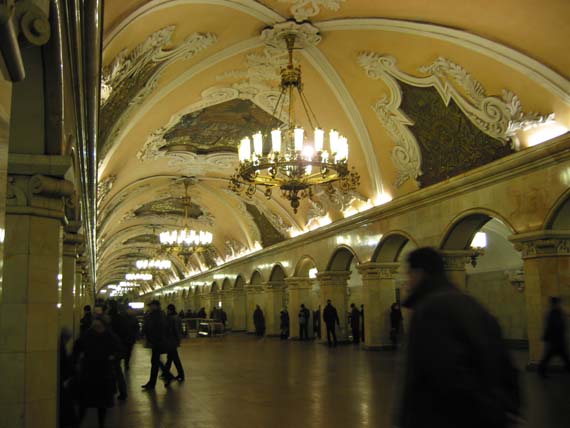
Can you believe this? This is a picture of a Moscow metro station.

Friday, December 23, 2005

Like a Feather on the Breath of God

Woke up last night around 4 am and, unable to get back to sleep, stumbled into living room and hit play on the cd player. I'd qued up, earlier in the day, Hildegard of Bingen's 'Like a Feather on the Breath of God" (recorded on Hyperion in1983 or so). But at 4 am I'd basically forgotten what I had in the player so when I sat down to just stare blankly out the window and will myself back to sleep, the music didn't hit me as familiar even though this is one of the first cd's I ever bought -- at least 15 years ago -- and one that I've listened to probably hundreds of times over the years.
In my half-conscious state I just let my thoughts and impressions of the music lead me where they might. What was really interesting was how the female voices created a sense of both etheriality and earthiness.

While I was listening I was watching these clouds of smoke drifting out of the Detroit Public Library whose rooftop I can see clearly from my 6th floor apt. The smokecloud would waft, at times, horizontally across the nighttime cityscape, and then it would wisp up vertically into the stars. I've spent a lot of time contemplating this smoky drifting, it looks very beautiful especially against the very gray backdrop of the city in winter. (At least I think so).

This particular night the billowing clouds were strikingly similar to how the the choral voices on the cd seemed to work and move in and across sonic space. The architecture of the voices, singly and in combination at times seemed to blend horizontally (this is literally what I was thinking, examining) and when the solo parts came in they seemed to lift up out of that horizon, but never entirely away from it. One could really hear how this was about musical embodiment -- spirit made flesh.

When I finally got up to check what the heck I was listening to I first felt sheepish that I hadn't recognized it, so I switched on the lamp to read the liner notes. I have a biography of Hildegard of Bingen that I've read a few times over the years and which I totally love, but I don't recall ever reading these notes. It seems that most of the pieces were written as homages to varios founders of abbeys and churches in medieval Germany (men and women who Hildegard honored as forefathers and mothers of her own important role as a founding abbess). One of the main metaphors is that of the cornerstone, rock or edifice upon which the sounds are built. That is, the lyrics often refer to the architecture and spatial significance of belief. In some way this changes (or at least contributes to) my sense of what belief might mean.

Or perhaps the medieval notion of it is far more "grounded" than later metaphysical developments.

Music as a physical, material, spatial, reality shouldn't be news to anyone, it's just that the delight of its history was a palpable epiphany at 4 am .

Wednesday, December 21, 2005

this is for shashi (and all youother crazy grad students me included)


From The Onion:

Grad Student Deconstructs Take-Out Menu

July 24, 2002 | Issue 38•26

CAMBRIDGE, MA—Jon Rosenblatt, 27, a Harvard University English graduate student specializing in modern and postmodern critical theory, deconstructed the take-out menu of a local Mexican restaurant "out of sheer force of habit" Monday.

Enlarge ImageGrad Student

Jon Rosenblatt with the menu in question.

"What's wrong with me?" Rosenblatt asked fellow graduate student Amanda Kiefer following the incident. "Am I completely losing my mind? I just wanted to order some food from Burrito Bandito. Next thing I know, I'm analyzing the menu's content as a text, or 'text,' subjecting it to a rigorous critical reevaluation informed by Derrida, De Man, etc., as a construct, or 'construct,' made up of multi-varied and, in fact, often self-contradictory messages, or 'meanings,' derived from the cultural signifiers evoked by the menu, or 'menu,' and the resultant assumptions within not only the mind of the menu's 'authors' and 'readers,' but also within the larger context of our current postmodern media environment. Man, I've got to finish my dissertation before I end up in a rubber room."

At approximately 2 a.m., Rosenblatt was finishing a particularly difficult course-pack reading on the impact of feminism, post-feminism, and current 'queer' theory on received notions of gender and sexual preference/identity. Realizing he hadn't eaten since lunch, the Ph.D candidate picked up the Burrito Bandito menu. Before he could decide on an order, he instinctively reduced the flyer to a set of shifting, mutable interpretations informed by the set of ideological biases—cultural, racial, economic, and political—that infect all ethnographic and commercial "histories."

"Seeing this long list of traditional Mexican foods—burritos, tacos, tamales—with a price attached to each caused me to reflect on the means by which capitalist society consumes and subsumes ethnicity, turning tradition into mass-marketable 'product' bleached of its original 'authentic' identity," Rosenblatt said. "And yet, it is still marketed and sold by the dominant power structure in society as 'authentic' experience, informed by racist myths and projections of 'otherness' onto the blank canvas of the alien culture."

Added Rosenblatt: "Then, of course, I realized that this statement was problematically narrow, since I was assigning an inherent 'actual' meaning to the Ethnicity Content of the take-out menu. Which was, in itself, contradictory to one of the primary theses of deconstruction, i.e., that it's impossible for an 'impartially' observing arbiter to establish any ultimate or secure meaning in a text. I'd just begun to make a mental note of the cartoon anthropomorphic burrito on the front of the menu as a signifier of such arbitrary 'otherness' when I yelled, 'What the hell am I doing?'"

Rosenblatt's inadvertent outburst nearly led to an altercation.

Enlarge ImageGrad Student Jump

Rosenblatt's analysis of the Burrito Bandito menu.

"I totally woke up my neighbor in the room across the hall," Rosenblatt said. "He looked like he might hit me, so I tried reasoning with him, but it came out all wrong. Instead, I found myself saying that the multiplicities and contingencies of human experience necessarily pose a threat to the tendency of any arbitrary power or 'authority' to dictate oppressive hierarchical social structures or centralize power. Ergo, any attempt to establish hierarchies and centralized power according to arbitrary dichotomies of 'right' and 'wrong' behaviors was therefore not only morally and philosophically, but also politically problematic, and, in fact, oppressive. Man, did that ever not work."

According to friends, Rosenblatt has been under a great deal of stress in recent months due to the financial strain of student-loan debts, his part-time tutoring job, and a heavy academic courseload.

"Lacking proper sleep and struggling to keep up in the intensely competitive crucible that is Harvard grad school, Jon is starting to lose it," said roommate Rob Carroll, 26. "He has become so steeped in the complex jargon of critical theory that he's unable to resist the urge to deconstruct even the most mundane things."

This is not his first time Rosenblatt has deconstructed a random item out of habit.

"The other day, we passed a bus stop with a poster for Disney's The Country Bears," said friend Karen Pilson, 26. "I heard him mumble something about the incorporation of previously received notions concerning wildlife and our ecological environment into a reassuring, behavior-validating consumer commodity in the form of aggressively infantilized computer-animated pseudohumans that talk and play country music. Before I even had a chance to react, he went off the deep end and started throwing out terms like 'prenotional,' 'prolegomena,' 'gynocritical,' and 'logocentrism.' I was just stunned."

Added Pilson: "I told him he was worrying me and recommended a good psychiatrist. Bad move, because that prompted him to launch into a whole discussion of Foucault's 'Male Gaze' as it applies to mother/child pair-bonding in Lacanian psychoanalysis."

In spite of his friends' concern, Rosenblatt seems unable to restrain his reflexive impulse to deconstruct.

"I can't help it," Rosenblatt said. "Even when I close my eyes at night, I feel myself deconstructing things in my dreams—random stuff like that two-hour Dukes Of Hazzard reunion special or the Andy Warhol postage stamp or commercials for that new squeezable gel deodorant. I'd say I'm going crazy, but that presupposes an artificial barrier between societally preexisting concepts of 'sanity' and 'insanity' which themselves represent another false dichotomy maintained for the preservation of certain entrenched elements of the status quo and... Oh, God. I'm doing it again."

Rosenblatt is considering taking a leave of absence from his graduate studies to spend several months living in his mother's basement in Elmira, NY.

Asked for comment, Professor Derek Nystrom of Skidmore College, an expert on deconstructivist thought, said that the Burrito Bandito take-out menu is open to many interpretations.

"The menu can be viewed an infinite number of ways, depending on viewer perspective," Nystrom said. "None of these differing views would be any more or less 'correct.' However, the menu's Pancho Villa-style burrito caricature, complete with bandoliers, six-guns, gaucho moustache, and sombrero, would be considered problematic by most scholars."

Added Nystrom: "To paraphrase: 'What is a take-out menu not, anyway? Everything, of course. What is a take-out menu? Nothing, of course.'"


Monday, December 12, 2005

Her Muse

Beginnings of my argument on women and noise/music:

Her Noise: "why are there so few female activists in the electronic music scene?" - each one of us has heard this question a thousand times... here is the answer: it's not our number, it's about how and if we are recognized!

From female composers like Delia Derbyshire, Wendy Carlos, "deep listening" pioneer Pauline Oliveros, to sound sculptor Maryann Amacher, to Sonic Youth co-founder Kim Gordon, and noise artists like Lindsay Karty and Jessica Rylan, the influence of women on experimental and popular forms of music, while serious and profound, continues to skate on the margins of sonic cultural awareness. This paper will attempt to describe and locate the multifarious genres and musical developments that have been pioneered by women in contemporary times. If Jacques Attali’s premise that music is an important auger for change at the economic, political and culturally representative levels is true then one may fairly ask how gender plays a part in its development and force. One might also productively explore ways in which the relation between gender and music might change the narrative Attali writes. This paper will explore how the eliding of gender from discussions about music as a force for cultural change needs to be addressed. The hope is that by exploring the impact and importance of innovative music by women one might disrupt and/or contribute to the narrative of musics culturally dynamic role as a whole.

What becomes immediately obvious once one brushes past the cultural obscurity of women’s roles in the production and experimentation of musical forms is that women have been instrumental (excuse the pun) not just in performing music (the role they have typically been assigned), but in developing and expanding its sonic perameters. Of crucial significance is the technological adeptness of many pioneering women composers and instrumentalists. I want to focus in particular on the development of complex and sophisticated (as well as beautiful and challenging) electronic and acoustic assemblages and instruments invented by women over the past 50 or so years. By working with electronic tape, making their own synthesizers, adapting acoustic instruments or delving into the range of hearing/listening possibilities inherent in everyday objects, women have been capably manipulating what has often been deemed a "man's world."

I use the term "man's world in a doubly exclusive sense. What I mean by doubly is that, first of all, music itself has traditionally been deemed as excusively within the purview of men. Music, particularly at the level of composition, production, and distribution (as is the case with most levels of culture no doubt) has circulated through patriarchalized systems of power. In addition, at the level of understanding music as a purely aesthetic form, as an intellectualized, disembodied, and trascendant entity, music takes on a further significance. In Laocoon Lessing emphasized the separation of artistic practices into the simultaneous and the successive. The plastic arts were described as simultaneous in that they could be perceived spatially or all at once i.e., a painting is a bounded, framed object of perception. Music, on the other hand is seen as succcessive in that it unfolds over time. The division between the spatial and temporal arts and the privileging of the temporal/musical can then be attributed to the baseness or materiality of visual forms of art. Music was deemed the highest form of aesthetic practice and registered as the "upper limit" of asthetic form since, in effect, it was invisible/nonmaterial. The plastic arts and even poetry could only attempt to reach this limit, their materiality prevented them from ascending to the immaterial level. This hierarchizing of aesthetic forms was, according to WJT Mitchell, gendered at its core. Femaleness was ascribed to the base level of material, embodied form, maleness to the realm of disembodied transcendant thought. This supposedly natural division between the arts served as "proof" of the inherent division between the sexes. Music as such, as both a thing in itself and as a cultural practice, has thus been deemed to be produced and to exist outside the inherent nature and capabilities of women; its hierarchized placement within aesthetic discourse has further served to ideologically reinforce their subordinate role.

For the most part then, women have engaged at the margins of musical composition. It is not that they have been entirely excluded from exploring music's formal boundaries -- boundaries that lie within the harmonic scales and modes that reinforce its immateriality and transcendence -- rather, they have been excluded from inheriting the mantleship of musical authority and creative authorship both within traditional compositional fields and from outside its boundaries. The history of musical innovation, particularly though not exculsively within dominant forms of musical authorship, has thus excluded women from being known as and considering themselves as musical innovators or pioneers in a practical creative sense, and it has excluded them from the realm of music in an inherent, essentializing sense. [It is interesting to note the history of myths about music originating within ancient cultures and the role of the female muse. Briefly, I would argue that mythic female figures --the Pleaides for example-- were never equated with the actual social and intellectual abilities of women as they actually existed in those socieites in there everyday habits and practices. (Go here for background.) Womanhood or femininity has served as a guide for artistic impulses while remaining a subordinating attribute in historical, lived experiences. In fact, the whole notion of the muse as servant to the artist functions as an inherently subordinating procedure. See Rachel Blau du Plessis's essay "Marble Paper: Toward a Feminist 'History of Poetry'" for a compelling examination of the ideological role of the muse in the development of lyric poetry.]

Sunday, December 11, 2005

1968


Eugene McCarthy died yesterday. RIP.

Isn't this a terrific pic?

I'm too young to recall the '68 campaign, but I do remember my parents speaking very respectfully of McCarthy. In the same tones, Adlai Stevenson's name was often mentioned. I distinctly remember (I couldn't have been more than 7 or 8) wacthing my mom take a bath while she told me about hearing Stevenson deliver a speech on the radio that changed her life. She not only admired what he said, she admired his intelligence, sophistication, his calmness. An uneducated little housewife from Detroit... My whole family (aunts uncles cousins) campaigned vigorously for McGovern in '72. What ever happened to the working class liberal? Do they still exist?

[If you ever want to get a fresh and hilarious perspective of the impact of that campaign year and its aftermath in '72 I highly recommend Hunter S Thomson's Fear and Loathing on the Campaign Trail of '72.]

This morning Meet the Press aired a segment in which McCarthy addressed the youth vote-- thier coming into political consciousness and the impact it was having on mainstream structures of power. I was struck by the _lack_ of an equivalent consciousness in our own times. I'm sure the absence of the draft has a lot to do with this, and the intervening cyncism of the last 25 years or so, but it is still disheartening to note. I don't want a "return" to the 60's, I want a debate or a coherent and persuasive (extended) discussion that could influence the average American mindset. That doesn't seem to be happening anywhere. Trying to discuss the war in my classroom was like trying to move a hibernating bear. Students are (for the most part) ignorant and anesthetized. That denial of the present is striking when one compares it to the level of awareness during Vietnam, I think. Interestingly, in the MTP segment, McCarthy comments on 1968 as a turning point in terms of the politicization of the young. It was a year with global dimensions of awareness that doesn't just come down to retrospective wishful thinking. I find that extremely interesting.

I have to go read about affect now.

Friday, December 09, 2005

I feel sick

Perhaps I'll write 6 posts today, all of them disjunctive and inane. That'll be great! Just can't seem to "get to" paper ideas. Spent early morning reading Massumi, especially the chapters on Vision, which are extremely interesting. I just have nothing specific to say about it... yet.

I truly do feel, physically, pretty awful. Something keeps "coming on" but it just won't fully arrive. I'm going home after this and cuddle with sweet Kelvin.(all the while trying not to succumb to urge to re-read Ulysses, which has been on my mind lately). Kelvin missed me so much that the first night I was home he slept for a long while with his little face pressed against my cheek. People who think cats are heartless creatures are insane. (I realize I sound like a crazypathetic Cat Lady, but.... he slept with his face pressed against my cheek!!!).

Before heading home to lounge around in PJ's and drink tea (white tea, my latest comfort drink) I am going to the store to buy a vanilla scented something or other-- candle probably. Don't know why, just in the mood for the scent of vanilla. All of which makes me think of my old house on Hancock. I don't miss it all that much, but the winter weather really makes me feel strange to not be there. It was a very cozy house in winter and partly for that reason all my best times/memories of living there were winter ones.

New dark canvas of my blog perfectly suits my mood. Not depressed, cozy.

To be *from* somewhere

I've always found it difficult to grasp that being from Detroit had such a determinate (determining?) influence on my life-- its habits, choices, modes of perception, values etc. In some important ways where one is from and who one is never quite match up I think. The imaginative spaces one occcupies, particularly if one is an avid bookreader, productively warp lived space. Some deep-rooted form of self-alienation has contributed to feeling of being *in* Detroit but not *of* it. Well, actually, it's more complicated than that. And anyway, what I really wanted to mention was my excitement at meeting Lytle Shaw in Germany and getting to know his work a bit better. His talk at Tubingen was the most exciting for me in that it seemed to crystallize or at least point in a productive direction my own vague notions and the possibilities I might be circling around. I'll try to flesh this out more fully once I've read more of his stuff. For now this is a link to an interview with him in Jacket magazine.

kindly forwarded


I didn't take any of these pics (which may be obvious since I am in one of them). Who knew "dark and blurry" was so flattering? Ms Ruddy is responsible for all our Paris memories. The images on her blog are really lovely too; the purple lips one I especially like -- that was the view outside our hotel window.

Thursday, December 08, 2005

Missing


Does anyone else here (wherever *here* is) miss James? Took a too-long nap today and awoke with sensation of lingering dream with James as central figure. Wayne State needs cowboy Jenner.

And I am writing this in lieu of trying to say something profoundclevermeaningful about trip to Paris and Tubingen, of course. Once the exhaustion lifts.... All I can say for now is that I don't think I'll ever be the same. And I wish my mom was around to share it with, in the telling.

Not wanting to end on a sad note --

I have been thinking so much about space, and vision and the localization of site/sight, it makes me dizzymisslizzy. Can't wait to re-read Lytle Shaw's paper on discursive sites, tho I'm not sure inscribing a site disvcursively is equivalent to site specificities materiality. Then again, I don't really know that that is his point.

And I think we all need to buy a poster of Marjorie Welish to hang in our bedrooms and worship. The Ruth Gordon of language poetry (that's a compliment by the way).

I'm sure it's just a matter of time until Michael and Sarah download thier pics for our further enjoyment (hint hint).

Tthe Dada exhibit at the Centre Pompidou was terrific (as was the Pompidou itself: the most amazing panoramic view of Paris imaginable, seriously breathtaking) even if it was a completely overwhelming amount of material. Standing in front of a reproduction of Duchamp's " A Bride Stripped Bare by Her Bachelors (even)" Whoa... But what I think I liked best was all the paperwork-- letters, magazines, sketches. Dada and publication aesthetics has always been very inspiring to me. The pic above is just an example. You can access other images here.

As for Tubingen-- besides all the intellectual stimluation and camaraderie what I recall right now is how the evening lights shone gracefully off the Neckar outside the Holderlinturn the first night. The night of Barrett and Carla's readings. All of a sudden there we were, in Tubingen, in the Holderlinturn, and there was the famous Neckar. ( I have a thing for German rivers since I had to memorize and draw their location for a diplomacy and military power class in undergrad... don't ask.) The "Neckar moment" was sort of contained and re-experienced on our last evening in Stuttgart, where the soft light reflecting off of a duckpond situated between the Suttgart museum and the Opera house entranced me. No wonder the Germans were (are?) such Romantics.

Monday, November 21, 2005

Detroit

The pic below was taken by Michael Schmidt. It's one of my favorite images of Detroit, in part because you can't tell where it was taken! It's actually not a secret location; if you pay attention the next time you're walking around downtown, you might recognize it. I call it: "The Wedge."